An American son of Russian immigrants, Lou Novikoff was an outfielder who thrilled baseball fans with prodigious hitting and frustrated managers with erratic baserunning and atrocious fielding. He was nicknamed the Mad Russian.
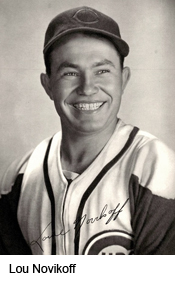 Novikoff grew up near downtown Los Angeles in an area known as Russian Town. He spoke Russian and English, learned to cook Russian specialties such as shashlik (grilled lamb) and married a daughter of Russian immigrants.
His pride in his heritage was as strong as a Siberian bear, yet Novikoff willingly joined several of baseball’s most prominent players in a fundraising effort to provide aid for the people of Finland during their war with the Soviet Union.
World in peril
After Germany invaded Poland in September 1939, igniting World War II, the Russians were concerned the Nazis would come through Finland to attack the Soviet Union. The Russians wanted the Finns to cede border territory to them for security reasons. When Finland refused, the Russians invaded with 500,000 troops in November 1939. The conflict became known as the Winter War.
The Finns fought fiercely to defend their land. More than 126,000 Soviet soldiers were killed. More than 25,000 Finns died, according to Radio Free Europe.
With food and other supplies cut off from them in the frigid Nordic winter, Finnish civilians needed help. Former U.S. President Herbert Hoover was put in charge of a Finnish Relief Fund.
Pitching in
In addition to soliciting private donations, Hoover sought to have high-profile public fundraising events. He convinced baseball officials to get involved.
Two baseball fundraising exhibition games were planned for March 1940.
The first, sponsored by the Los Angeles Times, took place March 10 at Wrigley Field in Los Angeles. It matched players from the four big-league clubs training in California _ Athletics, Cubs, Pirates and White Sox _ against top players from five Pacific Coast League teams: Hollywood, Los Angeles, Portland, Sacramento (a Cardinals farm club) and Seattle.
The second game was played March 17 at Plant Field in Tampa. It matched American Leaguers against National Leaguers from the teams training in Florida. The American League clubs were the Indians, Red Sox, Senators, Tigers and Yankees. (The Browns trained in Texas). Representing the National League were the Braves, Cardinals, Dodgers, Giants, Phillies and Reds.
“In the spirit of sportsmanship and in recognition of the Finns’ heroism, both in the field of sports and in the protection of their homes, baseball … joins in helping to alleviate their sufferings and makes its contribution to a worthy cause,” The Sporting News declared.
Note: Though ice hockey may be the most popular sport in Finland, pesapallo, a Finnish version of baseball, is the country’s official national sport. Video
John Michaelson, who was born in Finland in 1893 and immigrated to Michigan as a youth, is the only native Finn to play big-league baseball. He pitched in two games for the 1921 White Sox.
Game one
Batting orders for the Finnish Relief Fund game in Los Angeles were:
Pacific Coast League: Jo-Jo White, center field, Seattle; Bill Cissell, second base, Hollywood; ex-Cardinal Rip Collins, first base, Los Angeles; Lou “The Mad Russian” Novikoff, left field, Los Angeles; Max Marshall, right field, Sacramento; Art Garibaldi, third base, Sacramento; Ed Cihocki, shortstop, Los Angeles; Cliff Dapper, catcher, Hollywood; Bill Thomas, pitcher, Portland.
Major leaguers: Augie Galan, left field, Cubs; Benny McCoy, second base, A’s; Luke Appling, shortstop, White Sox; Gabby Hartnett, catcher, Cubs; Elbie Fletcher, first base, Pirates; Eric McNair, third base, White Sox; Lloyd Waner, center field, Pirates; Paul Waner, right field, Pirates; Ted Lyons, pitcher, White Sox.
Five of the big-league starters _ Appling, Hartnett, Lyons and the Waner brothers _ would be elected to the Baseball Hall of Fame. Three of the reserves, Billy Herman (Cubs), Al Simmons (A’s) and Arky Vaughan (Pirates), also were future Hall of Famers.
The managers were ex-Cardinal and future Hall of Famer Frankie Frisch of the Pirates and Seattle’s Jack Lelivelt. Coaches for the big-league squad were Monty Stratton and Honus Wagner.
Played on a Sunday afternoon under threatening skies, the game attracted 9,753 spectators and netted $7,204.06 for the Finnish Relief Fund, the Los Angeles Times reported. The big-leaguers won, 4-1. Frisch used a different pitcher for each of the nine innings. In addition to starter Ted Lyons, the others were Bill Lee, Claude Passeau, Julio Bonetti, Bob Klinger, George Caster, Thornton Lee, Johnny Gee and Mace Brown.
Lou Novikoff, who’d go on to hit .363 with 41 home runs for Los Angeles (a Cubs farm club) in 1940, rolled to the pitcher and fouled out to the catcher.
Game two
Two days after the game, on March 12, the Winter War ended with the signing of the Moscow Peace Treaty. The agreement became public on March 13 and was ratified on March 21. Finland lost significant territory to the Soviet Union in the deal, according to Wikipedia.
Finns still were in need of food and basic supplies, so the work of the Finnish Relief Fund continued.
On March 17, both Palm Sunday and St. Patrick’s Day, 13,320 people attended the fundraising game between the American Leaguers and National Leaguers in Tampa. It was the largest crowd to attend a baseball game in Florida, according to the Baseball Hall of Fame. “Carpenters were still nailing up new bleacher seats at game time” to accommodate the crowd, the New York Daily News reported. “United States and Finland flags fluttered from alternate poles around the park.”
Ticket sales produced $16,401.50 but additional donations brought the total raised from the game for the Finnish Relief Fund to $19,641.85, The Sporting News reported.
American League batting order: Joe Gordon, second base; Red Rolfe, third base; Charlie “King Kong” Keller, left field; Joe DiMaggio, center field; Jimmie Foxx, first base; Ted Williams, right field; Bill Dickey, catcher; Frank Crosetti, shortstop; and Red Ruffing, pitcher. Foxx and Williams were Red Sox; the rest were Yankees. All except Rolfe, Keller and Crosetti were destined for election to the Baseball Hall of Fame.
Future Hall of Famers in reserve for the American League included Bobby Doerr (Red Sox), Bob Feller (Indians), Rick Ferrell (Senators), Hank Greenberg (Tigers).
National League batting order: Morrie Arnovich, left field, Phillies; Cookie Lavagetto, third base, Dodgers; Mel Ott, right field, Giants; Frank McCormick, first base, Reds; Harry Danning, catcher, Giants; Frank Demaree, center field, Giants; Tony Cuccinello, second base, Braves; Billy Jurges, shortstop, Giants; and Paul Derringer, pitcher, Reds. Ott was the lone future Hall of Famer among the starters.
Five Cardinals _ Mort Cooper, Joe Medwick, Johnny Mize, Terry Moore and Enos Slaughter _ were chosen for the National League roster, but Cooper (injury), Medwick (contract holdout) and Mize (illness) were unavailable. Moore and Slaughter (a future Hall of Famer) were reserves.
The game’s managers were Joe McCarthy (Yankees) and ex-Cardinal Bill McKechnie (Reds). Both would be elected to the Baseball Hall of Fame.
The star-studded American League team was considered the heavy favorite, but the score was tied at 1-1 when the National Leaguers went to bat in the bottom of the ninth against Bob Feller.
Tampa native Al Lopez slashed a leadoff single to center. Attempting to sacrifice, Terry Moore bunted to the left of the plate. Described by the Boston Globe as “fast as an antelope,” Moore reached first at the same time as catcher Rollie Hemsley’s throw to Hal Trosky. Bumped by Moore, Trosky dropped the throw. Lopez hustled to third and Moore was safe at first on the error.
(A son of John and Mary Trojovsky of Norway, Iowa, Hal Trosky was no relation to Leon Trotsky, the Russian revolutionary assassinated by an agent of Joseph Stalin in Mexico City in August 1940.)
With the American League infielders playing in for a play at the plate, Pete Coscarart, a Dodgers second baseman, lashed a Feller fastball toward short. The ball skipped past Frank Crosetti for a game-winning single.
“Single, bunt, playing for one run. That’s National League baseball, a brand good enough to beat the American League,” Hy Turkin noted in the Daily News.
John Drebinger of the New York Times called the 2-1 National League triumph “an upset of major proportions in the name of charity.”
John Lardner of the Boston Globe wrote, “Fighting for the lost, but living, cause of Finland, the National League struck a blow for all downtrodden minorities.”
Dark days
Overall, the Finnish Relief Fund raised more than $2.5 million by March 1940. The American Red Cross distributed food and other basics provided from the funds.
The war with the Soviet Union led to Finland making a dark, disturbing decision.
Looking to reverse land losses from the Winter War, Finland joined Operation Barbarossa, Germany’s invasion of the Soviet Union in 1941. Finland called itself a “co-belligerent,” rather than an ally of the Nazis, but Adolf Hitler considered Finland a partner. Finland permitted German troops to operate from its soil.
In 1944, when the Allies were turning back the Nazis, Finland changed course. It reached a peace agreement (the Moscow Armistice) with the Soviet Union. Key terms of the armistice forced the Finns to cede extensive territories to the Soviets, pay them $300 million in reparations, legalize the Communist Party, ban fascist organizations and expel German troops from Finland.

 RetroSimba
There are a lot of US history lessons in the history of baseball. A lot of great players participated in the cause. I knew of Finland’s somewhat schizophrenic role in WWII, but I didn’t know about the fund raising that went on in the USA to help them. It’s clear that the Nazis would not have been defeated without the huge effort of the Soviet Union, but having them as allies is Exhibit A in just how evil Adolf Hitler was.
Thank you for reading and for commenting.
While Finland’s desire to take back territory lost to the Soviet Union is understandable, its partnership with Hitler and Nazi Germany is not.
In 2000, Finland Prime Minister Paavo Lipponen issued a formal apology to the Jewish community for the actions of the Finnish police, who handed over eight foreign Jewish refugees to the Gestapo in November 1942. In 2019, a report commissioned by the Finnish government and conducted by the National Archives concluded that Finnish SS volunteers “very likely” participated in the execution of Jewish people, civilians and prisoners of war. Following this, the Finnish state secretary expressed regret, stating, “We share the responsibility for ensuring that such atrocities will never be repeated”.
I can’t help but think that things in this world have only changed for the worse. At least back then you were able to organize a couple of charity baseball games. Today, with the the overly sensitive political and social climate, you probably wouldn’t be able to do even that. I enjoyed doing some reading on Lou Novikoff. From what I understand he was notoriously good at hitting bad pitches. The problem seemed to be with pitches straight down the plate. He did have a good year in 1942 with a .300 batting average. That season he was very successful against the Cardinals batting .360. You can understand why they considered the NL defeating the AL a huge upset. From 1926 to 1939 the NL champion would win the World Series only four times.