There are more versions of the story of Grover Cleveland Alexander striking out Tony Lazzeri than there were teams in a Branch Rickey farm system.
First, the undisputed facts:
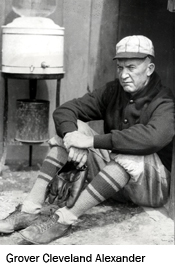 With the Cardinals ahead, 3-2, in the seventh inning of Game 7 in the 1926 World Series, the Yankees had the bases loaded and Lazzeri at the plate. Cardinals manager Rogers Hornsby called for Alexander to relieve Jesse Haines, who had developed a blister on his pitching hand. Alexander, 39, had pitched a complete game the day before in the Cardinals’ Game 6 victory.
Lazzeri, a rookie, had 18 home runs and 114 RBI that season. Alexander struck him out. Then he shut down the Yankees in the eighth and ninth, earning a save to go with two World Series wins.
Alexander retired the side in the eighth and the first two batters in the ninth. Then Babe Ruth drew a walk, but was thrown out attempting to steal. Boxscore
In winning their first World Series championship, the Cardinals transformed from a perennial also-ran into an elite franchise in the National League.
The two people most qualified to know the full story of Alexander’s Game 7 heroics were catcher Bob O’Farrell and Alexander himself. Alexander gave his account to Francis J. Powers for the book “My Greatest Day in Baseball.” O’Farrell related his version to Lawrence Ritter in “The Glory of Their Times.”
Alexander: “There are stories that I celebrated (after Game 6) and had a hangover when Rogers Hornsby called me from the bullpen to pitch to Lazzeri. That isn’t the truth.”
O’Farrell: “When he struck out Lazzeri, he’d been out on a drunk the night before and was feeling the effects.”
Alexander: “In the clubhouse after (Game 6), Hornsby came over to me and said, ‘Alex, if you want to celebrate tonight, I wouldn’t blame you, but go easy for I may need you tomorrow.’ I said, ‘OK, Rog’ … Hell, I wanted to win that Series and get the big end of the money as much as anyone.”
O’Farrell: “After the sixth game was over, Rogers Hornsby told Alex that if Jesse Haines got in any trouble the next day he would be the relief man. So he should take care of himself. Well, Alex didn’t really intend to take a drink that night, but some of his friends got hold of him and thought they were doing him a favor by buying him a drink. Well, you weren’t doing Alex any favor by buying him a drink because he just couldn’t stop.”
Alexander: “Early in (Game 7), Hornsby said to me, ‘Alex, go down into the bullpen and keep your eye on (Bill) Sherdel and (Herman) Bell. Keep them warmed up and if I need help I’ll depend on you to tell me which one looks best.”
O’Farrell: “In the seventh inning of the seventh game, Alex is tight asleep in the bullpen, sleeping off the night before … The Yankees get the bases loaded with two outs, and the next batter up is Lazzeri. Hornsby and I gather around Haines at the pitching mound. Jesse’s fingers are a mass of blisters from throwing so many knuckleballs, and so Hornsby decides to call in old Alex, even though we know he’d just pitched the day before and had been up most of the night.”
Alexander: “The bullpen in the Yankee Stadium is under the bleachers and when you’re down there you can’t tell what’s going on out in the field … When the bench wants to get in touch with the bullpen, there’s a telephone. It’s the only real fancy modern bullpen in baseball. Well, I was sitting around down there, not doing much throwing, when the phone rang and an excited voice said, ‘Send in Alexander.’ … I take a few hurried throws and then start for the box.”
O’Farrell: “In he comes, shuffling slowly from the bullpen to the pitching mound.”
Alexander: “When I come out from under the bleachers, I see the bases filled and Lazzeri standing at the box. Tony is up there all alone, with everyone in that Sunday crowd watching him. So I just said to myself, ‘Take your time. Lazzeri isn’t feeling any too good up there and let him stew.’ ”
O’Farrell: “Hornsby asks, ‘Can you do it?’ Alex says, ‘I can try.’ We agree that Alex should pitch Lazzeri low and away, nothing up high.”
Alexander: “I get to the box and Bob O’Farrell, our catcher, comes out to meet me. ‘Let’s start where we left off yesterday,’ Bob said. Yesterday (in Game 6) Lazzeri was up four times against me without getting anything that looked like a hit. He got one off me in the second game of the Series, but with one out of seven I wasn’t much worried about him … I said OK to O’Farrell. We’ll curve him.”
O’Farrell: “The first pitch is a perfect low curve for strike one.”
Alexander: “My first pitch was a curve and Tony missed. Holding the ball in his hand, O’Farrell came out to the box again. ‘Alex,’ he began, ‘this guy will be looking for that curve next time. We curved him all the time yesterday. Let’s give him a fast one.’ I agreed.”
O’Farrell: “The second one comes in high, and Tony smacks a vicious line drive that lands in the left field stands but just foul. Oh, it’s foul by maybe 10 feet.”
Alexander: “I poured one in, right under his chin. There was a crack and I knew the ball was hit hard … I spun around … and all the Yankees on base were on their way, but the drive had a tail-end fade and landed foul by eight to 10 feet in the left field bleachers. I said to myself, ‘No more of that for you, my lad.’ ”
O’Farrell: “So I run out to Alex. ‘I thought we were going to pitch him low and outside?’ Alex says, ‘He’ll never get another one like that.’ ”
Alexander: Bob signed for another curve and I gave him one. Lazzeri swung where that curve started but not where it finished. The ball got a hunk of the corner and then finished outside.”
O’Farrell: “A low outside curve and Tony Lazzeri struck out.”
In the bottom of the ninth, with two outs, Babe Ruth took off from first base on Alexander’s first pitch to Bob Meusel.
Alexander: “I caught the blur of Ruth starting for second as I pitched, and then came the whistle of the ball as O’Farrell rifled it to second. I wheeled around and there was one of the grandest sights of my life. Hornsby, his foot anchored on the bag and his gloved hand outstretched, was waiting for Ruth to come in.”
O’Farrell: “I wondered why Ruth tried to steal. A year or two later I went on a barnstorming trip with the Babe and I asked him. Ruth said he thought Alex had forgotten he was there. Also that the way Alex was pitching they’d never get two hits in a row off him, so he better get in position to score if they got one. Maybe that was good thinking. Maybe not. In any case, I had him out a mile at second.”

 RetroSimba
Cool Story. Thank you.
I appreciate your readership and your comment, Larry.
I like the style of this piece. KInd of reminds me of “The Glory of Their Times.”
Thanks, Gary. It is a pleasure to have a writer of your caliber appreciate the style of a post.
Even if you subtract all the embellishments that have been added on through the years this is still a classic baseball story. For myself, this was probably one of the first baseball stories I read as a kid.And there’s a whole lot more than the actual duel between Alexander and Lazzeri. How many times has a team started a knuckleball pitcher in a 7th game of a World Series? And was Ruth actually trying to steal second, or was it a botched hit and run? Alexander and O’Farrell were right in giving Lazzeri curve balls. That season as a rookie he struck out more than any other hitter. He would have other opportunities though in other World Series play. Too bad he passed away at such a young age. Alexander says he didn’t “touch” anything the previous night. O’Farell gives a different story. Even this adds to the tale.
Phillip, thank you for sharing the statistical insight about Tony Lazzeri striking out more than any other batter during the 1926 big-league season. Lazzeri fanned 96 times. He had 20 more strikeouts than Babe Ruth (76) did. (The batter who struck out the most in the National League that year was Bernie Friberg of the Phillies. Friberg, who hit one home run, fanned 77 times.)
Those 96 strikeouts were a career high in one season for Lazzeri. In 14 big-league seasons, he had a .380 on-base percentage.
Lazzeri fanned six times in 26 at-bats in the 1926 World Series. Two years later, when the Cardinals and Yankees were matched in the 1928 World Series, Grover Cleveland Alexander relieved Bill Sherdel in the seventh inning of Game 4. The first batter Alexander faced was Tony Lazzeri, who doubled.
Lazzeri’s last big-league home run was a game-winner for the Giants against the Cardinals at the Polo Grounds on June 3, 1939. With St. Louis ahead, 5-4, in the seventh, the Giants had a runner (Mel Ott) on base when Lazzeri blasted a Curt Davis pitch for a two-run homer that carried New York to a 6-5 triumph: https://www.retrosheet.org/boxesetc/1939/B06030NY11939.htm
In a previous post here, reader Hugh of CheapHill44 commented that both Grover Cleveland Alexander and Tony Lazzeri were epileptics. According to the Society for American Baseball Research, the Cubs and Reds both passed up chances to sign Lazzeri before the Yankees did because of concern about his epilepsy. Lazzeri died at 42 from a fall at his home. Official cause of death was ruled a heart attack but some speculate that an epileptic seizure may have caused Lazzeri to fall.
This at-bat has to be one of the most dramatic showdowns in World Series history, and it endures as such coming up on its 100th anniversary. Looking at the box score, there are so many subplots to this story. The Cardinals walked Ruth his first time up, he homered in his second at-bat, and then it looks as if they pitched around him the rest of the game (4 BBs total). In that seventh inning, Combs led off with a single, and with Ruth on deck, Yankees manager Miller Huggins still had Koenig bunt Combs to second, virtually guaranteeing the Cards would walk Ruth intentionally. After Meusel hit into a force play to put runners at first and third, the Cards walked (maybe pitched around) Gehrig to set the stage for the Lazzeri/Alexander showdown.
Also, it seems odd that Meusel was batting fourth behind Ruth rather than Gehrig; maybe Huggins wanted a right-handed batter between Ruth and Gehrig. Whatever the case, it makes me wonder whether Ruth would have attempted the steal with Gehrig at the plate instead of Meusel.
And as Gary said in an earlier comment, I like the style of this post–a pitch-by-pitch account from two different perspectives. Excellent.
I enjoyed your intriguing analysis of Game 7 of the 1926 World Series, Hugh.
Regarding the Yankees’ seventh inning, Jesse Haines would have been out of the inning if Cardinals third baseman Les Bell made the proper play on the Bob Meusel ground ball, and Grover Cleveland Alexander would never have faced Tony Lazzeri with the bases loaded.
First, as you noted, Mark Koening sacrificed Earle Combs to second and Babe Ruth walked (after being behind in the count 1-and-2), bringing Meusel to the plate against Haines. According to Richards Vidmer of the New York Times, “Meusel pounded the ball down the third base line and all Les Bell had to do was to step on the bag, which wasn’t more than a foot away, and throw to first for a double play that would have ended the inning.”
Instead, “Bell threw to second, forcing Ruth, but Rogers Hornsby’s pivot throw was too late to cut down Meusel.”
Then Lou Gehrig walks, loading the bases, and that sets the stage for Alexander versus Lazzeri. (By the way, Haines was trying to retire Gehrig. The count was 0-and-2 on Gehrig before he walked. Haines’ failure to get the out after being ahead in the count like that was a factor in the decision to lift him.)
Here’s how James R. Harrison of the New York Times described the scene that followed:
“Forty thousand pair of eyes peered anxiously through the gray mist toward the bullpen out in deep left. There was a breathless pause, and then around the corner of the stands came in a tall figure in a Cardinals sweater. His cap rode rakishly on the corner of his head. He walked like a man who was going nowhere in particular and was in no hurry to get there. He was a trifle knock-kneed and his gait was not a model of grace and rhythm.”
In his account of the Lazzeri at-bat against Alexander, Harrison wrote, “Alex calmly carved the outside corner with a strike, like a butcher slicing ham.”
After Lazzeri struck out, Harrison wrote, “Alex took off his glove and shuffled again to the bench. The Cardinals, young and impetuous, pounded his back and hugged him madly. Old Alex took it with placid good humor _ not the shadow of a smile on his face.”
In the ninth inning, with two outs, Alexander worked carefully to Babe Ruth but he was trying to get him out. With the count 3-and-2, “Alex just missed the corner of the plate on the next one,” the New York Times reported.
I like what you asked about whether Ruth would have tried to steal second if Gehrig, rather than Meusel, was at the plate. The New York Times reported Ruth was out on a botched hit-and-run play, as Phillip noted in his comment above. (Apparently, perhaps, Meusel missed the sign.) Meusel struck out just once in 21 at-bats in the 1926 World Series, so it’s possible manager Miller Huggins saw him as a good candidate to execute a hit-and-run. To your point, if Gehrig is the batter, it’s likely he’s swinging for the extra-base hit. Gehrig produced 47 doubles, 20 triples and 16 homers in the 1926 season.
this kinda reminds me of a scene in Annie Hall, the movie or one of those Allen movies. Allen is sitting on a shrink’s couch saying they only have sex once a month or something like that and his wife is sitting on a shrinks couch too and she says they have sex all the time, like once a month!
the details of one single solitary moment, one at bat, all that’s riding on it and all the side stories that Hugh and Phillip point out. i guess every at bat has this potential, not a a game 7 WS game, but all that goes into that moment.
Your comment about the Woody Allen scene made me smile, Steve. It’s spot on.
Babe Ruth ended a World Series by getting caught stealing!!!!!
The Sultan of Steal….