Reggie Smith was a proud, obstinate ballplayer. Gussie Busch was a proud, obstinate team owner. The combination made for a combustible mix.
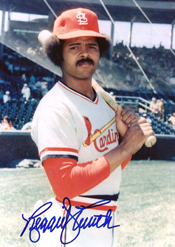 With the Cardinals in 1976, Smith opted to play without a signed contract because Busch wouldn’t agree to defer part of Smith’s salary. If Smith stayed unsigned, he could play out his option and become a free agent after the season.
Busch, an imperious meddler, would not tolerate what he perceived as defiance. “Get rid of him,” Busch barked to general manager Bing Devine, Smith told the Los Angeles Times.
On June 15, 1976, in a trade they would come to regret, the Cardinals sent Smith, their all-star switch-hitting right fielder, to the Dodgers for catcher Joe Ferguson and prospects Bob Detherage and Freddie Tisdale.
They are the egg men
Carl Reginald Smith was one of eight children raised in a family in Los Angeles County near Compton. His father had an egg delivery service and young Reggie helped him on the truck during weekends.
Smith became a high school baseball and football standout. A quarterback and defensive back, “I felt football was my best sport,” he told the Los Angeles Times.
Baseball, though, provided the best chance for him to earn money and help the family. Big-league clubs showed interest in the shortstop. In 1963, the Houston Colt .45s brought Smith to Dodger Stadium to work out before a game. “I was throwing as hard as possible on the sidelines when one throw got away from me,” Smith recalled to the Los Angeles Times. “Sandy Koufax was hitting fungoes to the outfielders and my throw missed his head by less than three inches. I still break into a cold sweat when I think about it.”
The Twins ended up being the club that signed Smith, 18, in June 1963 and assigned him to Wytheville (Va.) of the Appalachian League. The woman who ran the boarding house for blacks in the segregated town “told me to never go out alone,” Smith recalled to the Times. “I hit a white kid who called me a nigger. I yelled back to people in the stands … I’m lucky I’m not hanging from some tree.”
Smith played shortstop for Wytheville, made 41 errors in 65 games and had more strikeouts (69) than hits (65). The Twins made him available in the minor-league draft and the Red Sox took him. Four years later, Smith began the 1967 season as the Red Sox’s Opening Day second baseman and finished it as their center fielder in the World Series against the Cardinals.
Booed in Boston
Smith won a Gold Glove Award in 1968 and led the American League in doubles. He was tops in the league in total bases and extra-base hits in 1971.
He had one of the best arms in baseball, but his knees ached. The Red Sox wanted to trade Smith for pitching. They offered him to the Cubs for Ferguson Jenkins at the 1972 winter meetings, but the deal fell apart, the Boston Globe reported. Smith then was headed to the Dodgers for Bill Singer, but the Red Sox backed out at the last minute, general manager Al Campanis told the Times.
So Smith was back in Boston in 1973. He produced a .303 batting average, .398 on-base percentage and slugged at a .515 clip, but it was a miserable season for Smith. He confronted teammate Bill “Spaceman” Lee during a game in Milwaukee and called him gutless for not brushing back Brewers batters. Lee challenged him to a fight. Smith had the Spaceman seeing stars. The pitcher was knocked out cold. “He had it coming,” Smith told Frank Dolson of the Philadelphia Inquirer.
In a game at Boston, fans booed Smith when he didn’t run to first on a grounder. They booed him again when a shallow fly fell in front of him for a single. Smith mockingly doffed his cap on the way to the dugout, marched into the clubhouse, changed and went home while the game continued.
“My anger is like a balloon,” Smith told the Los Angeles Times. “Blow it up, let it go all over the place, then it lies on the floor, exhausted.”
The Red Sox put him on the trading block after the season. The Dodgers wanted him, but when the Red Sox demanded either Don Sutton or Andy Messersmith in return “that stopped that,” Al Campanis told The Sporting News.
The Cardinals won the prize, obtaining Smith and Ken Tatum for Rick Wise and Bernie Carbo on Oct. 26, 1973.
A Spike in spikes
Smith was a National League all-star in each of his first two seasons with St. Louis. He led the club in total bases in 1974, and his on-base percentage (.389) and slugging mark (.528) were tops among the regulars. Though sidelined for three weeks of the 1975 season because of back ailments, Smith was the Cardinals’ home run leader (with 19), and again produced quality on-base (.382) and slugging (.488) percentages.
Cardinals players appreciated him in those years. “He gives 100 percent all the time,” second baseman Ted Sizemore told the Los Angeles Times. “He’ll do anything to win.” In the book “The Spirit of St. Louis,” pitcher Rich Folkers said, “Reggie Smith was a good guy … When Reggie was in the lineup, he did real well.”
Bob Gibson saw Smith as a soulmate. In his book “Stranger to the Game,” Gibson said, “My affinity for Reggie Smith was a natural because we were very much alike, both of us maintaining an exterior toughness that really wasn’t what we were about. Smith was a very bright, thoughtful guy who was ready to fight if somebody looked at him wrong. I called him Spike because he reminded me of those spike-collared bulldogs on Saturday morning cartoons.”
Things go wrong
On the advice of agent Tom Reich, Smith requested the Cardinals defer a portion of his 1976 salary. When Gussie Busch said no, Smith opted to play without a signed contract. That meant the Cardinals would renew his pact basically at 1975 terms, but Smith would qualify to become a free agent after the season. “We had no quarrel with the Cardinals over gross salary,” Reich told the Los Angeles Times. “The difficulty was in working out the draft of the deferred arrangement.”
At 1976 spring training, a trade proposal was discussed: Reggie Smith and Ted Sizemore to the Dodgers for shortstop Bill Russell and outfielder Willie Crawford, Al Campanis confirmed to the Times.
When the Cardinals balked at giving up Smith, the trade became a swap of Sizemore for Crawford on March 2.
The 1976 Cardinals were a bad team. Their record entering the June 15 trade deadline was 25-34. Smith, experiencing pain in his left shoulder, struggled to hit. The injury caused him to alter his batting style. He couldn’t hold his hands as high as he wanted on the bat. Smith batted .174 in April and .219 in May. The bright spot was a three-homer game against the Phillies.
With third baseman Hector Cruz and first baseman Keith Hernandez struggling early in the season, manager Red Schoendienst had Smith fill in at third and first. In his book “I’m Keith Hernandez,” Hernandez recalled, “Reggie was a premier player … but he’d spent the last month, since being moved to the infield, sulking and brooding in the clubhouse. Everywhere he went, a dark cloud followed.”
Gussie Busch was fed up. The team was a mess and he viewed Smith as a problem. Busch assumed Smith wasn’t playing hard because of the contract disagreement. He wanted him gone _ just like he had ordered the trades of others who angered him such as Steve Carlton and Jerry Reuss.
“The Cardinals thought Reggie was jaking it,” Tom Reich said to the Los Angeles Times. “There were some words between Reggie and management. Hell, Reggie was playing in a lot of pain.”
Smith told the newspaper, “The Cardinals accused me of malingering to force a trade. I can’t understand them making that kind of statement. I have too much pride to stoop to that sort of thing.”
On June 15, Bing Devine called Al Campanis and offered him Smith. Campanis knew Devine was being forced to deal and had little leverage. Now, instead of Bill Russell, the Dodgers gave up Joe Ferguson, batting .222.
The deal was completed when the Dodgers agreed to the deferred salary arrangement and Smith agreed to sign a two-year contract for 1976-77. “Smith will receive in excess of $100,000 for each season, with a large portion of it deferred,” the Los Angeles Times reported.
Rot at the top
About a month after the trade, the Dodgers came to St. Louis for three games. Smith hit a home run in each. The pitchers were John Denny (solo shot), Pete Falcone (two-run) and Bob Forsch (three-run). “The pitch I threw to Reggie just straightened out,” Forsch told the St. Louis Post-Dispatch. “I was trying to sink it outside … The last time I saw it, it was sinking over the wall in right.” Boxscore Boxscore Boxscore
Smith batted .476 against the 1976 Cardinals. Five of his 10 hits were home runs. After the season, exploratory surgery by Dr. Frank Jobe showed Smith had been playing with a torn rotator cuff, the Los Angeles Times reported.
Smith went on to produce 41 RBI in 57 career games versus the Cardinals and had a .404 on-base percentage against them.
(Joe Ferguson batted .201 for the 1976 Cardinals and was peddled to Houston for Larry Dierker after the season.)
In a five-year stretch from 1977-81, Smith helped the Dodgers win three National League pennants and a World Series title.
Asked about the Dodgers’ success, Smith told the Post-Dispatch in 1977, “It’s something that comes down right from the top, from the man at the head of the organization to everyone on the club. It’s something every team could have if management wanted it.
“I think the Cardinals might have had it in the past, but I don’t think they have it in the organization anymore, and you have to go right to the top man for the reason it’s not there anymore. I think Mr. Busch soured on his players a few years ago in those contract disputes and it’s still having an effect. He took the hard line, and to him the answer to negotiating a contract was to trade the player if the player also took the hard line.
“As a result, it became every player for himself, and pretty soon you no longer had a team but a bunch of individuals.”

 RetroSimba
Great article and really frustrating. Pretty much is what the 1970’s Cardinal teams were about. He was a great player. To get a back up catcher for him is criminal.
Thanks, Dave. Yep, the Dodgers’ timing on the deal was excellent because, as you note, they robbed the Cardinals.
After making the deal, the Cardinals said they intended to make Joe Ferguson the everyday catcher and move Ted Simmons to first base. Initially, Simmons told the St. Louis Post-Dispatch of the proposed move, “I think I’m ready for it. Sometimes I feel I’m dragging too much from catching so much.”
However, shortly after, Ted had second thoughts. “This year, I think I’ve been a great catcher,” Simmons told the Post-Dispatch. “In other years, I know I wasn’t as good, but I’ve been as good as anybody this year. I can throw as well as anybody and I can block balls as well as anybody, and those are the two things everyone talks about when they consider good catchers.”
Regarding moving to first base, Simmons added, “I don’t consider it permanent.”
The Cardinals even tried Simmons at third base that year (with disastrous results). In the end, Simmons remained the catcher and, as you noted, Ferguson was basically a backup.
Excellent story and very informative. I was only 10 years old at the time and Ted Simmons and Reggie were my favorite players. I’m pretty sure I cried when my dad told me Reggie was traded. Glad Gussie finally came to his senses in 1980 and hired Whitey to run the team.
Thanks, Bob. I had forgotten, or didn’t know, until researching for this post that Red Schoendienst named Reggie Smith and Ted Simmons co-captains of the 1976 Cardinals.
That Cardinals outfield of Lou Brock, Bake McBride and Reggie Smith was pretty awesome in 1974 and 1975.
Don Sutton said of Reggie Smith to the Los Angeles Times, “Reggie doesn’t go out and publicize himself. He doesn’t smile at the right people, or say the right things. He tells the truth, even if it sometimes alienates people. Reggie and Richie Allen are the two most totally misrepresented players I ever met. They’re wonderful people with the wrong reputations.”
The Cardinals of the 1970’s could have been right up there with the elite teams of that decade if they would have had a less stubborn owner. A starting rotation of Steve Carlton, Jerry Ruess, Mike Torrez and a decent fourth starter would have had them right there pretty much every season. What a shame looking back. I remember during the 1969 season he blew the whole thing up. I still believe they had one more championship left in them if he would not have traded Cepeda, Flood and McCarver. Those three were the core of the team.
Well said. Thank you!
If you get a chance, you might be interested in my post on how Gussie Busch offended the two-time defending league champion Cardinals with his talk to them at 1969 spring training: https://retrosimba.com/2019/03/15/why-cardinals-were-offended-by-talk-from-gussie-busch/
Reggie Smith at shortstop and second baseman Roy White were a couple of tough outs at Centennial High School in Compton.
That is a cool keystone combination. Thanks for pointing that out.
Roy White was a good ballplayer who seems to get rarely mentioned anymore.
According to the Web site of the Centennial High School alumni group, Reggie Smith and Don Wilson, the future Houston Astros pitcher, were in the same 1963 graduation class: http://www.centennialhighalumni.com/page/notable-alumni
Those reading this comment also may be interested in knowing that another Smith who played for the Cardinals, Lonnie Smith, also graduated from Centennial High School a few years after Reggie Smith did.