Nothing was wrong with the left arm of Cardinals pitcher Tom Sunkel. He threw pitches with blinding speed. The problem was an eye. He was blind in the left one.
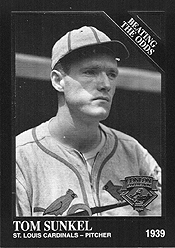 Though his vision was impaired, Sunkel spent the 1939 season with the Cardinals, and what he did showed he had plenty of heart, too. Sunkel pitched a two-hit shutout against the Giants. He won four decisions in a row as a starter. Plus, he swung a potent bat, hitting .321 for the season.
The Giants wanted him and arranged a 1941 trade. In his second game for them, Sunkel spun another two-hit shutout, against the Phillies.
Boyhood accident
Tom Sunkel grew up on a farm in Paris _ Illinois, that is _ about 20 miles northwest of Terre Haute, Ind. Incorporated in 1849, Paris, Ill., likely got its name from the word “Paris” carved into a tree in the center of the village.
When Sunkel was 4, a playmate loaded a popgun with a stick, aimed it and fired. Sunkel put up a hand for protection but the stick streaked between his fingers and pierced his left eye, the Minneapolis Star Tribune reported.
A doctor saved the eye but a traumatic cataract developed, cutting Sunkel’s sight to a little better than half normal, according to the Associated Press.
Despite the restricted vision, Sunkel became a standout amateur baseball player. At 21, he was pitching for a local church team when the Cardinals signed him for their farm system in 1934.
On his path through the minors, Sunkel took a step backward in 1936 when he posted a 6-26 record for a Class B Asheville (N.C.) club managed by Billy Southworth. As other pitching prospects advanced, Sunkel stayed at Class B in 1937, with Decatur (Ill.). It turned out well for him, though. His fastball and curve stymied batters from clubs such as the Moline Plow Boys and Terre Haute Tots. Sunkel totaled 227 strikeouts in 192 innings.
No rescue for Redbirds
Cardinals general manager Branch Rickey visited Decatur in August 1937 to scout Sunkel. The Cardinals were contending with the Cubs and Giants for the National League pennant but they needed starting pitching help. Dizzy Dean hurt his toe in the All-Star Game, altered his pitching delivery and damaged his arm. His brother, Paul Dean, underwent shoulder surgery. Jesse Haines was 44 years old.
St. Louis players were hoping Rickey would acquire proven pitching for the pennant push, but instead he called up Sunkel, 25, from Decatur to fill the void.
Sunkel’s arrival “became a big joke with the other players,” Sid Keener of the St. Louis Star-Times noted. “A pitcher from Decatur was Rickey’s idea of trying to win the 1937 pennant.”
(The Cardinals finished fourth, 15 games behind the champion Giants.)
The rookie was timid _ “I sure was a busher,” he admitted to the Star-Times _ and manager Frankie Frisch used him mostly in relief. Though he didn’t allow a run in six of eight relief appearances for the 1937 Cardinals, including a seven-inning stint versus the Pirates, Sunkel didn’t show enough to stick with the club in 1938. Boxscore
“Just when I figured I had made the grade (with St. Louis), the bottom fell out of everything,” Sunkel said to the Star-Times.
Rickey arranged for Sunkel to pitch for the 1938 Atlanta Crackers, which wasn’t a Cardinals farm club, but retained an option to recall him to St. Louis at any time.
Seeing the light
Sunkel was a success on the mound for Atlanta but it was a troubling season. He had a kink in his left arm the first part of the year. After that, he had a bout of neuritis, an inflammation of the nerves. One night, he was pitching a home game when a burglar broke into his apartment, “leaving the Sunkel family practically flat broke,” the Star-Times reported.
Then the vision in his left eye got dimmer and dimmer.
The traumatic cataract from his childhood injury had worsened considerably. On Aug. 3, 1938, Sunkel told Guy Butler of the Atlanta Journal that the condition of his left eye had deteriorated so much that “I can’t see out of it, but it’s been that way for a month, getting a little worse right along.”
Team trainer Dick Niehaus, a former Cardinals left-handed pitcher, said to the Journal, “I was standing right in front of him. I asked him to close his right eye and look at me. He said he couldn’t see me at all.”
With the club’s permission, Sunkel opted to keep playing. “It’s pretty tough that Tom must pitch under this handicap,” Atlanta catcher-manager Paul Richards said to the Journal. “I don’t want you folks to expect too much of him.”
Sunkel, though, adapted. “I have to guess where the plate is when I throw,” he told the Associated Press.
The results were amazing. Sunkel achieved a 21-5 record, winning his last 13 decisions in a row. For his 20th win, he pitched a one-hitter against Memphis. (Pitcher Hugh Casey got the hit on an infield roller in the third inning.) Sunkel posted a 2.33 ERA in 243 innings and also batted .255 (with 26 hits).
In the Southern Association playoffs, Sunkel won twice, helping Atlanta take the championship. Then he shut out Texas League champion Beaumont in the Dixie Series, winning a duel with Schoolboy Rowe.
Job well done
The Cardinals exercised their option and brought Sunkel to spring training in 1939. They had him examined by eye specialists, who agreed his condition couldn’t be corrected by surgery. “Sunkel calmly accepted the verdict that he would have to battle his way upward with only half the sight of other pitchers,” the Associated Press noted.
Sunkel made the team, but Cardinals manager Ray Blades didn’t use him much in the first part of the season. Then, in July, Sunkel was given some starts. He beat the Phillies for his first big-league win, limiting them to two runs in six innings. He also produced two hits and a sacrifice bunt. Boxscore
“He has developed a new pitching and batting stance, cocking the head slightly to one side so as to take in everything with his one good eye that he would normally see with two,” Ray Gillespie wrote in the Star-Times.
Sunkel told the newspaper, “As long as I’ve got one good eye … I’ll win a lot of games for the Cardinals … I’m big and strong enough to pitch and I’m not afraid of opposing batters. So how’s a little trouble in one eye going to stop me?”
Sunkel’s next win brought him national attention. On a humid afternoon at St. Louis, he held the Giants hitless until Tom Hafey (cousin of ex-Cardinals standout Chick Hafey) singled to right with one out in the eighth. The only other Giants hit was a two-out Billy Jurges single in the ninth. Sunkel produced as many hits as he allowed (two) and also had a walk and a RBI. Boxscore
Wins against the Dodgers and Pirates followed. Boxscore and Boxscore
In 20 games, including 11 starts, for the 1939 Cardinals, Sunkel was 4-4 with a 4.22 ERA. He also totaled nine hits in 28 at-bats.
Keep on going
His was a feel-good story, but results were valued more than sentiment in baseball. Sunkel, 27, gave up nine runs in his last 10 innings with the 1939 Cardinals. They determined he needed more time in the minors.
Sunkel spent 1940 with Columbus and 1941 with Syracuse. In September 1941, the Cardinals dealt Sunkel to the Giants for Jumbo Brown (a 295-pound pitcher) and Rae Blaemire.
Two weeks later, in his second start for the Giants, Sunkel held the Phillies hitless until Johnny Rizzo cracked a single with two outs in the eighth. Sunkel finished with a two-hit shutout, striking out 12. He also had a hit and scored a run. Boxscore
Sunkel was 3-6 for the 1942 Giants. A highlight was pitching 10 innings to beat the Dodgers. Boxscore
He spent most of 1943 in the minors. Then Branch Rickey, who had left the Cardinals, acquired Sunkel for the Dodgers. He pitched his last big-league games for them in 1944.
Sunkel continued to pitch in the minors until 1948. In an American Association playoff game for St. Paul in 1946, he pitched a no-hitter at Louisville. In describing the performance, Tommy Fitzgerald of the Louisville Courier-Journal called Sunkel “the Eiffel Tower of Paris, Ill.”

 RetroSimba
Jumbo Brown the Bartolo Colon of the Dead Ball Era. 😂
Alas, though he had 157 big-league at-bats, Jumbo, unlike Bartolo, never swatted a home run.
One of the many aspects of your writing Mark, of your posts that i enjoy is the details like in this one how Sunkel actually went blind in one eye, the childhood injury and also how the city got its name, from “the word “Paris” carved into a tree in the center of the village.” I love city names, especially their origins, so many of native american connections which often results in learning about a specific tribe.
I’m convinced more and more everyday that behind people’s smile or grimace is a story to be told.
Thanks very much, Steve.
There are a couple of places called Paris in your stomping grounds. Paris, Ontario, near Brantford, appears to be an attractive town with many walking and biking trails. There also is a place called Paris in Kenosha County in Wisconsin.
thanks Mark for mentioning the two places called Paris. I enjoy very much having a travel destination with not much in mind to do other than walking and visiting a local museum devoted to the history of that city….There is so much to see here in Quebec and all of canada and north america…..I just put Brantford, Ontario on my “to visit” list.