The Yankees thought Frank Leja was the next Lou Gehrig. The Cardinals later hoped he might be another Jim Gentile. Leja never claimed to be like anyone else. He just wanted a fair chance to show he could hit in the big leagues.
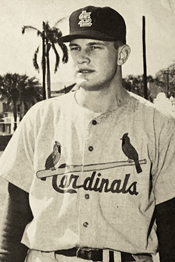 At 6-foot-4, 215 pounds, Leja was a first baseman and left-handed slugger who had major-league clubs clambering to sign him after he graduated from high school in 1953.
He was 17 years old _ too young to vote or to buy a beer in his home state of Massachusetts _ but ballclubs wanted to pay him a big bonus and bring him directly to the majors.
Paul Krichell, the scout who found Lou Gehrig for the Yankees, also got Leja for them. Krichell told the New York Times that Leja was the “closest thing to Lou Gehrig I ever have signed.”
Bidding war
Leja (pronounced Lee-juh) was from the Massachusetts town of Holyoke, once known as the Paper City because of its abundant mills. His ancestry was Polish.
Home was on the top floor of a two-family house. In 1946, when he was 10, Leja took an interest in playing first base because that’s where his favorite big-leaguer, Stan Musial, also of Polish heritage, had shifted to with the Cardinals.
A coach, former Boston Braves infielder Ed Moriarty, had a positive influence on Leja. As a prep senior in 1953, Leja hit .423 and led Holyoke to a state title. He also was an honor roll student and treasurer of the high school Latin Club.
In the summer after his senior year, Leja played American Legion baseball. To protect the integrity of the amateur game, big-league clubs weren’t supposed to attempt to sign American Legion players while their season was under way, but the Cleveland Indians, Milwaukee Braves and New York Giants couldn’t resist negotiating with a prospect as intriguing as Leja.
Ed Moriarty recommended Leja to a former Boston Braves teammate, Cleveland manager Al Lopez. When in Boston for a June 1953 series, Cleveland general manager Hank Greenberg, a former slugging first baseman, brought Leja to Fenway Park and put him in uniform for a workout. A newspaper photographer posed Leja with Lopez and first baseman Luke Easter. Lopez said Leja would be the successor to Easter, a left-handed power hitter who turned 38 that year.
American Legion officials complained to baseball commissioner Ford Frick, who fined the Braves, Giants and Indians for negotiating with Leja while his amateur league season was in progress.
In September, when American Legion play was completed, most big-league clubs joined in a hot pursuit of Leja.
He went to Chicago, where White Sox general manager Frank Lane handed him a check for $75,000, according to the Boston Globe. Leja handed it back.
The Phillies were aggressive, too. “I was willing to go up to $90,000 with him, but he turned me down,” Phillies farm director Joe Reardon told the Globe.
Cleveland officials “seemed quite certain they would get the boy,” The Sporting News reported. They met with Leja and his father in a New York hotel room to finalize a deal. “We told them what we were asking,” Leja recalled to Ted Ashby of the Globe, “and they left the room for a conference. After waiting for four hours in a room with Tris Speaker (then a Cleveland hitting instructor), we walked out.”
Leja contacted Paul Krichell and told him he would sign with the Yankees.
Yankee dandy
Krichell, 70, the Yankees’ head scout, had done a masterful job of selling Leja on the idea of wearing pinstripes.
Born in Paris, France, a son of a German cabinetmaker, Krichell grew up in the Bronx and became a catcher for the St. Louis Browns before he took up scouting for the Yankees. He signed Gehrig in 1923 and later brought Tony Lazzeri, Phil Rizzuto and Whitey Ford to the Yankees.
Krichell had Leja imagining what it would be like to follow in the footsteps of Babe Ruth, Lou Gehrig and Joe DiMaggio. The star-struck teen told United Press, “I’ve always been a great admirer of DiMaggio. I figure if I make good on Broadway I also can get lucky and find a Marilyn Monroe.”
Headed to their fifth consecutive World Series title in 1953, the Yankees had three future Hall of Famers among the regulars (catcher Yogi Berra, shortstop Phil Rizzuto and center fielder Mickey Mantle) but not at first base, where Joe Collins played. Krichell had Leja convinced he could replace Collins before too long.
In a workout at Yankee Stadium before he signed, Leja launched pitches from Vic Raschi into the bleachers and took a liking to the short distance, a mere 296 feet, from home plate to the fence down the right field line. Manager Casey Stengel grandly gestured with his hand toward the upper reaches of Yankee Stadium and said to Leja, “Son, the stadium was built by Ruth and you’ve got what Ruth had.”
Stengel’s statement “may be malarkey, and probably is, but, brother, I melted into a little lump and told my father I wanted to sign with the Yankees,” Leja recalled to Ben Epstein of the New York Mirror.
Though the Indians, Phillies and White Sox may have given him more money, the Yankees’ glamour lured Leja. He took their offer of a $45,000 bonus paid over two years _ $22,500 per year, the New York Times reported.
Major League Baseball had a rule then that any amateur who got a signing bonus of more than $4,000 had to stay with the big-league club for two full years. Leja was the first player the Yankees gave such a bonus to under those terms.
“He’s the most experienced 17-year-old I ever saw … I like the boy,” Stengel told the Associated Press.
After Leja signed on Oct. 1, 1953, he was sent to play winter ball in San Juan on a team managed by Yankees employee Harry Craft. Leja went hitless in his first 21 at-bats, but Yankees farm director Lee MacPhail said to The Sporting News, “What we wanted was for him to get plenty of batting practice and work in the field at first base under our coaches _ and he’s had lots of that.”
Inside but out
Leja arrived at the Yankees’ spring training clubhouse in 1954 and found that teammates had hung a money bag filled with phony dollar bills inside his locker, the Boston Globe reported.
With his $22,500 bonus, plus a $6,500 salary, the 18-year-old was being paid more that year than Mickey Mantle ($21,000 salary) and many other Yankees.
“The Yankees resented this fresh, young kid getting ($45,000) in bonus money,” Stan Isaacs of Newsday wrote.
Leja told the Globe, “Here I was, a year out of high school and my locker was next to someone (Hank Bauer) I’d watched on television in the World Series only a few months ago … I was in awe of everything going on.”
The first time Leja got into a game as a Yankee was as a pinch-runner in a spring training exhibition versus the Cardinals. “I was so jittery I couldn’t spit,” he recalled to the New York Mirror.
During the 1954 season, Stengel platooned a more experienced rookie, Bill Skowron, 23, who had played college baseball at Purdue and spent three seasons in the minors, with Joe Collins, 31, at first base.
Leja rarely left the bench. His major-league debut on May 1, 1954, came in the ninth inning of a game against Cleveland. Facing a future Hall of Famer, Early Wynn, Leja popped out to second. Boxscore
The teen’s first (and only) big-league hit was a single against Athletics left-hander Al Sima on a September Sunday before 1,715 spectators at Philadelphia. Boxscore
Leja’s 1954 season stats: 12 games, five plate appearances, one hit.
“The few times I came to bat I was not afraid of any pitcher I faced,” Leja said to Louis Effrat of the New York Times. “I know I can hit.”
In winter ball after the 1954 Yankees season, Leja hit .340 for Cordoba of the Veracruz League in Mexico.
At 1955 spring training, scout Johnny Neun, a former big-league first baseman, worked with Leja on his footwork. Coach Bill Dickey, a Hall of Famer, instructed Leja on hitting, but that didn’t go well. “They had Bill Dickey work with my swing,” Leja told a Springfield (Mass.) newspaper. “When he got through with it, it never was the same again.”
Stengel expressed confidence in Leja, telling Bill Keating of the Holyoke Transcript-Telegram, “I’ll play Leja, you can bet on that.”
However, Leja appeared in fewer games (seven) for the Yankees in 1955 than he did in 1954. He had a mere two plate appearances. Adding to the indignity of not playing, Leja suffered a broken nose when hit in the face by an Irv Noren liner while pitching batting practice in August. The ball struck the top of the protective screen in front of the mound and caromed toward Leja.
The Yankees won the 1955 American League pennant but the Dodgers prevailed in the World Series. Leja got a full runners-up share of $5,598.58.
Afterward, the Yankees embarked on a goodwill tour of Japan. They brought Leja along, but he felt disconnected from the team. “The loneliness was so terrible, he sometimes would sit in his room and cry,” Stan Isaacs of Newsday reported.
Cards come calling
Leja spent the next six seasons (1956-61) in the minors. In 1961, when he slammed 30 home runs, Cardinals scouts spent two months following him. On the advice of player development director Eddie Stanky, general manager Bing Devine traded outfielder Ben Mateosky for Leja in October 1961.
Leja reminded some of Jim Gentile. Like Leja, Gentile was big (6-foot-3, 210 pounds) and a first baseman with left-handed power. He spent eight years in the Dodgers’ farm system. After being dealt to the Orioles, Gentile produced 21 home runs and 98 RBI for Baltimore in 1960 and 46 homers and 141 RBI in 1961. “When you look at fellows like Jim Gentile, you wonder if lightning might not strike twice,” Bing Devine told the St. Louis Post-Dispatch.
The Cardinals had a quality first baseman, Bill White, but needed power (St. Louis and the Phillies tied for last in the National League in home runs in 1961) and hoped Leja could provide pinch-hitting punch and insurance if White got hurt.
“Just one season. That’s all I need to establish myself,” Leja told Harold Kaese of the Boston Globe. “I’m a fair fielder and I can hit left-handers. I have confidence, experience and power.”
At 1962 spring training, Leja blasted a home run against the Phillies’ Dennis Bennett and thought he hit well overall, but Cardinals manager Johnny Keane concluded Leja “would strike out too many times to be an effective pinch-hitter,” the Post-Dispatch reported.
The Cardinals chose rookie Fred Whitfield to back up Bill White and sent Leja to the Angels on March 30, 1962.
“I sure was surprised when they told me I was leaving the Cards,” Leja said to the Los Angeles Times. “Nobody gave me any inkling that the Cards didn’t want me.”
The Angels had two first basemen _ Lee Thomas, a graduate of St. Louis’ Beaumont High School, and ex-Cardinal slugger Steve Bilko _ but manager Bill Rigney gave Leja a chance. He started at first base in four games, but went hitless and committed two errors.
In May 1962, the Angels dealt Leja to the Braves, and he finished his playing career in the Milwaukee farm system.
After baseball, Leja ran a successful life insurance agency near Boston and then was self-employed in a lobster shipping business. A son, also named Frank, played baseball for Eddie Stanky’s University of South Alabama team and became a batting practice pitcher for the Red Sox when they were managed by his father’s former Yankees teammate, Ralph Houk.



what a wonderful opening sentence and concept Mark – to be like n0 one else except himself…..words to keep in mind, always, a balm, definitely a balm. Fun to think of a future big league catcher and scout Krichell being born in paris. i seldom think about big leaguers hailing from europe though bobby thompson was born in scotland i think. anyway, 296 feet, from home plate to the fence down the right field line!! that has me wanting to get in shape and give it a go…just kidding, but i forgot how short that was in right field and i think it still is?
thanks for digging up this treasure, the first ever yankee to be signed in such a way and forced to stay with the club for two years…what a commitment! and what a bizarre reality, to be paid more than Mantle and never a dull moment Stengel comparing him to Ruth and in the end only one big league hit. This brings me back to your opening line in this post and it sounded like Frank Leja carved out a nice life for himself after baseball so who knows maybe Stengle’s words worked like magic in the long run. i wish troubled people could be spoken to by people like Stengel, to instil some confidence and love and ideally prevent them from doing mean things like in today’s world, these mass shootings. if there’s one thing that I think would be great for this world is a better understanding of mentally ill people. i’m totally off topic. sorry about that. very inspiring story Mark…
Thanks, Steve. Your comment about mental health prompts me to share this quote from Frank Leja to Stan Isaacs of Newsday on why there was an urgency for him to take a big bonus from a club relatively close to home: “We needed the money badly,” Leja told Isaacs. “My mother had a nervous breakdown at the time. She spent four years in a mental institution. The (bonus) money paid for it.”
wow! i love it when the synchronicity of it all becomes so clear…referring to the mental health connection….inspiring and a new page in the history of athletes caring for their parents. thanks for adding that.
last night i watched The Other Side of Hell with the late Alan Arkin. He’s a great actor. The movie is about his escape attempts at a prison for the criminally insane. very moving tale, not a true story, but taps into the deplorable conditions at mental institutions and prisons. it reminded me a bit of Shawshank Redemption a bit in the escape attempts, so well thought out.
What a story. Let me say that I would have never wanted to be in the shoes of Frank Leja. While I understand that he desperately needed the money, to be a bonus baby on those legendary Yankees teams making more money than Mickey Mantle isn’t something that I would have wanted to experience. I suppose the Yankees could splurge on signing bonuses because they always had the Kansas City Athletics as an affiliate minor league team! I bet that it was always a bitter sweet experience for him to then look back at his baseball career. It’s sad to know that he passed away at still a young age. But it’s wonderful to see that besides raising a family he was successful and productive in the real world. I noticed that Ben Mateosky who was the prospect that the Cardinals gave to the Yankees in exchange for Frank Leja also had a storied minor league career.
Thanks, Phillip. I think you are correct about it being a bittersweet experience for Frank Leja to look back on his baseball career.
After joining the Cardinals, Leja told Jack Herman of the St. Louis Globe-Democrat: “I spent eight years in the Yankees organization and it was nothing but aggravation.”
In January 1963, when he still had hopes of returning to the majors with the Braves, Leja told the Boston Globe, “Becoming a big-leaguer is almost an obsession with me … You can live for a dream but you have to work to make it come true.”
I feel like Casey Stengel is somehow involved in every baseball story known to man.
Hah! You know, you may be right about that, Gary.
In 1912, when Casey Stengel made his big-league debut, going 4-for-4 for Brooklyn against Pittsburgh, one of the other players in that game was Honus Wagner, who began playing in the National League in 1897.
In Stengel’s last official game as manager, with the 1965 Mets, one of his pitchers that day was 20-year-old Tug McGraw, who would pitch in the majors until 1984.
So Casey was involved in big-league games with players who spanned 10 decades in the majors.
When you read this story you have to wonder how things would have worked out had he not been so highly touted and instead spent some time in lower minor league ball with kids his age. Who knows? It is at least comforting that he seems to have had a comfortable post-baseball career.
Indeed. During his second spring training with the Yankees in 1955, Frank Leja said to the New York Times, “Maybe the bonus rule should be changed to permit a young bonus player to be farmed out for experience.”
In 1956, when Leja finally was allowed under the rules to go to the minors, he didn’t do well, and ended up playing with three teams that year, being dropped a level each time. He explained that he was so rusty from sitting on the Yankees’ bench for two years that it took him all season to get back in the flow of playing regularly.
The problem wasn’t that the Yankees were paying Leja too much; they weren’t paying Mickey Mantle enough. These bonus baby stories are interesting. The Dodgers lost Roberto Clemente by trying to hide him in the minors. And this is yet another Casey Stengel story that shows him in a bad light. His treatment of Warren Spahn comes to mind.
Thanks, Hugh. You are correct about the salaries. The Yankees paid their best pitcher, Whitey Ford, $16,250 in 1954 and $21,000 in 1955. Yogi Berra and Phil Rizzuto were two of the highest-paid Yankees in 1954-55. Berra got $40,000 in 1954; $50,000 in 1955. Rizzuto got $40,000 in 1954 but took a cut in 1955, getting $38,000.
Casey Stengel may have done one of his best managing jobs in 1955. He led the Yankees to an American league pennant, even though he was hamstrung by having two bonus players. Frank Leja and shortstop Tom Carroll spent the entire 1955 season with New York, but Leja had a total of two at-bats and Carroll had six. So Casey basically managed a roster that was two below the limit, and still delivered a championship.