When Ron Northey ordered a double, it was for extra portions of ice cream, milk and chocolate syrup, not whiskey. Northey had a weakness for chocolate milkshakes. He sampled his favorite drink in just about every lunch counter or malt shop in each big-league city during his playing days in the 1940s and 1950s.
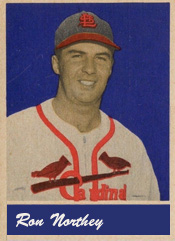 Northey’s diet gave him a physique as thick as a milkshake. His weight usually fluctuated between 200 and 220 pounds on a 5-foot-10 frame, giving him a shape “reminiscent of a fire hydrant,” Don Daniels of the Philadelphia Inquirer noted.
Sportswriters called him Round Ron. Phillies manager Ben Chapman told the Philadelphia Record, “Ron has a waistline that looks like a man who has just swallowed a watermelon.”
Chapman preferred the outfielder look like a cucumber, but, as The Sporting News noted, when “Northey’s waist shrinks so does his hit output.”
A left-handed batter, roly-poly Northey was a menacing hitter, especially in a pinch. He was the first big-leaguer to clout three career pinch-hit grand slams, doing it for the Cardinals in 1947 and 1948 and for the Cubs in 1950.
Three others have matched Northey’s feat: Willie McCovey with the Giants (1960, 1965) and Padres (1975); Rich Reese with the Twins (1969, 1970, 1972); and Ben Broussard with Cleveland (two in 2004) and Seattle (2007).
That jingle jangle
Northey was from Pennsylvania’s anthracite coal region. When he was in high school, a coach, Charlie Dunkelberger, took him to Philadelphia to work out for Athletics manager Connie Mack. According to the Pottsville Republican and Herald, Mack helped Northey get an athletic scholarship to Duke.
Batting for the Duke freshman team, Northey was beaned and suffered a punctured ear drum. “Since that day, Ron has had a buzz in his head,” The Sporting News reported.
The continual hum in his ear was so annoying that Northey sometimes slept with a radio on as a soothing distraction, according to The Sporting News.
It didn’t hurt his hitting, though. Northey had a power stroke. He also had an exceptionally strong right throwing arm that kept runners in check.
After a year at Duke, Northey entered the Athletics’ farm system in 1939. Two years later, his contract was sold to the Phillies.
Ready to hit
In his first big-league at-bat, with the 1942 Phillies, Northey walloped a double versus the Braves’ Al Javery. Two years later, he beat Javery with a home run in the 15th inning of a scoreless game. Boxscore and Boxscore
That 1944 season was Northey’s best _ 35 doubles, 22 home runs and 104 RBI. He pounded right-handed pitchers and was vulnerable against left-handers. With the 1946 Phillies, Northey batted .266 with 16 home runs versus right-handers and .159 with no home runs against left-handers.
After working in a stockroom at Sears during the winter, Northey reported late to 1947 spring training because of a salary dispute with the Phillies. Arriving 20 pounds overweight, he landed in Ben Chapman’s doghouse.
Punch, not Judy
After winning the 1946 World Series championship, the Cardinals had a dreadful start to the 1947 season. They lost 10 of their first 12 games, including the last eight in a row. They scored two runs or less in five of those 10 losses.
Harry Walker was deemed a weak link. After he batted .200 with no RBI in 10 games, the Cardinals stepped up efforts to acquire an outfielder with pop.
On May 3, 1947, they traded Walker and pitcher Freddy Schmidt to the Phillies for Northey. As a left-handed pull hitter, Northey’s swing was tailored to take advantage of the short distance (310 feet) down the line from home plate to the right field wall at Sportsman’s Park in St. Louis. Cardinals owner Sam Breadon told the St. Louis Star-Times, “Harry Walker is a fine defensive outfielder, but what we need right now is punch and I think Northey has it.”
The Cardinals, though, didn’t know Walker was close to mastering a revamped swing that would lead to a breakthrough.
Let ‘er rip
Making his Cardinals debut in a May 4 doubleheader at Boston, Northey singled and scored in the opener, a 4-3 Braves victory that extended the St. Louis losing streak to nine. In the second game, he went 3-for-4 with four RBI and three runs scored, sparking St. Louis to a 9-0 triumph. One of the hits was a two-run home run off Mort Cooper, the former Cardinals ace. Boxscore
Cardinals manager Eddie Dyer mostly platooned Northey in right field with Erv Dusak and Joe Medwick. Playing against right-handers, Northey delivered in the clutch, either as a starter or a pinch-hitter.
When the Cardinals played the Phillies for the first time since the trade, Northey’s former teammates heckled him unmercifully from the dugout, The Sporting News reported. As he heard shouts of “Well, well, here’s old Two Ton,” and “Roll out the barrel,” Northey’s neck turned red and “he swung and missed a pitch with a viciousness that shook the ground in the batter’s box.”
Later that season, Northey got his revenge, clouting a walkoff home run onto the Sportsman’s Park roof in right against Dutch Leonard to beat the Phillies. The first of his pinch-hit grand slams came while batting for catcher Del Rice against Doyle Lade of the Cubs at Wrigley Field. Boxscore and Boxscore
Northey was the central figure in a bizarre play at Brooklyn. He crushed a long drive toward the center field stands. As Northey steamed around second, umpire Beans Reardon signaled home run and, according to the Star-Times, said, “What are you running for? It’s a home run.”
Northey slowed to a trot, Another umpire, Larry Goetz, who’d gone into center to follow the ball, saw it strike the tip of the wall and bound onto the field. Goetz signaled the ball was in play. Outfielder Dixie Walker (Harry’s brother) retrieved it and relayed to second baseman Eddie Stanky, who threw to the plate. Northey started to run, but not fast enough. Catcher Bruce Edwards tagged him out.
The Cardinals filed a protest with National League president Ford Frick, saying Northey would have scored if Reardon hadn’t caused him to slow down. Frick ruled in the Cardinals’ favor. The game was declared a tie. All the statistics would count, but not the score. Boxscore
Frick ordered the game to be replayed in its entirety as part of an Aug. 18 doubleheader. The Dodgers won both. The Cardinals finished in second place at 89-65, five behind the Dodgers.
Northey was adept at reaching base for the 1947 Cardinals. His on-base percentages: .391 overall, .459 with runners in scoring position; and .484 as a pinch-hitter. He hit .313 versus right-handers; .154 versus southpaws.
Hot hitting
Meanwhile, Harry Walker went on a tear as soon as he joined the Phillies, getting 10 hits in his first 24 at-bats. He stopped trying to pull pitches and perfected a batting style suggested by Dixie Walker, who urged his sibling to close his stance and spray the ball to all fields.
In 130 games for the 1947 Phillies, Walker batted .371 with 181 hits, including a league-leading 16 triples.
Even with his 5-for-25 effort for the Cardinals added to his season total, Walker easily won the National League batting crown at .363. The runner-up, Bob Elliott of the Braves, hit .317.
Walker also placed second in the National League in on-base percentage at .436. Only the Reds’ Augie Galan (.449) did better.
Getting on base
Northey played two more seasons for St. Louis. He was good again in 1948, hitting .321 overall and .444 as a pinch-hitter. His on-base percentage for the season was .420, including .516 as a pinch-hitter. His first home run of the season was a pinch-hit grand slam against the Pirates’ Elmer Singleton. Boxscore
Harry Walker batted .292 for the 1948 Phillies, was traded to the Cubs after the season and then shipped to the Reds.
Northey hit two grand slams, including one against the Phillies’ Robin Roberts, for the 1949 Cardinals but was hitless as a pinch-hitter.
After the 1949 season, in a classic example of what goes around comes around, the Cardinals sent Northey and infielder Lou Klein to the Reds to reacquire Walker.
Northey’s time with the Reds was short. They dealt him to the Cubs. In a game against the Dodgers at Ebbets Field, he delivered his third pinch-hit grand slam, a shot over the right field screen against Dan Bankhead. Boxscore
Northey also played for the White Sox (1955-57) and scouted for them (1958-60).
Pirates manager Danny Murtaugh, Northey’s friend and former Phillies teammate, made him the hitting coach and he served in that role in Pittsburgh for three seasons (1961-63). The chocolate milkshake fan then took a job in public relations for Pittsburgh Brewing Company, makers of Iron City Beer.
A son, Scott Northey, was a big-league outfielder with the 1969 Kansas City Royals, an American League expansion team.



Notice there’s no mention of Northey’s stolen base stats. Haha.
Good point, Ken! Round Ron managed seven steals in 18 attempts in his 12 seasons in the big leagues. His first steal came when the Pirates’ Rip Sewell, who threw the infamous blooper ball, or eephus pitch, was on the mound.
I suspect most of those attempts were blown hit-and-runs.
Three pinch hit grand slams is quite an impressive feat. Too bad he couldn’t find more consistency against lefties. Maybe one of the reasons why the Cardinals traded for him is because Ron Northey did pretty well against them. Especially against Ted Wilks. 9 hits in 17 at bats with 5 homeruns and 7 rbi’s.
Thanks for the insights on Ron Northey vs. Ted Wilks, Phillip. In his first six career at-bats against Wilks, Northey produced home run, double, home run, out, home run, single. That was in 1944, the year that Wilks, a right-hander, posted a 17-4 record for the champion Cardinals.
any pinch hit prowess reminds me of Matt Stairs…..i loved that bizarre scene in Brooklyn. I imagine today’s instant replay world have solved it on the spot and prevented the more interesting conclusion to the game, the tie and later conclusion.
i know obesity is not healthy, but now being muscular and fit seems to be an obsession and off topic, but these pitchers that throw 200 mph or whatever, they come out and throw their gas and never learn how to pace themselves. i do the same thing in my life. jumping out of the gates too quickly (i’m speaking of social situations) and then a few innings later, i get myself in paranoid trouble. long story. but i like reading stories about older pitchers who paced themselves and lasted 9 or 10 innings and batters with some meat on their bones and working winter jobs and maybe i’m becoming grumpy. or just one of those days.
Glad you mentioned Matt Stairs, Steve. He was shaped a bit like Ron Northey and also batted left-handed. Stairs holds the big-league record for most career pinch-hit home runs, with 23 _ 14 in the National League and nine in the American League.
The National League record-holder for career pinch-hit HRs is Jerry Lynch, with 18. The American League mark of 16 career pinch-hit HRs is held by Gates Brown.
According to the Pottsville (Pa.) Evening Journal, Ron Northey’s great-grandfather, Louis D. Howard, was one of the youngest drummer boys to enlist for the Union army in the Civil War. Not yet 14 years old, he concealed his age. Being a tall boy, he was able to deceive the recruiting officers.
How this post connects to the Civil War blows my mind and is a testament to your incredible research and vast knowledge Mark, Thanks for sharing this.
After reading this (and pondering the man’s stature) I thought of Matt Stairs and strangely enough they were similar players, with Stairs having just a bit more power. Northey had a career ,801 career OPS with Stairs having a .832. Both played well into their late 30’s with Stairs (once again) being just a tad bit better and playing into his 40’s.
My brain works in mysterious ways, Mark.
I had never heard Ron Northey prior to this post. I remember McCovey and Reese hitting their third pinch grand slams, but was not aware of either Northey or Broussard doing it. The pinch-hit grand slam may be the ultimate feat in coming through in the clutch. Davey Johnson had two pinch slams with the Phillies in 1978. I think he is the only player with two in the same season. Pinch-hitting is a separate skill at which some players are able to excel. McCovey was at it, but when I think about good pinch-hitters I usually think of guys like Manny Mota, Matt Stairs, and even John Vander Wal before I think of any star players. The universal DH has made the pinch-hitting specialist a bit of a rare breed.
I enjoyed your comments, Hugh, and all the names you mentioned.
Another pinch-hitter who often gets overlooked is Cliff Johnson. The Wonder Dog slugged 20 career pinch-hit home runs _ 13 in the American League and seven in the National.
To your point about stars not being players that come to mind when thinking of top pinch-hitters: Keith Lockhart produced 59 pinch-hits in his time with the Atlanta Braves (1997-2002). Hank Aaron has a career .193 batting mark as a pinch-hitter. (Three of his homers came as a pinch-hitter).
After success as a regular, Chris Chambliss became a good pinch-hitter, with 20 hits for the 1986 Braves in a pinch-hitting role.
…..and like a complete dolt I just saw that Steve had already mentioned Matt Stairs.
I’m glad you made the connection between Ron Northey and Matt Stairs, Gary, and I appreciate the supporting data you provided.
In a March 2000 story by Brian Murphy for Scripps Howard News Service, Stairs, then with the A’s, said he was 5-foot-9 and 220 pounds. “I’ve got a beer gut,” Stairs said. “I’ve got a goatee and long hair. I’m a rebel. I enjoy life (but) I always treat people with respect because, if I didn’t, my old man would whup my ass.”
Stairs told reporter Brian Murphy that he developed an uppercut swing because one day, after a night of hard partying, he didn’t feel strong enough to hold his hands high while in the batter’s box.