As a Cardinals prospect in 1966, Dick Hughes appeared headed for the scrap heap. A year later, he was the leading winner for the World Series champions.
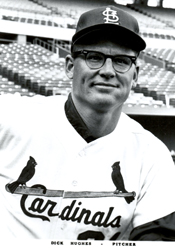 Hughes’ emergence as a top starter for the 1967 Cardinals seemed about as likely as if another Arkansas native, Dizzy Dean, tried making a comeback with them at age 57.
The 1966 season was Hughes’ ninth in the Cardinals’ system. A right-hander who threw hard but lacked command, he was 28 and going backwards. After starting the season at Class AAA, Hughes was demoted to Class AA in May. Two weeks later, needing roster room for more promising pitchers, St. Louis loaned him to the Toledo Mud Hens, top farm club of the Yankees.
It was the second time the Cardinals had loaned Hughes to another organization, a sure sign he wasn’t rated a serious candidate to reach the majors with them.
Reflecting on his struggles, Hughes told Neal Russo of the St. Louis Post-Dispatch, “A lot of times I figured it was do or die, and a lot of times I halfway died.”
Golden arm
Hughes moved with his family from rural Arkansas to Shreveport, Louisiana, when he was 8. He had poor eyesight _ 20-350 vision in one eye; 20-300 in the other _ and “couldn’t recognize his mother without his glasses,” the Post-Dispatch noted.
His right arm, though, was strong and he threw a baseball with velocity. Cardinals scout Fred Hawn took an interest. When Hughes graduated from high school, he told Hawn he wanted to try college. Hawn helped Hughes get a baseball scholarship to the University of Arkansas and urged him to stay in touch.
Two years later, in 1958, Hughes contacted Hawn, who arranged a tryout in St. Louis. Liking what they saw, the Cardinals gave Hughes a $10,000 signing bonus. He used most of the money to join his father in buying an Arkansas cattle ranch.
Help wanted
Entering St. Louis’ farm system with only a fastball, “I was a wild, strong-armed kid who kept fooling around too much looking for a second pitch,” Hughes recalled to Bob Broeg of the Post-Dispatch.
In 1963, his sixth season in the minors, Hughes was loaned by the Cardinals to the Washington Senators, who sent him to pitch for the York (Pa.) White Roses. He did enough (11-5, 2.17 ERA) to rekindle the Cardinals’ interest. They put him with their Class AAA Jacksonville farm club in 1964 and he was effective (9-4, 2.92 ERA), but not impressive enough to get a call to the majors.
Hughes was tempted to quit. “My confidence was shaken,” he told Bob Broeg.
Returned to Jacksonville in 1965, Hughes regressed (7-8, 3.82 ERA). The Cardinals made him available in the minor-league draft, but no team wanted him.
So it was back to the Cardinals’ farm in 1966 _ and that’s when Hughes caught a break. Billy Muffett had become the franchise’s minor-league pitching instructor. He taught Hughes to pitch with a no-windup delivery, which helped his control considerably, and showed him how to throw a hard slider.
The results weren’t immediate. Hughes flopped at Tulsa (1-1, 5.40 ERA), got demoted to Little Rock (2-3, 2.35) and then loaned to Toledo in June 1966.
Holy Toledo!
The Toledo Mud Hens played their games at a converted harness racing track in suburban Maumee, Ohio. The Yankees farm team was managed by Loren Babe, who later would mentor infielder Tony La Russa and encourage him to think like a manager. “I’ve learned something from every manager I played for, but nobody taught me as much as Loren,” La Russa said in the book “Man on a Mission.”
Hughes’ Toledo teammates included pitchers Stan Bahnsen, Paul Toth and Jerry Walker, first baseman Mike Hegan and a heralded shortstop, Bobby Murcer.
“Rescued from Cardinals farm system obscurity,” as the Toledo Blade put it, Hughes found his groove. The no-windup delivery enabled him to consistently throw strikes. The hard slider became a formidable complement to the fastball.
In his first Toledo appearance, Hughes pitched a two-hit shutout against Toronto. Then he struck out 10 in six innings versus Buffalo.
John Hannen of the Toledo Blade called Hughes the “mystery man of the Toledo Mud Hens. The mystery of it all is how a pitcher of Hughes’ caliber was lying around loose on a double-A roster.”
Hughes kept up the good work all summer. He struck out 13 in a win against Columbus and 14 in a two-hitter versus Richmond. Rochester manager Earl Weaver was so impressed that “I tried to get my boss, Harry Dalton, to get Hughes” for the Orioles, he told the Post-Dispatch.
Suddenly, the Cardinals coveted the pitcher they had rejected. On Sept. 5, they sought to call up Hughes. It was the same day as Toledo’s season finale and Hughes was the scheduled starter.
The pitcher who had waited nine years to reach the majors asked the Cardinals to delay the promotion one day so that he could pitch the final game for Toledo. “I felt obligated to pitch this last game,” Hughes told Bill Fox of the Toledo Blade, “and I wanted to do it.”
The game matched Hughes against Jacksonville’s Tom Seaver. Hughes struck out 12 and Seaver fanned 10, but ex-Cardinal Johnny Lewis slugged a two-run home run to win it for Jacksonville.
Hughes finished 9-4 with a 2.21 ERA and 132 strikeouts in 110 innings for Toledo.
In comments to the Post-Dispatch, Cardinals farm director Sheldon Bender called Hughes “one of those guys who has seemed to arrive just about when you’ve given up on him.”
Big-league stuff
Hughes’ first Cardinals appearance came on Sept. 11, 1966, at Pittsburgh. Relieving Al Jackson with the Pirates ahead, 3-2, in the seventh, Hughes “could not have had a much tougher task for his debut,” the Post-Dispatch noted. The Pirates were the best-hitting team in the big leagues and the first batter to face Hughes was Matty Alou, who was leading the majors with a .348 batting mark.
Undaunted, Hughes retired nine of the 10 batters he faced, including Alou twice. He struck out Roberto Clemente and got Willie Stargell to fly out. The only batter to reach base was Bill Mazeroski on a walk. The Cardinals rallied for two runs, making Hughes the winning pitcher. Boxscore
In his next appearance, Hughes earned a save against the Reds. Boxscore
Manager Red Schoendienst gave Hughes a start in the season’s final series against the Cubs and he responded with a three-hit shutout, winning a duel with Ferguson Jenkins. Boxscore
In 21 innings for the 1966 Cardinals, Hughes struck out 20 and was 2-1 with a save and a 1.71 ERA.
“The big thing about Hughes is he throws strikes,” Cardinals pitching coach Joe Becker told the Post-Dispatch, “and, when you throw strikes, you have a chance.”
Ace in the hole
The 1967 Cardinals began the season with a starting rotation of Bob Gibson, Steve Carlton, Ray Washburn, Al Jackson and Larry Jaster. Hughes was a reliever and spot starter.
On May 25 at Atlanta, after Hughes pitched a two-hit shutout against the Braves, he and Al Jackson swapped roles. Boxscore
While in Atlanta, Hughes bought a hunting rifle. In an insensitive and chilling stunt, he “checked out the scope by zeroing in on pedestrians from the window of his hotel room,” according to Bob Gibson in the book “Stranger to the Game.” After that, teammates “started calling me The Sniper and Lee Harvey Hughes because I was lugging the rifle around so much,” Hughes told Neal Russo of the Post-Dispatch in a comment appallingly devoid of self-awareness.
Wins have a way of making people overlook ignorant behavior _ and Hughes did a lot of winning for the Cardinals. After shutting out the Braves, he struck out 13 Reds in eight innings but lost, 2-1, then won five in a row.
“Hughes threw a hard slider that was almost unhittable,” Cardinals first baseman Orlando Cepeda said in his book “Baby Bull.”
In July, a Roberto Clemente shot fractured Bob Gibson’s leg. Nelson Briles moved into the rotation. Briles and Hughes each won seven of nine decisions during Gibson’s absence.
Hughes’ salary for 1967 was $10,000, but general manager Stan Musial twice rewarded him with bonuses _ one for $1,500 and another for $2,500.
Hughes led the 1967 Cardinals in wins (16), complete games (12), shutouts (three) and innings pitched (222.1). Along with a 16-6 record, he had three saves and a 2.67 ERA.
Though the Cardinals lost both games Hughes started in the 1967 World Series against the Red Sox, St. Louis won the championship largely because of Bob Gibson (three wins), Nelson Briles (one win), Lou Brock (12 hits, eight runs scored, seven stolen bases) and Roger Maris (10 hits and seven RBI).
In 1968, Hughes tore muscles in his right shoulder and lost his effectiveness. His final big-league appearance was a brief relief stint in Game 6 of the 1968 World Series versus the Tigers.



that Dean was vying for a spot at the same time Hughes emerged..them both being so unlikely and then it happening is a great reminder to me to take a quick peek at the mirror and tell myself I can do it, whatever that might be. This whole “loan” action is new to me. Strikes me as a strange to loan a player to another team. Why not just send him down to the minors?
musta been a thrill to pitch in that 68 world series.
I don’t think the loaning practice goes on much, if at all, any more. Another good example of it was infielder Junior Kennedy. He was in the Reds’ system and not progressing much. In 1977, the Reds loaned him to the Giants, who sent him to their Phoenix farm. Kennedy told Hal McCoy of the Dayton Daily News he figured the Reds were done with him. The 1977 season was Kennedy’s 10th in the minors. However, Kennedy blossomed at Phoenix, hitting .316 with a .408 on-base percentage. The Reds told the Giants, “We’re keeping him,” and the next year Kennedy was in the majors with Cincinnati.
what a story that makes…..the 77 loan turns into a robbery. now i’m curious how the reds responded and if it resulted in a rivalry. i forget what that’s called when you borrow someone something and they never return it. i’ve had that happen to me with books and other things and think about all the things i’ve found or gotten for free because someone has taken the time to leave a box and written on it,,,,it says “free” even at libraries they have book give aways and i’ve gotten so many at the book fair in montreal every fall at the mcgill university, there i got all kinds of baseball books and they were all like between one and four dollars…baseball books i never knew existed.
The only thing scarier than a hard thrower with 20-350 eyesight is putting a rifle in that guy’s hands.
As usual, you expressed it perfectly, Ken.
Dick Hughes just passed away several weeks ago.
Yes, thanks. That’s why I did the post now. Here’s the official obituary: https://www.legacy.com/us/obituaries/name/richard-hughes-obituary?id=61431231
Impeccable as always. Every time I read one of your essays, it occurs to me that without your love for this baseball team these tidbits of past players might have been lost forever. Maybe it’s true, maybe it isn’t but I’d like to think so.
Thanks, Gary. The love for the team faded a long time ago and now is gone, but the love for the history remains strong.
Thanks for another excellent post Mark. You have to wonder if the Cardinals would have won the 1967 World Series if just two years earlier another team would have picked up Dick Hughes in the minor league draft. Sometimes it’s really incredible how things play out. I was too young to remember the ’67 Cardinals but that must have been an unforgettable season. Losing Bob Gibson but having Dick Hughes take charge. Its too bad the Cardinals Organization of the early 70’s forgot how important it is to have a strong bullpen. The 1967 team led the NL in saves. It would have been interesting too see if Dick Hughes could have continued to build on the success he had in 1967. But back then suffering a torn rotator cuff meant that your career was over.
Thanks, Phillip. That 1967 club had the two key ingredients for success: selfless teamwork and collective pride. Mike Shannon moving from right field and learning to play third so that Roger Maris could take over in right. Nelson Briles and Dick Hughes stepping up after the injury to Bob Gibson. Al Jackson continuing to contribute and not sulking after being taken out of the rotation. Great fundamentals and focus. Special stuff. This post might provide you with more insights to why the 1967 club succeeded: https://retrosimba.com/2017/09/06/lots-to-celebrate-1967-cardinals-clincher/
That game on May 25, 1967 was the first big league game I ever attended. In a lineup full of sluggers, Woody Woodard and Marty Martinez got the only two hits, both singles. The closest the Braves came to a rally was when Mack Jones was hit by a pitch and then stole second base. Hughes looked more like a chemistry teacher than a professional baseball player. I also remember Alex Johnson got the first hit of the game, and it sounded like a rifle coming off his bat.
Thanks for sharing those wonderful recollections, Hugh.
What a great line about Dick Hughes looking more like a chemistry teacher than a big-league ballplayer. Wish I had wrote it!
It is amazing that the likes of Felipe Alou, Hank Aaron, Joe Torre and Rico Carty went hitless that day against Hughes.
It also amazes me that the Cardinals scored five runs with a batting order that had Phil Gagliano in the No. 3 spot and Ed Spiezio in the No. 5 spot. Plus, the Cards that day had lightweight hitters Johnny Romano (.121 for the season) and Dal Maxvill (.227 for the season) in the lineup.
It’s part of the magic of baseball that Alex Johnson had just one hit in Atlanta all season in 1967, but that one hit made a lasting impression on a youngster witnessing his first big-league game.
I became a full-time Cardinals fan in 1971 and have learned a lot about the teams prior to my being a fan. I knew a fair amount about the 1967 team but amazingly knew virtually nothing about Dick Hughes so kudos to Mark for writing another interesting and timely article. Like so many players, it sounds like he would have benefited from better coaching earlier and even if he was doomed to have an arm injury he could have been effective five years earlier.
Thank you for reading and for commenting. It’s great to hear again from such a longtime fan.
Yes, Dick Hughes spent those early years in the minors trying to find answers. He walked 131 batters in 1960 with Tulsa and walked 130 the next year with Portland, and that marked him as a pitcher who lacked control.