Aaron Herr had reason to think his baseball story would have a fabled climax.
After his playing career stalled in the Braves’ system, Herr, 24, went to a Cardinals farm club in 2005 and experienced a revival. Wearing a uniform jersey with the organization’s iconic birds on the bat seemed to conjure something magical in his game. He hit for average and with power. Talent evaluators took notice.
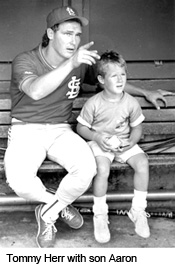 A former Cardinals batboy, Aaron was a second baseman, same position his father, Tommy Herr, played for 1980s Cardinals clubs that won three National League pennants and a World Series title.
Now, it seemed, Aaron Herr was following in those footsteps, firmly on a path toward reaching the major leagues as a second baseman for St. Louis.
It turned out the plot line was too good to be true.
High hopes
A standout high school shortstop in Lancaster, Pa., Aaron Herr was a supplemental pick of the Braves in the first round of the 2000 amateur draft. Another first-round pick of the Braves that year was pitcher Adam Wainwright.
Receiving an $850,000 signing bonus, Herr entered the Braves’ farm system as a second baseman. He underwent reconstructive right knee surgery in 2001 and had two follow-up arthroscopic procedures. After five seasons, Herr had advanced no higher than Class AA.
In December 2004, the Mariners selected him in the minor-league draft. After seeing Herr at 2005 spring training, the Mariners informed him he’d be a utility infielder at Class AA. Stunned to be relegated to a reserve role, Herr asked for and was granted his release.
“I lay in bed every night and I just wonder,” Herr said to Jason Guarente of Lancaster Newspapers. “I think about if things could have been different.”
Herr planned to play for an independent minor-league team, the Lancaster (Pa.) Barnstormers, managed by his father, but on the eve of the 2005 season opener the Cardinals offered a one-year contract to play in their farm system.
“We thought he’d definitely be an upgrade from what we had in double-A,” Cardinals director of player development Bruce Manno told Lancaster Newspapers.
Fresh start
Assigned to Springfield (Mo.), Herr was given uniform No. 38. (His father wore No. 28 with the Cardinals.) Though the word “Springfield” was on the front of the jersey, the rest of the uniform looked similar to the one worn by the big-league Cardinals. “This is the happiest I’ve been in professional baseball … I feel like a kid again, back in Little League,” Herr told the Springfield News-Leader. “I’ve always wanted to be able to put on a Cardinals uniform, so I’m doing everything possible to impress the right people.”
A right-handed batter, Herr (whose father was a switch-hitter) struggled at the plate his first few games with Springfield. “His swing was absolutely ugly,” hitting coach Dallas Williams told Springfield reporter Kary Booher.
Williams corrected a hitch in Herr’s swing and it made a positive difference. Herr led Springfield in home runs (21), batted .298 and produced 81 RBI. It was the most successful of his six seasons in the minors. “The job he did there was very impressive,” Bruce Manno told Lancaster Newspapers.
There were things, though, the Cardinals didn’t like. Herr struck out 108 times and had a mere 15 walks. He also made 22 errors at second base. “There are times when Herr just takes too much time getting to ground balls and tries to backhand them, then ends up in trouble,” the Springfield newspaper noted.
Bruce Manno told Harold Zeigler of Lancaster Newspapers, “Defensively, I think he needs to continue to work and improve. We talked to him about what he needs to do in the offseason to try to improve his defensive skills. If he can improve defensively, he’s got a chance to play at a higher level.”
Unfazed, Herr said to his hometown paper, “Hitting is going to get you to the big leagues … My defense will be good enough. That’s something I’ll work on. I know I can play second base.”
Moving on
After his season at Springfield, Herr became a free agent and said he wanted to re-sign with the Cardinals. “I love putting on that Cardinals jersey … I think that was one of the reasons I had such a good season,” Herr told Lancaster Newspapers. “I felt more at home with them than I ever had with any other team. I was in a comfort zone. I went to the field every day happy.”
However, Herr said he wanted a promise he’d be invited to the big-league training camp in February and given a chance to show manager Tony La Russa what he could do. “That’s a must,” Herr said. “My ultimate goal is to make the big leagues, and I’d prefer the Cardinals, but, with the kind of year I had, somebody’s going to give me what I want.”
The Cardinals didn’t accept Herr’s terms. In November 2005, he signed with the Reds, who invited him to their big-league training camp. “They’re not afraid to bring young guys up and give them a chance,” Herr told reporter Jason Guarente.
Reds director of player development Tim Naehring told Lancaster Newspapers, “Aaron has some outstanding power numbers. He has been seen by multiple people in our organization who feel at some point in his career he’ll be an everyday major-league player … We don’t have anybody with comparable production in our middle infield.”
Hit and miss
Herr went to big-league spring training with the 2006 Reds, but didn’t make the team. Instead, he was assigned to Class AA Chattanooga, shifted to third base and hit .287. He was promoted to Class AAA Louisville in July but injured a wrist. When he played, there were nights manager Rick Sweet “wondered if Herr was so determined to hit that he forgot that baseball players carried gloves as well as bats,” Rick Bozich of the Louisville Courier-Journal noted.
Sweet, a former big-league catcher, got through to Herr. In 2007, when Herr returned to Louisville, he often took extra practice at third base. To help Herr enhance his potential value to a big-league club, Sweet used him at both second and third throughout the season.
Herr, 26, had a terrific 2007 season for Louisville. He and first baseman Joey Votto tied for the team lead in total bases (each with 237). Herr produced 31 doubles, 19 home runs, 83 RBI, and did well enough in the field to impress Sweet.
“Aaron is the best all-around hitter on this team, if you’re talking about hitting for average, for power or controlling the strike zone,” Sweet told the Courier-Journal. “He’s also the most improved player on this team. That’s the thing that makes me the happiest for Aaron Herr. He’s becoming a good all-around baseball player, including his defense.”
However, the Reds promoted Mark Bellhorn from Louisville instead of Herr to fill a backup infield spot late in the season. The Reds said they considered calling up Herr but opted for Bellhorn, 33, because he had big-league experience.
After eight seasons in the minors, Herr was left to wonder what it would take for him to reach the big leagues. His father told Mike Gross of Lancaster Newspapers, “He had a great year … Did everything that was asked of him … He needs somebody to vouch for him.”
Bitter end
The 2008 season was Herr’s last with a farm club affiliated with a major-league franchise. From 2009-11 he played for the independent Lancaster Barnstormers. (Aaron’s brother, Jordan Herr, also spent a season with Lancaster in 2008.)
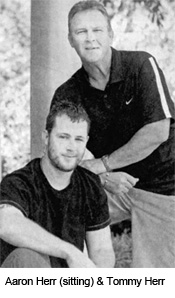 In 2010, when Tommy Herr was Lancaster’s manager, Aaron Herr played third base and hit .321 with 35 doubles, 23 homers and 103 RBI. (The team’s center fielder was Joe Gaetti, son of former Cardinals third baseman Gary Gaetti.)
Herr’s 12th and final minor-league season was with Lancaster in 2011. The manager was Butch Hobson, the former Red Sox third baseman and manager. Herr played right field.
Before the start of the Atlantic League playoffs in September 2011, Hobson cut Herr, 30, from the team, citing insufficient fielding skills. “He’s a hitter, that’s what he is, and I didn’t see him fitting in with my team for what I wanted to do for the playoffs,” Hobson told Lancaster Newspapers.
Herr said to the newspaper, “I try not to have bitter feelings but I do. I can’t get myself not to … I really felt like I got smacked in the face.”



It’s too bad that Aaron Herr never made it to the major league wearing a Cardinals uniform. The Herr family would have joined an impressive and interesting list of father and sons to have played for the Cardinals. Looking back, those TLR teams were loaded with all stars and future hall of famers. It would have been virtually impossible for Aaron to get a spot on the roster. If you look over the historical list of father and sons to have played professionally, the passion and enthusiasm for the game is a whole lot easier to pass on than the actual skills and talent.
Thanks, Phillip. I think Aaron Herr’s perspective, from the archived newspaper articles I read, was that if a second baseman such as Bo Hart could get a chance to play in the big leagues for the Cardinals (in 2003-04), then it was possible for Herr to do the same (in a utility role) if given a chance to prove himself.
A related side note: The Cardinals signed big-league free agent Junior Spivey to be their second baseman in 2006. However, Spivey was a bust at spring training and was demoted to Class AAA Memphis, the level Aaron Herr likely would have been at in 2006 if he had re-signed with the Cardinals. Spivey spent all of 2006 with Memphis and batted .200 with more strikeouts (65) than hits (57).
nice to read the other side of father son mlb baseball stories. doesn’t always work out the way we hope. i shouldn’t say it’s nice because i feel bad for Herr, but just that these stories aren’t always told.
Yes, well put, Steve. Most everyone knows the story of, say, Ken Griffey Sr. and Ken Griffey Jr. but not so much the stories like this one. I learned a lot reseraching it.
Lots of mediocre defensive players make it to the majors because of their bat. Herr must have been especially awful in the infield. Maybe the DH would have helped him get a shot. He was always with NL clubs.
You summed it up well, Ken.
Side note: Butch Hobson, the manager who cut Aaron Herr from the Lancaster team because of his inadequate defense, made 43 errors as the third baseman for the 1978 Boston Red Sox.
So he was an expert when it came to bad defense.
As always, I felt compelled to look at Herr’s stats on Baseball Reference, and if hitting was his strong point I don’t see why big league teams would be interested. As a second baseman they’re looking for someone who can turn a double play rather than sporadic power from an 8 or 9 spot hitter.
Yep, good point, Gary. A fellow during that period such as Mark Ellis, who multiple times ranked in the top 5 among AL second basemen in fielding percentage and double plays turned during his prime with the A’s, would be a good example. Ellis also hit .316 for the 2005 A’s, and contributed 84 runs scored, 19 home runs and 76 RBI for the 2007 A’s.
Great point. I absolutely love Mark Ellis and watched him play quite a lot with the River Cats. A true professional and a wiz with the leather.