Bill Sherdel, a mite on the mound, nearly achieved a mighty hitting feat.
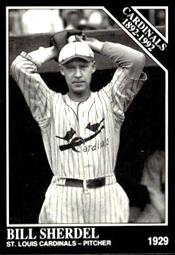 No big-league pitcher has hit for the cycle (single, double, triple, home run) in a game, but Sherdel, a half-pint Cardinals left-hander, twice came close to doing it.
In 1922, Sherdel produced a single, double, home run (but no triple) in a game against the Phillies. Four years later, versus Brooklyn, he got the triple, as well as a double and home run, but missed out on a single.
Changing speeds
A son of German immigrants, Sherdel grew up about 12 miles east of Gettysburg, Pa. He started out in sandlot baseball as a left-handed catcher and his brother, Fred, pitched. Eventually they switched roles.
Sherdel turned pro at 18 in 1915. He was 5-foot-8 and less than 150 pounds, according to the Society for American Baseball Research. As he advanced through the minors, Sherdel developed a dazzyling array of changeups and slow curves.
With Milwaukee of the American Association in 1917, Sherdel won 19. Cardinals president Branch Rickey took notice and purchased Sherdel’s contract for $1,000.
“Baseball men cheerfully admit that Bill Sherdel pitches primarily with his head and secondarily with his arm,” the St. Louis Post-Dispatch noted.
(During a visit to St. Louis in 1962, Sherdel was asked by Cardinals manager Johnny Keane to meet with the club’s pitchers. According to The Sporting News, Sherdel told them, “I tried to hit the plate low and on the outside corner. Learn that and you’re bound to last.”)
In his first big-league win, a complete game for the Cardinals against the Reds in 1918, Sherdel allowed 12 hits but two runs. He also had a RBI and scored a run. Boxscore
Branch Rickey, who became Cardinals manager in 1919, always called him William. The local newspapers called him Wee Willie and referred to him as “undersized,” “diminutive,” and “peewee.”
Rickey used Sherdel as both a starter and reliever. In 1922, he produced 17 wins and 17 hits. That was the year he first came close to hitting for the cycle.
In four plate appearances versus the Phillies’ Jesse Winters on Aug. 19 at St. Louis, Sherdel had a walk, single, solo home run and two-run double. Perhaps all that hitting and baserunning took its toll on the little man. He carried a 7-5 lead into the ninth, but the Phillies rallied and won, 8-7. Boxscore
Help from Hornsby
Sherdel had 15 wins and hit .337 for the 1923 Cardinals, but in 1924 Rickey used him more as a reliever (25 games) than as a starter (10).
Deciding the bullpen was where Sherdel belonged, Rickey took him out of the starting rotation in 1925. Sherdel made 11 relief appearances, but then Rogers Hornsby replaced Rickey on May 31. One of his first moves was to restore Sherdel to the rotation. Sherdel won 15 for the 1925 Cardinals and was 11-3 as a starter.
Back in the rotation in 1926, Sherdel lost four of his first five decisions. Hornsby stuck with him and Sherdel won eight of his next 10.
In June 1926, the Cardinals got Grover Cleveland Alexander from the Cubs to join a rotation with Sherdel, Jesse Haines and Flint Rhem.
“Alexander taught me more about pitching than any manager or coach,” Sherdel told Bill Duncan for The Sporting News. “There was a wonder. I studied him hour after hour, how he worked on the various hitters, what he threw each one and what he didn’t throw them. I talked to (Alexander) dozens of times and asked him many questions. He was friendly and cooperative.”
On Aug. 4, 1926, at Ebbets Field in Brooklyn, Sherdel flirted with the cycle for the second time. Facing starter Burleigh Grimes, he grounded out in the second, tripled in the fifth and lashed a two-run double down the line in right in the sixth. In the ninth, against reliever Rube Ehrhardt, Sherdel clouted a home run that struck the flagpole on top of the wall in right. Sherdel pitched a complete game in the 8-4 St. Louis victory. Boxscore
Describing Sherdel’s tantalizing off-speed pitches that kept the Brooklyn batters off balance, Thomas Holmes of the Brooklyn Eagle wrote, “He starts his slow ball delivery on Saturday morning and it reaches home plate on the following Wednesday afternoon. Beg pardon, that’s his fast one. His floater occupies two days longer in transit.”
Sherdel is among a small number of pitchers to get the three extra-base hits in a game needed for the cycle but come up short on the single. Others:
_ Grover Cleveland Alexander, who had a double, triple and home run for the Cubs against the Phillies on June 20, 1925, at Chicago. Boxscore
_ Steve Sundra, who had a double, triple and home run for the Browns against the White Sox on July 5, 1942, at Chicago. Boxscore
Leading lefty
Sherdel had 16 wins, including six against Brooklyn, in helping the Cardinals earn a National League pennant for the first time in 1926. Cardinals third baseman Les Bell said to The Sporting News, “Alexander was the more famous pitcher and Haines was great, too, but never overlook the magnificent work of Sherdel.”
He won 21 when the Cardinals earned another pennant in 1928.
Sherdel is the Cardinals’ franchise leader in most career wins by a left-hander (153). Only right-handers Bob Gibson (251), Jesse Haines (210), Adam Wainwright (200) and Bob Forsch (163) have more wins as Cardinals.
Just missed
Some other big-leaguers who almost hit for the cycle as pitchers include:
_ Jimmy Ryan of the Chicago White Stockings hit for the cycle on July 28, 1888, against the Detroit Wolverines. Ryan began the game as a center fielder. He got two hits (a single and triple) before he was switched to pitcher in the second inning. As the pitcher, Ryan hit a double, triple and home run, giving him five hits for the game. He pitched 7.1 innings in Chicago’s 21-17 victory.
_ Babe Ruth got four or more hits in a game 29 times but never achieved the cycle. As a pitcher, he came close to doing it at St. Louis. Ruth had four hits (single, home run and two doubles) for the Red Sox against the Browns in a 4-2 Boston victory on July 21, 1915. Boxscore
_ Shohei Ohtani hit for the cycle on June 13, 2019, as the designated hitter for the Angels against the Rays. As a pitcher, he came close to achieving the cycle, hitting a single, double and triple (but no home run) against the Athletics on April 27, 2023. Boxscore and Boxscore
Besides Bill Sherdel and Steve Sundra, some other St. Louis pitchers who nearly achieved a cycle:
_ Jesse Haines had two singles, a double and home run for the Cardinals against the Phillies on Aug. 11, 1920, at Philadelphia. Haines also walked and reached on an error, but couldn’t produce a triple. He hit two triples in 19 seasons in the majors. Boxscore
_ Milt Gaston hit a single, double and home run for the Browns versus the Tigers on July 5, 1927, at St. Louis. Gaston batted .260 with three homers for the 1927 Browns. Boxscore
_ Tommy Byrnes had four RBI, hitting a double, home run and two singles, for the Browns against the Athletics on July 17, 1952, at Philadelphia. In 13 seasons in the majors, Byrnes totaled 14 homers and 98 RBI. Boxscore
_ Scott Terry had a three-run home run, single, double and sacrifice bunt for the Cardinals versus the Giants on April 27, 1989, at St. Louis. A former minor-league outfielder, Terry had 21 hits, but no triples, in the majors. Boxscore
Special mention belongs to pitcher Don Newcombe. He three times came close to hitting for the cycle. Each time was against the Cardinals. The triple eluded him.
_ On June 17, 1955, Newcombe had a home run, double and single for the Dodgers at St. Louis. Boxscore
_ On July 15, 1955, Newcombe produced two singles, a double and home run for the Dodgers at Brooklyn. He also reached on an error. Newcombe hit .359 with seven home runs for the 1955 Dodgers and posted a 20-5 record. Against the Cardinals that season, he was 4-0 and hit .524. Boxscore
_ On July 18, 1958, Newcombe had a single, double and home run for the Reds at Cincinnati. In 10 big-league seasons, he slugged 15 homers, including six versus the Cardinals, and totaled 108 RBI. Boxscore



I really enjoyed this post, Mark. I would venture to say that the question, “Who is the winningest left-handed pitcher in the history of the St. Louis Cardinals?” would be a stumper for everyone but the most ardent fans of the Red Birds.
I have no doubt that if the DH had been around in his day, Bob Gibson could have been a two-way player. In fact, I would not have envied the manager who had to tell Gibson he wasn’t going to get to hit on the days he pitched.
I don’t understand why at some point over 100 years ago, MLB decided it was OK for pitchers not to be able to hit. Even today, I would wager that most pitchers in MLB were the best hitters on their high school baseball teams, and a lot of them were successful hitters at the college level. I don’t believe that pitchers sign pro contracts and then suddenly forget how to hit. Of course, with the universal DH, all this speculation is moot.
Thanks much, Hugh. You are so correct about Bill Sherdel being a stumper. He’d be a great daily double question in “Jeopardy.” By the way, No. 2 on the list of most career wins by a Cardinals left-hander is Harry Brecheen (128).
You are correct about Bob Gibson, too. In 1972, at age 36, Gibson not only had 19 wins, he slugged five home runs. That tied him with Luis Melendez for fourth among the club’s home run leaders that season.
When I was a young sports reporter, Tom Boswell of the Washington Post gave me some great advice: To get a pitcher to open up to you in an interview, start out by asking him about his most memorable hitting feats. Pitchers loved talking about their hitting, Boswell said, but hardly anyone asks them about it. Talking about their hitting gets them in a gabby mood, and sets a good tone for then asking the questions you really want answers to. I tried it _ and it worked.
Like so much in life today, baseball keeps lowering the standards of excellence. To your point, pitchers were expected to be ballplayers, meaning they hit (or at least tried to) as well. Today’s pitchers make more money than ever, yet don’t have to hit, don’t have to run the bases, don’t have to pitch complete games, don’t have to earn wins. Oh, well, I guess that gives some of them more time to scribble Bible verses on their caps.
Thanks for posting this Mark. I had no idea that he came close to hitting for the cycle a couple of times. He was very good swinging the bat. Bill Sherdel still comes in amoung the top ten in numerous all time pitching stats for the Cardinals. He probably deserves a better career won lost record. In 26% of his career starts the offense scored 2 or less runs. And he certainly was snakebitten in his World Series starts. The Cardinals gave him only 7 runs in the 4 games he started. The talks that he had with Grover Alexander must have been fascinating.
Thanks for the insightful stat about the lack of run support Bill Sherdel received in so many of his career starts, Phillip.
Indeed, perhaps the most frustrating loss came in Sherdel’s first start of 1927 for the reigning World Series champions. Sherdel pitched a two-hitter, but the Cubs won, 1-0, on a Hack Wilson home run in the second inning. The Cardinals couldn’t score against the Cubs’ Percy Jones. It was Jones’ only shutout of the 1927 season. He ended up with a 7.11 ERA in 19 innings pitched against the 1927 Cardinals. https://www.retrosheet.org/boxesetc/1927/B04150CHN1927.htm
Love the line about how he “pitches primarily with his head and secondarily with his arm.” Love to watch pitchers like that.
Yes, indeed. Baseball is at its best when it’s a thinking person’s game played by thinking people.
i always thought as a kid that the world in my grandpas time was black and white because all the pictures he showed me were in black and white…it’s the writing that brings color to the past…..writing like your writing Mark….and pitchers batting…it’s a bummer about the universal DH….i personally love the DH, but for one league only to add to the uniqueness of each league and in my world, there should be no interleague play…but whatever i stopped watching baseball it just happened this year…a bit like an amputation, but life goes on.
That’s an appealing concept you had as a kid, Steve; the notion of your grandpa living in a black-and-white world, and you getting to see it reflected in the snapshots. That would make a good short story for you to write. My wife and enjoy watching black-and-white movies, especially film noir, and admiring the skill that some cinematographers had in using shadow and light to create tone and mood. The black-and-white cinematography was an essential part of the storytelling experience. Like pitchers who can hit, I wonder whether black-and-white cinematography is a lost skill.
thanks for the encouragement to be inspired by black and white world for a short story. i love writing with my grandpa in mind.
What i love about black and white movies is that in the absence of special effects, the whole visual experience is the emphasis on dialogue. One of my favorites is The Hustler.
One current director who works well in black and white is Jim Jarmusch, my favorite of his DOWN BY LAW.
Great story! I wrote a book about Sherdel and really enjoyed your article. Did you know that Sherdel entered a game against the Phillies with runners on first and second, no outs, and retired the side on one pitch?
Thank you for reading and for commenting, John. I am delighted that the biographer of Bill Sherdel enjoyed this post.
I didn’t know about your book, or the intriguing scenario you mention about Sherdel retiring the side with one pitch against the Phillies.
I will be sure to read your book soon. For other readers of this post who have an interest, I’m including a link here on how to purchase your book from the publisher: https://books.friesenpress.com/store/title/119734000045686567/John-G.-Coulson-Wee-Willie-Sherdel
Thanks so much for your kind response. It has taken over 10 years to get Wee Willie the recognition he deserves. The Sherdel family and I will be in St. Louis in September for his induction ceremony. This was the first of your posts I noticed. Very impressive. I will continue to follow you. Thanks again for your support. I look forward to reading your next story. Sincerely,John Coulson