In 1926, St. Louis was the largest U.S. city west of the Mississippi River and a place where people dared to dream big.
 The Southwestern Bell Building, a 28-story art deco skyscraper with 17 individual roofs, was built in downtown St. Louis that year. Charles Lindbergh, flying the mail at night through rain, sleet and snow from St. Louis to Chicago, was pondering a daring non-stop solo flight from New York to Paris. A group of shrewd St. Louis businessmen would be ready to invest in him the next year.
That spirit of St. Louis was alive on the baseball diamond, too. The 1926 Cardinals won their first National League pennant and prevailed against the Yankees of Babe Ruth and Lou Gehrig in a classic seven-game World Series.
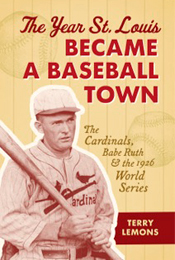
Terry Lemons, a former newspaper reporter for the Springfield (Mo.) News-Leader and Arkansas Democrat-Gazette, has written a book about the 1926 Cardinals. “The Year St. Louis Became a Baseball Town” skillfully tells of how the Cardinals transformed into a premier franchise.
The book is available from the publisher, Arcadia, and on Amazon. Check out the author’s website as well.
In June 2026, I conducted an email interview with the author:
Q: Congratulations on the book. I enjoyed it and found it to be a lively, well-researched and journalistically credible read. What inspired you to do a book about the 1926 Cardinals?
A: “The book is a culmination of a lot of things through my life. I’ve been a Cardinals fan as long as I can remember, and writing and reporting have been a passion since my days at Southwest High School in St. Louis. I wound up in newspapers as a news reporter, not sports. I ended up in Washington in the 1990s covering the Clinton administration for Little Rock’s Arkansas Democrat-Gazette.
“A couple of years ago, a good friend _ National Journal reporter Dick Kirschten, a St. Louisan who grew up as a “Knotholer” in Sportsman’s Park _ had terminal cancer, and he wanted me to have his collection of Cardinals books. I started leafing through those, and I noticed the 100th anniversary of the 1926 World Series was coming up. I dug around a bit, and sensed there was an interesting _ and different _ story about 1926 to pull together. That’s the genesis of the book.”
Q: Your mother, Ann Lemons Pollack, was a noted food writer and restaurant critic. Your stepfather, Joe Pollack, was a sports reporter. How did this journalism heritage help you in writing the book?
A: “For me, it’s fascinating how all of this flowed together. While I was a journalism student at Mizzou in the 1980s, my mom started writing about food _ and it was a bit of a race between us to see who could get the first writing job that paid. That path took her into writing, and she eventually met Joe, who at the time was a movie and restaurant critic. They got married after I was in Washington, but the family and I came back to visit often. Joe’s background covered a lot. He started out as a sports reporter, then moved into public relations for the football Cardinals in the 1960s before going back into newspapers. So when I came home to St. Louis, there was always this delicious mix of discussions revolving around food, sports and journalism. Mom and Joe wrote several books together over the space of nearly 20 years, and then she did two solo projects. As I watched their process, I found it intriguing and thought it would be a natural for me to give a book a shot when life got to a good point.”
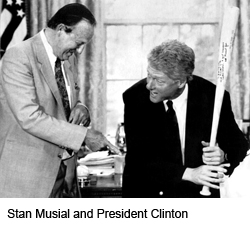
Q: During your years covering the Bill Clinton presidency, did you ever get the chance to talk with him about Cardinals baseball?
A: “Clinton was a dedicated sports fan and stayed on top of a lot of different sports. Like a lot of people across the Midwest and South, Clinton listened to the Cardinals’ radio broadcasts so he counted himself as a fan.
“Baseball came into play often on Capitol Hill outside the Senate chambers. It’s a lot less formal than the White House and senators can be willing to casually chat. I was struck by how many senators _ not just those from Missouri and Illinois _ seemed to keep track of the Cardinals. I think that’s a reflection of the power the KMOX clear-channel broadcast signal coming out of St. Louis had on that generation of politicians. Perhaps those senators also carried a bit of the legacy the Cardinals developed across large parts of the country following the 1926 World Series. As the book explores, the Redbirds had fervent support across the nation for the first time during the 1926 World Series.”
Q: Who were your favorite baseball players during your youth?
A: “Oh, that’s an easy call _ Bob Gibson. In the early 1970s for a Cardinals fan in second and third grade, Gibson was the man. When you went down to the corner drug store, there was Gibson’s face staring at you from the box of Topps baseball cards on the counter. He even showed up in the school library, where there was a surprisingly well-stocked supply of books about baseball. I found one that described Gibson’s heroics during the great Cardinals World Series runs in the 1960s. I was over the moon in 1971 when I got to see Gibson pitch in my first two visits to Busch Stadium.”
Q: Halfway through May 1926, the Cardinals hardly looked like a championship contender. After a 12-1 loss at home to the Giants, the Cardinals were 12-17. What accounted for the turnaround?
A: “General manager Branch Rickey and manager Rogers Hornsby found the secret sauce in mid-June. The New York Giants were struggling and center fielder Billy Southworth had become something of a scapegoat for manager John McGraw. Rickey, an incredibly shrewd judge of baseball talent, sensed an opportunity and shipped off Heinie Mueller in exchange for Southworth on June 14 and promptly put him back in his natural spot in right field. Invigorated, Southworth became the Cardinals’ cleanup hitter and lit things up.
“Amazingly, just eight days later, the Chicago Cubs released Grover Cleveland Alexander, an aging and troubled pitcher. Hornsby thought Alexander, who had been remarkable a decade earlier with the Philadelphia Phillies, still had the potential to be a master pitcher despite heavy drinking. When those two new players arrived, they were the missing spark the team lacked early in the season _ a bit like when the Cardinals got Lou Brock from the Cubs in 1964.”
Q: The 1926 Cardinals played their last home game of the season on Sept. 1. With a one-game lead over the Reds, the Cardinals then embarked on a 24-game road trip to end the season. What were the key factors in how they managed to come out of that grueling trip with a pennant?
A: “They had a lot of momentum coming out of that final, frenetic, fan-fueled St. Louis homestand where they won the “Little World Series” against the defending champion Pittsburgh Pirates. Not counting a meaningless final game against Cincinnati, the Cardinals’ final 15 games came against the bottom half of the National League _ Brooklyn, Philadelphia, Boston and the New York Giants, all teams under .500. Also helping out: Blasting 52 runs in a four-game stretch against the Phillies in mid-September.”
Q: Player-manager Rogers Hornsby was a strict teetotaler but two of the top 1926 Cardinals pitchers, Grover Cleveland Alexander and Flint Rhem, were notorious drinkers. How did that dynamic work?
A: “Hornsby certainly wasn’t wild about the off-field drinking, but he ended up tolerating it as long as it translated into success.
“Hornsby had something of a soft spot for Alexander. He recognized the man’s talent, and ultimately had some compassion for the issues that caused Alexander to imbibe off the field. Rhem, famously described as hailing from the South Carolina moonshine belt, seemed to be the straw that stirred the drink. Sportswriter Bob Broeg and others recounted that Rhem thought his role off the field was to drink more than Alexander. In Rhem’s view, drinking more meant Alexander would somehow drink less.
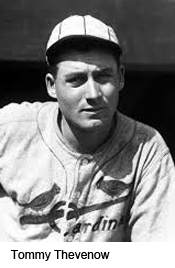 “A side note on Rhem’s league-leading 20 wins: You have to wonder how much defensive wizard Tommy Thevenow helped out Rhem through the course of the year. Rhem walked more batters than he struck out _ 75 versus 72. So he had some traffic on base, but he also had Thevenow backing him up at shortstop. Thevenow just happened to lead the league in putouts and assists. Rhem probably doesn’t lead the league in wins if an average shortstop is behind him. I sure hope Rhem bought little Tommy a drink or two.”
Q: On a team with the likes of Rogers Hornsby, Jim Bottomley and Chick Hafey, the leading hitter for the 1926 Cardinals was Les Bell (189 hits, .325 batting mark). Bell also was the team leader in RBI (six) during the World Series. What made him such an effective hitter that year?
A: “This is an example of where Hornsby excelled as a manager. He was a bit like Tony La Russa and could squeeze the most out of the talent that he had. Hornsby seemed to understand what worked for Bell. The 1926 season turned out to be a career year for Bell, who (heard) some boos in spring training but held down the sixth spot in the batting order. Southworth’s arrival helped everyone around him, and perhaps no one ultimately benefited from that more than Bell. The third baseman’s average kept climbing through the summer months, which meant in late July Hornsby moved Bell up to bat fifth behind Southworth. That batting arrangement clicked all the way through the World Series.”
Q: Babe Ruth hit four home runs in the 1926 World Series. He also drew 11 walks, but only one of those walks resulted in him scoring a run. Was walking Ruth an intentional strategy of the Cardinals?
A: “Hornsby said before the Series that they were going to pitch to Ruth, and I think the Cardinals generally did, but they pitched to him on their terms. He may have had 11 walks, but all of those weren’t on purpose. The Cardinals were just being extremely cautious with the greatest home run hitter on the planet _ especially after Ruth’s home run barrage in Game 4.
“Consider Ruth’s walk at the very end of Game 7. It wasn’t deliberate. With two outs, Alexander was ahead of Ruth with a 1-and-2 count. Alexander kept nibbling at the corners of the plate, but ball four (was) an extremely close call. Umpire George Hildebrandt hesitated before calling the pitch, and Alexander was visibly upset. Keep in mind the mystique around Ruth was unbelievable. Could that have played into the back of the umpire’s mind? That umpire already had a high-profile run-in with Ruth in 1922. An angry Ruth threw dirt in Hildebrandt’s face after being called out at second base.
“Here’s the other interesting twist on Ruth in the ninth inning: After he gets caught stealing second base to end the game, I was stunned by how the press dealt with it afterward. Most of the writers didn’t call him out for making a mistake; instead, they wrote it like he was the hero trying to steal second base and carry the Yankees single-handedly to a win. The baseball writers simply didn’t want to challenge the decision by Babe and his Ruthian-sized persona. That makes me wonder if the umpire dealt with his own version of that complex with Ruth at the plate. Maybe Hildebrandt didn’t want another controversial run-in with Ruth by calling a third strike to end the Series; instead, Ruth gets another walk.”
Q: The iconic moment in the 1926 World Series is the Grover Cleveland Alexander strikeout of Tony Lazzeri with the bases loaded in the seventh. What do you think is the most overlooked key moment in that Series?
A: “Beyond Alexander’s legendary appearance, my money for the key moment is the fourth inning of Game 7. It was a study in defensive contrasts between the Yankees and the Cardinals. In the top of the fourth, two Yankees made critical defensive misplays. That allowed shortstop Tommy Thevenow, a fascinating player, to drop a soft single in front of Ruth and score two runs to give the Cards the lead. In the bottom of the fourth, the exact opposite happened. New York was trying to make a comeback, and Lou Gehrig was in scoring position with the potential tying run. Hank Severeid, the Yankees catcher and a former St. Louis Brown, then hits a tremendous smash. Thevenow timed the play perfectly, leaping several feet to make a catch and save a run. For me, that inning was a bit of a microcosm of the Series.
“There were a number of heroes for the Cardinals in the 1926 World Series, but none more surprising than Thevenow. Imagine combining a mixture of Ozzie Smith’s fielding with the unexpected hitting heroics of David Eckstein in the 2006 World Series. Thevenow stepped up repeatedly with dazzling defensive plays and shockingly hit .417 at the bottom of the order. A small guy delivered a big series for the Cardinals 100 years ago.”



This is indeed a must have book if your a Cardinals fan. There’s always a lot that goes in to making a World Series Champion. And there’s really no such thing as an insignificant player transaction or insignificant game. In the end it all adds up. I had know idea how much Tommy Thevenow contributed to that team. I can’t tell you how much I appreciate the way the author considers the 4th inning of game 7 to be perhaps the defining moment of that series. How many Cardinals fans remember that in the 6th inning of game 6 and the 5th inning of game 7 of the 2011 World Series the Cardinals ended up scoring important runs without even though they didn’t hit a ball past the infield?But most of all, how grateful Cardinals fans should be that Flint Rhem made sure that Grover Alexander’s drinking was kept in moderation because he always made sure to drink more!
Thanks for your keen and clever comments, Phillip. You definitely reflect the spirit of the team and the book.
I appreciate the feedback Phillip! And great points on the 2011 Series. I always felt like the baseball gods made up for some past mistakes in 1968 and 1985 with the 2011 Series. At some point, I may be updating my website — 1926baseball.com — with some fan comments. Would you mind if I used a line or two of your comments?
I don’t mind at all. I actually feel honored. Thank you.
you ask a nice variety of questions Mark that result in answers that make both author and book compelling. fascinating that a good radio signal attracted fans so far away and the politician’s favorite teams that was a nice spice to the article….it interests me to know more how branch rickey was able to have so many farm teams for the cards.
Thank you, Steve. Those strong radio signals were appreciated in the days before 24-hour sports programming on TV and the Internet. As a teen in Toledo (470 miles from St. Louis) in the early 1970s, I could begin to pull in the KMOX signal about 9 pm Eastern. It would start out weak and static-filled and then get stronger by the minute. As night fell, the signal was as clear as any local station.
Wonderful! You getting that KMOX signal and it becoming clearer and clearer as night fell. Musta been thrilling. I remember those old TV antennas we had to move around to get a signal.
2 of the most knowledgeable individuals in the world concerning a baseball team….chatting about said baseball team. Great stuff.
Thanks, Gary. I’m glad to find a use for my college history minor…
Thanks, Gary! I was flattered Mark offered to do the interview. His website is a treasure trove of baseball stories!
Good interview, Mark. I’ve always been fascinated by the performance of Grover Cleveland in the 1926 World Series and by the fact that it ended with Babe Ruth attempting to steal second base. I’ll have to read this book for sure.
It always has baffled me that Ruth’s failed attempt never has been listed as one of the all-time blunders in WS history. He was probably one of the first, if not the first, player to get favorable coverage from the press even when he made a mistake.
This reminds me of an incident involving Pete Rose when he made a mistake, but someone tried to turn it into something positive. I was watching a postseason game, or maybe it was on “The Game of the Week,” when Pete Rose got picked off first base with a runner on second. During the ensuing rundown, the runner on second advanced to third. Tony Kubek, who was Rose’s biggest cheerleader, speculated to Joe Garagiola that since the runner made it to third, perhaps Rose got picked off first base on purpose. Garagiola’s response was, “I’m not buying it, Tony.”
I’ve often wondered what the straight-laced Kubek thought of Rose after the gambling and other troubling allegations came to light.
Good stuff, Hugh. Thanks.
Unfortunately, many in the broadcast and print media looked the other way at Pete Rose’s brazenly sleazy behavior during his time in baseball because he was so accessible, accommodating and quotable with them. It was (and still is) too much of a clubby, chummy clique.
In 1994, the Tulsa World published this quote from Tony Kubek when Michael Jordan was attempting to play for the White Sox: “Pete Rose is sitting in Florida, shunned by baseball because of gambling allegations. I’m not saying that there’s anything there, but (Michael) Jordan’s name has also come up in gambling allegations. I just wonder if baseball will look into that.”
Fun fact to know and tell: Pete Rose and Tony Kubek each had 35 career World Series hits.
Not at all. I actually feel honored. Thanks.
Mark, great interview. I love the questions you offered up, and it sounds like a very compelling read…a real slice of quality baseball history.
Glad to have you back reading and commenting, Bruce!