In September 1964, the folks at Webster Groves Christian Church in suburban St. Louis asked Cardinals first baseman Bill White to be the featured speaker at a youth banquet on Oct. 15.
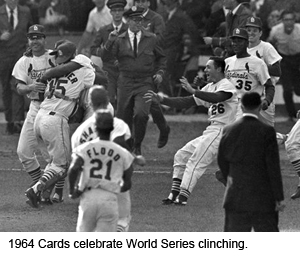 White said yes. His calendar for mid-October was clear of any baseball obligations. The Phillies led the National League and seemed uncatchable. The Cardinals figured to be done when the season ended.
In his book “Uppity,” White said, “At the time, I never dreamed we’d be in the World Series and that we’d win the championship the same day as the banquet.”
The Phillies, though, had their title dreams turned into nightmares. They collapsed down the stretch and the Cardinals clinched the pennant in the season finale. The World Series against the Yankees went to a decisive Game 7. Played on Thursday afternoon, Oct. 15, at St. Louis, the Cardinals won, 7-5. White contributed two hits and scored a run, helping St. Louis to its first World Series title since 1946. Boxscore
Party time
Revelry ensued in the Cardinals’ champagne-soaked clubhouse. In his autobiography “Stranger to the Game,” pitcher Bob Gibson called the celebration “out of the ordinary.” Catcher Bob Uecker was “at center stage in the clubhouse, wearing an usher’s cap, dancing a polka, mimicking (club owner) Auggie Busch and grabbing Harry Caray’s microphone to interview himself,” Gibson recalled.
In his memoir “Oh, Baby, I Love It,” catcher Tim McCarver said, “I remember Bob Uecker, without a stitch of clothing on, dancing to the dumbest song I’d ever heard _ ‘Pass the Biscuits, Miranda.’ He was dancing all by himself, somehow putting modern moves to this idiotic song that, for some reason, had been the 1946 Cardinals’ rallying song. Uke could dance, too.”
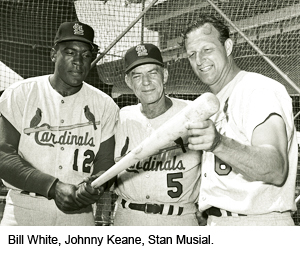 The club arranged for a victory dinner that night at Stan Musial & Biggie’s restaurant on Oakland Ave.
Bill White would like to have joined fully in the fun, but he couldn’t. He had that youth banquet to attend.
White was ready to leave the clubhouse when someone said manager Johnny Keane was looking for him, according to the St. Louis Post-Dispatch. White stopped by the manager’s office and found him talking with reporters.
“Did you want to see me, John?” White asked.
“Yes,” replied Keane. “I wanted to give you this.”
The manager walked over to White and hugged him. White returned the hug.
For the record
While his teammates headed to Musial’s restaurant, White drove to the church banquet. “A commitment is a commitment,” he said in his autobiography. “The banquet organizers were frankly surprised to see me, but happy to have me.”
After the event, White went to Musial & Biggie’s, where the party was going strong. “My teammates had a big head start on me with the champagne and other booze,” White recalled in his book. “I won’t say I was the only sober guy in the room, but I was one of the few. Maybe that’s why when Bob Howsam got up to give a little speech, I actually heard what he said _ and I didn’t like it one bit.”
Two months earlier, when the Cardinals were 62-55, nine behind the first-place Phillies, Gussie Busch fired general manager Bing Devine and replaced him with Howsam. From there, the Cardinals went 31-14, finishing in first at 93-69, one game ahead of both the Reds and Phillies.
Howsam “must have known something about baseball because later he led Cincinnati to success as the Big Red Machine, but hardly any of us liked the guy,” White said in his book. “As far as most of us on the Cardinals were concerned, it was Bing Devine, not Bob Howsam, who had made our World Series victory possible, not least of all by bringing in Lou Brock.”
In addition to Brock, Devine acquired White, Curt Flood, Dick Groat, Julian Javier and pitchers Roger Craig, Curt Simmons, Barney Schultz and Ron Taylor. With Devine in charge of baseball operations, the farm system developed Bob Gibson, Tim McCarver, Ray Sadecki, Mike Shannon and Ray Washburn.
“So when Howsam stood up that night in Stan & Biggie’s and told the crowd, ‘I just want to point out that this turnaround didn’t happen until I took over the team,’ I went into a slow burn,” White said in his book.
Team captain Ken Boyer rose next and said a few words. Then it was White’s turn. “We won this title for Bing Devine,” White told the room. “Bing put this all together. Bing is the reason we’re all here.”
As White recalled, “Howsam didn’t say anything. I knew he must have hated hearing that, but I didn’t care.”
Lifetime achievement
Bill White, 92, is the 2026 recipient of baseball’s Buck O’Neil Lifetime Achievement Award. O’Neal’s many accomplishments include being the scout who discovered Lou Brock for the Cubs and guiding him into the majors.
White is being honored for his work as an advocate for integration in baseball, and for his success as a player (Giants, Cardinals, Phillies), broadcaster (Yankees) and executive (National League president).
The attributes a recipient is required to possess were exemplified by White on the day the 1964 Cardinals became World Series champs: Character, integrity, dignity.



that sound – “Thursday afternoon” a game 7 world series game! afternoon… a WS in the afternoon….a game 7 and nowadays….oh never mind. this was a great trip this read of a series i knew nothing about. what a comeback and what a reminder to all teams, all people down in the dumps…like those alcoholics say “a day at a time”…..a game at a time or if drunk is your definition, then another beer to celebrate. I feel bad for Howsam and apparenty he was pissed too, but that’s history…..like an old confectionary building is transformed into a two story bar and no one knows how it got there or what it was before….the cardinals sure did…remembering Bing Devine
Thanks, Steve. I believe character counts, and that the character of people such as Bill White was a factor in why the 1964 Cardinals were able to pull together and win a championship.
i’ve heard the always entertaining and knowledgable Rob Parker, founder of MLBBRO refer to Juan Soto as not that kind of guy who is gonna rally the troops and be a leader type and that we shouldn’t expect him to be. I think it’s a great insight by Parker.
Good story about a good man. Bet there were kids in that youth group who still remember that banquet. What a role model for them.
Thanks, Ken. I got to interview Bill White in 2011 and he was as you said _ a good man; thoughtful, considerate and genuine.
Why doesn’t it surprise me that Bill White maintained his promise and spoke at that youth banquet? He’s an exceptional human being and as the saying goes made from a different mold. I can’t even begin to imagine not just the surprise but the admiration of the people who attended that banquet in regards to Bill White. Not that it really matters but the fact that the Yankees basically kept him handcuffed until the 7th game is something. During the second half of the 1964 season Bill White batted .345 and was kept off base in only 8 games. How I wish that I could have witnessed the clubhouse celebration and the words that Bill White spoke in behalf of Bing Devine. And it’s a shame there’s no footage of Bob Uecker doing his act!
I enjoyed your comments, Phillip. Bill White credited his mother, Edna Mae, for his upbringing.
In his autobiography “Uppity,” White said, “My mother was just 16 when she gave birth to me in 1934. My father was named Penner White, but he left town shortly after I was born and played no role in my upbringing or my life. The only thing he ever left me was his last name … Denied admission to college in the South because of her race and her family’s poverty, my mother never lost the drive to better herself and her position in life _ and mine … Eventually, my mother enrolled at Warren (Ohio) Business College where she was one of only two black students, and she graduated at the top of her class … My mother insisted that I excel at school _ and I did. Maybe it was because I was smart, or maybe it was because I just worked harder than the other kids. To me, being smart and working hard have always meant pretty much the same thing.”
Fine recollection of Bill White’s comments.
Howsam clearly didn’t care much for Bill White. He traded the great first baseman to Philadelphia after the 1965 season. I guess he wanted to see if Bill still “had it.” Like Boyer and Groat, White got “old” in 1965 when the Cardinals stunk up the joint and did an important rebuilding in 1965 and 1966, which Howsam helped engineer and Musial finished in his lone season as a GM in 1967.
Just an FYI that is easily fixable, John Jordan “Buck” O’Neil Jr. spelled his last name differently than you spell it in your article.
I am appalled that Bill White is not in the Hall of Fame as a contributor in a variety of roles.
Thanks from Bill Townsend
Thank you, Bill, for noting the misspelling. I have made the correction.
One reason Bob Howsam lost the respect of Bill White is that Howsam lied to the press when he traded White to the Phillies. Also, neither Howsam nor anyone from Cardinals management informed White of the trade.
In his book “Uppity,” White said he was with former teammate Charlie James when they heard on KMOX radio that the Cardinals traded White to Philadelphia. “When I got back home,” White said, “I asked my wife if the Cardinals’ front office had called. No one had called. It was the sort of petty, unclassy behavior I had come to expect from Howsam. The next day it got worse. In the St. Louis Globe-Democrat, Howsam was quoted as saying that one reason I’d been traded was because ‘Bill White is older than he says he is.’ Howsam told the Globe-Democrat that I was actually 37, not 31. That made me furious … I had a birth certificate, high school and college records, military records, any of which could have established my age if anyone wanted to check. Howsam hadn’t bothered. He just flat-out lied, presumably to get back at me for supporting Bing Devine. It was the most vicious, contemptible thing that anyone in baseball management had ever done to me.”
Bill White was among the players who are among my earliest memories of baseball as a Phillie. He also was someone whose broadcasting career I followed when the Yankees “magically” appeared on our cable system. Nice to see him honored for his outstanding achievements both on and off the field. One of those people who actually sounds like they are as nice as widely reported to be. Great read, Mark.
Thanks, Bruce. It says a lot for the Philadelphia area that Bill White was comfortable there and made Bucks County his permanent home.
Bill White is and always has been a classy guy. As you say, Howsman must have known baseball, but several cogs of the Big Red Machine were already in the organization when he got to Cincinnati–Pete Rose, John Bench, Lee May, Tony Perez, Bernie Carbo, and Gary Nolan to name a few. And Lee May was a big part of the 1970 WS team and was also the biggest piece of puzzle in the deal that brought Joe Morgan to Cincinnati from Houston.
Thanks, Hugh. I’ll add to your comment that part of the reason for Bob Howsam’s success in Cincinnati is he brought with him from the Cardinals several effective front office people (such as Sheldon Bender and Dick Wagner) and several key farm system and scouting people (such as Sparky Anderson and Vern Rapp).
Bender was Howsam’s most trusted aide and was influential advising Howsam on trades (including the acquisition of Joe Morgan) and in building a strong farm system. Bender also was influential in convincing Sparky Anderson to leave the Cardinals for the Reds.
With their knowledge of the Cardinals’ player personnel, Howsam and his group acquired from St. Louis players such as Bobby Tolan, Wayne Granger, Alex Johnson, Ray Washburn, Julian Javier, Pat Corrales and Joe Hague. They also acquired from other organizations such former Cardinals as Fred Norman, Pedro Borbon, Ed Sprague, Bill Plummer, Phil Gagliano and Dan McGinn.
Believe Bill White is distinctive in another way: he and a pitcher named Joe Margoneri are the last living New York Giants.
Thanks for that excellent info.