During a critical point in the 1982 division title chase, the Cardinals lost shortstop Ozzie Smith for two weeks because of an injury. To replace the Gold Glove Award winner, manager Whitey Herzog chose Mike Ramsey, a utility player with the physique of an exclamation point and a swing he described as “my dork stroke.”
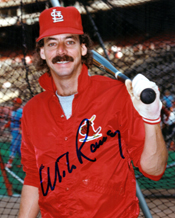 Rising to the challenge, Ramsey fielded flawlessly and performed with steely sturdiness. As Rick Hummel of the St. Louis Post-Dispatch aptly noted, “The iron man was the thin man.”
When St. Louis played five games totaling 46 innings in three days (Sept. 17-19) against the Mets, Ramsey was the only Cardinal to play every inning of each game. St. Louis won all five.
In the 14 consecutive games Smith sat out from Sept. 11 through Sept. 23, Ramsey was the St. Louis shortstop in every inning of every game. He made no errors in that 129-inning stretch and the Cardinals won 10 of the 14 games. St. Louis, in second place when Ramsey replaced Smith, was in first, with a 4.5-game division lead, when Ramsey completed his stint as the starter.
In the book “Whitey’s Boys,” Whitey Herzog said, “Unbelievable … Everybody thought when Ozzie got hurt that we were done, but that wasn’t the case.”
Late bloomer
A college shortstop at Appalachian State, Ramsey was chosen by the Cardinals in the third round of the 1975 amateur draft, but Garry Templeton was the top shortstop in the St. Louis system then.
Ramsey had knee surgery in 1976, made 44 errors with Arkansas in 1977 and another 41 with Springfield (Ill.) in 1978. The Cardinals gave Ramsey a look near the end of the 1978 season, but he floundered at Springfield (hitting .221) in 1979 and was benched in favor of Ron Farkas. Ramsey had a “terrible year,” Cardinals general manager John Claiborne told the Post-Dispatch.
“My mental state wasn’t good then,” Ramsey recalled to Larry Harnly of the State Journal-Register of Springfield, Ill. “I couldn’t put it together. I was 24 and 25, but in my mind I was a young kid. I didn’t go about my job the right way … I got down mentally. Different people mature at different times, and I matured late.”
Left off the Cardinals’ 40-man roster after the 1979 season, Ramsey was available to be drafted, but no team took him. Back at Springfield in 1980, “I knew then I had to show them I could play,” he told the Journal-Register. “I knew I had to do it then, or I might have had to think about quitting after the 1980 season. I turned it around. I started to grasp what I had to do. I took things more seriously.”
In May 1980, second baseman Ken Oberkfell got injured and the Cardinals brought up Ramsey to replace him. He got a boost from coach Dave Ricketts, who helped him with his hitting. “He has put it into my head what I have to do,” Ramsey said to the Journal-Register. “I have to lay off high pitches and I have to hit the ball on the ground.”
From May 26 to June 11, Ramsey hit safely in 12 of the 13 games he started at second. He produced four hits in a game against the Mets at New York. Boxscore
Whitey Herzog, who replaced Ken Boyer as Cardinals manager in June 1980, liked Ramsey. In June 1981, when Garry Templeton told Herzog he was too tired to play the day after a night game, Herzog started Ramsey at shortstop. In August, after the Cardinals suspended and fined Templeton, then moved him to the disabled list, Ramsey took over. He made 27 starts at shortstop for the 1981 Cardinals.
During a Cardinals series at Montreal, Ramsey met a Canadian woman, Merle Yos. “I was playing second base and I flirted with her as I came into the dugout,” Ramsey recalled to the Journal-Register. “I’d look into the stands. I asked her out. We had a long distance relationship. Her dad is a big Expos fan.”
In February 1982, the couple married.
Doing the job
Ramsey, 28, had two extended stretches during the 1982 season when he filled in as a Cardinals starting infielder.
When an injured Tommy Herr was out for a period from May into June, Ramsey replaced him at second base. He hit .358 in May and .308 in June. For the season, Ramsey made 35 starts at second with the 1982 Cardinals.
After Herr returned, Ramsey went back to his utility role. He played second, third, shortstop and even some left field.
On July 25 at St. Louis, Herzog started Ramsey at shortstop against the Astros. Don Sutton was Houston’s starting pitcher that day and Ozzie Smith, who had a .136 career batting mark against him, got a day off.
With the Astros ahead, 1-0, in the second, the Cardinals had two on, one out, and Ramsey at the plate. A switch hitter batting left, he worked the count to 3-and-1. Sutton decided to make the next pitch a fat one. “My chances of getting him out were good enough that I could throw him a strike,” Sutton told the Post-Dispatch. “The worst I would get was a single or a double.”
Instead, Ramsey walloped it over the wall. “I just floated around the bases,” he told the Post-Dispatch. The three-run blast was his first big-league home run. Ramsey told reporter Rick Hummel, “I used to hit them out in wiffleball when I was 10 years old. It was a real small area.”
Referring to the home run as “a fluke,” Sutton said to the St. Louis newspaper, “Who’s the last guy on their ballclub you figured would hit a home run?”
Ramsey’s rocket lifted the Cardinals to a 4-3 victory. “I was happy it came off a guy that good and that it wasn’t a cheap home run at all,” Ramsey told Rick Hummel. Boxscore
(A month later, Sutton was traded to the Brewers and helped them win the American League pennant. He started Games 2 and 6 of the World Series, but the Cardinals won both.)
Ramsey’s only other big-league homer was a solo shot against the Cubs’ Chuck Rainey at Wrigley Field in 1983. Boxscore
Play to win
In a Sept. 10, 1982, game against the Mets, Ozzie Smith ranged far to his left, dived and gloved a hard-hit ball, preventing a run from scoring. The next day his injured right thigh kept him from playing. That’s when Ramsey became the St. Louis shortstop.
“I’ll just play hard and stay within my limitations and try not to be Ozzie,” Ramsey told the Post-Dispatch.
Smith was nicknamed The Wizard _ as in Wizard of Oz _ because of his brilliant fielding, but Ramsey provided magic, too. The unheralded utilityman was a marvel of consistent excellence while performing under the pressure of a title chase.
As Rick Hummel noted in the Post-Dispatch, “He did the nearly unthinkable. He almost made one forget that Ozzie Smith was not there.”
Though he initially struggled at the plate after replacing Smith, Ramsey recovered and hit .385 over a four-game stretch against the Mets and Phillies. “I’ve got my stroke, my dork stroke, back now,” he told Rick Hummel.
Smith returned to the lineup on Sept. 24 and the Cardinals went on to win a division title and then the National League pennant.
In the World Series versus Milwaukee, Ramsey mostly watched from the bench until the decisive Game 7. In the sixth inning, he ran for Gene Tenace and scored the go-ahead run on George Hendrick’s single. Whitey Herzog kept Ramsey in the game at third base, replacing Ken Oberkfell. Ramsey played the final three innings of the Cardinals’ championship clincher. Boxscore
At spring training in March 1983, Tommy Herr had arthroscopic left knee surgery. When the reigning World Series champions opened the 1983 season, Ramsey was their second baseman. Boxscore
“Mike Ramsey is the best utilityman in baseball,” Whitey Herzog declared to the Post-Dispatch.
Told of the manager’s comment, Ramsey replied, “He’s just being kind to me.”
Ramsey made 47 starts, including 36 at second, for the 1983 Cardinals.
In July 1984, Ramsey was traded to the Expos for Chris Speier. Ramsey played his final big-league games with the Dodgers in 1985.
Cardinals director of player development Ted Simmons hired Ramsey to be an instructional coach in 1989, then promoted him to minor-league manager.
Ramsey managed for 14 years in the farm systems of the Cardinals (1991-95), Padres (1996-99), Rays (2000-01) and Giants (2002-04). Among the players he managed were Joe McEwing, Dmitri Young, Carl Crawford and Matt Cain.



And cynics complain about Olympic Stadium in Montreal being a horrible place to watch a game..What do they know! They never picked their eventual wives out of the stands!
Nice to see utility men get what they deserve – recognition by the likes of Herzog.
As Cardinals broadcaster Mike Shannon liked to chortle to listeners, “Nothing beats fun like being at the ol’ ball orchard.”
now there’s my new word for the day – chortle! my dad’s dad used to encourage us to try and learn one word a day. He lived to be 90 so i can’t argue with his advice.
Mark, one utility man I had totally forgotten about until now. I did then recall he actually played a key role on more than one occasion over the years. Nice story also about visiting Montreal and eventually returning with a bride!
Thanks, Bruce! In September 1982, when the Cardinals and Phillies were competing for the division crown, Mark Whicker of the Philadelphia Daily News did a column on Mike Ramsey and concluded, “Ozzie Smith will be back for the crunch, but Mike Ramsey saved his seat. Ozzie Smith was missed, but Mike Ramsey made sure he wasn’t mourned.”
When Whitey Herzog came to St.Louis he was determined to have a team with a good bullpen and dominant closer. He also knew the importance of having a deep, versatile and dependable bench. Mike Ramsey was one of those bench players. And it’s true. He fulfilled his role as a utility player in a way where you really couldn’t ask for more. I really admire his honesty and humility in confessing that he was a late bloomer when it came to taking responsibility for his own actions and becoming a bit more mature. I can relate. It was really classy of Whitey Herzog to let Mike Ramsey finish that 7th game. He deserved it. Speaking of maturity it’s interesting that Mike Ramsey had is eye on a woman that would become his future wife while playing in Montreal. During this same period Whitey Herzog and some of the coaches were becoming convinced that some of the players were getting that “white powder” on road trips to Montreal.
Thanks for all the good thoughts, Phillip. You are correct about Whitey Herzog understanding the importance of the bench players.
In his book “You’re Missin’ a Great Game,” Herzog said, “Ralph Houk was the best I ever saw at handling people. I got to play for him in Denver, in the American Association, and Ralph was a great manager because he knew how to keep 24, 25, different personalities happy. That’s harder than it looks … I never forgot his example.
“Maybe what I learned best from Ralph Houk was how important every guy is. You can’t win in baseball without an outstanding bench. A lot of the time, I spent more time with my 24th guy than I did with my stars … Maybe I appreciated them because they were the kind of players I used to be … but you better pick your bench right. You want good guys who are willing to sit, pinch-hit, and play roles, and who don’t think they should be playing every day. I’m talking about guys like Dane Iorg, Mike Ramsey, Tito Landrum, Tom Lawless, Tom Nieto … but you have to remember another thing: Never keep your bench around too long. Turn those guys over. If you don’t, they start thinking they’re too important.”
A story that’s all about stomping on the Mets! (This year everyone does it.)
The Mets wasting more than $350 million on a 2026 player payroll for a bunch of bums gives a whole new meaning to the word Amazin’
I had forgotten about Mike Ramsey’s contribution to the 1982 Cardinals. Over the course of a 162-game season, utility guys like Ramsey can really make the difference in whether a team makes it to the postseason or goes home. In 1982, Jerry Royster had his career year with the Braves, hitting .295 with an OBP of .351. Perhaps more importantly, he played several games at third base, left field, shortstop, and second base. Dale Murphy won the MVP that year, and rightfully so. But I don’t think the Braves make to the NLCS without Royster’s contributions.
That’s an astute comment about Jerry Royster, Hugh. Indeed, with the 1982 Braves, Royster hit .342 versus left-handers and .354 overall with runners on base. He was especially terrific in September when the Braves were battling the Dodgers for control of the division. Royster had four hits in a Sept. 24 Atlanta win against the Padres, and four hits and three steals in a Sept. 28 Braves win versus the Giants.
An aside on Mike Ramsey: He went to Roswell (Ga.) High School and was the baseball team’s leading hitter in 1971 and MVP in 1972. He also was the MVP of the Appalachian State University baseball team in both 1974 and 1975.
“The Rammer” was an inspiration out there! Dave Ricketts and Whitey knew how to find and develop the kind of Dark Horse talent that Mike Ramsey possessed. I remember that Jack Buck and Mike Shannon thought a lot of him, and he is one of the “backbone of the team” players that got them all the way through to the World Championship.
Funny enough, I’d forgotten that Don Sutton was with the Brewers in 1982. Although back in the day we Carindals loyalist would slam lots of opposing players just for kicks, the 1982 Brewers really were packed with talent (shout out to Ted Simmons!). Thanks for keeping all this history alive and for making it so much fun for people like me. I was at Game 7 in 1982 to Celebrate Good Times, and now here I am living in Japan and enjoying Cardinals’ baseball history! Many thanks!
Wonderful to hear from you! Thanks for staying in touch all these years.
Yep, any player earning the respect of Whitey Herzog, Dave Ricketts, Jack Buck and Mike Shannon is someone you want on your team.
Here’s a previous post on Don Sutton versus the Cardinals, including the 1982 World Series showdowns: https://retrosimba.com/2021/01/26/don-sutton-vs-cardinals-shutouts-and-sorrow/