Early in his big-league career, when he was well-regarded but not yet perhaps the top pitcher in the game, Christy Mathewson planned to leave the New York Giants and join the St. Louis Browns.
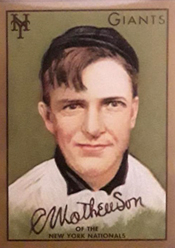 In 1902, his second full season in the majors, Mathewson was stuck on a bad Giants team. The 1902 Giants were last in the big leagues in hitting (.237) and runs scored (405) and made the most errors (338) in the National League. They finished 48-88 _ the worst record in the majors.
This was during a period when the American League and National League were raiding each other for players. After the 1901 season, for instance, multiple Cardinals _ second baseman Dick Padden, shortstop Bobby Wallace, left fielder Jesse Burkett, center fielder Emmet Heidrick, and pitchers Jack Powell, Jack Harper and Willie Sudhoff _ were enticed to defect to the Browns.
When the Browns made Mathewson an offer in July 1902 to switch leagues and join them after the season, he accepted. He took a $500 cash bonus and signed a contract for 1903. To sweeten the arrangement, the Browns also signed the Giants’ catcher, Frank Bowerman, for 1903.
If Mathewson had pitched for the Browns, maybe the franchise would have been a perennial contender instead of an also-ran, but he instead stayed with the Giants and tormented the rest of the National League, most especially the Cardinals.
Bucknell to big leagues
Christopher Mathewson was from Factoryville, Pa. His father, Gilbert Mathewson, served as a drummer boy for the Union Army during the Civil War under the command of his uncle, Col. D.N. Mathewson.
A big man on campus at Bucknell, Christy Mathewson was class president, majored in forestry, sang in the glee club, belonged to two literary societies, and played football, basketball and baseball.
A right-hander, Mathewson, 19, reached the majors with the Giants in 1900, but lacked command, walking more batters than he struck out. His ERA that season was 5.08. Mathewson’s first decision was a loss in a five-inning relief stint against the Cardinals at St. Louis in August 1900. He got his first big-league hit, a double, in that game but gave up five runs. The Cardinals’ leadoff batter, John McGraw, would soon become like a second father to Mathewson as manager of the Giants. Boxscore
The next season, 1901, Mathewson improved considerably, earning 20 of the Giants’ 52 wins. One of those was a no-hitter against the Cardinals at St. Louis. Boxscore
Meet me in St. Louis
Mathewson again was the Giants’ top winner in 1902 but the team was such a mess that he also was needed as an emergency fill-in at first base (three starts, four errors) and right field (three starts).
Meanwhile, the 1902 Browns, stocked with ex-Cardinals, were headed toward a second-place finish in the American League. The Browns fielded well (most putouts in the league) and had quality pitching (third-fewest runs allowed).
In July 1902, about the time the Giants hired John McGraw to take over as manager, Browns owner Robert Hedges convinced Mathewson to defect to St. Louis after the season. Mathewson signed “in the latter part of July and took our money,” Browns manager Jimmy McAleer told the St. Louis Republic.
Hedges acknowledged Mathewson and Bowerman would be Browns in 1903, the St. Louis Post-Dispatch reported. According to the St. Louis Republic, Hedges had the signed contracts of Mathewson and Bowerman in his office safe.
“We will certainly have Mathewson and Bowerman and probably one or two other National Leaguers,” Hedges told the Republic.
Then something unexpected happened.
Give peace a chance
The roster raids became too costly for some team owners. As St. Louis Star-Times columnist Sid Keener noted, “It was a free-for-all scrap, with the players reaping the profits.”
Club owners met in January 1903 and attempted to reach a peace treaty. “The factions were battling back and forth, trying to arrange a satisfactory agreement,” Keener reported.
Hedges was the key. For two days, he refused to return Mathewson and Bowerman to the Giants. When he changed his mind, the American League and National League signed a peace agreement on Jan. 10, 1903, ending the roster raids. According to the St. Louis Republic, Mathewson and Bowerman were required to return the bonuses Hedges paid them during the summer.
“I lost a pennant for St. Louis in that deal,” Hedges said to the Star-Times, “but I brought about peace in the baseball world.”
Ace of diamonds
With John McGraw in his first full season as their manager, the Giants made a stunning transformation, winning 84 times in 1903 (36 more wins than they had the year before) and placing second. Mathewson won 30, the first of his four seasons with 30 or more wins.
The Browns went backwards, posting a 65-74 mark in 1903. It would be 20 years before they would match the second-place finish of 1902.
McGraw led the Giants to nine National League pennants and three World Series titles. Mathewson pitched on four of those pennant winners. In the 1905 World Series, he shut out the Athletics three times. In 11 World Series starts for the Giants covering 101.2 innings, Mathewson had an 0.97 ERA.
In a stretch from 1904-08, Mathewson won 24 consecutive decisions against the Cardinals. In one of those wins, his 33rd of 1904, he struck out 16 Cardinals. Boxscore
(The only other pitcher to win 24 in a row against one club is Carl Mays, who did it against the Athletics from 1918-23.)
Mathewson had a 52-23 record (with nine shutouts) versus the Cardinals. He won 26 at New York and 26 at St. Louis.
Mathewson also was dominant against the Reds, winning 22 consecutive decisions versus Cincinnati from 1908-11.
He was a master at studying batters, finding their weaknesses, and delivering a wide variety of pitches with command of the strike zone.
Mathewson had a stretch of 68 consecutive innings without a walk in 1913. Johnny Evers of the Cubs told the Star-Times that year, “I don’t believe Mathewson pitched the same way to me twice all season. He might start out by dinking one a little on the inside, another on the outside, come across with a fadeaway and then shoot a fast one across the plate while I was waiting for something else. The next time I went up, Christy was liable to start out with a fadeaway, dink a slow one on the inside, follow with a fast one and then another fadeaway. Consequently, you never could be prepared for the next ball. Matty knows exactly what you can’t hit and takes advantage of said fact.”
As Mathewson told the Star-Times, “The pitcher is in a duel of wits with the man at the plate. There is as much mixture of brain as there is of delivery.”
Mathewson and Grover Cleveland Alexander share the National League record for most career wins (373). Only Cy Young (511) and Walter Johnson (417) have more. Mathewson also ranks third all-time in career shutouts (79). The top two are Walter Johnson (110) and Grover Cleveland Alexander (90).

 RetroSimba
this is fantastic Mark. Ever since reading a book by Frank Deford….I forget the name of the book but it explores the relationship of mcGraw and mathewson and they couldn’t have been more different in terms of temperament and yet, they seemed inseparable and inspirations to each other as you wrote Mark….McGraw “father” figure.
How odd that Cardinals players would join the Browns when considering the direction those two franchises went as the 20th century rolled out. I guess in a sense, it was free agency back then with players taking the highest bid.
Thanks, Steve. You are correct about that period of 1901-02 being like free agency. More than 100 players jumped leagues. The more prominent included Cy Young (who jumped from the Cardinals to the Boston Americans), Nap Lajoie (from Phillies to A’s), Big Ed Delahanty (from Phillies to Senators) and Sam Crawford (from Reds to Tigers).
Thank you Mark for another very interesting post. Once again I learned a piece of baseball history that I didn’t know about. Incredible that the St.Louis Browns had acquired Christy Matthewson only to agree to give him back. I couldn’t help but think about one of your previous posts on Branch Rickey when he was working for the Browns. The St.Louis Browns were dealt a cruel destiny. I couldn’t help but do a little research on Robert Hedges I plan on doing more. Certainly Christy Matthewson was one of the most dominant pitchers in mlb history, irregardless of the time period. Of all the batters that had at least 100 at bats against him only two, Sherry Magee and Hognus Wagner were able to hit .300 against Christy Matthewson. You could also say that he was a victim of poor run support. Of his career 188 losses the Giants scored 2 runs or less in 122 of those games.
I appreciate your comments and the bonus research you offered, Phillip. It’s incredible how little run support Christy Mathewson received in the majority of his losses. And Sherry Magee having a .315 career batting average versus Mathewson also is incredible. PS: Magee was 2-for-21 (.095) against another Giants pitcher, Fred Anderson. Typical unpredictable baseball.
Glad you will read more about Browns owner Robert Hedges. It will be worth your time.
Sid Keener of the St. Louis Star-Times wrote this about Hedges:
“He was Uncle Bob or Colonel Bob to everyone who met him. Extremely courteous, always affable, wearing a smile that became contagious even during his dark, dreary days as the owner of a tail-end ballclub … He sold himself to his public, thereby proving that a club owner could be successful, although his (team) was a perpetual loser … Standing at the top of his grandstand, close to the steps of the Dodier Street entrance, Hedges made it a habit to be on the reception committee for his customers each afternoon. He had a pleasing smile for everyone who walked through the turnstiles. ‘Well, I’m glad to see you,’ was his favorite expression when a friend or stranger entered his stadium.”
Mark, thanks for this revealing, informative slice of baseball history. I learned a lot, and while reading it I wondered what it would be like to go back in time to that crazy period where players were jumping from one league to the other, and watching all that play out before Hedges helped put an end to the raiding of rosters.
Yes, indeed, that was a wild period of double-crossing among players and teams, Bruce. The poor Phillies were one of the teams decimated. The Phillies were good in 1900 (75-63) and 1901 (83-57) but the raids took their toll and they finished 56-81 in 1902.
A pitcher, Chick Fraser, symbolized the times. After a 15-9 season for the 1900 Phillies, Fraser jumped to the A’s. After a 22-16 season for the 1901 A’s, he jumped back to the Phillies for 1902 and totaled 12 of the club’s 56 wins.
It was the first of two times that Hedges caused “peace in the valley.” The next time was when he agreed to sell the club to Phil Ball, the owner of the St. Louis Terriers of the Federal League, in order to settle the federal court case without a ruling from Federal Judge Kennesaw Mountain Landis. (Chicago Feds followed suit, closing down in exchange for Cubs ownership). . Landis was accused of helping Major League Baseball by delaying the case. But he was known for imposing enormous antitrust damages, so many historians believe he hoped the parties would work things out rather than have a court potentially dismantle organized baseball. ~E. McAuliffe
Thank you for providing this helpful insight, Emmett.
Mathewson’s stats are truly mind-blowing. There’s probably whole teams’ starting rotations who can’t match some of his achievements. Another thing that stood out for me was his college experience. I always picture star athletes as being disconnected from campus life, but he was all in. Guess things were a bit different in 1903.
Yes, indeed, Christy Mathewson was fully a part of campus life at Bucknell. In addition to starring in baseball, basketball and football, he was class historian, president of the junior class, sang first bass in the glee club and played bass horn in the band. One of the literary societies he belonged to studied European literature. As Bucknell president Gary Sojka said to United Press International in 1989, “Literally, he was a scholar, a singer, a musician, a writer, a leader _ the whole works.”
Fabulous article! Means a lot to me as a fan of old baseball! Matty and Alex are linked forever by their dominance on the diamond and by the chemical horrors of what is known as the Great War. It was such a huge tragedy. My own grandfather was at the front in 1918 as a cook for his squad. The war to end all wars that wasn’t harmed millions of families, including mine. When I look back on it, I envision Matty and Alex in a trench with guns goin’ off next to their ears, harming their hearing. Worse, the chemicals that would become “illegal” inflicted a slow death upon Matty and scrambled the mind of the hero of the 1926 World Series, Grover Cleveland Alexander. Pete’s participation in the inhumane battles showcasing man’s inhumanity to man unquestionably contributed to the alcohol abuse he took on as a way to cope with being alive. It is fittingly spiritual that these giants of the mound finished their lives with the same number of regular-season victories, 373. Great men, both.
Thanks for the insights about war and its devastating impact on so many, including Christy Mathewson and Grover Cleveland Alexander.
Tragedy continued to be a part of the Mathewson family story.
In 1930, the pitcher’s son, Christy Mathewson Jr., graduated from the Army Air Corps Advanced Flying School. Two years later, Mathewson Jr. was assigned to active duty in China, where he helped establish the Central Aviation School and served as an aviation advisor to the National Revolutionary Army. On Dec. 24, 1932, Mathewson Jr. married Margaret Phillips. Two weeks later, on Jan. 8, 1933, in Shanghai, Mathewson Jr. borrowed a Sikorsky amphibious plane to take his wife for a flight. It was the first time she had been in a plane with him as the pilot, according to the Associated Press. Thirty seconds after takeoff, the plane crashed and Mrs. Mathewson was killed. Mathewson Jr. was severely injured. His left leg had to be amputated above the knee. Mathewson Jr. eventually regained use of his arms and learned to walk with an artificial leg. In May 1942, he was promoted to the rank of captain on active duty with the Flying Training Command in California. Mathewson Jr. retired from the Air Corps in 1946 with the rank of lieutenant colonel.
On Aug. 15, 1950, a butane explosion occurred while Mathewson Jr. was installing an electric dishwasher in his basement. He died the following day at the age of 43.
it is astonishing what you discover and inspire Mark. The depth to the Mathewson story now. I’m shaking my head in awe.
While it would be unfair to compare today’s pitchers to Christy Mathewson, parts of this post are very revealing: “He was a master at studying batters, finding their weaknesses, and delivering a wide variety of pitches with command of the strike zone.” You mean he didn’t just go out to the mound at the beginning of the game and throw every pitch with maximum effort and hope to make it through six innings?
And the quote from Johnny Evers: “I don’t believe Mathewson pitched the same way to me twice all season.” Maybe if a pitcher pitched a batter differently every now and then, managers wouldn’t have to worry about their pitchers facing the batting order for a third time during a game.
I recently read a good book on Mathewson called Baseball’s First Superstar: The Lost Life Story of Christy Mathewson. It seem that Mathewson was quite the writer and scholar as well as being a dominant pitcher. He was a great chess player and also played in some professional Bridge tournaments.
And even Ty Cobb admired him!
I agree with all of your comments about pitching, Hugh.
Thanks for the book recommendation and for the insights about Christy Mathewson’s skills at chess and bridge.
His approach to pitching was much like that of a chess master or world-class bridge player.