Just as Yankee Stadium was the House That Babe Ruth Built, perhaps Busch Memorial Stadium, which opened in downtown St. Louis in 1966, could have been the House That Hector Espino Built.
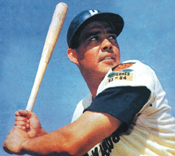 Known as Bambino Mexicano, or the Babe Ruth of Mexico, Espino was invited by the reigning World Series champion Cardinals to their big-league spring training camp in 1965.
A right-handed power hitter who played first base (his best position) and the outfield, Espino joined the Cardinals’ Class AAA Jacksonville Suns farm club in August 1964 and helped them win the International League pennant.
The Cardinals purchased his contract after they prevailed against the Yankees in the 1964 World Series. They were intrigued by Espino’s home run swing as they prepared to move from the former Sportsman’s Park to the new stadium in 1966.
Mentioned with the likes of Babe Ruth, Mickey Mantle and Harmon Killebrew, Espino was considered a sure bet to hit in the big leagues, but it didn’t work out.
Mexican marvel
A truck driver’s son from Chihuahua, Mexico, Hector Espino was 5-foot-10, 190 pounds “with a thick, muscular upper body and large, thick wrists,” according to Scott Ostler of the Los Angeles Times.
Taking a short stride, Espino hit with power to all fields while playing summers in the Mexican League and winters in the Mexican Pacific League. “No one can hit a ball farther and higher than Espino,” Joe Reichler of the Associated Press observed. “He has been known to have hit some drives 500 feet.”
Espino clouted more than 700 home runs in his pro career. According to the National Baseball Hall of Fame in Cooperstown, he hit 453 in the Mexican League; 299 in the Mexican Pacific League. Espino also hit 28 homers in the Mexican minors and three more with the Cardinals’ Jacksonville club, MLB.com reported.
The Arizona Daily Star called him “Bambino Mexicano.” Espino’s Jacksonville teammate Joe Morgan (the future Red Sox manager, not the future Hall of Fame second baseman) recalled to Rob Terranova of MLB.com, “I remember them telling us we were getting the Babe Ruth of Mexico.”
In 1989, the New York Times rated Espino as “Mexico’s greatest homegrown (baseball) talent.” Rafael Dominguez of the Mexican Professional Baseball Hall of Fame described him as “the maximum expression of Mexican baseball.”
As Encyclopedia Britannica put it, “Although virtually unknown in the United States, Espino is considered by many in Mexico to be the greatest native-born hitter of all time and is a national hero in that country.”
Cleveland calling
Playing for the Monterrey Sultans as a rookie in the Mexican League in 1962, Espino, 23, made an immediate impact: .358 batting average, .457 on-base percentage, .613 slugging mark. In June 1962, The Sporting News reported that Espino “already was attracting major-league scouts, and (team) owner Anuar Canavati of the Sultans predicted the husky hitter would bring the club a fancy return on the open market in the near future.”
The Sultans and Cleveland Indians formed a working agreement for 1963. Espino and his Monterrey teammate, pitcher Mike Cuellar, were invited to 1963 spring training in Arizona and assigned to Jacksonville, a Cleveland farm club that year.
Ben Geraghty, who 10 years earlier managed Hank Aaron at Jacksonville, gave Espino a chance to play regularly in exhibition games and he hit well, including a game-winning home run against Tacoma on March 31. The next day, Espino was a no-show at Jacksonville’s workout.
In a story headlined “Suns wonder: Where did Hector go?,” Cuellar told the Jacksonville Journal, “I saw him in the morning and I told him where he was supposed to report. He said he understood but I haven’t seen him since.”
According to the Florida Times-Union, Espino “left camp without saying a word.”
Feeling homesick, he was located at Chihuahua, where he was visiting his parents, The Sporting News reported.
Espino opted to stay in Mexico and play for Monterrey.
Pennant push
The Monterrey club shifted Espino from the outfield to first base in 1964. Comfortable with the move, he responded with a big season at the plate: 46 homers and a league-leading .371 batting mark.
Meanwhile, the Jacksonville Suns became a Cardinals farm club in 1964. Managed by Harry Walker, the Suns were competing for the International League pennant. To help their chances, Suns general manager Bobby Maduro used his close ties to Monterrey management to arrange for three Sultans players to join Jacksonville after completion of the Mexican League season in early August.
The trio consisted of former Washington Senators pitcher Evelio Hernandez, shortstop Rigo Mena and Espino, who was expected to provide the right-handed power Jacksonville lost when Mike Shannon was called up to the Cardinals. “There were great hopes (Espino) would be the difference in the International League pennant race,” Jacksonville journalist Jack Hairston wrote.
The transition to a new team late in the summer and in a town that was deeply segregated and filled with racial tension was challenging. Intensely shy and introverted, Espino “spoke no English, had difficulty adjusting to the alien culture and, like many Latin players who come to the United States, he was homesick,” Leo W. Banks of the Arizona Daily Star noted.
Pat Corrales, then a catcher in the Phillies’ system, recalled years later to Newsday, “He had no way to communicate, and this Mexican superstar was treated like a rank amateur … What an insult.”
Jacksonville teammate Joe Morgan said to MLB.com, “I’m just not sure he ever got comfortable here … You definitely got the feeling he was homesick.”
Adding to Espino’s discomfort was the position he was required to play. The Suns put him in the outfield after he thrived at first base in the Mexican League.
A low point came during a doubleheader at Buffalo on Aug. 18. The Cardinals sent their 82-year-old consultant, Branch Rickey, to watch Espino play and assess whether the parent club should purchase his contract. What Rickey saw was a player who shouldn’t be in the outfield.
As Bill Kastelz observed in the Florida Times-Union, “His defensive play in right field was enough to make you turn your head away as he committed three errors in two games and failed to get two or three fly balls which were more or less routine, losing one because his cap fell down over his face.”
It dawned on the Suns that Espino might be better playing first base. Moved there, he began to feel at ease and his overall performance improved.
On Sept. 8, Espino crushed a home run (his 49th of the year) in a win that clinched the pennant. Through interpreter and teammate Coco Laboy, Espino told Wayne Minshew of the Jacksonville Journal, “I’ll take that one over all the rest of my homers.” In 32 games for Jacksonville, Espino hit .300 with 15 RBI, 15 runs scored and three homers.
Deal or no deal
According to the Jacksonville Journal, Harry Walker said Espino showed much potential as a hitter. The Cardinals purchased his contract for $25,000 and invited him to their 1965 big-league spring training camp at St. Petersburg. “Not since Bobby Avila teamed with Lou Boudreau in Cleveland’s pennant-winning years have the Mexican people had a baseball hero to compare with Hector Espino, Mickey Mantle’s counterpart south of the border,” the Associated Press declared.
Plans went awry, however, as the opening of training camp neared. Espino’s father became ill and the first baseman was given permission to report late, but then the Cardinals received no communication from him, the Jacksonville Journal reported.
A few weeks later, Espino’s luggage arrived without him in Florida. He’d taken a flight from Monterrey to Dallas, changed his mind about going to spring training and went back to Mexico. By then his checked baggage was on its way to Florida.
Espino never did report to the Cardinals. He wanted a share of the purchase price Monterrey Sultans owner Anuar Canavati received from the Cardinals for him, but Canavati refused. “When the (spring training) invitation came in 1964, I looked forward to going and wanted to continue with the Cardinals in 1965, but it was Canavati who stopped me,” Espino told the Arizona Daily Star.
He also said to the Los Angeles Times, “If they had given me the money, I’m pretty sure I’d have been there (with the Cardinals) a long time.”
Asked in 1985 whether he had regrets, Espino replied to journalist Leo W. Banks, “I would do the same thing over again.”
The Cardinals kept the door open. In August 1965, St. Louis general manager Bob Howsam told Larry Lee of the Columbus (Ind.) Republic that Espino didn’t want to play in the United States but added, “We’re keeping track of him just in case.”
Safe at home
Espino had one more flirtation with a major league franchise. In 1967, he agreed to report to Angels spring training at Holtville, a California agricultural town of about 3,000 residents and home to the annual Carrot Festival.
Holtville was 15 miles from Mexicali, a bustling Mexican city with the cantinas and strip clubs Holtville lacked. Before camp opened, Angels manager Bill Rigney issued a stern warning to his players about journeying to Mexicali at night. “I realize we are not at war with Mexico, but I would prefer my guys stay on this side of the border,” Rigney told Ross Newhan of the Long Beach Independent.
Espino notified the Angels he would remain in Mexico.
“He was some hitter, but he didn’t care about leaving Mexico,” catcher Elrod Hendricks, a former Cardinals prospect who played three years (1964-66) in the Mexican League before going to the majors, said to the Associated Press.
Testimonials to Espino’s talents from the archives of the Los Angeles Times and Arizona Daily Star included:
_ Maury Wills, who managed the Hermosillo Orange Growers to a Mexican Pacific League title in 1971 with Espino at first base: “Espino is about as fine a hitter as I ever saw. He should have been in the big leagues five or six years ago.”
_ Frank Lane, ex-Cardinals general manager: “He was one of the great hitters … In the major leagues, he would have been a .320 to .340 hitter, with power.”
_ George Brunet, who played 10 seasons in the Mexican League after pitching for the 1971 Cardinals: “If he got a chance in America … he would have been just like Harmon Killebrew.”
_ Eddie Leon, an American League infielder and Espino’s Mexican League teammate: “I saw Hector when he was 36 and even at that age I thought he was as good a hitter as I’d ever seen or played against, and I played with Dick Allen on the White Sox the year after he won the MVP. Hector couldn’t do as many things as Dick Allen, but he was as good a hitter.”
Looking back on his pro career, Espino said to journalist Leo W. Banks, “Hitting a home run is a great satisfaction, but it is momentary … The satisfying thing, the thing I am most proud of, is that I’ve played 24 years.”



Interesting story, Mark. I’ve often wondered how many players never made it due to getting homesick. The Cincinnati Reds drafted a pitcher on our high school baseball team. He went to Spring Training and was impressive enough that the Reds assigned him to Chattanooga (AA) for his first season, but he was back in Pleasant View soon afterwards. Years later, when writing a column for our local paper, I asked him what happened with his professional baseball career, and he told me he just got homesick. He said until he went to Spring Training, he had never spent a night out of town without his parents in his entire life. I asked him if he had any regrets, and he replied, “No, I’ve done all right.” Good for him.
Good insights, Hugh. Thanks!
An interesting story about ambition and sacrifice. For some this is a tale of unfulfilled potential. But others might see Espino as a man who opted instead for the comfort of his homeland and a good career, albeit something short of major league stardom.
Yep, you expressed it well and accurately, Ken.
According to the Arizona Daily Star, in explaining why he didn’t play in the U.S., Hector Espino told Monterrey Sultans GM Cesar Faz, “In Mexico, I play the way I want to play. Nobody tells me anything. If I want to act one way, or go one way, or drink a couple of beers, nobody is going to tell me anything. I’m scared if I go over there they’ll start telling me to lose weight and show up at certain times and cut out the beer, and I don’t want that.”
What an incredible account of a very unique person and very good baseball player. When he says that he didn’t need to play in the professional baseball in the States it has nothing to do with vanity or arrogance. He simply just wanted to play the game that he loved in his native country. Nothing wrong with that. Let me say though Mark, that as a Cardinals fan, I can’t help but play fantasy baseball with Hector Espino in the starting lineup. I mention this not just because of the potential that he possessed but also because during the 60’s the St.Louis Cardinals were the model franchise when it came to integration. I’m convinced he would have gradually felt at home. But of course Hector Espino was going to decide for himself his own destiny.
Those are all good points, Phillip.
I was thinking, too, that if Hector Espino hit for the Cardinals the way he hit in Mexico, then the Cardinals likely don’t need to trade for Orlando Cepeda in May 1966. Everything about those 1967-68 Cardinals would have been different, for better or worse. According to journalist Bob Broeg, Cardinals GM Bob Howsam had offered Steve Carlton, Nelson Briles, Bobby Tolan and Alex Johnson to the Cubs for right fielder Billy Williams. If Howsam doesn’t need to trade Ray Sadecki to the Giants for Cepeda, perhaps he uses Sadecki (who was more established then than Carlton or Briles) in a package to try to get Billy Williams. Then he wouldn’t have needed to acquire Roger Maris for right field.
You are correct, too, about the welcoming multi-cultural atmosphere of the Cardinals clubhouse then. Orlando Cepeda has cited that as a big reason why he thrived with St. Louis after leaving what Cepeda said was a toxic environment with the Giants.
I’d rather have Cha Cha Cha pure and simple.
Orlando Cepeda sure had a special season for St. Louis in 1967 and was an important part of two Cardinals pennant-winning teams and a World Series championship club.
A side note: After Cepeda was released by the Red Sox in March 1974, he played for a couple of months for Yucatan of the Mexican League. His ex-Cardinals teammate Julian Javier was manager. In 28 games for Yucatan, Cepeda, 36, hit .213 with 4 homers. Playing for Tampico that season, Hector Espino, 35, hit .313 with 17 homers in 109 games.
thanks as always Mark for opening a window into unknown worlds. I find it fascinating that some take the plunge and not only predict how he might have done in the MLB, but they even give specific averages and what not.
Much appreciated, Steve. Yes, in doing the research, it was telling to me that I didn’t come across even one big-league scout, manager, player or executive who thought Hector Espino would flop if he played in the majors.
It is interesting to hear of stories like this, where athletes decide a bigger future in the sport isn’t necessarily a better one for them personally. It is refreshing to learn of anyone in any walk of life who knows themselves well enough to reject what everyone else thinks they should do…and instead do what they feel will make them the happiest in the long run. Some people really get unsettled when someone doesn’t follow the “normal path.” Great post, Mark.
I agree with you, Bruce. I was fortunate very early in my journalism career to have mentors who stressed, “Don’t follow the pack.” That meant always seek an original angle, or news hook, to a story rather than cave to the peer pressure of doing the norm. I tried to apply the “don’t follow the pack” guidance to most everything I do in life. It works for me, but, as you note, there are those who are disturbed by someone not conforming.