The Cardinals had a pitcher in their system who collected wins the way neighborhood kids flocked to an ice-cream truck _ in bunches.
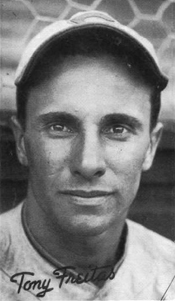 A left-handed lilliputian who relied on control and off-speed pitches, Tony Freitas achieved 20 or more wins for six seasons in a row (1937-42) with Sacramento. The Cardinals offered to bring him to the majors, but Freitas said no. Sacramento was his home and that’s where he preferred to stay.
Besides, Freitas had been in the big leagues _ with the Athletics and Reds _ before the Cardinals acquired him, and though he had multiple highlights, including 10 wins in a row as a rookie and an epic 17-inning duel with Dizzy Dean, the overall experience wasn’t satisfying.
So, being in the minors, where he won a lot, felt appreciated and got to remain in his home state of California, was all right with him.
Freitas went on to pitch until he was 45. He is the career leader in minor-league wins for a left-hander (342). Only right-handers Bill Thomas (383), Joe Martina (349) and George Payne (348) have more career wins in the minors than Freitas.
In the fast lane
Antonio Freitas was the son of immigrants from the Azores, a cluster of Portuguese islands. Freitas and Eve Arden were born a week apart in Mill Valley, a town near San Francisco. Arden became an actress in movies (“Mildred Pierce”) and television (“Our Miss Brooks”). Freitas chose baseball.
A cabdriver who’d seen Freitas pitch semipro ball in Mill Valley recommended him to Sacramento manager Buddy Ryan, who arranged for Freitas, 20, to start a pro career with Class D Phoenix in 1928. In his first pro game he pitched a one-hitter, according to the Sacramento Union. A year later, Ryan put him on the pitching staff of the Pacific Coast League’s Sacramento Senators.
Freitas had consecutive 19-win seasons for Sacramento in 1930-31. He listed his height as 5-foot-7. His weight during the season usually dropped below 160 pounds. Freitas lacked velocity on his pitches, so he depended on an assortment of curves and changeups with pinpoint control.
He made up for his dearth of speed on the mound when he got behind the wheel of a car. Freitas drove like a demon, paying no attention to speed limits, and was arrested multiple times. When the leadfoot got cited yet again in August 1931, Marin County Justice Thomas Rudolff sentenced him to serve five days in jail.
A Brooklyn Dodgers scout had come to San Francisco to see Freitas pitch the next night. Sacramento club owner Lewis Moreing told the San Francisco News he pleaded with Marin County authorities to free Freitas just long enough to pitch in the game. The nation was in the grip of the Great Depression and it was important to Moreing for Freitas to be showcased in the hope a big-league club would make a lucrative offer to purchase his contract.
Freitas was released and escorted to the San Francisco ballpark by a deputy sheriff, who kept a close watch over the prisoner during the game. Freitas got the win, going the distance in a snappy one hour, 40 minutes, and was back behind bars by 11 p.m., the San Francisco Call-Bulletin reported.
The scout was impressed, the San Francisco News noted, but the Dodgers wouldn’t agree to Moreing’s purchase price, the Brooklyn Eagle reported.
In the groove
Back with Sacramento in 1932, Freitas pitched a no-hitter versus Oakland on May 5, his 24th birthday. Two weeks later, he was in the majors, dealt to the Athletics for a pitcher (Jimmie DeShong) and $25,000.
Managed by Connie Mack, the A’s were the three-time defending American League champions and featured a roster with the likes of Mickey Cochrane, Jimmie Foxx, Lefty Grove and Al Simmons. “I was a green kid, shy as the devil,” Freitas recalled to the Sacramento Bee. “I didn’t have enough guts to go up to somebody and ask them something. I was scared. I was in awe of the big names.”
Mack put the rookie in the starting rotation. In his debut, at home against the Washington Senators, Freitas pitched well. He retired 12 batters in a row, 11 of them on ground outs.
With the A’s ahead, 3-2, one out, in the ninth, Joe Cronin was at the plate for Washington. Catcher Mickey Cochrane told Freitas not to give Cronin a low pitch, but he did, and Cronin walloped it over the wall for a home run, tying the score. Freitas departed after 10 innings and Washington won in the 12th against George Earnshaw, but Freitas “made an impression with the crowd with his brainy and steady pitching,” the Philadelphia Inquirer noted. Boxscore
Freitas’ second start was against the Yankees. He walked the first two batters, then struck out Babe Ruth on a changeup. If the strikeout caused Freitas to have his head in the clouds, the Yankees brought him quickly back to earth. Lou Gehrig (single), Ben Chapman (triple), Bill Dickey (double) and Tony Lazzeri (single) followed with consecutive hits, giving New York a 5-0 lead on the way to a win. Boxscore
Freitas lost again, to Cleveland, then won 10 in a row. Nine of those wins were complete games, including a shutout of the White Sox. Boxscore
During that streak, Freitas turned a rare unassisted double play against the Browns. With one out in the fifth, the Browns had runners on second (George Blaeholder) and third (Jim Levey). Fred Schulte hit a high bouncer toward the mound. Freitas snared it, ran toward Levey, who had stopped between third and home, and tagged him before he could return to the bag. Then Freitas saw Blaeholder frozen between second and third. With Freitas in pursuit, Blaeholder retreated toward second. Freitas caught up to the runner, tagged him to complete the double play, but lost his balance. In the tangle, Freitas was spiked across the right instep and had to depart. Boxscore
Freitas completed his rookie season with a 12-5 record and earned the admiration of Connie Mack, who told the Sacramento Bee, “Freitas is a great pitcher because he has a wonderful change of pace, deadly control and the knack of putting the ball any place he wants.”
Duel with Dean
Imagine Freitas’ surprise when the A’s sent him a 1933 contract calling for a $1,400 pay cut. Mack blamed the economy. Freitas wouldn’t accept the offer and finally signed for the same amount he got in 1932 _ $1,000 a month for seven months, according to the Society for American Baseball Research.
He pitched three scoreless innings against the Cardinals in a 1933 spring training game, but the success from his rookie year didn’t carry over to his sophomore season. Freitas got hit often and was sent to the minors that summer. The Reds rescued him, bringing Freitas to the National League in May 1934.
On July 1, at Cincinnati, Freitas was matched against Dizzy Dean, who was on his way to 30 wins for the Cardinals that season. Freitas and Dean each pitched 17 innings, and Freitas stroked three hits versus the St. Louis ace. The Cardinals won in the 18th with two runs against Paul Derringer. Jim Lindsey (traded by the Reds for Freitas) got the save for the Cardinals. Boxscore
Freitas was 6-12 for the Reds in 1934 and 5-10 in 1935, when he beat the Cardinals twice. The wins came against the Dean brothers _ Dizzy and Paul. Boxscore and Boxscore
Home sweet home
In 1936, a lump formed on Freitas’ left elbow. For a month he “could not even comb his hair or butter his toast with his left hand,” the Sacramento Bee reported.
The swelling eventually faded but the Reds no longer wanted him. The Cardinals, though, were willing to take a chance. They bought his contract and sent him to their Columbus (Ohio) farm team.
Freitas earned 10 wins for Columbus in 1936. Afterward, he asked Cardinals general manager Branch Rickey to move him to Sacramento. The Sacramento Solons became a Cardinals affiliate in 1936, four years after Freitas had settled in the California capital city with his wife.
Rickey granted the request.
Comfortable at home, Freitas posted records of 23-12 for Sacramento in 1937 and 24-11 in 1938.
Rickey offered to reward Freitas, 30, with a promotion to the majors. “I said, ‘Mr. Rickey, I never felt good back there (in the majors) and I feel great out here … and I don’t care about going back up.’ ” Freitas told the Sacramento Bee.
In an interview with reporter Marco Smolich, Freitas explained, “I’ve had a shot in the American League and in the National League. Frankly, I think I got a raw deal each time. Why ask for more? The main thing is, though, that I’d just as soon pitch in my own backyard. I’m happy in Sacramento.”
Freitas’ next four seasons with the Cardinals’ farm club produced marks of 21-18 (1939), 20-19 (1940), 21-15 (1941) and 24-13 (1942).
Gene Lillard, who played with and against Freitas in the Pacific Coast League, told the Sacramento Bee, “He was about as smart as any pitcher in the league … He threw at different speeds … That made it difficult to time. Hitting is mostly timing.”
Henry Oana, who played for the San Francisco Seals, said to the Associated Press, “He’s got five different speeds. I can’t figure him out. When I get set for number one, he feeds me number four. Just when I’m ready for number five, he gives me number two. I wish he’d get out of the league.”
On the final day of the 1942 season, Sacramento, managed by Pepper Martin, needed to sweep a doubleheader against the Los Angeles Angels to win its first pennant. Freitas earned a save in the opener, then pitched a four-hitter for the win in the finale.
Man of many skills
Freitas spent the next three years (1943-45) as an aircraft mechanic in the Army Air Corps during World War II.
He pitched for Sacramento (1946-49), Modesto (1950-51), Stockton (1952-53) and did some managing, too. After that, Freitas worked from 1956-70 as a mechanic at Aerojet, a rocket and missile propulsion manufacturer.
In retirement, Freitas enjoyed fishing in the Sacramento River and tending to his garden, which included a small orchard of apple, lemon, orange and peach trees.



Another legendary tale Mark and you told it superbly. I’m drawn to the fact that he pitched slow and drove his car so fast like there’s some psychological condition or syndrome to explain the itch to go fast or go home. I once saw a bumper sticker that said that.
I couldn’t help being reminded of Ron LeFlore’s incredible tryout, being set free from jail for a short minute and in Freitas case, it almost was a short minute, one hour and forty minutes! Now, that’s pitching the way I like it….throwing strikes and relying on your defense. Today’s game of strikeouts is boring if you ask me though Freitas did strike out the Babe so that musta been a thrill.
I’m enchanted by his love of place, of Sacramento, his choosing his road based on connection, of feeling home rather than going for the money or fame.
I appreciate all of your comments, Steve.
Tony Freitas pitched during a time when there were no big-league clubs west of St. Louis, and he had the strength of his convictions to want to work and reside in the place he liked best _ California. At that time some considered the Pacific Coast League to be practically as good as the big leagues and the pay wasn’t much different.
According to one published report, Branch Rickey intended to trade Freitas if he agreed to return to the majors, and that was another reason he didn’t want to go back.
I don’t blame Tony Feitas for choosing to remain in the PCL. Besides the disappointing contract issues that he experienced with the A’s and Reds I get the impression that he was realistic in regards to having the necessary talent and ability to remain with a major league team. And I agree that knowing Branch Rickey, he probably would have been traded. He probably deserved to win that pitching duel against Dizzy Dean but unfortunately the Reds left 21 runners on base.
I enjoyed your comments, Phillip, and thanks for noting that the Reds left 21 runners on base in the 18-inning loss to the Cardinals in which Tony Freitas and Dizzy Dean went 17 innings apiece. The Reds loaded the bases with one out in the bottom of the 16th but failed to score. They loaded the bases again in the 18th but ex-Cardinal Jim Bottomley flied out, ending the game.
I thought you would appreciate that Tony Freitas was the starter and winner for the Reds in the game in which Kitty Burke, “the lady in red,” came out of the stands and made a plate appearance against the Cardinals’ Paul Dean: https://retrosimba.com/2015/07/28/how-a-lady-in-red-got-an-at-bat-vs-the-cardinals/
What a refreshing story. A guy who cared little of fortune and fame, but instead opted for a happy life. These days you couldn’t get even a high school coach to take a look at a 5’7” guy with no velocity.
Good stuff, Ken. Thanks. In addition to his pitching skills, Tony Freitas was an accomplished accordion player, an amateur watchmaker, a pinochle champion and a pinball wizard, according to the Sacramento Union. As you noted, he had a zest for life and had his priorities straight.
That July 1 game with Freitas and Dean sounds wild, Mark. Obviously a small guy with a big heart who loved to compete, and most importantly he knew what would make him happy and stuck to his vision of what life should be like. Pitched until he was 45 – that’s a love of the game.
I like your line about “small guy with big heart,” Bruce. That describes well the essence of Tony Freitas. He came from a good family. His father was the superintendent of street sweepers in Mill Valley.
In 1953, the year he turned 45, Freitas was 22-9 with a 2.39 ERA for the Stockton Ports and led the California League in wins (22) and complete games (28). He walked a mere 45 batters in 279 innings. Among the California League’s hitters that season were future big-leaguers Albie Pearson (who became the 1958 American League Rookie of the Year), Marty Keough and Santa Barbara second baseman Sparky Anderson.
Lefthanded starting pitchers not known for their fastball were “crafty” or “stylish.” Righthanded starting pitchers not known for their fastball were “struggling.”
Reminds me of the line from Yankees left-hander Eddie Lopat. After he used an array of sliders, curves, changeups and knuckleballs to beat the Dodgers in Game 2 of the 1953 World Series, Lopat said to the Associated Press, “I threw everything at Brooklyn except the rosin bag.”
Nice profile, Mark. I would love to see more pitchers with “a wonderful change of pace, deadly control and the knack of putting the ball any place he wants.” I’m not surprised that Freitas opted to stay in Sacramento rather than return to the big leagues. In those days, the difference in pay likely wasn’t that much, and minor league players could get good off-season jobs or even run a side business.
I enjoyed your comments, Hugh.
Johnny Vergez, a former Giants third baseman, managed the Oakland Oaks of the Pacific Coast League from 1939-43. He offered some good insights about Tony Freitas to the Sacramento Bee. “Freitas is a dinker,” Vergez said. “He is a little guy, but has one of the biggest pairs of hands in baseball. I’ve seen him hold seven baseballs in his left hand … The secret of Tony’s slow curves is in his big hands. He throws four or five different kinds of curves, all at slow speed … Freitas mows down long and hard swingers. They swing before the ball reaches them.”