Orlando Cepeda was supposed to be traded to the Cubs, not the Cardinals.
In April 1966, the Giants offered to swap Cepeda, a slugger recovering from knee surgery, to the Cubs for left-handed starting pitcher Dick Ellsworth. The Cubs were willing but wanted an outfielder included with Cepeda in the deal.
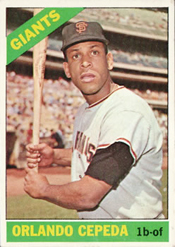
While the sides dickered, details of the talks were leaked to newspapers, irritating Giants owner Horace Stoneham, who killed the proposed deal.
The Cardinals, desperate for a first baseman, stepped in and made their pitch: left-handed starting pitcher Ray Sadecki for Cepeda.
Pain relief
A right-handed batter, Cepeda was a consistent run producer for the Giants after entering the majors in 1958 and earning the National League Rookie of the Year Award. In his first seven seasons (1958-64) with San Francisco, Cepeda averaged 106 RBI and 31 home runs each year.
His right knee, though, ached after he dropped a weight on it during a workout late in 1962. He had knee surgery in December 1964. At 1965 spring training, the knee caused Cepeda “constant pain,” he said in “Baby Bull,” his autobiography.
Manager Herman Franks “kept saying I was faking, that there was nothing wrong with my knee,” Cepeda recalled in his book. “He said it was all in my mind and that I should get my ass on the field and earn some money.”
Cepeda spent most of the first month of the 1965 season on the bench. On May 3, he was sent to bat for Jose Pagan in the seventh inning at St. Louis and flied out to left. “I could barely walk,” Cepeda said in his autobiography. “I had to walk up to the batter’s box using my bat as a cane because my knee hurt so much.” Boxscore
He didn’t appear in another game until August. For the season, Cepeda batted .176 with one home run in 33 games, 27 as a pinch-hitter.
Let’s make a deal
At home in Puerto Rico during the winter, Cepeda worked to get the knee in shape. “I would run in the water, work with weights, then run some more,” he said in his book. “I was like Rocky Balboa training for a shot at the title, working harder than I ever had before. When I arrived in Arizona in the spring (of 1966), I was in the best shape of my life. Even my knee felt good. I was running well.”
However, when the Giants opened the season at home against the Cubs, Herman Franks started Willie McCovey at first base and Len Gabrielson in left. Cepeda, who played both positions, was on the bench. Boxscore
Cepeda finally got a chance to start in the sixth game, as the left fielder, only because the Giants intended to trade him for a left-handed starting pitcher and wanted to show clubs his knee was OK. Boxscore
The Giants’ starting rotation consisted of right-handers Juan Marichal, Gaylord Perry, Bobby Bolin, Bob Shaw and Ron Herbel.
General managers Chub Feeney of the Giants and John Holland of the Cubs met in April to discuss a swap of Cepeda for Dick Ellsworth, the San Francisco Examiner and Chicago American reported. Ellsworth, 26, a Fresno resident, won 22 for the Cubs in 1963 and 14 in each of the next two seasons.
“What a deal that would have been, especially for the Giants, who are dirt-poor for southpaw pitchers,” Fresno Bee sports editor Omer Crane wrote. “Ellsworth, with that Giants power behind him, could win 20 to 22 games.”
Willie McCovey, who had one hit in 20 career at-bats against Ellsworth, said to The Sporting News, “He’s tough for any hitter.”
The trade would have given the Cubs a lineup with four future Hall of Fame run producers: Ernie Banks, Ron Santo, Billy Williams and Cepeda. With Banks stationed at first base, the Cubs would have put Cepeda in left field, John Holland told the Chicago Daily News.
“While Cubs fans thrill at the thought of Cepeda (40 home runs?) in the lineup, they shudder at the suggestion of their otherwise aging pitching staff without the presence of Ellsworth,” the Chicago Tribune noted.
Loose lips sink trades
Herman Franks was pushing for Chub Feeney to make the trade for the Giants, but Cubs manager Leo Durocher wanted John Holland to get more for Ellsworth than Cepeda. Durocher also insisted on proof that Cepeda’s knee was sound.
“Sure, I wanted Cepeda,” Durocher told Dick Young of the New York Daily News, “but I wanted some assurance that his knee was all right. After all, if I give them a pitcher like Ellsworth and then Cepeda’s knee goes pop, what have I got?”
The Giants would make no guarantee, but would permit the Cubs to have their own team doctor examine Cepeda’s knee in advance of a deal.
As for including an outfielder with Cepeda in the trade, Jesus Alou, Ollie Brown and Len Gabrielson were discussed, according to published reports. The Giants were given until two weeks after the season opened to agree to the terms, John Carmichael reported in the Chicago Daily News.
Giants owner Horace Stoneham didn’t like the Cubs’ demands and was miffed that they were leaking details to the newspapers. He told Chub Feeney and Herman Franks to call off the deal.
In the book “The Man Stan Musial Then and Now,” Musial, a Cardinals vice president in 1966, said, “It was common knowledge that a Cepeda-to-Chicago deal had fallen through because the Cubs, giving up Dick Ellsworth, wanted something other than the knee-damaged Cepeda to sweeten the pot. Those of us who knew Horace Stoneham were aware you didn’t push or prod” him.
According to Jack McDonald of the San Francisco Examiner, “Chicago fans are crying in their beer because the Cubs missed the boat on a Cepeda for Dick Ellsworth deal. Every Cubs official wanted it.”
Cardinals swoop in
After the collapse of the discussions with the Cubs, the Giants went after Ray Sadecki, 25, of the Cardinals. A 20-game winner in 1964, Sadecki won just six the next year but looked good in 1966. In April, he was 2-0 with an 0.98 ERA. One of those wins was a five-hitter against the Giants. Boxscore
The Cardinals were dissatisfied with rookie first baseman George Kernek, who lacked power. Cepeda, who slammed a two-run homer against the Cardinals on April 30, appealed to them. Boxscore
However, like the Cubs, Cardinals general manager Bob Howsam tried to get the Giants to include another player with Cepeda in a trade for Sadecki.
In the book “The Man Stan Musial Then and Now,” Musial recalled to collaborator Bob Broeg that “Howsam hedged and vacillated” on making the Sadecki for Cepeda deal until Cardinals executive vice president Dick Meyer, the top aide to team owner Gussie Busch, intervened.
Because of Howsam’s haggling, “We were fearful Horace (Stoneham) would nix the deal with St. Louis, too,” Musial said, “but Dick Meyer, always a sound stabilizing influence, urged Howsam to get along with the deal and to forget trying to get more for Sadecki.”
Getting it done
On May 7 at St. Louis, Cepeda clouted a grand slam against Cardinals starter Art Mahaffey. The next day, during the final game played at the former Sportsman’s Park, soon after Cepeda hit a two-run double against Larry Jaster, the Cardinals and Giants agreed to the Cepeda for Sadecki trade. Boxscore and Boxscore
The Cardinals and Cubs were the winners in the deal.
Cepeda helped the Cardinals win two National League pennants (1967-68) and a World Series title (1967). He received the 1967 NL Most Valuable Player Award.
Immediately after Horace Stoneham stopped the Cepeda trade talks with Chicago, the Cubs contacted the Phillies. On April 21, 1966, the Cubs sent pitchers Larry Jackson and Bob Buhl to Philadelphia for pitcher Ferguson Jenkins, center fielder Adolfo Phillips and first baseman John Herrnstein.
Jenkins developed into an ace and a Hall of Famer. He totaled 167 wins for the Cubs, and remains their career leader in strikeouts (2,038) and starts (347).
“I doubt very much whether we would have made the Philadelphia deal if we’d got Cepeda,” John Holland told the Chicago Daily News, “because we couldn’t afford to send two starters like Jackson and Ellsworth away at the same time.”
Former Cardinals ace Dizzy Dean predicted to United Press International that Sadecki “will give” the Giants the 1966 pennant. However, Sadecki was 32-39 in his four seasons with the Giants, who won no pennants during that time.



the cubs swinging and missing on getting cepeda and then getting Jenkins as a sort of consolation prize…..funny how things work out…kind of hammers home the idea that anything is possible, bust or boom.
Orlando Cepeda hit 29 home runs and produced 96 RBI in 461 career at-bats at Wrigley Field. It would have been fascinating to see how he would have done playing a full season or two there.
Cepeda only once hit three home runs in a game. It occurred at Wrigley Field in 1970 against the Cubs’ Bill Hands: https://www.retrosheet.org/boxesetc/1970/B07261CHN1970.htm
i was just doing a quick scan of cepeda and it looks like the Brits caught him messing around as a switch hitter. his splits on b-ref suggest that he was pretty effective against both righties and lefties.
https://www.britannica.com/biography/Orlando-Cepeda
Yep, righty or lefty on the mound, Orlando Cepeda, a right-handed slugger, was effective against both. His first big-league at-bat in 1958 was against a fellow future Hall of Famer, right-hander Don Drysdale, and his last big-league at-bat in 1974 was against a fellow future Hall of Famer, right-hander Rollie Fingers. Cepeda deprived Fingers of a save with a RBI-single in the ninth, tying the score.
Thanks for posting this Mark. I didn’t know about these trade talks between the Giants and Cubs. I’m glad he ended up in St.Louis but I also wonder what numbers he would have put up playing full time in Wrigley Field. I agree with you that in the end both the Cardinals with Cepeda and the Cubs with Jenkins came away from the trade talks as the winners. If I’m not mistaken the Giants ended up getting their left handed starter picking up Mike Mccormick from the Washington Senators.
Orlando Cepeda’s first game as a Cardinal, ironically enough, Phillip, was at Wrigley Field. He had two hits, including a homer, two RBI and two runs scored against the Cubs’ Bill Faul, a self-styled hypnotist and substitute teacher from Pleasant Plain, Ohio. https://www.retrosheet.org/boxesetc/1966/B05100CHN1966.htm
The Giants reacquired left-hander Mike McCormick (he was with them from 1956-62) after the 1966 season. He was terrific for them in 1967, winning 22 and the National League Cy Young Award, but a starting staff that included Juan Marichal, Gaylord Perry, Mike McCormick and Ray Sadecki still wasn’t enough for the Giants to beat out the Cepeda-led Cardinals for the pennant: https://retrosimba.com/2020/07/09/mike-mccormick-worked-magic-versus-1967-cardinals/
As Harry Carey said on the broadcasts at KMOX:
“Dancing across the plate Cha Cha Cha”- “Don’t spike him boys; he’s the franchise.” It was the harbinger of things to come when they traded The Baby Bull to the Braves. Even though Joe Torre had some great years in St. Louis, the team lost its identity and soul when they traded Cepeda. Busch was a stubborn man who could not get out of his own way. Moreover, the organization was set in their starting pitching until they GAVE away Jerry Reuss, Steve Carlton, and Mike Torrez. I still feel to this day they could have won 2 or three division titles with those three studs. It wasn’t until Whitey Herzog came along that common sense was restored. Whitey was the only person who could talk some sense into Busch. Trading Jerry Reuss over growing a mustache was really foolish.
The mention of Harry Caray reminds me of an anecdote Orlando Cepeda told in his autobiography, “Baby Bull.” When Cepeda got traded to the Cardinals, his wife and son planned to reside with him in St. Louis.
“I didn’t want them to live in a hotel suite … I needed a house,” Cepeda said in his book. “I asked the black players about renting a house in a nice neighborhood but that was still pretty hard (for a person of color) to do in St. Louis. So I talked with Harry Caray, who was announcing the Cardinals games. Harry agreed to mention on the air that I was looking for a house in a nice neighborhood. Over 100 people responded and were eager to help. I settled on a house in Olivette. It was a great neighborhood, almost entirely Jewish. My neighbors couldn’t have been nicer, and the community as a whole couldn’t have been warmer. Lou Brock bought a house there too a short time later.”
Durocher wasn’t keen on Ernie Banks as an everyday player in the Spring of 1966. He had John Boccabella competing for the starting first base job in Spring Training. I don’t know how long Cepeda would have lasted in left field. When the Cardinals’ team physician examined him before the trade, Cepeda showed him the good knee.
Yep, Leo Durocher, in his first season as Cubs manager in 1966, seemed to want to get rid of Ernie Banks.
According to the book “Leo Durocher: Baseball’s Prodigal Son” by Paul Dickson, “In late April (1966), Banks was benched by Durocher, who even prevented him from taking batting practice on an off day. Banks was batting under .200 when he was taken out of the lineup, but Leo made matters worse by what he said the next day to Dick Young of the New York Daily News. Young had asked Durocher if Banks was through, and Leo blithely suggested that it might be the end of the road for (Banks) … He said that Banks had developed a hitch in his swing and was no longer whipping his bat around. He also charged Banks with bailing out of the batter’s box on inside pitches.”
Durocher criticized Banks in clubhouse meetings. “I can trade you if I like,” Durocher told him.
In his autobiography “Nice Guys Finish Last,” Durocher said of Banks, “He was a great player in his time. Unfortunately, his time wasn’t my time.”
(Banks, though, outlasted Durocher with the Cubs.)
Here’s the story on Orlando Cepeda showing his good knee, rather than the surgically repaired one, when the Cardinals’ doctor examined him before the trade: https://retrosimba.com/2016/05/11/cardinals-rolled-out-welcome-mat-for-orlando-cepeda/
These trades are among my earliest memories of baseball. I do recall these players swapping jerseys. The Cards and Cubs definitely prevailed making the moves they did. Chicago really did pivot quite nicely to improve their organization in this scenario.
When the Phillies traded Ferguson Jenkins and two others to the Cubs for starting pitchers Larry Jackson and Bob Buhl in April 1966, the consensus among the Philadelphia area newspapers was that the Phillies had made a great deal.
Stan Hochman, Philadelphia Daily News: “So what if Larry Jackson is going to be 35 years old in June. So what if Bob Buhl will be 38 in August … The first guy to suggest that the Phillies gave up promising youth for struggling age is going to get rapped over the head with a bottle of vintage wine.”
Larry Merchant, Philadelphia Daily News on Jackson and Buhl: “If they were 101 years old each, it would still be impressive for a pitcher-short pennant contender to acquire them for three unproven players who don’t figure to contribute much in the immediate.”
Rich Westcott of the Delaware County Daily Times of Chester, Pa., called the trade “a colossal burglary … and the Phillies should reap endless benefits from it this season.”
According to the Chicago Tribune, the Cubs “tried hard” to get the Phillies to include Dick Allen in the deal but failed.
Geez, the Cubs weren’t asking for much asking for Allen were they? I guess if you don’t at least ask you’ll never get what you want. Those Philly beat writers got beat up over those observations…
One more twist to the tale: After that 1966 season, the Cubs traded Dick Ellsworth … to the Phillies! (The Cubs got pitcher Ray Culp in return.) Ellsworth lasted one season with the Phillies, posting a 6-7 record, got dealt to Boston and won 16 for the 1968 Red Sox.
And who was the loser? Obviously the Giants. It’s hard to imagine any team would be shopping Orlando Cepeda around.
Between 1958 and 1964, Orlando Cepeda and Willie Mays combined to hit 488 home runs, nine more than Hank Aaron and Eddie Mathews hit for the Braves during that span.
In Mays’ authorized biography, “Willie Mays: The Life, The Legend,” author James S. Hirsch noted, “Mays was disappointed by the trade (of Cepeda), in part because the Cardinals sent the Giants pitcher Ray Sadecki, whom Mays had always hit well.”
Mays batted .365 (27 for 74) with five home runs versus Sadecki.
1965 Tacoma and 1966 Phoenix were absolutely stacked with talent, and more was on the way–a 20-year-old Bobby Bonds was in Double A.
Problem with the Giants (just my opinion) is that Stoneham had to be pushed and prodded into doing anything. Hating to be embarrassed and hating publicity is OK if you’re running a small accounting firm but it’s not OK if you’re running a major league franchise in a top ten market.
It was inevitable Stoneham would wind up broke and the Giants faltering just as Charlie Finley’s Athletics were making their move.
I agree with your assessment of Horace Stoneham. To support your point, another example is Candlestick Park. Its harsh conditions were a factor in the Giants falling short so often in the 1960s. Stoneham was advised to renovate Seals Stadium, including adding an upper deck, rather than build (with public funds) at Candlestick. Seals Stadium was a gem of a location. However, Stoneham was concerned about parking. He got plenty of parking at Candlestick but it was a difficult place to play (and watch) 81 games a year. He didn’t do enough due diligence in choosing a good location for a new ballpark.
As a Braves fan, I was disappointed when they traded Joe Torre for Orlando Cepeda; I was 10 years old at the time. Still, I enjoyed Cepeda’s time with the Braves; he hit 34 homers in 1970, but his knees gave out on him in 1971. Ray Sadecki moved on to San Francisco, where he gave up the second of Tony Cloninger’s grand slams later in the 1966 season. (Sadecki also homered in that game.) In an ironic twist, Sadecki made a brief return to the Cardinals in 1975 in the trade that sent Torre to the Mets. Paul Richards was seen by many (himself included, apparently) as some sort of baseball genius, but I believe his time with the Braves provides much evidence to the contrary. Another good post, Mark.
Like Orlando Cepeda in March 1969, Ray Sadecki was traded by the St. Louis Cardinals to the Atlanta Braves in May 1975. The deal was Sadecki and Elias Sosa for Ron Reed and Wayne Nordhagen.
Sadecki, 34, pitched in 25 games for the 1975 Braves and was 2-3 with a 4.21 ERA. He was better as a reliever (1-1, one save, 2.72 ERA in 20 games) than as a starter (1-2, 6.00 ERA, 5 starts).
His first start for the Braves came at St. Louis. The score was 2-2 in the eighth when Reggie Smith smacked a two-run triple against Sadecki and St. Louis won.
On July 5, Sadecki pitched eight innings at the Astrodome in a 4-3 win versus Houston. Sosa got the save.
Sadecki’s save for the Braves came against the Cardinals in Atlanta on Aug. 14. He pitched two scoreless innings, including escaping a bases-loaded, none out jam in the eighth, to save the win for Phil Niekro: https://www.retrosheet.org/boxesetc/1975/B08140ATL1975.htm
In September 1975, Sadecki was on the move again. The Braves sent him to Kansas City (his hometown) to complete a deal for Bruce Dal Canton, Norm Angelini and Al Autry.