During a three-year stretch (1950-52), when pitchers such as Warren Spahn and Robin Roberts dominated the National League, none was tougher for the Cardinals to solve than Dave Koslo of the Giants.
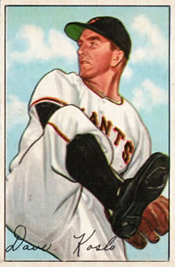 As The Sporting News put it, “His specialty was beating the Cardinals.”
A left-hander who relied on pitch location rather than velocity, Koslo won 13 consecutive decisions versus the Cardinals from June 1950 to July 1952.
Of Koslo’s 92 National League wins, 24 (or 26 percent) came against St. Louis.
In his autobiography, “Stan Musial: The Man’s Own Story,” Musial said, “We helped keep Dave Koslo in the league.”
Name of the game
George Bernard Koslowski was born to Polish immigrant parents Stanley and Theodosia in the Wisconsin town of Menasha. (The town’s name is derived from a Menominee Indian tribe word meaning little island.) A paper mill center, Menasha is located on the Fox River and Lake Winnebago, 100 miles north of Milwaukee.
A quiet youth, Koslowski raised pigeons, liked polkas and was adept at athletics. He was in his teens when an uncle, Julian Konetzke, taught him how to pitch, according to The Sporting News. Koslowski caught on fast and began playing semipro baseball for the Menasha Polish Falcons of the Fox River Valley League.
At a tournament in Milwaukee, a scout, Richard (Red) Smith, signed Koslowski to a pro contract with the Class D Hopkinsville (Ky.) Hoppers for the 1939 season.
A newspaper reporter advised Koslowski he’d get his name in the headlines more often if he’d shorten it. According to the Stevens Point (Wisc.) Journal, George consulted with his father, a printer, who said, “How about Dave Koslo?”
The name stuck.
Advancing quickly, Koslo, 21, joined the Milwaukee Brewers of the American Association in 1941. The Brewers, having financial trouble, hoped Koslo would pitch well enough so his contract could be sold to a big-league team. As Milwaukee manager Bill Killefer said to The Sporting News, “He’s our pot of gold.”
Killefer, former manager of the Cubs and Browns, had been Grover Cleveland Alexander’s catcher with the Phillies (1911-17) and knew a thing or two about pitching. Koslo impressed him. “I’ll tell you why Koslo is ready for our league,” Killefer told Sam Levy of the Milwaukee Journal. “He has poise, brains and, what’s more, he’s a cold-blooded cuss.”
Koslo led the 1941 Milwaukee club in wins (13), innings pitched (203) and complete games (15). A scout, Hank DeBerry, who had been Dazzy Vance’s catcher with Brooklyn, recommended Koslo to the Giants, who paid Milwaukee $10,000 for his contract.
Koslo joined the Giants for the last month of the 1941 season and got his first win with a complete game against the Braves at Boston. Boxscore
Ups and downs
A three-year stint (1943-45) in the Army interrupted Koslo’s baseball career. In his first year back with the Giants (1946), he worked 265 innings for a last-place club. His first winning season in the majors was 1947 (15-10). In January 1948, Koslo had surgery to remove bone chips in his left elbow, but was pitching for the Giants three months later.
Koslo had an unusual 1949 season, posting the best ERA in the National League (2.50), issuing the fewest walks (1.82) per nine innings but compiling an 11-14 record. The Giants didn’t score in five of those defeats and managed just one run in four others.
It wasn’t until 1950, though, that Koslo became a consistent Cardinals killer and, as Stan Musial said in his autobiography, “cast quite a spell over us.”
Cardinals nemesis
In his 13 wins in a row against the Cardinals from June 22, 1950, to July 22, 1952, Koslo pitched three two-hit shutouts. Boxscore Boxscore Boxscore
For a while, it seemed he could do no wrong when facing St. Louis. In his second win of the streak, Koslo, a career .109 hitter, produced two hits and three RBI, scored twice and pitched a complete game. He also had two hits, two RBI and a run scored in the 12th win of the streak. Boxscore Boxscore
Even Stan Musial was stymied. In 1950, when he led the National League in hitting at .346, Musial batted .167 against Koslo. In 1951, when Musial repeated as NL batting champion at .355, he batted .130 against Koslo, including a stretch of 17 consecutive at-bats without a hit.
“He had control and he could win at the Polo Grounds because he could keep the ball low and away,” Musial said in his autobiography. “He wasn’t overpowering, didn’t have what you could call a good curve, but wouldn’t walk anybody. He was awful tough for me for a time.”
(As usual, Musial adjusted, though. He hit .412 against Koslo in 1952 and .308, with 10 doubles and five home runs, for his career.)
Musial wasn’t kidding when he said the Cardinals kept Koslo in the National League. A breakdown of Koslo’s records shows:
_ 1950, 4-1 versus the Cardinals; 9-14 versus the rest of the league.
_ 1951, 4-0 versus the Cardinals; 6-9 versus the rest of the league.
_ 1952, 5-1 versus the Cardinals; 5-6 versus the rest of the league.
Bob Broeg of the St. Louis Post-Dispatch described Koslo as “a cunning Carl Hubbell against the Cardinals and pretty much a humpty-dumpty otherwise.”
Big stage
Koslo’s biggest win, though, came against the Yankees, not the Cardinals.
Thirty minutes after Bobby Thomson hit the walkoff home run against the Dodgers’ Ralph Branca that clinched the National League pennant for the 1951 Giants, manager Leo Durocher told Koslo he would start Game 1 of the World Series the next day at Yankee Stadium.
It was a daring choice. Koslo hadn’t made a start in two weeks. The New York Daily News called him “little more than the No. 6 starter on the club” and “a second-line pitcher who had been an ill-fitting cog most of the year.”
The Giants had big winners on their staff _ Sal Maglie (23 wins), Larry Jansen (also 23), Jim Hearn (17) _ but all three appeared in the playoff series against the Dodgers and Durocher ruled them out for the World Series opener.
A special feature of the 1951 World Series was the presence of Joe DiMaggio (center field) and Mickey Mantle (right field) for the Yankees and Willie Mays (center field) for the Giants. It was the only time all three appeared in games together. Mantle and Mays were rookies. DiMaggio was closing out his career.
Amid the glitter, Koslo stole the Game 1 spotlight. DiMaggio and Mantle went hitless. Yogi Berra was limited to a harmless single. Finding the outside corner with sinkers, Koslo pitched a complete game in the Giants’ 5-1 victory.
“He never actually fooled us,” DiMaggio said to the Daily News, “but he kept us off balance continually.” Boxscore
Koslo also started Game 6 at Yankee Stadium. With the score tied at 1-1 in the sixth, Hank Bauer hit a two-out, bases-loaded triple against him and the Yankees went on to win, 4-3, clinching their third consecutive World Series title. Boxscore
Koslo always returned home to Menasha after the baseball season. (He delivered mail during the holiday rush, according to the Stevens Point Journal.) When he got home in October 1951, Koslo was given a hero’s welcome for being a member of the National League champions and winning a World Series game.
Menasha held a parade in his honor. Escorted by three marching bands and a squadron of police cars with sirens blaring, Koslo stood in a convertible, happily puffing on a cigar and waving to the nearly 4,000 people who lined the main street, the Appleton Post-Crescent reported.



i was wondering yesterday if pigeons get so close to us humans because we treated them so well, caring for them like Dave Koslo. I see in different places around town where people leave piles of bird seed for pigeons though some people call them flying rats. i like pigeons like i liked learning about Koslo’s strange dominance over the cardinals which is interesting because cardinals are birds and so are pigeons. i love crafty pitchers, my all-time favortie is righty marco estrada, a change up wizard. our high school baseball coach was named Koslowski..he kept his last name. i think i would keep my last name too.
I think you are onto something about the pigeons and the cardinals, Steve. Dave Koslo pitched briefly for the Orioles in 1954, too.
The scout who signed George Koslowski also signed George’s brother, Herbert Koslowski, a catcher, and the brothers both were assigned to Hopkinsville. No one asked Herbert to change his name, though, because he hit .136 and wasn’t in the headlines.
Several other Koslowskis have played minor-league baseball, but only George (Dave Koslo) made the majors.
In 2024, Benedictine University in Illinois had a pitcher named Kash Koslowski and he, no doubt, tried to kompile the K’s.
i like the name Davo Koslo rhyming with combo like a burger and fries as well as cosmo like that CCR album, Cosmo’s Factory. I think i’ll give that another listen this morning…”down the road I go”…..and Kash Koslowski kompiling the k’s…i love it and i wonder how he made his kash?
Always fascinating when one guy literally has owned another team, but can’t get anyone else out otherwise. Kudos to him for delivering the mail against the Cardinals, as well as in his home town during the holidays. Love the fact they had a parade in his honor. Right place and time for Dave to craft that Game 1 masterpiece.
I like your line about Dave Koslo delivering the mail on the diamond and at home…
There was one other team Koslo did consistently well against. Naturally, it was the Phillies. He was 13-8 against them. On July 7, 1949, at the Polo Grounds, Koslo hit two home runs, driving in five, and got the complete-game win against the Phillies: https://www.retrosheet.org/boxesetc/1949/B07070NY11949.htm
Well, of COURSE it was the Phillies.🤣Thanks, Mark!
The dominance that Dave Koslo had over the Cardinals is really impressive if you take into consideration that the Cardinals went 100-94 against lefthanded pitchers from 1950 to 1952. I really enjoyed Stan Musial commenting about his troubles against Dave Koslo. It doesn’t surprise me though that he figured him out and began to hit against him. Just curious Mark. Did Stan Musial ever mention what he began to do differently against Koslo? The World Series victory in game 1 must have shocked the entire baseball world. You can’t help but feel happy that an underdog like Dave Koslo had his moment of glory. Sorry to hear that he had health problems and passed away far to early.
Thanks for doing the research that shows the Cardinals’ record versus left-handers from 1950-52, Phillip. It helps illustrate how amazing it was then for Dave Koslo to win 13 in a row against St. Louis in that period.
Yes, in his autobiography, Stan Musial, in his humble way, gave an indication of his turnaround versus Koslo: “I saw so much of him that I began to have better luck with him,” Musial said. “Every time he would try to jam me inside, I’d swing at the ball and managed to fist a few home runs that weren’t hit well enough, but which went just far enough.”
One more note on Koslo and the Cardinals: The last pitch Koslo threw in the majors was walloped by Bill Virdon for a walkoff home run. In the Cardinals’ 1955 home opener, the score was tied when Koslo entered the game in the 11th. The first batter he faced was Virdon, playing in his second big-league game. Virdon hit the ball atop the pavilion roof for his first big-league homer and first big-league RBI. Koslo never appeared in another game: https://www.retrosheet.org/boxesetc/1955/B04140SLN1955.htm
“He never actually fooled us, but he kept us off balance continually.” Isn’t keeping them off balance fooling them? Oh well, who am I to quibble with Joe D.? Anyway, not many pitchers held Stan the Man to such lowly averages, I’m sure.
Anytime I see or hear talk of a pitcher dominating a particular team, I think of rookie Larry Jaster, who led the NL in shutouts in 1966 with five–all five against the eventual pennant-winning Dodgers.
Good post, as always, Mark.
Joe DiMaggio recovered from that 0-for-4 skunking in Game 1, producing six hits (including a home run), two walks and five RBI in the six-game 1951 Series. In the final at-bat of his career, against Larry Jansen in the eighth inning of Game 6, DiMaggio doubled: https://www.retrosheet.org/boxesetc/1951/B10100NYA1951.htm
Thanks for mentioning Larry Jaster. You are correct: his dominance of the Dodgers was a lot like Dave Koslo’s dominance of the Cardinals. Here’s my post on Jaster’s five shutouts vs. the 1966 Dodgers: https://retrosimba.com/2016/09/24/how-cardinals-rookie-larry-jaster-dominated-dodgers/
That’s pretty crazy. In 1952, the Cardinals were the only team he beat!
My awkward sentence structure must have confused the issue. Sorry about that. Dave Koslo was 10-7 for the 1952 Giants. He was 5-1 vs. the Cardinals, 2-2 vs. the Braves, 1-0 vs. the Pirates, 1-1 vs. the Reds and 1-3 vs. the Cubs.
He almost had a sixth win vs St. Louis that season. On Aug. 22 at St. Louis, Koslo held the Cardinals to one run (unearned) in seven innings, but the Cardinals rallied against the bullpen and won, 3-1: https://www.retrosheet.org/boxesetc/1952/B08220SLN1952.htm