As a newspaper sports columnist, Larry Jackson had an edge over contemporaries such as Red Smith, Jim Murray and Shirley Povich. He not only wrote about Jackie Robinson, he pitched against him.
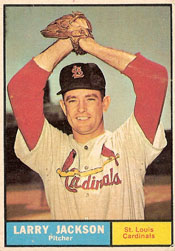 Think it’s pressure to face Hank Aaron with the game on the line? Try filing a basketball story when the game ends after 11 p.m., you have a 30-mile drive in sleet or snow to the newspaper office and a 1 a.m. deadline.
Larry Jackson did both of those jobs.
After pitching in spring and summer for the Cardinals during the 1950s, Jackson went home to Boise each winter for eight years and worked as a sports reporter for the Idaho Statesman, covering games and writing columns for the daily newspaper. Part of the time he was sports editor of the evening edition.
Pitching in the big leagues and toiling as a journalist for his state’s most prominent newspaper were just part of Jackson’s eclectic career. After his baseball days, he was elected to the Idaho state legislature and served four terms.
Larry’s brother, Dennis Jackson, said to the Idaho Statesman, “We were raised by a mother who believed that you participated, not just in sports but in your state and city. There was no sitting on sidelines for Larry.”
Learning to pitch
Larry Jackson was born in Nampa, a railroad town in Idaho’s Canyon County and home to the Snake River Stampede Rodeo. He was 6 when he moved with his siblings and parents, Lawrence and Aldythe, to Boise.
As a teen, Jackson developed blood poisoning, or sepsis, after a hike and a swim. He recovered and became an athlete. In football, Jackson was starting tailback for Boise Junior College (now Boise State University). In baseball, he played shortstop in high school, then took up pitching in American Legion and semipro games.
Cardinals scout Ollie Vanek signed him for $5,500 in 1951. “It seemed like a lot of money,” Jackson told the Idaho Statesman. “I didn’t sign with the idea of being a major-league pitcher.”
At Class C Fresno in 1952, Roland LeBlanc, the team’s manager and catcher, taught Jackson to be a pitcher rather than a thrower. A quick study, Jackson won 28 for Fresno in the regular season and four more in the playoffs.
Advancing up the Cardinals’ farm system, Jackson developed a sinker, a hard slider and a reputation for completing what he started. The Sporting News described the right-hander as “a stylish workaholic.”
A danger to Dodgers
Jackson is one of a small number of Idaho natives to reach the majors. The list includes Hall of Famer Harmon Killebrew, father and son Vern and Vance Law, and Cardinals players Ken Dayley, Mike Garman and Joe Mather.
In Jackson’s big-league debut in April 1955, the Cardinals scored 10 runs in the first and he did the rest, pitching a four-hitter against the Cubs. Boxscore
A month later, Jackson got his first shutout against a Dodgers lineup that featured future Hall of Famers Pee Wee Reese, Duke Snider, Roy Campanella, Gil Hodges and Jackie Robinson. Boxscore
As a Cardinal, Jackson was a terror versus the Dodgers and especially Duke Snider. On Aug. 4, 1958, Jackson beat the Dodgers for the eighth consecutive time. He struck out 12, including Snider four times. Boxscore
For his career, Snider batted .219 with 22 strikeouts against Jackson. Yet, on March 27, 1961, Jackson suffered a fractured jaw when Snider’s bat splintered and struck the Cardinals pitcher in the face during a spring training game.
In eight seasons with St. Louis, mostly as a starter, Jackson posted a 101-86 record with 20 saves. The Cardinals’ best player, Stan Musial, told Dan O’Neill of the St. Louis Post-Dispatch, “He was a very good pitcher on some mediocre teams. We weren’t very good in the ’50s but he was the ace of our staff.”
After Jackson won 18 in 1960, the Cardinals offered him and others to the Yankees for Whitey Ford, Elston Howard and Ryne Duren, but were rejected.
Sports scribe
Starting with his early teen years, Jackson worked a variety of jobs in Boise when he wasn’t playing sports. “At 14, I was a bellhop, passing out booze and hauling suitcases at the Idanha Hotel,” Jackson recalled to the Idaho Statesman. “There was an old Basque fellow who bootlegged whiskey there and had a locker downstairs. When he wasn’t around, I was to open up the locker so Air Force guys (from a nearby base) could have a bottle of liquor.”
Jackson also tried his hand at being a chimney sweep, a furnace cleaner and a highway sign painter, according to The Sporting News.
After entering pro baseball, he looked for winter work at the Idaho Statesman. “I started as a gofer in the sports department,” Jackson told the newspaper in 1982, “and worked my way into covering games and writing columns … It took me longer than the average guy to do the story and box scores.”
His coverage included the 1954-55 College of Idaho basketball team that featured the dynamic duo of Elgin Baylor and R.C. Owens. Like Jackson, Baylor and Owens went on to have successful pro sports careers _ Baylor as a power forward with the NBA Lakers and Owens as a wide receiver with the NFL 49ers.
Jackson’s sports columns in the Idaho Statesman appeared under the heading “Jackson Jottings” and covered topics as wide-ranging as bowling and fishing, but most were about baseball. A sample:
_ On Jackie Robinson: “Robinson owes no more than he has already given to baseball … As a player, Robinson was outstanding … He was a hustling, determined ballplayer … very tough with men on bases.”
(Like many Dodgers, Robinson found Jackson hard to solve. A career .311 hitter, Robinson batted .238 versus Jackson.)
_ On Del Ennis, a slugging outfielder acquired by the Cardinals from the Phillies in November 1956: “Whether his hitting … will more than make up for his limitations in the outfield is something that will have to be seen.”
(Ennis produced 24 home runs and 105 RBI for the 1957 Cardinals.)
_ On his prediction for the 1957 season: “The Cardinals are a cinch for fourth place and may do better.”
(St. Louis finished in second place at 87-67.)
With Jackson and Jim Brosnan, the 1958-59 Cardinals may have had the best pair of writers on any pitching staff. Brosnan wrote columns for the Post-Dispatch during the Cardinals’ tour of Japan, and authored two classic baseball books, “The Long Season” and “Pennant Race.”
On the move
In October 1962, the Cardinals traded Jackson, Lindy McDaniel and Jimmie Schaffer to the Cubs for George Altman, Don Cardwell and Moe Thacker. The Cardinals hoped Altman would provide steady left-handed power but he lasted one season with them. McDaniel had 13 wins and a league-leading 22 saves for the 1963 Cubs. Jackson was the league leader in wins, with 24, for the 1964 Cubs.
(The Cardinals managed to make good on the deal, flipping Cardwell with Julio Gotay to the Pirates for Dick Groat.)
In April 1966, Jackson was sent to the Phillies in the trade that brought Ferguson Jenkins to the Cubs. Though Jackson wasn’t a Hall of Famer like Jenkins would become, he wasn’t a dud. He had 15 wins and five shutouts for the 1966 Phillies. In his last season, 1968, Jackson, 37, had a 2.77 ERA in 243.2 innings pitched.
Jackson asked the Phillies to trade him to a team closer to Idaho. Instead, they exposed him to the expansion draft in October 1968. When the Expos chose him, he decided to quit playing rather than pitch for Montreal.
Though he never pitched for a pennant winner, Jackson totaled 194 big-league wins, including a 21-2 career mark against the Mets. He achieved double-digit win totals each season from 1957-68, never winning fewer than 13 a year.
Political games
Back home in Boise, after stints as a lobbyist and publicist for a building supplies manufacturer and selling insurance, Jackson ran for state office in 1971. A Republican, he served eight years in the state legislature as the representative from Idaho’s most populous county.
A former Cardinals pitching teammate, Wilmer “Vinegar Bend” Mizell, a Republican, became a U.S. congressman in North Carolina, serving three terms (1969-75). “Wilmer and I used to talk a lot when we were teammates, but never about politics,” Jackson told the Associated Press.
In 1978, Jackson sought the Republican nomination in the Idaho governor race but was opposed by an arch-conservative movement within the party.
As Idaho Statesman political editor Steve Ahrens explained to John Husar of the Chicago Tribune, “He (Jackson) is a moderate Republican and the state is in the midst of a very conservative mood. There is an initiative on the ballot that would reduce the property taxes to one percent of market value. It is the most popular initiative in Idaho history but, for a number of complicated reasons, Jackson can’t stomach it, and so he’s in trouble.”
Jackson opposed the extreme property tax reduction because it would eliminate the source of funding for many public services. “I believe that government has two responsibilities _ a good education program and delivering vital services, such as police, water, highways and public health,” Jackson told the Chicago Tribune. “After that, I become very conservative.”
Regarding his reputation as a moderate, Jackson said to the Chicago newspaper, “Being a moderate in Idaho would make me an ultra-conservative in New York.”
In a bid to appeal to far-right voters, Jackson appeared in print advertisements with a hunting rifle and the words, “Larry Jackson, ready to shoot down government spending.”
Jackson lost his bid to become the 1978 Republican nominee for governor. The party instead chose Allan Larsen, a potato farmer. In the November general election, the incumbent Democrat, John Evans, defeated Larsen with 58.7 percent of the vote.
Eight years later, in the 1986 Idaho governor race, Jackson endorsed the Democrat, Cecil Andrus, over Republican nominee David Leroy. Andrus had served as Idaho governor from 1971-77 before becoming U.S. Secretary of the Interior in the administration of President Jimmy Carter. Leroy was a former prosecutor.
Republicans criticized Jackson for his endorsement, but in the November 1986 general election Andrus defeated Leroy with 49.9 percent of the vote.
Jackson “was eager to serve his state and always did so with dignity and integrity,” Andrus said to the Idaho Statesman. “He always played it straight.”



it’s exhausting to think of all Larry Jackson did in one lifetime. wakes me up today! what a gem! thanks for this. i did a double take of joy reading about the Basque guy who bootlegged whisky and Larry’s job to serve the air force. That musta been one crazy time and that it was illegal musta made it even more enjoyable. Great research done on his political career too. That takes guts to get into politics. Too bad more people like Jackson don’t run…..for political office that is, not the other running like Zola Budd, a distant cousin of Tony Franklin and the barefoot contessa!
Thanks, Steve. Nothing like a RetroSimba missive to jolt you awake in the morning!
Maybe Larry Jackson might have tried long-distance running if he’d had the time. No, wait, I just remembered: Most pitchers can’t stand running.
Absolutely Vodka! Your monday posts turn monday into a welcomed day Mark and Mondays, well you know. The only pitcher I recall who loved running was Nolan Ryan, but he was an anomaly. how did he manage to not get arm troubles along the way. amazing…all those innings. all those walks. all those strikeouts.
Your stories are always chock full of facts. There is always at least one that catches my eye and makes me do a double-take. In this one it’s Elgin Baylor playing for the University of Idaho!
Thanks, Ken. In doing the research for this post, I, too, was surprised to learn of Elgin Baylor playing for an Idaho school before going to the University of Seattle. After high school in Washington, D.C., Baylor received no basketball scholarship offers from major colleges. The College of Idaho offered him a football scholarship. That’s how he ended up there, though he never played football for Idaho. After one season there, Idaho fired the basketball coach. So Baylor departed and went to Seattle. Over three collegiate seasons, one at the College of Idaho and two at Seattle, Baylor averaged 31.3 points per game and 19.5 rebounds per game. He led the NCAA in rebounding for both the 1956–57 and 1957–58 seasons.
Assume racism had something to do with the no scholarship offers.
Yes, it was the primary factor. Even the public high schools Elgin Baylor attended in our nation’s capital were racially segregated.
Another great post Mark. Larry Jackson sure was a busy man off the field. I would also like to say that he set a very good example. Just my humble opinion, but one of the worst kinds of apathy and indifference is in regards to politics. With the current political situation all of us need to get involved. But to get back to the more lighter side of baseball, I like what Stan Musial had to say about Larry Jackson. And it’s all true. With a bit more run support and a bit more luck Larry Jackson could have very easily been a 20 game winner for St.Louis.
Thanks, Phillip. I agree with all of your points.
The best way for people to get involved politically is to vote. It’s why the bullies, racists and tyrants do all they can to surpress the vote.
In 1960, the year he won 18 for the Cardinals, Larry Jackson got no decisions in at least three games in which he pitched well enough to win. On June 26 against the Phillies, he gave up two runs in 10 innings, but Philadelphia won, 3-2, against Ernie Broglio in the 12th. On July 25, Jackson pitched seven innings and allowed two runs against the Pirates, but Pittsburgh won, 4-2, against Ron Kline. On Sept. 5, Jackson allowed one run in 7.1 innings but the win went to Lindy McDaniel when the Cardinals prevailed against the Cubs, 2-1, in 10.
Larry Jackson was quite a fellow. I remember the days of yore when pitchers went nine innings and you could go to the polls and vote for a Republican in one race and a Democrat in another because there wasn’t very much difference in what they wanted to accomplish, which was doing what they felt was in the best interest of the country, not their party. We could use a few more Larry Jacksons today–both in MLB and at the ballot box.
In 2026, no big-league pitcher had two complete games. A Chicago White Sox shortstop struck out 227 times. A team with an 81-81 record was declared a division champion and given a spot in the playoffs. The standard for what qualifies as excellence in baseball and in the White House has sunk to pathetic lows.
Great post. Thank you!
Thanks for reading and for commenting.
I think Larry was a better player than some might think based upon this post’s information, Mark. He most definitely had a varied and interesting life off the field as well. He’s one of those players who retired just around the time of my earliest baseball memories, but because of his time with the Phils, one I do recall.
In 1967, Bill Conlin of the Philadelphia Daily News wrote of Larry Jackson, “He is 36, an age when a baseball player is trying to hang on, but the Phillies pay him $40,000 a year to pitch like a man 26. There is nothing that suggests a twilight air about Larry Jackson. Jackson lacks Chris Short’s tremendous stuff. He doesn’t have Jim Bunning’s magnificent stage presence. He has the club fighter’s instinct and the matador’s pride _ and he knows how to pitch.”
Tony Taylor told Conlin, “When I play second base, the man I like to have pitching in front of me is Larry Jackson. You look at him in a tight jam and say to yourself, ‘Everything will be all right. This man knows how to win. He believes in himself.’ “
Fascinating read, though I have to laugh at the description of him as an “ultra-conservative in New York” just for being a moderate in Idaho. Sounds like typical Idaho politics then and now. Crazy that he endorsed Andrus over Leroy later on, too… the guy really marched to the beat of his own drum.
Thanks for reading. I enjoyed your comments.
One reason Larry Jackson endorsed Cecil Andrus for governor was Andrus’ stance in support of land conservation. “I want my son to have the same land to hunt and fish and live in that I have,” Jackson told the Philadelphia Daily News. “I wonder if it will be the same. My dad had more than I had. My son will probably have to settle for less.”