Willie McCovey was frustrated. What’s with these pitchers and managers, he wondered? Why don’t they throw him strikes? What’s with those defensive shifts?
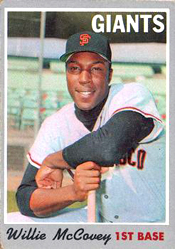 It was early in the 1970 season. McCovey was perhaps the most feared hitter in the National League. He won the 1969 NL Most Valuable Player Award. Led the league in home runs and RBI. Now pitchers preferred to walk him instead of challenge him, and fielders filled the right side of the diamond when the Giants’ left-handed slugger came to the plate.
McCovey was pressing, swinging at slop and trying too hard to slam the ball past the gimmicky alignments. His batting mark sunk below .200. He’d had enough.
On May 3, 1970, McCovey settled into the batter’s box in the first inning at Candlestick Park and saw a phalanx of Phillies fielders bunched on the right side, like mussels clustered on a rock in San Francisco Bay.
He looked to the left and saw only an umpire.
McCovey chose to do something that was as abnormal to him as rooting for the Dodgers. He bunted _ and got a double.
Power supply
From the moment he came to the majors and got four hits, including two triples, in his debut game against future Hall of Famer Robin Roberts, McCovey’s swing sent shivers through the National League.
In 22 big-league seasons, McCovey totaled 521 home runs and 1,555 RBI. He belted 41 homers against the Cardinals, including a 1966 clout some consider to be the longest ever hit at Busch Memorial Stadium. Even at age 41, in 1979, he was a force, blasting a walkoff homer to beat St. Louis.
McCovey hit .301 (with three homers) against Steve Carlton, .290 (seven homers) versus Bob Gibson and tormented Don Drysdale (.336 with 12 homers). “He’d climb out of a hospital bed just to bat against me,” Drysdale said, according to the St. Louis Post-Dispatch.
Stretch, as McCovey was called, reached his peak in 1969 when he led the league in homers (45), RBI (126), on-base percentage (.453) and slugging (.656). McCovey also hit .320, scored 101 runs and struck out a mere 66 times.
That was the first of four consecutive seasons McCovey received the most intentional walks in the league. The 45 intentional passes he got in 1969 were 26 more than the runner-up, Hank Aaron, with 19.
In addition, teams tried defensive shifts in a bid to cut down his extra-base hits to the outfield and singles through the infield.
At San Francisco in June 1969, Reds manager Dave Bristol utilized a four-man outfield against McCovey. Shortstop Darrel Chaney moved to straightaway center, center fielder Pete Rose shifted to right-center and right fielder Bobby Tolan played along the line. Third baseman Tony Perez joined second baseman Tommy Helms and first baseman Lee May on the right side of the infield. Only left fielder Alex Johnson remained on the left side of the field.
(In 1954, another Reds manager, Birdie Tebbetts, also used four outfielders with Stan Musial at the plate for St. Louis.)
Double trouble
After his MVP season “most of the league’s managers rearranged their defenses for McCovey” in 1970, the San Francisco Examiner reported.
McCovey batted .192 in April 1970 but his on-base percentage for the month was .404. He had 26 walks (eight intentional) with 14 hits (eight for extra bases).
“Pitchers just refuse to give me anything much to hit,” McCovey told The Sporting News. “Then sometimes I get overanxious and swing at bad pitches.”
In the opener of a Sunday doubleheader at home on May 3, McCovey went hitless, dropping his season batting mark to .193, and then received his 1969 MVP award in an on-field ceremony between games.
The Phillies went into a shift when McCovey came to the plate in the first inning of Game 2. Willie Mays, three days away from turning 39, was the runner on first, with one out. Pitching for the Phillies was left-hander Woodie Fryman, who, shift or no shift, was tough on McCovey. (For his career, McCovey hit .190 with no homers and 14 strikeouts versus Fryman.)
Third baseman Don Money had moved to the right side of the infield. McCovey bunted a Fryman pitch down the third-base line. When the ball hit the artificial turf, which was installed at Candlestick Park that spring, it picked up speed and skimmed past the bag and down the line in left field.
Willie Mays, hurtling around the bases like a runaway trolley car, scored easily, and by the time left fielder Tony Taylor got to the ball, McCovey had a double, laughing as he cruised into second.
In 2018, recalling the play to his listeners, Giants broadcaster Jon Miller said, “To this day it was the most outstanding thing I’ve ever seen in a baseball game.”
Rattled, Woodie Fryman gave up a home run and a triple to the next two batters, Ken Henderson and Al Gallagher, and was removed from the game.
“I’m not going to do it as a regular thing,” McCovey said of his bunt to Jim McGee of the San Francisco Examiner. “If I kept bunting like that, they’d make me a leadoff man. Can you imagine me being the next Matty Alou?” Boxscore
Mac is back
Energized, McCovey returned to his MVP form. On May 10, 1970, he drove in six runs against the Mets with a two-run homer off Nolan Ryan and a grand slam, the 12th of his career, versus Tug McGraw. Boxscore
McCovey had 26 RBI in 20 games in May; 10 homers and 28 RBI in August.
In a Sept. 7 game at San Francisco, Reds manager Sparky Anderson tried a shift with six outfielders against McCovey. Shortstop Dave Concepcion and second baseman Tommy Helms were stationed in short right field. Left fielder Bernie Carbo joined Pete Rose in deep right. Tony Perez moved from third base to left field and Bobby Tolan was in center.
McCovey could have bunted for an easy hit. Instead, he clobbered a Jim Maloney pitch over the fence in right for a shift-shattering home run. As McCovey trotted around second, he waved to Perez. “I was waving for him to come in … He didn’t have any reason for being out there any more,” McCovey told the San Francisco Examiner. Boxscore
After the frustrating first month, McCovey ended up with a 1970 season that was similar to his MVP year of 1969. He had a career-high 137 walks but also produced 39 homers and 126 RBI (same as 1969). His on-base (.444) and slugging percentages (.612) were stellar, too.
“I realize I could get more hits if I’d bunt against some of those shifts,” McCovey said to The Sporting News. “You can see that a lot of them would like me to, but that’s not normally my job.”



I love that doubleheader when his average dropped to .193 and on the same day he received his 1969 MVP award. man that musta been such a bitter sweet feeling. reminds me of what U2 answered when asked what they were doing now and they answered something to the effect of trying to forget about the Joshua Tree, to move on, that yesterday was gone, that today is .193.
i’ve heard that a first baseman felt a McCovey line drive whiz by him and it ended up over the fence.
During a 1987 U2 concert in San Francisco, Bono misunderstood a fan’s banner that read “SF + U2.” The SF was an abbreviation for San Francisco, but Bono mistook the SF for Sinn Féin, the Irish political party linked to the IRA and its terrorism. Infuriated, Bono stopped the concert mid-song and launched into an anti-terrorism rant directed at the confused fan before realizing he had forgotten what city he was performing.
i wonder what he did after that? did he apologize to the fan? i know later on at U2 shows, he would bring people up on stage to sing and dance. maybe he brought that guy on stage later on and discussed the misunderstandings of the world and then tied it to the Irish crisis misunderstandings?
No, none of that. According to the San Francisco Examiner, Bono did try to lighten the mood, though, after his scolding of the fan by saying to the crowd at the outdoor concert on Justin Herman Plaza in downtown San Francisco, “We do have a reputation to live down to. We’re very serious about all music and ourselves. We shouldn’t even be playing San Francisco at all. This town is too cool to let a band like us come in and be serious, but these are difficult times we live in and you need a rock n’ roll band to tell you that.”
During the show’s final song, “Pride,” Bono climbed high up on a public fountain with a spray can and scrawled these words grafitti-style: “Rock n’ roll stops traffic.”
Back to baseball: Bono probably was a good bunter, but The Edge, no doubt, always would swing from the heels.
i’m trying to think of the other members of the band so we can round out the top 4 in the batting order. Can we borrow SLASH from guns n roses? though as loud as he can be we might have to put him in the nine hole.
Slash being good for on base, not sound.
Loved watching McCovey play. I always thought Candlestick Park was one of the wildest places to play baseball in ever, yet he was able to navigate it well. His record against Fryman was interesting, as Willie always impressed me as a guy who would eventually figure you out. He did figure out lefties eventually, but Woodie not so much apparently!
After Woodie Fryman made it to the big leagues, his former teammates with the Flemingsburg (Ky.) Aces of the semipro Blue Grass League recalled how the tobacco farmer achieved command of his pitches. As a youth, Woodie would play catch with his father, Woodrow Sr., after supper and a day in the tobacco fields. “His dad was usually tired,” O.D. McIntosh recalled to the Lexington Herald, “and he would sit in a chair, and when Woodie threw the ball away, Woodrow would make him chase it. That’s how he learned control.”
In today’s game the coaching staff would have probably talked nonsense about exit velocity, launch angle and who knows what. But that’s not baseball. The beauty of baseball is the constant battle of making adjustments and trying to stay two or three moves ahead of your opponent. Willie McCovey did the right thing. Forgive me if I get a little off the subject but I just recently finished watching the 1971 World Series. It’s simply incredible how many opposite field hits Roberto Clemente had. That’s the way the game was meant to be played.
To your point about making adjustments, Phillip:
In the first regular-season game that Roger Maris played as a Cardinal, the 1967 opener at St. Louis, the Giants twice used a defensive shift against the left-handed pull hitter. Shortstop Jim Davenport moved to the right side of second base and onto the edge of the grass, second baseman Hal Lanier shaded closer to first, right fielder Ken Henderson played along the line and Willie Mays went from center to right-center. Only third baseman Jim Ray Hart was left to cover the area between second and third.
Against that shift, Maris punched a 1-and-2 pitch from Juan Marichal to Hart’s right and into left field for a double. In the sixth, Maris bunted an 0-and-1 pitch toward third for a single.
Cardinals manager Red Schoendienst said to the St. Louis Post-Dispatch, “I told Rog, ‘If you’ve got a chance to get a hit, you’d better take it. Get on base. You’ve got Orlando Cepeda coming up behind you.’ ”
Hitting coach Dick Sisler said, “The big thing was that Roger went to left field (with the pitch). He didn’t challenge the shift. In a park with a short porch, you’d have to challenge, but in a park like this (Busch Memorial Stadium), you’re better off going to all fields.”
In Roger’s other three at-bats in the game, the Giants didn’t shift and Maris was hitless. https://www.retrosheet.org/boxesetc/1967/B04110SLN1967.htm
Thanks for the insights on Roberto Clemente. I enjoyed your observations.