The Cardinals went shopping for a left-handed starting pitcher at the 1971 baseball winter meetings in Phoenix. They pursued St. Louisan Ken Holtzman, but the Cubs traded him to the Athletics for Rick Monday. They tried for Tommy John, but the White Sox sent him to the Dodgers for Dick Allen.
 Next on their list was Dave Roberts of the Padres. “Roberts is a very desirable pitcher,” Cardinals general manager Bing Devine told Ed Wilks of the St. Louis Post-Dispatch. “We thought we had made a pretty good offer for him and thought we were close to getting him (but) San Diego wanted Ted Sizemore, and, if we trade him, who plays second base?”
So, instead, San Diego dealt Roberts to the Astros for Derrel Thomas, Bill Greif and Mark Schaeffer.
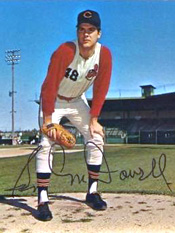
Cleveland offered its top pitcher, left-hander Sam McDowell, but Devine replied with a firm no.
“Maybe I’ve never been impressed by McDowell as much as many baseball men,” Devine said to Bob Broeg of the Post-Dispatch in December 1971. “We would like to add a starting pitcher … but I couldn’t justify giving up promising young (pitchers) such as Reggie Cleveland or Jerry Reuss for McDowell.”
Though McDowell five times led the American League in striking out the most batters, Devine noted, he also five times led the AL in walking the most batters.
There was another thing: “Sam hasn’t always taken care of himself,” Devine said diplomatically to the Post-Dispatch.
In fact, McDowell was an alcoholic.
Sudden Sam
Big (6-foot-5) and athletic, McDowell was a dominating pitcher for Pittsburgh’s Central Catholic High School (also the alma mater of future NFL quarterbacks Dan Marino of the Miami Dolphins and Marc Bulger of the St. Louis Rams).
The Cleveland Indians signed him in 1960. With their Class D farm club in Lakeland (Fla.), McDowell, 17, “displayed a sizzling fastball and a curve that literally flopped off the table,” the Lakeland Ledger reported.
Cleveland officials put McDowell on a fast track. At 18, he made a huge leap from Class D to Class AAA in 1961 and finished the season in the majors, starting against the Twins. Boxscore
McDowell got nicknamed “Sudden Sam” because of how his fastball suddenly burst upon batters at the plate. The back of his 1963 Topps bubblegum card noted, “Cleveland fans can’t help but compare Sam to Bob Feller when they watch this fire-balling youngster perform.”
In the book “We Played the Game,” Cleveland pitcher Pedro Ramos said McDowell had “a blazing fastball and so much wildness that batters were scared of him. We all thought that if he learned better control he was going to be a big winner.”
Wild thing
McDowell was an exasperating talent. He could be wonderful or wretched _ sometimes in the same game. In pitching a two-hitter against the White Sox, he struck out 11; walked nine. In a win versus Washington, he whiffed 15 but gave up 11 hits and five walks. Boxscore and Boxscore
On a night when he had both overpowering stuff and command of his pitches, striking out 16 and walking none in a three-hitter against the Athletics, McDowell told the Cleveland Plain Dealer, “You have just seen the eighth wonder of the world. I mean, I made only 119 pitches and the game was over in two hours and 11 minutes. I never thought I’d see the day.” Boxscore
The lack of control he experienced on the mound extended to his lifestyle. “I was baseball’s answer to Dr. Jekyll and Mr. Hyde,” McDowell told The Pittsburgh Press.
Except for an occasional beer, McDowell said he didn’t drink alcohol until he got to the big leagues. He started guzzling the booze, he told The Pittsburgh Press, because, “I just wanted to be one of the boys … I wanted to be wanted.”
McDowell became addicted to alcohol. He had a penchant for barroom brawling when drunk. “I can’t tell you how many times I sat in a police department,” he told Jim O’Brien of The Pittsburgh Press.
(O’Brien and McDowell were high school classmates. In 1981, when McDowell decided to go public with the story of his alcoholism, he contacted O’Brien.)
During his time with Cleveland, McDowell had a 122-109 record and 2.99 ERA, but he and the club were ready for a divorce. General manager Gabe Paul put out the word at the 1971 baseball winter meetings that McDowell was available.
According to The Sporting News, Cleveland offered McDowell to every club and more than a dozen were interested. The Tigers offered Mickey Stanley, Dick McAuliffe and Mike Kilkenny. The Mets offered Jerry Koosman and an infielder, columnist Dick Young reported.
Giant gaffe
Since winning the National League pennant in 1962, the Giants had been on a perpetual (and usually futile) quest for a left-handed ace. They traded Felipe Alou to the Braves for Bob Hendley, Matty Alou to the Pirates for Joe Gibbon, Orlando Cepeda to the Cardinals for Ray Sadecki, reacquired Mike McCormick from the Senators, and signed 44-year-old Warren Spahn.
When Cleveland dangled Sam McDowell as trade bait, the Giants bit. They dealt Gaylord Perry and Frank Duffy for the left-hander. “They didn’t know about my drinking problem,” McDowell told The Pittsburgh Press.
On the day after the trade, “I flew to San Francisco (and) I got drunk on the plane,” McDowell said to Jim O’Brien. “I was arrested at a restaurant there that night for disorderly conduct.”
Departing spring training with the 1972 Giants, McDowell “didn’t get out of the Phoenix airport without assistance,” the San Francisco Examiner reported. “He bombed out at the bar and collapsed on the floor.”
Gaylord Perry won 24 for Cleveland in 1972 and received the American League Cy Young Award. McDowell was 10-8 (1-1 versus the Cardinals) for the 1972 Giants.
The next year, McDowell pitched mostly in relief. His last win for the Giants came against St. Louis before he was shipped to the Yankees in June 1973. Boxscore
“The Giants were in Pittsburgh (when) I was told that I had been sold to the Yankees,” McDowell recalled to The Pittsburgh Press. “I took a plane to Oakland to join the Yankees there. I got out there six hours before they did and I got blitzed out of my mind.”
Bronx bomber
Manager Ralph Houk put McDowell in a starting rotation with Mel Stottlemyre, Doc Medich, Fritz Peterson and Pat Dobson. McDowell won five of his first six decisions, then lost seven in a row as his drinking worsened.
In his book “The Bronx Zoo,” Yankees reliever Sparky Lyle said, “When Sam was with us he had a terrible drinking problem … Sam was notorious for getting in the sauce, getting real rowdy, picking a fight and getting beat up.”
McDowell said to The Pittsburgh Press, “Looking back, it’s hard to understand how the managers put up with me. I knew I went beyond the bounds of normal decency once I got into my addiction.”
McDowell told Jim O’Brien how he betrayed the trust of Ralph Houk: “I was out late one night in Minneapolis and I’d been drinking pretty good and I stepped off a curb and tore the hell out of my ankle. I told Houk I did it on an escalator in a department store. Houk asked me if that’s what really happened … I said, ‘Yeah, that’s how it happened.’ I lied straight to his face.”
In 1974, Bill Virdon managed the Yankees. McDowell told Jim O’Brien, “I came to Yankee Stadium one day stoned out of my mind. I was getting killed diving after balls in the outfield during the pregame warmup … Virdon sent the pitching coach out to get me off the field before I got killed out there.”
Virdon recalled to The Pittsburgh Press, “When Sam was with the Yankees, we sent him to psychiatrists. We had to get him out of jail a couple of times. We had to have a babysitter for him on the road.”
The Yankees released him in December 1974.
Last chance
McDowell’s hometown team, the Pirates, threw him a lifeline, inviting him to 1975 spring training. “I had dreamed of pitching for the Pirates when I was a kid,” McDowell said to The Pittsburgh Press.
He pitched well at training camp and the Pirates offered him a spot on the Opening Day roster, but general manager Joe Brown also told McDowell there would be zero tolerance of any drunkenness.
McDowell was on good behavior until June 21, a Saturday. He pitched four scoreless innings of relief that day against the Mets at Shea Stadium. “I went out that night in New York and celebrated,” McDowell recalled to Jim O’Brien. “I got back to my hotel room at 6 a.m., if that.” Boxscore
When he was called on to warm up in the bullpen at Shea Stadium that Sunday afternoon, McDowell couldn’t get a pitch near the plate. “Don Leppert, our bullpen coach, took me inside and told me to stay out of sight,” McDowell told The Pittsburgh Press.
A week later, when they returned from the road trip, the Pirates released him. At 33, McDowell’s pitching days were finished.
Biggest win
Deep in debt, McDowell took a job selling insurance in Pittsburgh to support a wife and children, but his addiction had a stranglehold on him.
He told Jim O’Brien, “I wanted to fight everybody and the only one I was beating up was me … Toward the end of my drinking days … I couldn’t go into a bar without getting my butt kicked seriously, or I’d remodel the bar … A sheriff would serve me with papers regularly. To me it was always someone else’s fault … In time I realized it was me, and that was my problem.”
After awakening from a two-day binge in April 1980, McDowell decided to quit drinking. He entered a rehabilitation program at a Pittsburgh hospital. The experience inspired him to become a counselor. McDowell earned an associate’s degree in sports counseling and addictions at the University of Pittsburgh, and the state of Pennsylvania certified him as a counselor in 1982.
McDowell was hired by big-league franchises such as the Blue Jays, Rangers and Reds to counsel their players.


He was simultaneously “the next Koufax” and “the next Belinsky.” Decades of sobriety is a huge accomplishment. RIP, Sober Sam.