Nearly 50 movies have been made about the adventures of Charlie Chan, the fictional Chinese-American detective created by novelist Earl Derr Biggers.
 Warner Oland, a Swede, played the title role in 16 films. Sidney Toler from Warrensburg, Missouri, was the philosophical detective in 22 pictures. Other movie Charlie Chans included Ross Martin and Peter Ustinov. Peter Sellers spoofed the character in “Murder by Death.”
In “Charlie Chan at the Opera,” Boris Karloff played the main suspect. “Charlie Chan at the Olympics” included footage of the 1936 Berlin Games. There also were “Charlie Chan at the Circus” and “Charlie Chan at the Race Track,” but no movie of Charlie Chan at the baseball park.
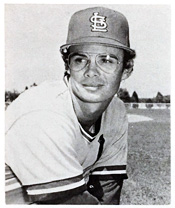
The Cardinals provided the closest version. They had Charlie Chant in the outfield.
Name game
The fictional Charlie Chan was born in China and immigrated with his parents to Honolulu. As a young man he joined the city’s police department and worked his way up to detective, then inspector, because of his skills in solving high-profile cases. Chan’s most prominent connection to baseball came in the film “Charlie Chan in Panama” with a mention that a son, Jimmy (played by Victor Sen Yung), was a member of the University of Southern California (USC) team.
Baseball’s Charlie Chant was born and raised in the Los Angeles area to parents of English, Irish and Scottish ancestry. There is no Chinese in his lineage. His formal name is Charles Joseph Chant. He preferred to be called Chuck _ that was what he went by in high school _ but was known as Charlie during his pro career because of the surname.
“A lot of people still keep leaving the ‘t’ off my last name,” Chant said to Neal Russo of the St. Louis Post-Dispatch in 1975. (Russo added, “Charlie Chant is pretty tired of hearing all the cracks about his name.”)
Chant was a high school shortstop when the Oakland A’s drafted him in the 19th round in June 1969. Assigned to a farm club managed by Hall of Famer Billy Herman in Kennewick, Washington, Chant, 17, clouted a home run in his first professional at-bat. He played second base, shortstop and third base that first season but was shifted to the outfield the next year.
“Cannot tell where path lead until reach end of road.” _ Charlie Chan in “Charlie Chan at the Circus.”
The case of the unlucky nighthawk
In a May 1972 game at Birmingham’s Rickwood Field, Steve Gardner of the Columbus (Ga.) Astros hit a shot to the outfield. As Chant tracked the ball, a nighthawk chasing insects swooped across the sky. The ball struck the bird.
“The bird went one way, the ball the other, but that didn’t confuse Chant,” Bill Lumpkin noted in the Birmingham Post-Herald. “Chant played the ball instead of the bird and caught it for the out.”
The nighthawk fell dead near shortstop Gary Marion (nephew of Marty Marion). “The bird almost hit him in the head,” Chant recalled to the Post-Dispatch.
“In darkness, sometimes difficult to distinguish hawk from vulture.” _ Charlie Chan in “Charlie Chan’s Murder Cruise.”
The case of the mysterious dancing knuckler
Chant advanced through the Oakland system, earning a reputation as a good defensive outfielder with a strong arm. He regularly cut down runners trying to advance, totaling 24 assists with Tucson in 1974. Chant also hit 31 doubles that season. He had 27 doubles, 21 steals and 18 assists for Tucson the next year.
(According to The Sporting News, when someone asked Tucson pitcher Dave Hamilton whether Chant was Chinese, he replied, “No. He’s a right fielder.”)
It was a tough time, though, to gain a spot on the Oakland regular-season roster. The A’s were flush with talent and success, winning five division titles and three World Series championships between 1971 and 1975. Chant’s career got stalled at the Class AAA level until the A’s called him up in September 1975 and issued him uniform No. 24. (The A’s eventually retired that number to honor the player who later wore it, Rickey Henderson.)
Manager Alvin Dark didn’t do Chant any favors. The one time Chant got to start was as the designated hitter against Wilbur Wood, the knuckleballing left-hander with a 1.55 ERA versus the 1975 A’s. Chant went hitless in four at-bats. Boxscore
“Door of opportunity swing both ways.” _ Charlie Chan, “Murder Over New York.”
The case of Lou Brock’s stolen at-bat
The A’s traded Chant to the Cardinals for infielder Larry Lintz in October 1975. The 1976 Cardinals media guide suggested Chant “has a chance of making the Cardinals as a pinch-hitter and reserve outfielder.” Instead, he was sent to their Tulsa farm club managed by Ken Boyer.
When Cardinals center fielder Bake McBride underwent knee surgery in early August 1976, Jerry Mumphrey came off the bench to replace him. Seeking someone to fill Mumphrey’s previous role, the Cardinals wanted to call up Mike Easler, who hit .352 with 26 home runs at Tulsa, but he was out of options and frozen on the Class AAA roster. So Chant, batting .281, was the choice.
His two months with the 1976 Cardinals produced two highlights:
_ Chant was a pinch-hitter for a future Hall of Famer, Lou Brock.
_ Chant’s first big-league hit contributed to a winning rally.
At 37, Lou Brock still was a force and he showed it in a game against the Padres on Aug. 17, 1976, at St. Louis. Brock produced a double, two walks, three stolen bases, three runs scored and a RBI.
With the Cardinals ahead, 9-3, in the seventh and a left-hander, Dave Tomlin, on the mound for the Padres, St. Louis manager Red Schoendienst decided Brock had done enough for one night. With runners on second and third, two outs, Schoendienst sent Chant to bat for Brock. Chant flied out to left. Boxscore
On Sept. 1, 1976, in the 11th inning of a scoreless game against the Reds at St. Louis, the Cardinals had runners on first and second, none out, and Chant at the plate. He’d entered the game in the 10th as a defensive replacement in left field.
Chant was given the bunt sign, but as he later told the Post-Dispatch, “I’m not very good at bunting. With Oakland, they really didn’t work at it.”
Facing Rawly Eastwick, Chant bunted the ball hard. First baseman Tony Perez slipped as he reached for the ball. Eastwick picked it up and bounced a throw to Joe Morgan covering first. Chant was safe with a single, his first hit in the majors, and both runners advanced. The Cardinals went on to win on a bases-loaded walk to Don Kessinger. Boxscore
Chant’s only other big-league hit, a single against the Pirates’ Jim Rooker, came on the last day of the season. Boxscore
“Optimist only sees doughnut, pessimist sees hole.” _ Charlie Chan in “Charlie Chan in Paris.”
The case of the changing tides
In a 1977 spring training game on St. Patrick’s Day, Charlie Chant had Cardinals eyes smiling when he slammed a game-winning two-run homer against Silvio Martinez of the White Sox, but it wasn’t enough to earn him an Opening Day roster spot with St. Louis.
Sent to Class AAA New Orleans, Chant batted .157. Even teammate Tony La Russa (.188) hit better. Demoted to Class AA Arkansas, Chant (.209) couldn’t hit there either. At 26, his playing days were finished.
About this time, Charlie Chan was fading out of favor. Critics viewed the fictional figure as an insulting stereotype.
In 1958, James Hong, an Asian-American actor, played Charlie Chan’s son on a television show. In 1980, Hong told the Oakland Tribune he regretted that part. “Charlie Chan was a role created by the white man,” Hong said, “and for 50 years he was the only leading Asian character, complete with buck teeth and fortune cookie language.”



alternative title – Cardinals Tune into Charlie Chant. What a treat this was with a compelling intro about a character i’m ashamed to say I knew nothing about…Just a tremendous job Mark at weaving these two together and summing up each paragraph with a quote, all of them dynamite funny. I can imagine how much work went in to this post and it’s appreciated or maybe and who knows with you…..you remembered his lines? I think I’ll take a look on Tubi TV for some Charlie Chant.