The East China Sea was rough and dangerous in the predawn hours of Dec. 2, 1944, as the submarine USS Sea Devil cruised along the surface on a war patrol.
Radar detected a convoy of Japanese ships in the area. The Sea Devil went in search, changing course to enter Japanese home waters near the Kyushu coast.
About 2:30 a.m., a massive wave suddenly swamped the surfaced submarine. Sea water poured into the air intake system and entered both engine rooms.
As the website Bremerton Base Historian noted, “A submarine lives by its ability to keep water out of the places where men and machinery occupy the same narrow space. When water pours into both engine rooms … and the control room, that sense of order becomes a distant memory. For several minutes, the boat was less a warship and more a stubborn steel cylinder refusing to drown. The crew fought the flooding with the kind of instinct that only comes from training and the unspoken desire to see another sunrise. They made the boat tight again.”
One crisis averted, but another soon followed.
About 3:30 a.m., lookouts on the surfaced submarine spotted a floating mine less than 100 yards off the bow. The Sea Devil slipped past the explosive in the nick of time, then submerged.
The Japanese convoy, consisting of 11 ships, was in sight now, but conditions weren’t ideal for peering through a periscope and finding a target. Waves were coming from different directions and at different speeds in the churning sea, making it difficult for the Sea Devil to keep its course. Clouds prevented any moonlight from shining on the enemy ships.
A freighter emerged out of the darkness from the convoy’s left side, about 3,000 yards from the Sea Devil. The submarine fired four torpedoes. All missed.
A massive troop transport ship then came into view, a mere 600 yards away. The Hawaii Maru was packed with Japanese soldiers. One of them was Eiji Sawamura, perhaps the most celebrated pitcher in Japanese baseball lore.
Baseball field to battlefield
As a right-handed high school pitcher, Eiji Sawamura “threw a rising fastball and a curveball known as the waterfall drop _ a ball that would climb and then drop sharply and dramatically, like water cascading down a waterfall,” according to Thomas Love Seagull of the website Japan Ball.
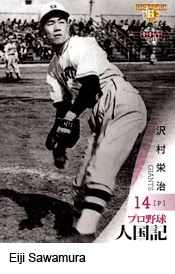 When manager Connie Mack brought a team of big-leaguers to Japan for a tour in November 1934, Sawamura, 17, was chosen by Japanese organizers to pitch against the Americans.
Entering in the fourth inning of a Nov. 20, 1934, game in Shizuoka, Sawamura struck out nine, including in succession future Hall of Famers Charlie Gehringer, Babe Ruth, Lou Gehrig and Jimmie Foxx. Gehrig’s home run against the teen sensation in the seventh inning gave the Americans a 1-0 victory.
Sawamura was a prominent part of a Japanese team that toured North America in 1935. In Milwaukee, a St. Louis Cardinals scout “mingled with the fans after a game and pushed a (contract) toward Sawamura for his signature. Sawamura, who could not read English, assumed it was an autograph request and signed his name,” according to the Japan Ball website. A member of the Japanese entourage arranged for the contract to be voided.
(Other online accounts identify the scout as working for the Pittsburgh Pirates.)
When Japanese professional baseball was formed in 1936, Sawamura became one of its top players. Pitching for the Tokyo Kyojin, he was 14-3 (1.18 ERA) in 1936 and 33-10 (1.38 ERA) in 1937.
Three stints in Japanese military service disrupted his baseball career. Sawamura was inducted into the Japanese Army in 1938 and went willingly into combat against China in the Second Sino-Japanese War.
On the front lines, Sawamura “gave morale-boosting exhibitions, throwing hand grenades in distance competitions for the benefit of grateful troops and newsreel cameras. The Japanese press ate it up, and baseball fans back home devoured news of their great hero,” baseball historian Gary Joseph Cieradkowski noted.
Sawamura was shot in the left arm and contracted malaria. He recovered, completed his military service and pitched for Tokyo in 1940 (7-1, 2.61 ERA). The next year, Sawamura rejoined the Japanese Army and took part in the invasion of the Philippines. He fought as an enemy of the U.S. and its Allies in World War II.
Discharged in 1943, Sawamaru made a brief, final attempt at pitching, then went back into military service.
He was aboard the Hawaii Maru in the predawn hours of Dec. 2, 1944, as part of the convoy heading for combat in the Philippines.
Hellish conditions
Built in Kobe, Japan, in 1915, the Hawaii Maru carried passengers and cargo to ports such as New Orleans, Seattle and Vancouver. In 1916 a cholera outbreak swept across the ship while it anchored in Yokohama.
The Japanese Army requisitioned the Hawaii Maru in 1941. It transported Japanese troops for the invasion of the Philippines. The Hawaii Maru also carried Dutch and British prisoners of war from Singapore to prison camps in Japan. It was labeled a hell ship because conditions onboard led to deaths of many POWs.
A torpedo launched from the submarine USS Trigger struck the Hawaii Maru in April 1944, but the ship stayed afloat. After repairs, it became part of the convoy that USS Sea Devil spotted in December 1944.
Submarine commander
Commander Ralph Emerson Styles of Asheville, N.C., was skipper of USS Sea Devil. A graduate of the U.S. Naval Academy in Annapolis, Md., Styles was an engineering officer aboard the submarine USS Narwhal in port at Pearl Harbor when the Japanese attacked on Dec. 7, 1941. He joined a gun crew aboard the Narwhal that opened fire on the attacking planes. “I wasn’t thinking, I was just shooting,” he recalled to the Sarasota Herald-Tribune.
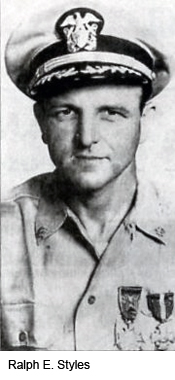 Styles also served aboard the Narwhal during the pivotal Battle of Midway.
Built in the Portsmouth (N.H.) Navy Yard, USS Sea Devil was commissioned in May 1944, with Styles, 34, given command. The submarine arrived at its assigned port, Pearl Harbor, in August 1944. On its first war patrol, the Sea Devil sank a Japanese cargo submarine on Sept. 16, 1944.
Three months later, it was in position to do the same to the Hawaii Maru.
Mission accomplished
At 4:24 a.m. on Dec. 2, 1944, the Sea Devil fired two torpedoes at the Hawaii Maru. Besides being loaded with soldiers, the ship carried ammunition and gasoline. When the torpedoes struck, the ammunition exploded. That explosion caused the gasoline to explode.
The double explosion made the Hawaii Maru sink quickly before lifeboats could be launched. All 2,074 soldiers and crew onboard, including Eiji Sawamura, 27, perished in a matter of minutes in a cold sea with nine-foot waves.
The Japanese called it zenmetsu _ complete annihilation.
Five minutes after attacking the Hawaii Maru, the Sea Devil launched four torpedoes at a Japanese steamship, the Akikawa Maru. The ship broke in two and sank, killing 300 soldiers onboard.
Escort ships with the convoy dropped 12 depth charges, trying to destroy the Sea Devil, but the submarine escaped unharmed.
As the Bremerton Base Historian website noted, “Submarines lived on the fine edge between success and loss. Sea Devil succeeded because her crew was skilled, her captain was calm and a measure of luck tilted her way.”
In 2007, retired realtor Ralph Styles, the World War II Sea Devil commander residing in Siesta Key, Fla., told the Sarasota Herald-Tribune, “I’m happy with my life. At age 97, I’ve outlived everybody, including my enemies. I don’t have an enemy in the world now. All is well.”



after reading the first paragraph, i took a look at the east china sea and thought what a vulnerable place, vulnerable place as far as both Koreas and Japan and many other countries so close to China. Feels like an invasion waiting to happen. Anyway, I really enjoyed the way you described that sea and its waves and the threats men faced at sea and i take this quote with me for maybe forever – “the unspoken desire to see another sunrise….”
it’s hard to relate to being a baseball player and being asked to also serve in a country’s military, hard to relate to because of the way I assume players are pampered today though I think Paul Skenes attended one of the military groups.
Researching for this post was educational in many ways, including learning about the geography and the waterways. Just north of the East China Sea, for instance, is the Yellow Sea, so named because of the golden-yellow color of the silt-ridden water discharged from rivers. In some accounts, it appears the USS Sea Devil patrolled in the Yellow Sea, too.