The St. Louis football Cardinals went into their 1969 NFL season opener hoping to showcase a newly acquired prize receiver, John Gilliam, against the zone coverage of the Dallas Cowboys.
 Traded from New Orleans for three players and St. Louis’ second-round draft position, Gilliam was a sprinter with good hands.
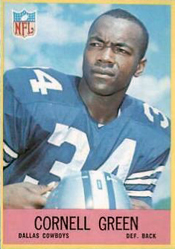
He caused some cornerbacks anxiety, but not Dallas’ Cornell Green. So certain was Cowboys coach Tom Landry that Green could stick with Gilliam, he surprised St. Louis with man-to-man coverage rather than the expected zone.
Every time Cardinals quarterback Charley Johnson looked for Gilliam, he saw Green there, too. Green broke up passes and cut off lanes. Gilliam made just two catches for 25 yards in his Cardinals debut. One of those grabs required an acrobat’s flexibility, falling backward and snaring the ball with one hand.
Green also blocked a Jim Bakken field goal attempt and a had a second blocked kick nullified by a penalty. He did all that _ even though he suffered a cracked rib in the second quarter and refused to leave the game.
Led by the brilliant defense, the Cowboys won, 24-3. “You’re playing great defense when you give a team like St. Louis good field position and hold them to three points,” Landry told the Fort Worth Star-Telegram. Game stats
Gilliam went on to have a stellar season for St. Louis (52 catches, 997 yards, nine touchdowns, 19.2 yards per catch) but didn’t face Cornell Green again that year.
Athletic family
Elijah (a truck driver) and Gladys Green (a nurse) raised five sons in the public housing projects of Richmond, Calif., near Oakland.
The eldest son, Elijah Jerry Green, known as Pumpsie, excelled in baseball.
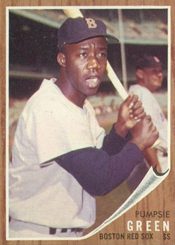 On the El Cerrito High School team in the early 1950s, Ernie Broglio was the top pitcher and Pumpsie Green was the catcher. Broglio and Pumpsie Green also were teammates with the 1955 Stockton Ports, an unaffiliated minor-league club. Broglio won 20 and Green, the shortstop, hit .319 and scored 133 runs. Both reached the majors in 1959 _ Broglio with the Cardinals; Green with the Red Sox.
Pumpsie Green was the first black player on the Red Sox, the last big-league team to integrate. According to Ed Levitt of the Richmond Independent, Jackie Robinson wrote in a letter to Green dated July 24, 1959, three days after Green made his Red Sox debut, “I hope that in your effort to make good as the first Negro ballplayer ever to play for the Red Sox you will not allow anything or anybody to divert you from being anything other than Pumpsie Green … With your outstanding record, Pumpsie, you need have no fears if you just go out and do the same kind of job in the same way. So congratulations on being a first. You may not always find it the easiest or most pleasant category in the world, but it’s an opportunity at which I know you’ll do your very best to make good.”
During his five seasons as a big-league infielder, Pumpsie Green wasn’t an all-star, but he hit .385 against Jim Bunning and .364 versus Jim Kaat; belted a grand slam off Jim Perry; led off a game at Yankee Stadium with an inside-the-park home run; and in another Yankees-Red Sox game in which Yogi Berra, Mickey Mantle, Enos Slaughter and Ted Williams batted, the hitting star was Pumpsie Green (four hits and a walk). Boxscore, Boxscore, Boxscore
Another of the Green brothers, Credell Green, was a running back for the University of Washington. On Nov. 19, 1955, playing on a muddy home field described by the Seattle Post-Intelligencer as a “pig trough,” Credell Green rushed for 258 yards (9.5 yards per carry) and scored two touchdowns, leading Washington to a 27-7 triumph against archrival Washington State.
Drafted by the Green Bay Packers, Credell Green was cut from the roster in his first training camp. It was his brother, Cornell Green, who didn’t play any college football, who made it in the NFL.
Hardwood to gridiron
Cornell Green played a little bit of football his junior year at El Cerrito High School, but the sport he focused on and excelled at was basketball. Recruited to Utah State, Green was the university’s top basketball player at the same time that lineman Merlin Olsen was its standout football player.
Green told the Logan (Utah) Herald-Journal he was a half-inch shorter than his listed height of 6-foot-4. In three varsity seasons at Utah State, he averaged 22.5 points and 12.7 rebounds per game. “He wasn’t a great leaper … but he was strong, with that Greek-god build to him,” Utah State coach LaDell Andersen said to Dick Rosetta of the Salt Lake Tribune.
In noting Green’s leadership skills, teammate Phil Johnson, who would earn the 1975 NBA Coach of the Year Award for guiding the Kansas City Kings into the playoffs, told the Salt Lake City newspaper, “He went to class every day, he never missed a practice and he was just like another coach on the floor.”
Green led Utah State to a NIT berth in 1960 and wins against St. Bonaventure and Villanova before losing to Providence and its slick playmaker, Lenny Wilkens, in the semifinals. In 1962, Utah State reached the NCAA Tournament and Green scored 29 in a first-round win versus Arizona State. UCLA then eliminated Utah State on the way to its first Final Four under coach John Wooden.
As Ray Buck of the Fort Worth Star-Telegram noted, the Dallas Cowboys set up a hospitality room at the 1962 Final Four and invited college basketball coaches attending the event to come in for food and drinks. Tom Landry and Cowboys personnel director Gil Brandt were seeking insights into players with elite athleticism who could be converted from basketball to football. LaDell Andersen told Brandt he should check out Cornell Green.
Brandt drove through a snowstorm to reach the Utah State campus to spend time with Green. It was worth the effort. “Green has the natural ability, agility and determination to be an outstanding athlete for us,” Brandt told the Logan paper.
Chicago had chosen Green in the fifth round of the 1962 NBA draft, but he opted to sign with the Cowboys. Green got $250 to commit and was promised another $750 if he went to Cowboys training camp.
“I wasn’t planning on playing for the Cowboys or anybody else,” Green told the Star-Telegram, “but I figured if they were going to give me 250 bucks for nothing, I’d take it … Making the Dallas Cowboys was the furthest thing from my mind … I figured I’d get cut.”
Durable defender
The Cowboys projected Green to be a defensive back. Tom Landry, a former defensive back, refused to give up on him. “You have no idea how much of an effort Tom put into making Cornell Green a good football player,” Gil Brandt told Rick Gosselin of the Dallas Morning News. “He was so green.”
Landry recalled to the Star-Telegram that Green “really didn’t know anything about football. The first time he ever put his hip pads on, he got them backwards … but he really came on through the years, just because of his own determination to become a great player.”
In 13 seasons (1962-74) with the Cowboys, Green was an all-pro at left cornerback and at strong safety. He was a key member of the Doomsday Defense and helped Dallas become 1971 Super Bowl champions. Green never missed a regular-season game, playing in 182 in a row. “His success has been a product of tremendous quickness, concentration, confidence and pain tolerance,” Jerry Gandy of the Richmond Independent noted.
Teammate Bob Lilly called Green “probably the most underrated player the Cowboys have ever had,” the Star-Telegram reported.
Though quarterbacks often avoided throwing into Green’s coverage area, he totaled 34 career interceptions, including five against the Cardinals. Asked in 1969 by the Richmond Independent to name the best receivers he defended against, Green chose Charley Taylor (Washington), Gary Collins (Cleveland) and Paul Warfield (Cleveland, then Miami). Video
Impressed by Green’s ability to assess talent, the Cowboys hired him to scout college prospects in 1970 while Green still was a player. After his playing days, Green scouted fulltime for the Cowboys.
In 1987, Green began scouting for the Denver Broncos, whose coach, Dan Reeves, was a former teammate. Green scouted for Denver for 28 years.



I am a huge sports fan and know a lot, but I always learn something from you.
I learned while watching Dallas play in the late 1960s and early 1970s that Mr. Cornell Green had been a basketball player in college. Pat Summerall probably was the announcer I heard that from. Cornell Green was a lot like STL’s Roger Wehrli. Staubach simply would not throw to Roger’s side of the field. My hunch is that Hart was like that when Green was playing.
I did NOT know Pumpsie Green’s real name or that he was the brother of Cornell or that a third brother was an athlete, too. Pumpsie and Ted Williams became pals, with Williams insisting that during pregame warmups that he and Green play catch. I learned in the 1970s busing crisis in Boston that the city was a cesspool of racism, so Yawkey waited a long time before hiring a black player. Disgusting.
I think Landry was one of the few football coaches to check out great athletes who could learn the game at its highest level. In addition to Cornell Green, he hired sprinter Bob Hayes, who was a superb receiver in the era before sticky gloves were allowed. I still think that stinks, but it kind of makes sense because pass coverage has gotten so sophisticated that a receiver frequently gets nailed just as the ball arrives. That scenario happened in days gone by, but not nearly as often as it does now. That’s based on my observations and I wonder if you think that’s correct. The gloves kind of even out the passing/receiving game of today. I still don’t like them, just because. However, my stepson plays at Affton High as a running back and linebacker and I’m glad he wears gloves for protection and to catch passes. Yes, hypocritical points of view are us.
I find it fascinating that Green went on to scout talent. Great article.
bill townsend
Thanks for all your insights, Bill, and for your readership.
That’s a good comparison you made, Cornell Green and Roger Wehrli being similar in skillsets. Both excelled at cornerback as well as safety in the NFL.
You are correct about Pumpsie Green and Ted Williams being pals. Looking back at his Red Sox days, Pumpsie Green told the Boston Globe in 1997, “I used to love to talk to Ted Williams, one of the nicest guys I ever met.”
I’m glad you mentioned track star Bob Hayes being another athlete Tom Landry and the Cowboys smartly converted to football. Another is Pete Gent, who never played college football. Gent was a star basketball player for Michigan State. The Cowboys made him a wide receiver and then a tight end. Multi-talented, he wrote the popular novel “North Dallas Forty.”
i enjoyed learning more about Pumpsie Green’s family. My dad is from Boston and so that name pops up often in our conversations. I find it fitting that Boston’s first world series in so many years, back in 2004 had two important players on it who were black…Ortiz and Pedro martinez.
Much appreciated, Steve.
You and your Dad might appreciate this Milwaukee connection involving Pumpsie Green: In December 1962, the Red Sox traded Tracy Stallard and Pumpsie Green to the Mets for Felix Mantilla, the infielder who played in the 1957 and 1958 World Series for the Milwaukee Braves.
I’ll pass this on to my dad. Thanks.
Another fine post Mark. The first thing that comes to mind about Cornell Green is that the man basically thrived and flourished at everything he did. The stats he put up at Utah State still come in amoung the top ten. Then there’s the transition he made from college basketball to playing in the NFL. Let’s also not forget his accomplishments as a scout for the Denver Broncos. Maybe there’s something to be said for humility, determination and a hard work ethic. He certainly seems to have possessed all of those qualities and even more. I bet that Tom Landry and Gil Brandt were always thankful for the fact that they didn’t lose their patience with Cornell Green even not knowing how to wear those hip pads!.
I enjoyed your spot-on observations, Phillip.
Indeed, Cornell Green thrived and flourished as a college basketball player at Utah State. In recalling Green’s college playing days, Greg Hansen of the Logan (Utah) Herald-Journal wrote, “Cornell Green was one of the greatest big-game players I’ve seen. You never stopped Cornell Green in overtime, or when the game was on the line.”
You are correct, too, about his humility and determination. In his first NFL exhibition game in 1962, Cornell Green was assigned to cover Boyd Dowler, the Green Bay Packers’ top receiver. Green did well except on one play, when Dowler got behind him and caught a TD pass. In explaining the play, Green told the Salt Lake Tribune, “Dowler stepped on my toe. That’s what he was laughing about in the end zone. I didn’t think it was that funny, but why should I be discouraged? He’s scored touchdowns on a lot better men than me. I’ve got a lot to learn.”
One more tidbit you might appreciate: In addition to Pumpsie Green and Cornell Green, another big-league pro athlete who grew up in Richmond, Calif., was baseball’s Willie McGee.
A couple things stood out for me in this story. One was the Cowboys going to the Final Four to recruit players. I guess that’s an example of the approach to recruiting that says get size and the best athletes then teach them everything else. The other is the fact that Green never missed a regular season game. Can’t imaging that is too common.