Feeds:
Posts
Comments

Archive for the ‘Broadcasters’ Category

In 2025, Jim Kaat was interviewed by Jon Paul Morosi for the Baseball Hall of Fame podcast “The Road to Cooperstown.”

Here are excerpts:

Being enshrined in the Baseball Hall of Fame:

Kaat: “I’m probably the only pitcher inducted based on longevity, dependability, accountability (rather than) dominance … There are a lot of guys who are there because they’re thoroughbreds, but there’s room for a Clydesdale as well.”

The secret to pitching 25 years (1959-83) in the big leagues:

Kaat: “I didn’t play Little League baseball. I didn’t really pitch organized baseball until I was about 15 _ American Legion ball in Michigan. Before that, we just had neighborhood kids, you’d get eight, 10 kids together, and go out and play … My sports were fast-pitch softball and bowling. Little did I know that those two exercises are great for the pitching arm … because your arm is going underhanded. I didn’t abuse my arm. Lucas Giolito (2019 all-star) threw 90 mph when he was 14 years old. He’s probably suffered through some injuries because of that. I probably threw 90 in my early 20s. There wasn’t an emphasis on velocity. It was movement and control.”

On youth baseball today:

Kaat: “It’s become so competitive. There is so much pressure on these young kids that I think a lot of times, by the time they’re 16, they’re probably burned out. A lot of it is the coaches and the parents … When I see the parents nowadays, they’re hanging on the fence, screaming at their kids, ‘Get the ball over.’ They’re paying big money to send these kids to these schools. They’ve taken the fun out of it. I never had to go through that. I think that’s a big reason I was able to pitch for a long time.”

On his father, John Kaat:

Kaat: “I have a picture on my desk of my dad standing in front of the Hall of Fame in 1947. He went to see Lefty Grove’s induction. That was his favorite player. He was an avid fan.”

On what he might have done if he didn’t become a big-league pitcher:

Kaat: “I’d have loved to have been a small-town high school basketball coach. You’d have a lot of influence on kids.”

On Twins teammate and fellow Hall of Famer Harmon Killebrew:

Kaat: “Harmon kind of set the tone for the behavior of the Twins … If you look at his penmanship, it’s the most immaculate, perfect, and he taught all the Twins players … He insisted, ‘Don’t you want to write your name so people know who you are?’ (Today) the Twins’ top-paid player, Carlos Correa, (signs) C.C. You don’t even know who it is.”

On Twins teammate and fellow Hall of Famer Rod Carew:

Kaat: “He took batting practice with us the end of 1966 and he was hitting some home runs. Then I think he found out that we didn’t care about exit velocity or launch angle … He was a magician with the bat. He changed his stance pitch to pitch. He moved all over the place. He got about some 30 bunt hits a year.”

On Twins teammate and fellow Hall of Famer Tony Oliva:

Kaat: “American League catchers in those days … would say the one guy we feared coming up in a clutch situation was Tony O. because Tony was that blend of power, average and speed.”

On Sandy Koufax, the Dodgers starter who opposed Kaat in Games 2, 5 and 7 of the 1965 World Series (Koufax won two of the three):

Kaat: “Happy to say he became a friend. He’s one of the (congratulatory) calls I got when I (was elected to) the Hall of Fame. We’ve stayed in touch. We’ve had some dinners together through (ex-Cardinal) Bill White, who was my broadcast mentor. He and Sandy live close to one another in the summer in Pennsylvania. I cross paths with Sandy a fair amount.”

On White Sox teammate and fellow Hall of Famer Dick Allen, who came up to the majors with the Phillies:

Kaat: “Had he been brought up in the Cardinals organization, where they had more black players, (Lou) Brock and (Curt) Flood, (Bob) Gibson, Bill White … it would have been easier for him … Dick suffered a lot in Philadelphia … It was tough for him as a black star in Philadelphia.”

On pitching for the Phillies (1976-79):

Kaat: “The end of my time in Philadelphia in 1979, I wasn’t pitching much. Danny Ozark was not a manager that had much confidence in guys who didn’t throw hard. I used to tell him, ‘Danny, Walter Johnson’s not around anymore.’ ”

On pitching in 62 games for the 1982 Cardinals at age 43 and being a part of a World Series championship team:

Kaat: “That was the most exciting team … The most enjoyable year I ever had … We hit 67 home runs as a team, stole 200 bases, had Bruce Sutter at the end of the games … To see that team play every day and the havoc it created for the opposition … Willie McGee would get on first. Boom! He’s on third … That was such a rush for me, waiting that long and to be a part of a team that … was totally foreign to the way the game is played today … Baseball came from the words base to base, and that’s what we did … That was the kind of baseball I was raised on.”

On what he told rookie pitcher John Stuper, who, with the Cardinals on the brink of elimination, pitched a four-hitter to beat Don Sutton and the Brewers in World Series Game 6:

Kaat: “I was kind of like a mentor to Stuper. I sat with him on the plane (after Game 5). I said, ‘Stupe, nobody expects you to win tomorrow. We’re facing Don Sutton. He’s going to the Hall of Fame. (Pretend) it’s a 10 o’clock in the morning exhibition game. Have some fun out there. Don’t worry about it.’ ”

On Cardinals teammate Keith Hernandez:

Kaat: “I don’t think there was ever a player I played with that was more intense on every play of the game … He kind of personified our team in that every play, every day, there was an intensity that’s hard to have over 162 games.”

On what he’s most proud of in his broadcasting career:

Kaat: “I learned from Tim McCarver to be honest and objective … Not being a homer.”
Read Full Post »

When Larry Miggins was a student at Fordham Prep in the Bronx in the early 1940s, he told a classmate he wanted to be a big-league baseball player. The classmate, Vin Scully, told Miggins he wanted to be a big-league baseball broadcaster. The boys ruminated about the possibility of Scully broadcasting a game Miggins played in.

A decade later, in 1952, Miggins was in the big leagues as a rookie reserve left fielder for the Cardinals. Scully was in his third year as a Dodgers broadcaster.

On May 13, 1952, Miggins was in the starting lineup for a game at Brooklyn against the Dodgers. It was the first game he played at Ebbets Field. Scully was the junior member of a three-man broadcasting crew doing the game that day. Red Barber and Connie Desmond were the more experienced broadcasters.

When Miggins struck out in his first plate appearance of the game in the second inning, Scully was not on the air.

Two innings later, though, he was doing the broadcast when Miggins stepped to the plate against Preacher Roe. Scully had the call when Miggins belted a pitch into the seats in left for his first home run in the majors. Boxscore

Decades later, in recalling the moment for an audience at the Ronald Reagan Library in Simi Valley, Calif., Scully said, “It was probably the toughest home run call I’ve ever had because (the dream) came true,” the Ventura County Star reported. “Don’t be afraid to dream.”

Traveling man

A son of Irish immigrants, Larry Miggins was the valedictorian of the class of 1943 at Fordham Prep. He enrolled at the University of Pittsburgh, but in December 1943, when his boyhood favorites, the New York Giants, offered him a contract, he left college and signed with them.

Miggins, 18, played eight games for the Giants’ Jersey City farm club in April 1944, then joined the United States Merchant Marine. He was discharged in time to play the 1946 minor-league season and was in the lineup for Jersey City when Jackie Robinson played his first game in the Dodgers’ system for Montreal. You Tube Audio interview

A 6-foot-4 right-handed batter with power, Miggins slugged 22 home runs in the minors in 1947, but the Giants left him off their big-league winter roster. Rated by Cardinals scouts “as one of the best prospects in the minors, possessing speed and a good arm,” according to The Sporting News, Miggins was selected by St. Louis in the November 1947 draft of unprotected players.

The transaction stunned Miggins, who “always thought he was going to play with the Giants,” the St. Louis Post-Dispatch reported.

Three days before the Cardinals’ 1948 season opener, Miggins was placed on waivers and claimed by the Cubs. According to the Associated Press, he drove to Chicago in a 1931 jalopy, parked at Wrigley Field, and joined the Cubs on their trip to Pittsburgh, where they opened the season against the Pirates.

Miggins, who didn’t play in any of the three games at Pittsburgh, returned to Chicago with the Cubs on April 23 and was summoned to the Wrigley Field office. He was told the Cubs had placed him on waivers and he was reclaimed by the Cardinals. On his way out, the Associated Press noted, he was asked to move his crate from club owner Phil Wrigley’s private parking space.

The Cardinals assigned Miggins to their Class A farm team at Omaha and he hit 26 home runs in 97 games. “Uses his wrists well,” Omaha manager Ollie Vanek told the Omaha World-Herald. “Watches the pitches with keen discrimination and rarely offers at a bad one. He has a follow-through, and a stance. Miggins can hit that low curve, which is one of the hardest things to do in baseball.”

The Irish lad from the Bronx also had “a lilting voice and likes to entertain his teammates with songs,” The Sporting News reported.

Called up to the Cardinals in September 1948, Miggins got into one game, making his big-league debut as a pinch-hitter against the Cubs and scoring after reaching base on an error. Boxscore

Family man

Miggins spent the next three seasons (1949-51) in the minors. With Houston, he hit 21 home runs in 1949 and 27 in 1951.

“Miggins is big and strong and fast, and while his quiet manner and impeccable behavior may give some the impression that he lacks aggressiveness, he has a burning desire to play big-league baseball,” the Post-Dispatch reported.

During the winters, Miggins took college courses and earned a bachelor’s degree from the University of St. Thomas in Houston.

In 1952, Eddie Stanky’s first year as manager, Miggins, 26, made the Cardinals’ Opening Day roster as a backup left fielder and pinch-hitter. He didn’t play much. The highlights were the home run in Brooklyn with Vin Scully at the microphone and a home run against a future Hall of Famer, Warren Spahn of the Braves. Boxscore

“Larry Miggins could do it,” Cardinals owner Fred Saigh said to the St. Louis Globe-Democrat. “He has all the equipment. He’s a wonderful boy, one of the best in our organization, and that’s the trouble. If he could get just a little more determination, he could make it.”

Miggins hit .229 in 96 at-bats for the 1952 Cardinals. He spent the next two seasons in the minors, then left baseball when a Houston judge, Allen B. Hannay, approached him about a government job in probation and parole.

With the judge’s encouragement, Miggins earned a master’s degree in criminology from Sam Houston State and had a long career as a probation and parole officer.

Miggins and his wife, Kathleen, had 12 children, four girls and eight boys. With a touch o’ the blarney, Miggins explained to blogger Bill McCurdy, “Kathleen was hard of hearing. Every night we went to bed as I was turning out the light, I would softly whisper to Kathleen, ‘Are you ready to go to sleep or what?’ She gave me the same answer every time: ‘What?’ “

Read Full Post »

Harry Caray became a popular baseball broadcaster, in part, because he seemed so familiar to listeners and viewers. It’s not until someone digs under the surface that a much fuller, sometimes surprising, version of him emerges.

Mike Mitchell has written the definitive Harry Caray biography, “Holy Cow St. Louis!” An entertaining and informative read, the book is available on Amazon and at the author’s webpage.
A superb researcher, Mitchell separates fact from myth about Caray’s life, and shows how he became a cultural icon. In addition to telling a compelling story about Caray, the book explores how radio and television shaped baseball. Bonuses for readers include insights into Harry’s son, Skip Caray, and other broadcasters.

“Holy Cow St. Louis!” is Mitchell’s third book. He’s also written “Mr. Rickey’s Redbirds: Baseball, Beer, Scandals and Celebrations in St. Louis” and “Show-Me Kings: Bootheel Ball, the Cookson Clan and a Run-And-Gun All-Star Show.”

Here are excerpts from a March 2023 e-mail interview with the author about the Harry Caray book:

Q: Congratulations on the book, Mike. Other books have been written about Harry Caray. What makes yours different?

A: Thank you. This is the first book to focus on Harry’s St. Louis years. Because he spent so many seasons calling baseball on television in Chicago, many forget that Harry spent more time with the Cardinals than any other team. I interviewed a relative of Harry’s in Webster Groves, Mo. (where Harry graduated high school in 1932). I was the first journalist he had spoken with. I have pictures and stories about a young Harry and his parents that no one has ever published. Beyond his youth, focusing on his time in St. Louis allowed me to delve into details of Harry’s professional career that many have either forgotten or never known.

Q: Harry Caray died 25 years ago, but yet he remains a prominent baseball figure. Why is that?

A: A big part of it is the breadth and depth of his career. Harry spent more than 50 years broadcasting baseball. He deeply connected with fans in two cities (St. Louis and Chicago) and three fan bases _ Cardinals, White Sox and Cubs (and don’t forget two years of Browns games and a season calling baseball in Oakland). Combine thousands of games with a man who loved to spend a night on the town means everyone has a favorite Harry story. Fans look at sports as fun and entertainment. So did Harry.

Q: Was Harry Caray a good baseball broadcaster or a good showman?

A: He was both, but it all started with his broadcasting ability. Long before he ever stood up to sing “Take Me Out to the Ballgame,” Harry was a voice on the radio that stirred great emotion among fans. I have a chapter in the book titled “Listening to Harry.” He influenced a generation of sportswriters and broadcasters, with more than one saying they were disappointed the first time they ever attended a baseball game. The actual contest paled in comparison to Harry’s descriptions. “He could make a foul ball sound exciting,” said Indiana University broadcaster Don Fischer.

Q: What did you learn in your research about Harry that most surprised you?

A: Many things. We primarily think of Harry as a baseball broadcaster, but he worked year-round. Besides the Cardinals, he broadcast more seasons of University of Missouri football than any other team. He called St. Louis University and later St. Louis Hawks basketball in the winter. Early in his career, he broadcast wrestling, boxing, hockey, and even some high school football. When he wasn’t describing a game, he was making appearances and doing speaking engagements all over the Midwest. As far back as the 1940s, someone, somewhere, was listening to Harry nearly every night of the year.

I spent a lot of time researching the papers of Al Fleishman, the man who ran public relations for Anheuser-Busch. He and Harry had a stormy relationship almost from the moment the brewery bought the ballclub. The sheer amount of memos that flew between Fleishman-Hillard and Anheuser-Busch makes it clear that many people spent an awful lot of time worrying about things Harry said or did. Even after Harry left the Cardinals and Anheuser-Busch, the brewery still kept tabs on him. As I write in “Holy Cow St. Louis!,” any surprise at Harry’s dismissal in 1969 is replaced by another thought: How did he last as long as he did?

Q: Was Harry Caray as big a drinker and partier as his reputation makes him out to be?

A: There is no doubt Harry enjoyed his alcohol and loved to go out. He was an extrovert who drew his energy from being around people. He enjoyed a quality adult beverage or two and a good bar argument. At the same time, Harry was a master of public relations and a beer salesman. He was directly employed by breweries his entire St. Louis career. Harry knew that if fans thought he was drinking and having a good time, they would be more inclined to do the same. Harry’s best friend, Pete Vonachen, spoke of many nights in bars where they would leave drinks on the counter if Harry didn’t like the atmosphere. The buzz and the vibe were more important than the beverage.

Q: Will we ever see the likes of a baseball broadcaster like Harry Caray again?

A: What Harry accomplished will never be repeated. He dominated two entirely different media eras. He began his broadcasting career with radio as the dominant medium. His St. Louis years are preserved in his radio calls. He joined the Cubs as cable television exploded in popularity. That’s our Chicago memory of Harry. With KMOX, his voice reached fans nationwide. With WGN, his image was beamed across North America. No one better navigated the transition from 50,000-watt clear-channel radio to cable television superstation than Harry.

Q: What do you think Harry would have thought about grandson Chip Caray becoming the Cardinals’ TV broadcaster?

A: I’m sure he’d be extremely proud. Chip was supposed to work with Harry in 1998, then Harry passed away. Twenty-five years later, Chip joins the Cardinals. His grandfather called Cardinals baseball for 25 seasons. If Chip can make it until 2045 with the Cardinals (the year he turns 80), baseball will celebrate a century of Carays (Harry, Skip, and Chip) broadcasting major league baseball. No other family can say that.

Q: Harry Caray spelled backwards is Yrrah Yarac. Think he’d enjoy trying that one out on the air?

A:  No one enjoyed spelling _ or attempting to pronounce names _ backward more than Harry. My favorite was listening to Harry’s attempt to pronounce Mark Grudzielanek _ forward or backward.

Read Full Post »

In the early days of baseball on television, Cardinals owner Fred Saigh was one of the first to go dialing for dollars.

In November 1952, Saigh tried to get a form of revenue sharing started among National League franchises regarding broadcast rights fees.

To Saigh, baseball’s television audience was an extension of the ballpark audience, and he wanted a split of the television money that home teams were getting for broadcasting Cardinals road games.

If Saigh was denied a share of those television revenues, he threatened to unplug the broadcasts.

On the air

The first televised major-league game was Aug. 26, 1939, when New York’s NBC station aired the Reds versus the Dodgers from Brooklyn, but it wasn’t until after World War II ended that TV sets became widely available and more affordable to mass markets.

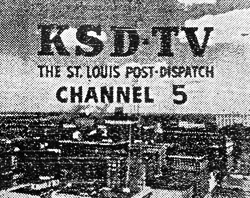
The first television station in St. Louis, and the 13th in the United States, was KSD-TV, Channel 5. A NBC affiliate, the station was owned by Pulitzer Publishing, also the owners of the St. Louis Post-Dispatch. Pulitzer became the first to own both a newspaper and a television station.

(In 1979, when Pulitzer sold the station, its call letters were changed to KSDK.)

KSD-TV began broadcasting on Feb. 8, 1947, with a 90-minute local information afternoon program. In one of the program’s segments that day, Post-Dispatch sports editor J. Roy Stockton interviewed Cardinals catcher and future broadcaster Joe Garagiola.

The KSD-TV studio was located with the Post-Dispatch building on Olive Street in St. Louis. According to the station, the newspaper’s press operators also handled the studio lights. Sometimes, when needed to put out the latest edition of the afternoon paper, they’d leave the studio, delaying the start of a local program.

Show time

KSD-TV management recognized immediately the potential audience and advertising value of baseball programming, and entered into agreements with the Browns of the American League and the Cardinals of the National League to televise some of their games.

The first televised games in St. Louis were KSD-TV broadcasts of two Browns versus Cardinals exhibitions at Sportsman’s Park in St. Louis on April 12-13, 1947, just before the start of the regular season.

KSD-TV also broadcast the Browns’ season opener against the Tigers on April 15 in St. Louis, and the Cardinals’ home opener against the Cubs on April 18.

From then on, Browns and Cardinals games in 1947 were a programming staple on KSD-TV.

Rights and wrongs

Sam Breadon, who made the deal with KSD-TV for the Cardinals, sold the club to Robert Hannegan and Fred Saigh in November 1947. Hannegan died in 1949, leaving Saigh as majority owner.

Saigh had no options in negotiating a local TV deal for the Cardinals. By 1952, St. Louis had 372,000 TV sets but still only one television station, KSD-TV. According to The Sporting News, the franchises reaping the most in broadcast rights fees then were all in New York _ the Yankees ($500,000), Giants ($375,000) and Dodgers ($300,000).

Baseball had no unified television policy then. “Each team signs private agreements with the others, giving the home club permission to televise the games,” Saigh explained to The Sporting News.

In the summer of 1952, a Cardinals versus Giants series became a flashpoint for a broadcasting battle.

“We signed an agreement permitting the Giants to televise our games at the Polo Grounds in New York,” Saigh told The Sporting News, “but were turned down by the Giants when we asked to televise our games in New York back to St. Louis. Our reaction was to prohibit the Giants from televising our two remaining games in New York. The Giants said they would televise anyway. So we threatened to keep our team off the field. The commissioner (Ford Frick) stepped in and warned us that these games would be forfeited if our team failed to take the field.”

Saigh stewed about what he viewed as bullying by the Giants to control broadcast revenue, and was determined to fight back.

Show me the money

In November 1952, Saigh said he would seek compensation from the Giants for the two home games they televised without the Cardinals’ permission.

Saigh also said he would refuse to allow any team to televise a Cardinals road game in 1953 unless the home club agreed to share its broadcast revenue with the Cardinals. At that time, a home club received all revenue from its telecasts.

“Saigh proposed to the National League that television and radio revenues be regarded as part of the gate receipts and that visiting clubs be cut in on these funds as they had been on the box-office takes,” The Sporting News reported.

Predictably, most team owners called Saigh’s idea “socialism,” The Sporting News noted.

One exception was maverick Browns owner Bill Veeck, who usually was in conflict with Saigh in competing for a chunk of the St. Louis baseball market. Veeck supported Saigh’s suggestion that visiting teams share in the broadcast revenue. “It is odd to find Veeck and Saigh on the same side of any campaign, but they are fighting for a split of the TV and radio money,” The Sporting News reported.

Saigh suggested a visiting team get 30 percent of a home team’s broadcast revenue, or 50 percent when the home team was the Giants or Dodgers.

Meet the new boss

Saigh succeeded in changing some minds. The Cubs and Reds agreed to share broadcast revenues with the Cardinals. The Phillies were close to joining in, too, the Associated Press reported.

Owners of the Giants and Dodgers “were aghast” and showed “no intention of backing down on their determination not to pay Saigh a dime for permitting the telecasts of Cardinals games at their parks,” The Sporting News reported.

Saigh had a bigger problem than broadcast revenue rights. On Jan. 28, 1953, he was sentenced to 15 months in prison and fined $15,000 for federal income tax evasion. Unable to keep the team, he apparently considered an offer from buyers who wanted to move the franchise to Milwaukee, but sold the Cardinals to St. Louis brewery Anheuser-Busch, which was run by Gussie Busch

Eager to ingratiate himself into the old boys network of club owners, Busch reversed the revenue sharing stance of Saigh. Busch said he would not demand a share of TV revenue for any Cardinals road game televised by a home club. “Anything we can do to bring the game to more and more people, we hope to be able to do,” Busch told The Sporting News.

Busch had a business reason for his decision. He viewed televised baseball games as an outlet for pitching Anheuser-Busch products to a broad audience. “Under the new ownership, Cardinals television will become a vital asset,” Dan Daniel wrote in the New York World-Telegram and Sun.

Learning to share

In 1966, Major League Baseball sold its first national television package, netting $300,000 per team.

Soon after the players’ strike in 1994, the capitalists who own Major League Baseball and its franchises entered into a comprehensive revenue sharing arrangement. It eventually included the evenly split sharing of revenue from sources such as broadcasts, merchandising and Internet.

Baseball socialism wasn’t so bad, management discovered. In 2022, each team got $110 million from revenue sharing.

Read Full Post »

Dizzy Dean always could talk a good game, so given the choice of being a coach or a broadcaster, the former Cardinals ace grabbed the microphone.

On July 7, 1941, Dean quit as Cubs coach and signed a three-year deal with Falstaff Brewing to call Cardinals and Browns home games on St. Louis radio station KWK.

“I can make enough in radio in three years to put me on easy street,” Dean told The Sporting News. “There is no future coaching in baseball.”

Desperate measures

Dean made a dazzling debut in the majors with the Cardinals in 1930 and went on to become one of the game’s best and most popular players. He led National League pitchers in strikeouts four times and had 30 wins for the 1934 Cardinals, plus two more in the World Series.

A right-hander, he was 27 when he injured his pitching arm in 1937. A year later, in April 1938, the Cubs sent $185,000 and three players to the Cardinals to acquire Dean.

“When the Cubs purchased Dean, they said they made the move with their eyes wide open,” The Sporting News noted. “They knew his arm was bad, but were confident that proper treatment would take care of everything. It didn’t.”

Dean was 7-1 in 1938 for the National League champion Cubs and 6-4 in 1939, but his arm ached and his availability was limited.

In June 1940, with his ERA for the season at 6.18, Dean, 30, accepted a demotion to the Cubs’ Tulsa farm club.

“Diz is supposed to have made the suggestion,” The Sporting News reported. “He told club officials he wanted to develop a new sidearm delivery.”

The Cubs assigned scout Dutch Ruether, a former big-league pitcher, to work with Dean at Tulsa. “It will be Ruether’s job to keep an eye on Dean’s conduct and assist him in his professed aim to master the sidearm delivery,” The Sporting News reported.

Dean returned to the Cubs in September but “still had the nothing ball,” according to the Chicago Tribune. He was 3-3 with a 5.17 ERA for the 1940 Cubs. All three losses were to the Cardinals.

Different role

Dean, whose top salary as a player was $25,000 in 1935 with the Cardinals, signed with the Cubs for $10,000 in 1941, according to The Sporting News.

Cubs manager Jimmie Wilson, a former catcher who was Dean’s teammate with the Cardinals, endorsed the signing, saying Dean provided the club with “color and pep.” Wilson indicated he’d start Dean against second-division opponents. “Whatever he wins is gravy,” Wilson told The Sporting News.

On April 25, 1941, Dean started against the Pirates, pitched an inning and gave up three runs. Boxscore

“The arm simply went dead and the best doctors in the country couldn’t fix me up,” Dean told the St. Louis Star-Times.

Dean, 31, wrote a letter to Cubs general manager Jim Gallagher, asking to be placed on the voluntary retirement list.

“I have tried everything I know about to get my arm in shape, and this is a step I deeply regret having to take,” Dean wrote. “I sincerely and gratefully appreciate the many kindnesses the club have extended me. I only hope some day, some way, I may be able to repay in part, at least, the debt I owe it.”

On May 14, 1941, the Cubs gave Dean his unconditional release and then signed him to be a coach.

“Dean’s wife had urged him to retire for several weeks before he took the step that made him a coach,” the Chicago Tribune reported.

According to The Sporting News, “Arrangements were made for the remainder of his season’s salary to go into an annuity and a new salary was agreed for the coaching job.”

Follow the money

Dean’s coaching role primarily was to “pitch batting practice and lead cheers in the dugout,” the Chicago Tribune noted.

After a couple of weeks, The Sporting News declared, “Dean is taking his new job as coach as seriously as Diz could be expected to take anything.”

On June 6, 1941, Dean was ejected from a game at Brooklyn for arguing that Dodgers batter Billy Herman interfered with a throw from catcher Clyde McCullough. After being tossed, Dean headed for the clubhouse but returned and had to be chased a second time, The Sporting News reported. League president Ford Frick punished Dean with a $50 fine and five-day suspension. Boxscore

Three weeks later, Cubs first-base coach Charlie Grimm resigned to become manager of a farm team in Milwaukee and Dean replaced him.

Dean was the first-base coach for two weeks before he, too, resigned to accept the offer to become a broadcaster in St. Louis.

According to The Sporting News, Dean would be paid $5,000 to broadcast for the remainder of the 1941 season and $10,000 per season for the next two years.

“I only hope I’m as great an announcer as I was a pitcher,” Dean said to national columnist Walter Winchell.

Meet me in St. Louis

After attending the 1941 All-Star Game in Detroit, Dean boarded a train to St. Louis to begin his broadcasting job. When he arrived at Union Station at 8 a.m. on July 9, he was greeted by a band playing and a welcoming committee of about 300 people, the St. Louis Globe-Democrat reported.

Arriving on the train with Dean was Joe DiMaggio, who played in the All-Star Game and was joining the Yankees in St. Louis for a series with the Browns.

According to the St. Louis Star-Times, “A parade was formed and Dizzy was taken to the Park Plaza hotel for a breakfast reception. DiMaggio joined in the festivities.”

Dean’s first broadcast on KWK was the July 10 game between the Yankees and Browns at Sportsman’s Park. He joined sportscasters Johnny O’Hara and Johnny Neblett in describing the 1-0 Yankees victory. The game was called after five innings because of rain, but DiMaggio got a single in the first, extending his record hitting streak to 49 games. Boxscore

Dean was an immediate hit that summer. The Sporting News credited him with attracting “many new listeners because of his conversational style.”

Some examples of Dean’s style:

_ On the inability of Red Sox pitcher Mickey Harris to throw strikes: “A pitcher can’t pitch that way in the majors, or in the minors either, and parade up to the cashiers window every first and fifteenth.”

_ On Red Sox slugger Ted Williams: “I don’t know if Ted’s got a nickname, but I’m going to give him one: Goose. That’s what he looks like to me _ tall, skinny, loose-jointed.”

_ On batters who complain about an umpire’s strike zone: “It just don’t do you any good to think when you’re up there hitting that the ump has given you a bum call. The ump does his thinking first and that settles it all.”

Dean went on to have a long career in broadcasting, including national telecasts for ABC and CBS.

Read Full Post »

Harry Caray built a broadcast career in St. Louis based on baseball and beer, but his relationship with the Anheuser-Busch brewery became as flat as a cup of Budweiser left outside in the summer sun.

On Oct. 9, 1969, Caray, the voice of the Cardinals for 25 years, was fired by the sponsor of the broadcasts, Anheuser-Busch.

Caray said he wasn’t told why he was fired.

Cardinals owner Gussie Busch, president of Anheuser-Busch, said the brewery’s marketing department recommended Caray’s dismissal.

In his 1989 book, “Holy Cow,” Caray scoffed at widespread speculation his departure came because he was having an affair with the wife of an Anheuser-Busch executive.

“At first, these rumors annoyed me,” Caray said. “Then they began to amuse me. They actually made me feel kind of good. I mean, let’s face it … I wore glasses as thick as the bottom of Bud bottles, and as much as I hate to say it, I was never confused with Robert Redford.”

Wild about Harry

In 1945, Caray, a St. Louis native, began broadcasting Cardinals games on radio station WIL. Griesedieck Brothers Brewery was the sponsor. Caray and former Cardinals manager Gabby Street formed the broadcast team.

Cardinals games also were broadcast on two other radio stations then. Johnny O’Hara and former Cardinals pitcher Dizzy Dean called the games on KWK. On KMOX, the broadcast team was France Laux and Ray Schmidt.

Caray’s colorful broadcasting style made him popular. In 1947, the Cardinals chose Griesedieck Brothers Brewery as the exclusive broadcast sponsor and Caray’s career soared.

In his book “That’s a Winner,” Cardinals broadcaster Jack Buck said, “In the Midwest, no announcer has been more revered or respected than Harry. He told it like he thought it was, and that’s different from telling it like it is. He never hesitated to give his opinion … He had the guts to do it. That was his style.”

In February 1953, Anheuser-Busch purchased the Cardinals and took over sponsorship of the broadcasts. Caray went from pitching Griesedieck Brothers beer to advertising Anheuser-Busch products.

Anheuser-Busch sales increased, and Caray and Gussie Busch became pals.

“Harry and Gussie Busch were close friends,” said Buck. “They used to drink and play cards at Busch’s home at Grant’s Farm.”

Said Caray: “Gussie and I rarely talked about baseball. Ours was not a business relationship. It was social.”

When Caray was struck by a car and severely injured in November 1968, Busch gave him use of a Florida beach house to recuperate during the winter. Caray made a triumphant return to the broadcast booth in the Cardinals’ 1969 opener.

Trouble brewing

A few months into the season, speculation about Caray’s job status became a hot topic in St. Louis. In August 1969, Pirates broadcaster Bob Prince told the Pittsburgh Post-Gazette he was offered a five-year contract for “excellent money” to join KMOX.

Prince decided to stay with the Pirates’ broadcast team, but Caray was worried. Gossip about Caray’s alleged womanizing was rampant, so he met with Gussie Busch to talk about it. In his book, Caray said Busch laughed and told him, “You’ve got nothing to worry about.”

In September 1969, before he went on a trip to Europe, Busch told Caray “to keep his mouth shut” about his concerns until Busch returned, Buck said.

On Sept. 20, 1969, the Cardinals, whose hopes of qualifying for the postseason were fading, played the Cubs in Chicago when a journalist informed Caray of a report saying he would be fired. During the game broadcast, Caray told his audience, “The Cardinals are about to be eliminated and apparently so am I.”

According to Buck, Busch was livid with Caray for making the remark and for disobeying his edict to stay mum.

The ax falls

On Oct. 2, 1969, before the Cardinals played their season finale at St. Louis, Caray said he approached Buck, his broadcast partner since 1954, and asked him, “Do you know something I should know?”

Caray said Buck revealed he had been asked by Anheuser-Busch publicist Al Fleishman and KMOX general manager Robert Hyland to recruit other broadcasters. In his book, Caray said he and Fleishman “had been enemies for decades” and Fleishman wanted Caray fired.

A week later, Caray was at the Cinema Bar in downtown St. Louis on a Thursday afternoon when the bartender told him he had a phone call. An Anheuser-Busch advertising executive, who knew Caray’s hangouts, was on the line. The ad man informed Caray, 55, he was fired and Buck would replace him as head of the Cardinals broadcast team.

“I’m bruised, I’m hurt and I feel badly about it,” Caray said to the Post-Dispatch.

Caray also was miffed he didn’t hear about the decision from Gussie Busch. “You’d think after 25 years they would at least call me in and talk to me face to face about this,” said Caray.

Buck said, “I had nothing to do” with the decision to fire Caray.

“I always wanted to be No. 1 on the broadcast team,” Buck told the Post-Dispatch, “but not at the expense of Harry or anyone else.”

Special order

On his way home, Caray stopped at Busch’s Grove restaurant in the suburb of Ladue _ despite its name, the restaurant wasn’t affiliated with Anheuser-Busch _ and “decided to get some revenge,” he said.

Caray ordered a Schlitz, a beer made by an Anheuser-Busch rival. The restaurant didn’t carry the brand, so the bartender went across the street to a liquor store and bought cans of Schlitz.

As news photographers and television cameramen arrived, Caray posed with a can of Schlitz in his hand and “drew applause from a large number of patrons,” the Associated Press reported.

The bartender made several runs to the liquor store to stock up on Schlitz because customers kept ordering the beer in support of Caray, according to the Associated Press.

“I thought it was funny at the time because I was angry and hurt,” Caray said. “It seemed like the right gesture to make, but now I realize it was petty.”

After former players Bill White and Elston Howard each rejected a chance to join Buck in the Cardinals booth, Jim Woods, who did Pirates games with Bob Prince, was hired to be Buck’s broadcast partner.

According to the Cincinnati Enquirer, the Reds were interested in Caray. Their general manager, Bob Howsam, was the Cardinals’ general manager from August 1964 to January 1967. “You know Harry and I are good friends,” Howsam said.

Instead, Caray joined the Athletics broadcast team in 1970. He left after one season, went to the White Sox and capped his career with the Cubs, for whom he hawked Budweiser with the line, “I’m a Cubs fan and a Bud man.” Video

Read Full Post »

Older Posts »