Feeds:
Posts
Comments

Archive for the ‘Broadcasters’ Category

Dodgers president Larry MacPhail, accustomed to rocking the status quo, was the first executive in the major leagues to go to bat for television.
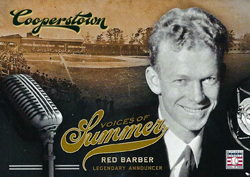
On Aug. 26, 1939, a big-league baseball game was televised for the first time when NBC aired the opener of a doubleheader between the Reds and Dodgers at Ebbets Field in Brooklyn.

MacPhail, an innovator who introduced night games and yellow baseballs to the big leagues, approved the experiment to televise a Dodgers game when the opportunity was presented to him by team broadcaster Red Barber.

Today, television is as much a part of baseball as bats and gloves, but in 1939 the medium barely was part of American culture.

Greatest showman

MacPhail, a lawyer and colleague of Cardinals executive Branch Rickey, worked in the Cardinals’ system as president of their Columbus, Ohio, farm club before getting to the big leagues as general manager of the Reds in 1934. MacPhail installed lights at Cincinnati’s Crosley Field and introduced night baseball to the big leagues on May 24, 1935, when the Phillies played the Reds.

In 1938, MacPhail became general manager of the Dodgers and was promoted to team president a year later. MacPhail chose Leo Durocher, the fiery former Gashouse Gang Cardinals shortstop, to manage the Dodgers and brought Barber to Brooklyn from Cincinnati, where they had worked together with the Reds.

Barber’s folksy Southern charm and catchy phrasing on his Dodgers radio broadcasts entertained and attracted listeners. According to The Sporting News, Barber in 1939 helped “to establish a record attendance at Ebbets Field by the interest he aroused in the team.”

Modern technology

Television sets were demonstrated to the American public at the New York World’s Fair in 1939. A television set cost about $600, the same price as a new car.

The U.S. had fewer than 500 television sets in 1939 and most were in New York City, but advancements rapidly were occurring. In April 1939, Franklin D. Roosevelt became the first U.S. president to have a speech televised. A month later, in May 1939, a college baseball game featuring Princeton and Columbia was televised. A heavyweight bout between Lou Nova and Max Baer was televised in June 1939.

Alfred Morton, a NBC vice president in charge of their fledgling television division, was looking for more opportunities to test the technology. He called his friend, Barber, and asked whether he thought MacPhail would allow NBC to televise a major-league game from Ebbets Field. Barber agreed to find out.

In his 1968 book, “Rhubarb in the Catbird Seat,” Barber said he went to MacPhail’s office and said, “Larry, would you like to be the first man ever to put on a television broadcast of a major-league baseball game?”

MacPhail replied simply, “Yes.”

Barber said MacPhail didn’t charge NBC any rights fees. He only asked for the network to install a television set in the Ebbets Field press room so club officials and media could watch the telecast.

New world

In August 1939, NBC”s New York station, W2XBS, was on the air for four hours a day (2:30 p.m. to 4:30 p.m. and 8:30 p.m. to 10:30 p.m.) and five days a week (Wednesday through Sunday).

“Television then was on about the same level of speculation as a trip to the moon is now,” Barber said. “It was feasible, within reach, about to happen, actually happening, but, even so, it was still away out in the future.”

Barber was chosen to be the broadcaster for the Saturday afternoon telecast from Ebbets Field. Only the first game of the doubleheader was televised.

NBC set up two cameras. One was near the visitors’ dugout on the third-base side and the other was on the second deck behind home plate.

Barber did his announcing from a seat among the fans in the upper deck behind third base because the radio broadcast was being done from the press box booth.

“I had to guess which way the camera was pointing, and I never knew for sure what was on the picture,” Barber said. “Burke Crotty was the director and every once in a while he would holler at me through the earphones that the camera was on second base now, or it was on the pitcher.”

Barber ad-libbed commercials for the three telecast sponsors _ Wheaties, Mobil Oil and Ivory Soap.

“They put the camera on me and I held up a box of Wheaties and poured them in a bowl,” Barber said. “I took a banana and a knife and I sliced the banana onto the Wheaties. Then I poured in some milk and said, ‘That’s the breakfast of champions.’

“I put on a Mobil service station cap and held up a can of oil. For Ivory Soap, I held up a bar of soap.”

After the Reds won the game, 5-2, before 33,535 spectators, Barber did television’s first postgame show on the field, interviewing Durocher, Reds manager Bill McKechnie, Dodgers first baseman Dolph Camilli and Reds pitcher Bucky Walters. Boxscore

“I got Camilli to show his hands on camera,” Barber recalled. “I had always been much impressed with the size, the agility, the dexterity, the grace, the beauty, the strength of Camilli’s hands.”

That’s entertainment

Public response to the telecast was “instantaneous and amazing,” according to The Sporting News.

The Television Building at the World Fair, which showed the telecast, had to shut its doors because the crowd wanting to get in was so great. A Broadway theater which showed the game on its television set “was swamped” with curious viewers, The Sporting News noted.

International News Service marveled at how the game could be seen by television viewers “as far as 50 miles away” from Brooklyn.

As for the quality of the telecast, International News Service reported, “At times, despite the great speed of play, the baseball was visible in the television image, particularly when pitchers Luke Hamlin and Bucky Walters resorted to slower delivery, or when the batter drove out a hit directly away from the iconoscope camera.”

According to The Sporting News, “The players were clearly distinguishable, but it was not possible to pick out the ball.”

On Sept. 30, 1939, a college football game between Waynesburg and Fordham was televised. A NFL game featuring Philadelphia and Brooklyn was televised a month later.

About 2,000 television sets were in use in the U.S. by 1940, but World War II slowed development because people and resources were needed for the military effort. At the close of World War II in 1945, there were 7,000 television sets in the U.S. and nine stations on the air. By 1960, the number of TV sets nationwide was 52 million.
Read Full Post »

Five months after he suffered multiple injuries when struck by a car, Harry Caray returned with a flourish to broadcast the season opener for the Cardinals.

On April 8, 1969, when the two-time defending National League champion Cardinals opened the season against the Pirates at St. Louis, Caray called the game from the Busch Memorial Stadium broadcast booth.

Caray’s appearance was a testament to his determination to recover from compound fractures of both legs, a broken right shoulder, a broken nose and facial cuts and he made certain his comeback was noticed. Given center stage as emcee for pre-game ceremonies on the field, he put on a performance for the audience.

Road to recovery

At about 1:15 a.m. on Nov. 3, 1968, Caray, 51, was hit by a car while he attempted to the cross the street outside the Chase Park Plaza Hotel in St. Louis.

Caray’s injuries were disabling and he spent several weeks in a St. Louis hospital. After his release just before Christmas in 1968, Caray went to Florida and continued his recuperation near St. Petersburg at the beach house of Cardinals owner Gussie Busch.

In his 1989 book “Holy Cow!,” Caray said he was under the care of a male nurse at Busch’s residence and dutifully did isometric exercises daily. According to The Sporting News, he also did a daily radio show from the beach house for St. Louis station KMOX.

Though both legs were in casts, Caray said in his book, “I managed to keep myself entertained. I had a lot of friends there and they were always coming by the house or taking me out to restaurants. I could get around in a collapsible wheelchair.”

In early February 1969, Caray went to St. Louis to be evaluated by his doctors. He convinced them to remove the casts from his legs and returned to Florida as the Cardinals were arriving in St. Petersburg for spring training.

“I was determined to get myself in shape right along with the players,” Caray said.

Caray reported daily to Cardinals trainer Bob Bauman at the club’s spring training facility. “Caray has spent more time in the rubbing room than the adhesive tape,” The Sporting News noted.

Said Caray: “I worked hard, kept on the leg exercises and by the end of spring training I had advanced from crutches to canes to the point where I didn’t really need anything to help me walk.”

Ribbed at roast

On April 7, 1969, on the eve of the Cardinals’ opener, Caray was the guest of honor at the annual Knights of the Cauliflower Ear banquet at the Stouffer’s Inn in downtown St. Louis. The event was similar to the famous Friars Club roasts where the guest of honor was expected to be skewered, or “roasted,” by colleagues.

According to the St. Louis Post-Dispatch, Caray used a cane to maneuver his way around the banquet hall.

Jack Buck, Caray’s Cardinals broadcast partner, was master of ceremonies for the event and delivered several zingers at the guest of honor.

“What nice things can I say about Harry that you haven’t heard from the man himself?” Buck said in his opening remarks.

Referring to Caray getting hit by a car, Buck said to the audience, “What can I say to make you believe I didn’t do it?”

As the event ended, Buck told the crowd, “Please drive carefully. Harry’s walking again.”

St. Louis showman

The Cardinals opened the 1969 season on a Tuesday night.

When Caray emerged from the dugout to begin the pre-game ceremonies at home plate, he used two canes to walk onto the field. He received polite applause while “hobbling along rather pathetically,” he said in his book.

As Caray approached the first-base line, “I whirled one cane over my head and flung it as far as I could,” he said.

With the crowd cheering and urging him on, Caray started toward home plate with the help of the remaining cane. Just before he got to his spot, Caray stopped and tossed the cane into the air as spectators roared in approval.

After the ceremony, Caray made his way to the dugout and was approached by pitcher Bob Gibson. According to Caray, they had the following exchange:

Gibson: “Harry, what the hell was that all about?”

Caray: “Hey, Gibby, it’s like I’ve always told you, pal. This isn’t just baseball. It’s show biz.”

During the broadcast of the game, won by the Pirates in 14 innings, Caray interviewed baseball commissioner Bowie Kuhn and let him do some play-by-play. Boxscore

The 1969 season turned out to be Caray’s last with the club. On Oct. 9, 1969, he was fired after serving as the voice of the Cardinals for 25 years.

Read Full Post »

(Updated Feb. 17, 2022)

Seventeen years after he left Chicago as a player, Lou Brock returned as a broadcaster.

Brock, who transformed from an underachiever to a Hall of Famer after his trade from the Cubs to the Cardinals in 1964, joined the White Sox as a television analyst in 1981.
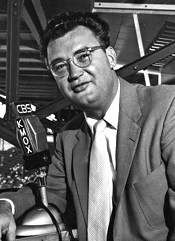
Brock, 42, was paired with broadcaster Harry Caray to call games for a White Sox team managed by Tony La Russa.

In seeking a role that would keep him involved in baseball two years after he had retired as a Cardinals player, Brock discovered that being a White Sox broadcaster wasn’t right for him.

Idea develops

After playing his last game for the Cardinals in 1979, Brock got involved in several business ventures, including a role doing promotional, marketing and sales work for Anheuser-Busch.

Brock also tried broadcasting. In 1980, he briefly was an analyst on national games for ABC-TV. He also did occasional Cardinals games.

In spring 1981, while in Chicago to present an award to White Sox outfielder Ron LeFlore, Brock met Eddie Einhorn, according to the Chicago Tribune.

Einhorn and Jerry Reinsdorf, co-owners of the White Sox, had plans to launch a subscription-based televised sports service in Chicago and were on the lookout for former professional players with broadcasting talent. Einhorn talked with Brock about working White Sox games.

“I listened to some tapes he did for the St. Louis Cardinals and I was impressed,” Einhorn said.

Reinsdorf added, “When we hit on the idea of Brock, I thought it was sensational.”

At that time, Anheuser-Busch was a sponsor of televised White Sox games. According to columnist Dick Young in The Sporting News, “Anheuser-Busch, feeling pressure from Old Style beer in that area, got up the dough for (Brock) to join the ChiSox air crew.”

Softer approach

On June 20, while the 1981 season was on hold because of a players strike, the White Sox announced Brock would join their broadcast team when play resumed.

“We feel very fortunate,” Einhorn told the Associated Press. “We said we had been planning to enlarge our announcing team and this seemed a good time to do it.”

Said Reinsdorf: “I didn’t want to get caught short on announcers. We started looking for someone with stature and credibility. Brock has both.”

Brock’s hiring broke up the White Sox’s television broadcast team of Caray and Jimmy Piersall. The White Sox said Piersall would move to the radio side and work with Joe McConnell.

Caray and Piersall were popular and controversial. Both were critical of La Russa, irritating the manager. Though Einhorn and Reinsdorf denied Brock’s hiring was intended to change the tenor of the telecasts, many thought otherwise.

“It’s obvious why they’re doing it,” wrote Ron Maly of the Des Moines Register. “They’re tired of hearing Caray and Piersall bombard the Sox manager and players with criticism.”

In his book “The Truth Hurts,” Piersall said, “La Russa went to Einhorn and Reinsdorf and told them that the problem with the White Sox … was the announcers, Harry and myself.

“La Russa had Reinsdorf wrapped around his little finger … If La Russa was as good a baseball man as he was a politician, the White Sox would have been a lot better for it. I understood that in early 1981.”

Regarding Piersall, La Russa later told The Sporting News, “He’s an entertainer. He’s not a baseball man.”

Cardinals reunion

Caray had been the voice of the Cardinals when St. Louis acquired Brock in June 1964. As Brock sparked the Cardinals to three National League pennants (1964, 1967 and 1968) and two World Series titles (1964 and 1967), Caray described the speedster’s exploits to the club’s vast audience. To the White Sox owners, pairing them seemed natural.

“He’s a good friend,” Caray said of Brock. “He is an intelligent, articulate man. There’s no way I can object to a Lou Brock in the booth.”

Brock told the Chicago Sun-Times he looked forward to partnering with Caray “because I can learn an awful lot working with him.”

“I’ve always had a good rapport with Harry,” Brock said. “He’s one of the best and most knowledgeable play-by-play men in the country.”

Bad reviews

When the players’ strike ended in August 1981, viewers tuned in to discover the tandem of Caray and Brock was not what they wanted. They missed Piersall’s brashness and the playful exchanges he had with Caray. Brock was measured in his remarks.

“If he were any good, he’d still be behind the mike for the Cardinals, right?” Maly said of Brock in the Des Moines Register.

Ron Alridge, Chicago Tribune TV-radio critic, called Brock “inexperienced and inarticulate.”

Said Caray: “Poor Lou Brock. I feel sorry for him … I just don’t think people are buying Brock.”

Feeling like an outsider on the announcing crew, Brock told Rick Hummel of the Post-Dispatch, “I’m the fifth wheel out of four.”

After the 1981 season, the White Sox broadcast team got a shakeup. Caray left and joined the crosstown Cubs. Piersall was fired. The club was “disappointed” in Brock’s performance, the Chicago Tribune reported.

For 1982, the White Sox went with a revamped broadcast team of Don Drysdale and Ken “Hawk” Harrelson on television and McConnell and Early Wynn on radio.

With the exception of a few appearances on Cardinals telecasts through 1984, Brock’s broadcasting career basically was finished.

Previously: How Harry Caray survived near-fatal car accident

Previously: Cubs knew Lou Brock was on verge of stardom in 1964

Read Full Post »

Combining talent with a relentless commitment to learning his craft and creating his own breaks, Dan McLaughlin earned one of the best jobs in baseball, becoming the signature voice of Cardinals telecasts.

McLaughlin, a St. Louis native, began his professional career with KMOX Radio in 1997. Two years later, at 25, he was doing play-by-play of Cardinals road games on TV.

McLaughlin’s annual charity golf tournament in St. Louis has raised millions of dollars for children with disabilities.

On March 23, 2017, McLaughlin consented to an interview with me in Jupiter, Fla. He was gracious with his time and with his insights.

Here is an edited transcript of that tape-recorded interview:

Q.: Of all the major-league broadcasters, you’re the best at interacting with your audience, especially through social media. What made you decide to be so accessible?

McLaughlin: “Two things. One, I felt people didn’t really know who I was. I’m kind of a smart-aleck, like to have fun, definitely don’t take myself too seriously. When I burst on the scene, a young guy, I think the perception was for a long time that I was buttoned up, no personality. That’s the furthest thing from the truth.

“No. 2, I’m involved in a lot of charities in St. Louis, including my own golf tournament, and I thought if I could promote that, maybe get a following on Twitter, maybe I could raise some more money and it would be a good thing.

“Those were the two main reasons I did it. As I got more involved, I found it to be really helpful for what I do. It was great to see the opinions _ good and bad _ of fans. It’s important to get the feel of the fan base.”

Q.: Who were the broadcasters that influenced you?

McLaughlin: “I was making $4 an hour to do producing at KMOX. I would listen to those guys on KMOX intently to see how they got in and out of commercial breaks, or how they were able to build off the anticipation of what might be a big moment.

“Those guys were, in no particular order, Jack Buck, Mike Shannon, Ken Wilson on hockey, Mike Kelly on Mizzou games. Another guy who really helped me was Randy Karraker, who was a talk-show host at KMOX. He gave me a lot of time and listened.

“All those guys, all those experiences, are what shaped what I am today.”

Q.: Can you share a story about something you learned from Jack Buck?

McLaughlin: “Jack Buck was phenomenal to me. One day in the baseball season, it was a Saturday, there was a rain delay in a game between the Cardinals and Dodgers at Busch Stadium. They knew they were going to get the game in, but it was going to be a long rain delay.

“So I get a call from KMOX and I’m told that Mike Shannon has to leave the ballpark and go to his Night at the Races show and can I fill in and work with Jack. Yeah, I’ll be there. I was doing yard work. So I shower real quick, race down to the ballpark.

“The weekend before, in Los Angeles, I had done Cardinals and Dodgers on TV. So I had all these little notes with anecdotes on all these players. I could tell you everything about every player on both sides.

“I walk into the booth and _ (McLaughlin launches into a spot-on impersonation of Buck’s comforting, gravelly growl) _ Jack says, ‘Dan, how are you?’ I said, ‘Mr. Buck, I’m excited. I’m ready to go.’ He said, ‘What are those?’ I said, ‘These are my notes. I am ready.’ He said, ‘Oh, really. Let me see those.’

“He takes them and tears them up into about a thousand pieces and slams them into the trash can. He points at the trash can and says, ‘That’s not the story.’ Then he points at the field, ‘That’s the story. Tell them what you see, kid.’

“He walked out on purpose and left me alone for a few innings to do the game. I’ll never forget it _ the story is on the field. Never forget you’re the eyes and the ears of those who can’t be there.”

Q.: You’re carrying on a Cardinals tradition of broadcaster excellence _ Harry Caray, Joe Garagiola, Jack Buck and others. Do you ever reflect on the importance of that role?

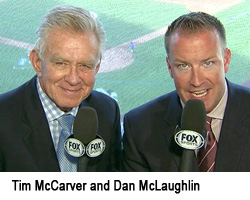
McLaughlin: “It will hit me during a game in the middle of the season. I’m sitting next to Tim McCarver, who has done 24 World Series, and I’m talking about the team I grew up cheering for, in the city I grew up in and love, and it’s like, ‘How did this happen?’
“This is a great responsibility. That’s how I look at it. This is more than a job. This is a responsibility to carry on a legacy and a tradition for these fans. I better bring my A game, at least try to, every single night because they deserve that.”

Q.: What makes Tim McCarver such an outstanding analyst?

McLaughlin: “When his playing days ended, he didn’t just say, ‘I’m a former player.’ It was the close of a chapter in a long book of his life. He wanted to be the best broadcaster he could be. He took that on just like he took on being a catcher for the Cardinals. He looked to advance the story and didn’t just settle for being a former ballplayer.

“In my mind, he’s the best baseball analyst that’s ever lived. It’s not even close.”

Q.: Mike Shannon is the Cardinals radio voice. You’re the Cardinals TV voice. Do you two interact at all?

McLaughlin: “All the time, but especially when I was younger and Mike was on the road more. We had a lot of fun together.

“He always had a place set up to go play golf. We’d play golf almost every morning on the road. Sometimes he’d have Red Schoendienst or Jose Oquendo or a player with him. They treated me like a peer, but I always looked at it like I was an invited guest. I’d just shut up and listen to what they had to say.

“Mike always has been really good to me. Still is. Very kind. He understood the role I was in as a young guy, 23, and that it wasn’t easy. He always made it easy for me.”

Q.: You’re living the dream for a lot of people. What advice do you have for someone hoping to become a major-league broadcaster?

McLaughlin: “If this is what you truly want to do, go for it. My advice, especially for high school and college kids, is write the informational letters, ask for the internship, get involved immediately and get behind a microphone.

“In this business, there are so many people who start out wanting to be behind the microphone and then wind up being behind the camera. Don’t let people say you can’t. If I can do it, anybody can.”

Q.: You’re at the top of your game now. What else would you like to try to do with your career?

McLaughlin: “I’ve had multiple opportunities to leave for different teams, networks, national stuff. This job is the ultimate to me. This is my dream. I’m where I want to be. I would hope this is the last job I’ll ever have because I really don’t have anything else I want to do.

“The Cardinals are great to me. With the platform we have in the community, you can make a difference in a lot of lives. I know that sounds corny, but I get more out of this than I would doing a national game. That doesn’t resonate with me. What resonates is doing the best job I can for this franchise. That’s clearly the most important thing in my professional life. I love it.”

Read Full Post »

Joe Garagiola, a St. Louis native who began his big-league career with the Cardinals, hit his most dramatic home run against his hometown team.

joe_garagiola2Pinch-hitting with two outs in the ninth inning of the second game of a Memorial Day doubleheader, Garagiola hit a three-run walkoff home run that erased a 3-1 deficit and lifted the Pirates to a 4-3 victory over the Cardinals on May 30, 1952.

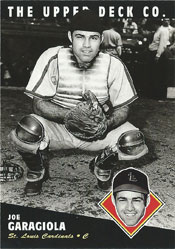
Garagiola was better known as a broadcaster than as a player, but he had several significant performances during a nine-year playing career in the majors as a catcher with the Cardinals, Pirates, Cubs and Giants.

His most important contribution as a player was his performance for the Cardinals as a 20-year-old rookie against the Red Sox in the 1946 World Series. Garagiola batted .316 (6-for-19), scored twice and had four RBI. He caught 42.2 innings without an error for the Cardinals, who won the championship in seven games.

A left-handed batter, Garagiola hit 42 big-league home runs. In addition to the walkoff home run to beat the Cardinals, he hit two grand slams for St. Louis.

Here is a look at those three home runs:

First base open

The 1952 Pirates were a dreadful team. After the Cardinals beat them, 3-2, in the first game of the May 30, 1952, doubleheader at Pittsburgh, the Pirates’ record was 8-33.

In the second game, starting pitchers Cloyd Boyer of the Cardinals and rookie Ron Kline of the Pirates each pitched eight scoreless innings. Clem Koshorek singled to lead off the bottom of the first for the Pirates. Boyer held Pittsburgh hitless from then through the eighth.

The Cardinals scored three in the top of the ninth, breaking the scoreless tie.

In the bottom of the ninth, Koshorek led off with a bunt single. After Bobby Del Greco popped out, Gus Bell doubled, moving Koshorek to third.

Cardinals manager Eddie Stanky replaced Boyer with Gerry Staley. A starter, Staley was making his first relief appearance of the 1952 season. He issued an intentional walk to the first batter he faced, cleanup hitter Ralph Kiner, loading the bases. A rookie, Brandy Davis, ran for Kiner.

When Jack Merson grounded out, pitcher to first, Koshorek scored, with Bell advancing to third and Davis to second.

Garagiola, who had caught the first game, was sent by manager Billy Meyer to pinch-hit for catcher Clyde McCullough. Meyer wanted a left-handed batter, Garagiola, to face the right-handed Staley.

With two outs and first base open, Stanky could have had Staley issue an intentional walk to Garagiola. On deck was George Strickland, a right-handed batter who hit .177 for the 1952 Pirates.

Instead, the Cardinals pitched to Garagiola, who ended the game with his first home run of the season. Boxscore

Trash talking

Four years earlier, playing in his first game of the season, Garagiola broke a 5-5 tie in the seventh inning with a grand slam off reliever Harry Gumbert, lifting the Cardinals to a 13-7 victory over the Reds at Cincinnati on April 30, 1948.

Garagiola hit a line drive off Gumbert, 38, a former Cardinal, that carried over the right field screen at Crosley Field, according to the Associated Press.

As he rounded the bases, Garagiola was razzed by players in the Reds dugout. Garagiola challenged one of the Reds on his way to bench, The Sporting News reported.

Said baseball commissioner Happy Chandler, who witnessed the incident: “I told manager Eddie Dyer that he’d better have a talk with Garagiola and see that it didn’t happen again.”

Garagiola was 3-for-4 with a walk, two runs scored and four RBI in the game. His teammate, Stan Musial, was 5-for-6 with three runs scored and four RBI. Boxscore

Sizzling in Cincinnati

Two years later, Garagiola hit the second and last grand slam of his big-league career. Again, it occurred in Cincinnati.

On May 28, 1950, in the first inning of the second game of a doubleheader, the Cardinals led, 1-0, and had Red Schoendienst on third and Enos Slaughter on second, one out, when Reds starter Ewell Blackwell issued an intentional walk to Bill Howerton, loading the bases for Garagiola.

The grand slam hit by Garagiola was his first home run of the season, giving the Cardinals a 5-0 lead. Garagiola went 3-for-4 with a run scored and four RBI in a 7-2 Cardinals triumph. Boxscore

Four days later, on June 1, Garagiola separated his shoulder when he tripped over the legs of the Dodgers’ Jackie Robinson on a play at first base.

Previously: Think Buster Posey is good? How about Joe Garagiola?

Previously: How Harry Caray got Joe Garagiola in Cardinals booth

Read Full Post »

At 29, Joe Garagiola ended a big-league playing career and began a big-league broadcasting career, joining Harry Caray and Jack Buck on the Cardinals radio team. Caray had encouraged Garagiola to make the move, but eventually regretted doing so when the pair had a falling out.

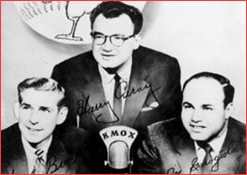
buck_caray_garagiolaIn 1955, KMOX in St. Louis became the exclusive flagship radio station of the Cardinals. The 50,000-watt CBS affiliate signed a deal to broadcast the team’s entire 1955 schedule, including spring training games. KMOX hadn’t broadcast a complete Cardinals schedule in 15 years.

Caray, Buck and Milo Hamilton had broadcast Cardinals games on a rival station, KXOK, in 1954. Caray and Buck were recruited to KMOX in 1955. Hamilton was let go. At the urging of Caray, Garagiola replaced Hamilton.

Recruited by Caray

“Harry didn’t get along with Milo any better than he got along with me at the time and we knew he wanted to get somebody else on the broadcasts with whom he was more friendly,” Buck said in his book “That’s a Winner.”

“The man he wanted _ and got _ was Joe Garagiola. He and Harry had become friends when Garagiola was playing with the Cardinals … Harry kept bending his ear about getting into broadcasting … Harry talked the brewery and advertising people into hiring Joe.”

In his book “Baseball is a Funny Game,” Garagiola said, “I made a real effort to become a talk-for-pay guy. Every day I agitated Harry Caray … about what a soft job he had. His answer was that if I could hit like I could talk I wouldn’t have any worries. The kidding got on the square when he kept encouraging me about a future in broadcasting. Harry was a big help to me as a broadcaster.”

Goodwill ambassador

Garagiola, a St. Louis native, was 20 when he made his big-league playing debut as a catcher with the 1946 Cardinals. He played in the World Series that year, hitting .316 with four RBI in five games against the Red Sox.

The Cardinals traded Garagiola to the Pirates in June 1951.

In 1954, Garagiola played in his final big-league season for the Cubs and Giants. In his book “Holy Cow,” Caray implied the Cardinals knew in 1954 that they wanted Garagiola for their 1955 broadcast team.

“The third spot on the team was being saved for Joe Garagiola … Once he was done playing, Joe was going to join up with me,” Caray said.

Garagiola spent the winter before the 1955 season “traveling the banquet circuit in his new role as sportscaster of the Cardinals games and goodwill ambassador for Anheuser-Busch.”

Odd man out

When it came time for spring training, Caray and Garagiola went to Florida to do the games. Buck was left behind in St. Louis.

“It was difficult for me because Joe became Harry’s right hand and I was the odd man out,” Buck said. “I was all set to go to spring training that year, 1955, and Joe bumped me out of the trip. He talked the brewery into sending him instead. He also became the full-time partner for Harry on the road, leaving me at home in the studio to do the commercials and scoring updates of other games.”

Garagiola’s wife, Audrie, became the Busch Stadium organist. She was as popular as her husband. According to The Sporting News, the “ballpark switchboard received several calls complimenting” the musical skill of the organist, while Joe “has made a favorable impression … as a broadcaster of Redbird games.”

Said Buck: “Nobody at the time knew how well Garagiola was going to do in the broadcast booth … He walked right in and started doing it. It helped that Harry liked him, but I give Joe a lot of credit for working at it.”

Hurt feelings

Caray, Garagiola and Buck formed the Cardinals’ broadcast team from 1955-59. In 1960, Buck departed, leaving Caray and Garagiola as a duo.

“Caray was helping make Garagiola the success he became, but they probably were too much alike to remain partners for long,” Buck said in his 1997 book. “Harry resented the fact that Joe became a national celebrity and never gave Harry credit … The relationship between Harry and Joe fell apart to the point that they’re still not friends today.”

Buck rejoined Caray and Garagiola in 1961 and they remained Cardinals broadcast partners in 1962. Garagiola departed to join NBC on its national broadcasts in 1963 and was replaced in the Cardinals booth by Jerry Gross.

The Ford C. Frick Award, presented annually since 1978 to a broadcaster for major contributions to baseball, has been awarded to Buck (1987), Caray (1989), Garagiola (1991) and Hamilton (1992).

Previously: Jack Buck, Darryl Kile faced same foe in Cardinals debuts

Previously: Think Buster Posey is good? How about Joe Garagiola?

Previously: How Harry Caray survived near-fatal car accident

Read Full Post »

« Newer Posts - Older Posts »