Feeds:
Posts
Comments

Archive for the ‘Executives’ Category

Wintertime and the living was easy for the frontcourt trio of Bob Pettit, Cliff Hagan and Clyde Lovellette. The high-scoring glamour boys of the NBA St. Louis Hawks were living on Easy Street. Their coach, Ed Macauley, was known as “Easy Ed.” His coaching style matched his nickname. He liked a set offense, with Pettit, Hagan and Lovellette taking most of the shots.

Easy as one, two, three.
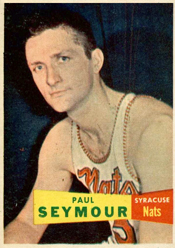
Then came a change. Paul Seymour replaced Macauley. As a playmaking guard, Seymour sparked the Syracuse Nationals to a NBA title in 1955, then became their coach. He coached like he played _ fiery, tough, wily.

When Seymour came to St. Louis, he envisioned a wide-open style of play. He wanted a fast pace and scoring from the guards.

Cleo Hill was the kind of player Seymour had in mind. Hill was exceptionally quick, an acrobat who could score from anywhere on the court. After the Hawks drafted Hill, Seymour turned the rookie loose to run the floor and put up shots.

The Big Three, Pettit, Hagan and Lovellette, did not like this. Ease off, they told their coach. Buzz off, Seymour replied.

Then all hell broke loose.

Pioneer pro

As a youth, Paul Seymour played alley basketball in his hometown of Toledo, Ohio. The matchups were two against two. He and a friend, Bob Harrison, “challenged any other pair in the city,” Seymour recalled to the St. Louis Post-Dispatch. “In winter, we’d shovel the snow off the alley and play on.”

(Harrison later played nine seasons in the NBA, including two with St. Louis.)

After his freshman year at the University of Toledo, Seymour, 18, quit to join the Toledo Jeeps of the National Basketball League (NBL) in 1946. “That was a great club,” he told Lowell Reidenbaugh of The Sporting News. “I was the kid, getting $87.50 a week, and we traveled in a station wagon, often covering 500 miles a night to keep our schedule. We took turns at the wheel and you know what trick I got _ the last one, from 4 a.m. to daybreak.”

Seymour picked up the lifelong habit of smoking cigars then “because, with everyone else in the car smoking, a guy needed a smokescreen in self defense,” he told Bob Broeg of the Post-Dispatch.

The St. Louis Browns had seen Seymour play baseball and in 1947, when he was 19, he signed with them, then changed his mind rather than go to minor-league Pine Bluff, Ark., as an outfielder, the Post-Dispatch reported. Instead, he went to Baltimore of the Basketball Association of America (BAA).

After the 1948-49 season, the NBL and the BAA merged to become the National Basketball Association (NBA). Baltimore sold Seymour’s contract to Syracuse for $1, according to the Toledo Blade.

Seymour played 11 seasons for Syracuse, including the last four as player-coach. He was talented and successful in both roles.

A three-time all-star, Seymour was team captain of the 1955 NBA champions, averaging 14.6 points and 6.7 assists per game. “He played a brand of defense that bordered on stalking, refusing to let his opponent out of sight,” wrote Syracuse Post-Standard columnist David Ramsey. “He dropped 25-foot set shots and sank layups with either hand. He ran the team’s offense with wisdom and imagination. In short, he could play.”

As Syracuse forward Dolph Schayes noted to the newspaper, “He was the heart and soul of the Syracuse Nats … We were scrappy and never gave up. That was Paul … He was indestructible.”

Syracuse was 155-124 in Seymour’s four seasons as coach and twice reached the NBA Eastern Division Finals. The job paid just $13,000 a year, though, and Seymour wanted better.

After the 1959-60 season, Hawks owner Ben Kerner eased Easy Ed Macauley out of the coaching job, named him general manager and wooed Seymour with a three-year contract that included a pay raise, plus incentive clauses.

“He’s a complete coach,” Kerner told The Sporting News. “He knows the game, knows the talent and has that tremendous desire which is so necessary for all champions … He’s a rough, tough competitor … He reflects confidence in his every move and that assurance rubs off on his players.”

Changing times

Ben Kerner was to Hawks basketball coaches what George Steinbrenner later became to Yankees baseball managers: a carnivore who ate them for breakfast, lunch and dinner.

In the five seasons since moving the Hawks from Milwaukee to St. Louis in 1955, Kerner went through five head coaches: Red Holzman, Slater Martin, Alex Hannum, Andy Phillip and Ed Macauley. After Hannum led the Hawks to the 1958 NBA championship, he quit. “I never liked Hannum,” Kerner told Sports Illustrated. “He was a real tough hombre … He did a hell of a job, but he never was my type of guy … I didn’t feel safe with him. He wasn’t loyal.”

(Hannum won another NBA title with the 1966-67 Philadelphia 76ers.)

As for Macauley, Kerner told Sports Illustrated’s Gilbert Rogin, “I like Macauley … but he didn’t have the guts … I do feel Paul is a better coach than Macauley.”

The team Seymour inherited was a good one. The Hawks finished in first place in the Western Division in each of Macauley’s two seasons as coach and reached the NBA Finals in 1960. Seymour was hired to win a NBA title.

In addition to the Big Three of Pettit, Hagan and Lovellette, Seymour’s 1960-61 Hawks had a self-assured rookie guard, Lenny Wilkens. (Wilkens, elected to the Naismith Basketball Hall of Fame for his success as a player and a coach, was accepted by the Big Three because he passed the ball to them often. The rookie averaged 11.7 points per game.) “Our front line has the power,” Seymour told the St. Louis Globe-Democrat, “but we can increase that power through a more effective backcourt, especially in scoring.”

Seymour sent a message to the Big Three early in the 1960-61 season that the easy living days of Easy Ed were gone. (Macauley quit as general manager in September 1960.) Seymour fined Lovellette for lagging on defense during a game. As Bob Broeg noted, “When he put the bit on (Lovellette), he served notice to the rest of the team. Paul has been around long enough to know that hustle is part condition, part ability, but mostly desire.”

Described by Hawks radio broadcaster Buddy Blattner as “a backroom brawler with polish,” Seymour energized the Hawks, who hustled their way to the 1961 NBA Finals but then lost in five games to the Boston Celtics.

Boston was the better balanced team. It had plenty of muscle up front with center Bill Russell and power forward Tommy Heinsohn, and an array of guards (Bob Cousy, K.C. Jones, Sam Jones, Frank Ramsey, Bill Sharman) who poured in points. While Hagan and Pettit scored big, the Hawks’ backcourt didn’t match Boston’s. Wilkens was the only threat.

Meanwhile, two of the Hawks’ Western Division rivals had introduced big-scoring rookie guards _ Oscar Robertson with the Cincinnati Royals and Jerry West with the Los Angeles Lakers. If the Hawks were to stay atop the division and have a chance to dethrone Boston for the NBA title, Seymour determined, they’d need more firepower in the backcourt.

Urban legend

The Hawks’ first-round choice in the 1961 draft was Cleo Hill, a 6-foot-1 guard from Winston-Salem Teachers College.
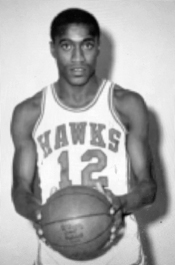
Hill’s path to the NBA had been filled with roadblocks. Growing up on Belmont Avenue in Newark, N.J., “I got in with a tough bunch of guys and wasted a lot of time,” Hill said to Dave Klein of the Newark Star-Ledger. “I didn’t study, I didn’t have respect for my elders, and I thought I knew everything there was to know.”

The first mentor who helped Hill get on track was Frank Ceres, a coach and playground instructor at Grover Cleveland Elementary School in Newark. Ceres told Hill he could become a good basketball player. He taught Hill to shoot a jump shot and how to produce backspin.

At Newark’s South Side High School (now Malcolm X Shabazz High School), Hill came under the guidance of Frank Delany, who taught U.S. history and coached the basketball team. “The best part of the (basketball) practice was his talk period,” Hill said to the Newark Star-Ledger. “He’d talk about the educational, athletic and social aspects of his players’ lives.”

Hill became a prolific prep scorer. His homecourt gym was small, with a low ceiling that intimidated visiting players. Hill tailored his shot-making to fit the territory. His arsenal included a line-drive hook shot he could make with either hand.

Al Attles, whose success in the NBA as a player, coach and executive earned him election to the Naismith Basketball Hall of Fame, played for Weequahic High School in Newark and was matched against Hill. “Cleo was the greatest high school player I’ve ever seen,” Attles said to the Star-Ledger. “In terms of overall basketball talent, he’s as good as there ever was.”

Weequahic coach Les Fein told the newspaper that Hill “could shoot from anywhere … He was incredibly quick and flexible and he had the ability to get free for any shot he wanted, any time he wanted.”

Despite Hill’s basketball talent, going to college was not a slam dunk. His academic grades “were barely passing,” the Star-Ledger noted. Frank Ceres, the elementary school mentor, made some calls to friends at Winston-Salem Teachers College. The school offered a basketball scholarship on one condition: Hill would need to get good grades in college to stay eligible.

Big man on campus

Winston-Salem Teachers College (now Winston-Salem State University) was the first historically black institution in the nation to grant degrees for teaching the elementary grades.

The school’s basketball coach, Clarence “Big House” Gaines, was dedicated to education as well as to athletics, and he helped Hill focus on studies. “He took a guy from the streets and put him into the programs _ English, mathematics and reading, remedials,” Hill recalled to the Star-Ledger. “He made me work hard and stressed getting a degree over and against making pro.”

To help Hill expand his vocabulary, Gaines encouraged a game: When Hill learned a new word, he’d test Gaines on whether the coach knew the meaning. Hill kept coming back with new words, hoping to trip up Gaines.

Hill also met a student, Eliza Ann, who emphasized to him the importance of an education. She became his wife.

(In spring 1962, after his season with the Hawks, Hill returned to Winston-Salem and completed the work to earn his degree.)

Meanwhile, Hill’s basketball skills blossomed. “He was the most scientific player I ever coached,” Gaines told the Star-Ledger. “He had the greatest assortment of shots of any player I ever coached.”

Basketball broadcaster Billy Packer was a player at a bigger Winston-Salem school, Wake Forest of the Atlantic Coast Conference (ACC), at the time Hill was in college. ACC basketball teams hadn’t integrated _ (the first black basketball player in the ACC wouldn’t arrive until December 1965) _ but Packer and his teammates would play pickup games against Hill and his teammates. “Cleo was better than anybody in the ACC at that time,” Packer told the Winston-Salem Journal.

Hill scored 2,488 career points in college. That was the school record until Earl “The Pearl” Monroe totaled 2,935. (Both achieved those figures before there was a three-point line.) Though Gaines coached both players, he told Mary Garber of the Winston-Salem Journal in 1973 that Hill was “the most complete player I’ve ever had … He could do the job both offensively and defensively.”

Special talent

The Hawks took Hill with the eighth pick in the first round of the March 1961 NBA draft. Paul Seymour, chief scout Emil Barboni and scouting adviser Ed Vogel saw Hill play and put him at the top of their list. “He would have been our first draft choice even if we would have had the first pick,” Seymour told the Post-Dispatch.

The Celtics, selecting after St. Louis, would have taken Hill if the Hawks hadn’t, the Post-Dispatch reported.

Marty Blake, then the Hawks’ business manager, later told reporter Vahe Gregorian that Hill “came into the league with abilities that were 40 years ahead of his time.”

“Great first step, unlimited range … and he was quick,” Blake said to the Asbury Park (N.J.) Press. “I mean, he was a speed demon.”

In a 1993 interview with reporter Bill Handleman about Hill, Billy Packer said, “There was no question he was destined for superstardom in the NBA. We’re not talking about some nice rookie here. We’re talking about Michael (Jordan). Cleo was Michael 33 years ago. At 6-foot-1, he did the things Michael Jordan does … We’re talking about a guy who should be in the (Naismith) Hall of Fame.”

Packer’s broadcast colleague Bill Raftery concurred, telling the Asbury Park Press in 1993 that Hill “did a lot of Jordanesque type of things we see today.”

With Lenny Wilkens unavailable for the first three months of the 1961-62 NBA season because of a military service commitment, Hill became the Hawks’ top guard. Seymour worked with the rookie to get him ready.

Power plays

In the regular-season opener, at home against Cincinnati, Hill scored 26, “drawing roars from the large crowd with his spectacular leaps while driving for shots or snaring rebounds,” the Post-Dispatch reported.

The black-owned weekly, St. Louis Argus, noted, “This young man captures the imagination of the crowd with his grasshopper leaps under the basket (and) his showboating gallops down (the) court.” Game stats

Hill scored 16 in his second game, but went cold soon after. The rookie missed 13 of 16 against Syracuse, misfired on 10 of 12 versus Chicago and clanked another 13 of 16 against Syracuse again.

Critics said he looked nervous, insecure, and there were grumbles about his unorthodox ways and playground style.

Seymour asked his players for patience and unity. He was confident Hill would figure it out, make the necessary adjustments.

The way the Big Three saw it, though, the rookie wasn’t ready, he’d been given too big a role too soon, and he should stop shooting so much. From their perspective, the team was better when the offense revolved around them.

Tensions built to a boiling point. In late October, Seymour told the Post-Dispatch that Lovellette “has been pouting for a month” and has complained about “not getting the ball.” Seymour also said one of the Big Three came to him and said Hill was getting too much publicity and should be benched.

“Never before was it more obvious that we needed a fast backcourt man, an outside scorer like Hill, an exceptional talent, but the big guys up front wouldn’t play with him,” Seymour told Bob Broeg of the Post-Dispatch. “Jealous, no doubt. Protecting those big salaries, I guess. Imagine, telling me the kid was getting too much publicity.”

On Nov. 8, Hill scored 20 points and snared 12 rebounds against the Lakers. He made half his shots the next game, finishing with 16 against Detroit. Then he sank six of nine and totaled 16 points versus Cincinnati.

It appeared Hill was finding a groove, but Ben Kerner, acting on behalf of the Big Three, ordered Seymour to remove the rookie from the starting lineup.

Reluctantly, Seymour did so, but he was seething.

Speaking at a luncheon in Detroit, before the Hawks played the Pistons, Seymour told the audience, “I’d trade any of our top players and that includes Bob Pettit … There are no untouchables any more on my club.”

Two days later, Nov. 17, 1961, with the Hawks’ record at 5-9, Kerner fired Seymour. “I couldn’t run a smooth club with the bad feeling between team and coach,” Kerner told the Globe-Democrat.

Seymour said he was fired because he insisted, against the wishes of the Big Three, to start Hill.  “I’d just rather lose my job doing what I think is right,” Seymour said to the Globe-Democrat.

Regarding the Big Three, he told the newspaper, “They didn’t help the kid but were against him. That’s my only gripe, the way they boycotted the kid … It takes the heart out of you when your own team players won’t help you … I wouldn’t treat a dog the way they treated him.”

Hill’s take on the Big Three was, “They knew they were getting paid for the points they scored, and, here I was, taking their points … It wasn’t racial. It was points,” he told the Newark Star-Ledger.

Pettit said to the Associated Press, “There’s nothing we want more than for Cleo Hill to be the greatest ballplayer in the world. We don’t care who plays or who scores as long as we win. I know I speak for Cliff (Hagan) and Clyde (Lovellette).”

New directions

Kerner asked Pettit to fill in as interim coach until a replacement for Seymour could be hired. In Pettit’s first game in that role, Hill played a total of two minutes.

Fuzzy Levane, who’d coached the Hawks when they were based in Milwaukee, took over for the remainder of the season and used Hill sparingly. The Hawks finished 29-51. Hill averaged 5.5 points in 58 games during his only NBA season.

Harry Gallatin became the next Hawks coach, and he cut Hill from the roster before the 1962-63 season. No other NBA team was interested in him.

Hill went on to play in the lower levels of professional basketball with the Philadelphia Tapers of the American Basketball League and then the Trenton Colonials, New Haven Elms and Scranton Miners of the Eastern League.

Putting his college degree to use, Hill became an elementary school teacher in New Jersey and then the basketball coach at Essex County College in Newark. His record in 24 seasons there was 489-128.

Back home in Syracuse, Paul Seymour worked in real estate, owned a liquor store and coached basketball at Onondaga Community College from 1962-64. He returned to the NBA as coach of Baltimore (1965-66) and Detroit (1968-69).

In a letter he sent to Hill, Seymour wrote, “Occasionally, I get disgusted thinking what happened to you (in the NBA). I believe you got white-balled.”
Read Full Post »

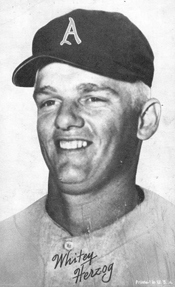
A player with the baseball smarts Whitey Herzog had didn’t need to be told when it was time to quit. It was autumn 1963. Herzog just turned 32, but his prime playing days had past. “His baseball epitaph could read: A Nice Guy Who Couldn’t Hit The Slow Curve,” Detroit columnist Joe Falls noted.

A journeyman outfielder, Herzog squeezed out every bit of talent he had, lasting eight seasons in the majors, mostly with losing teams, before the Tigers removed him from their big-league roster after the 1963 season. The Tigers offered him a role as player-coach at Syracuse, with a promise he’d be considered for a managerial job in their farm system some day, the Detroit Free Press reported. The Kansas City Athletics proposed he join them as a scout.

Herzog, though, was through with baseball. He could earn more ($16,000 a year) supervising construction workers for a company back home in Kansas City than he could coaching in the minors or pursuing prospects on the sandlots.

So Herzog took the construction job, but soon found he didn’t like it, mainly because he had little say in selecting the crew he was tasked with supervising. Hoping to trade his hard hat for a ball cap, Herzog asked the A’s if the scouting job still was open. It was, and he was hired to scout amateur players in 1964.

The scouting experience with the A’s, and then the Mets, gained Herzog a reputation as an astute talent evaluator and helped him develop the managing skills that would lead to his eventual election to the Baseball Hall of Fame.

Going pro

As a teen in New Athens, Ill., Herzog was a good basketball player. “Your basic small, scrappy guard,” he said in “White Rat,” his autobiography. Herzog received seven college basketball scholarship offers, but he wanted to play pro baseball. He could run, throw and hit a fastball.

The St. Louis Browns made an offer: no signing bonus, a minor-league salary of $200 a month and a chance to pitch. Herzog said no. Actually, he claimed in his autobiography, he said to Browns scout Jack Fournier, “Now I know why you guys are in last place all the time, if you wanted to sign a wild-ass left-hander like me.”

On the day after he graduated from high school in 1949, Herzog was invited to a Yankees tryout camp in Branson, Mo. The Yankees told him he could make it as an outfielder. Heck, they said, Joe DiMaggio would be retiring just about the time Herzog should be ready for the majors. (What he didn’t know is that another prospect, Mickey Mantle, was signing with the Yankees in 1949, too.) Herzog took the Yankees’ offer of a $1,500 bonus and a minor-league salary of $150 a month.

Years later, Herzog told the Kansas City Star, “If I had gotten more money, it would have been all right, but I was foolish to sign for that kind of a bonus. I could have gone out and broken my leg the first year, and then where would I have been? If I had it to do over, I would have gone to college (on a basketball scholarship) and then signed a baseball contract.”

Tough breaks

Herzog played five seasons in the Yankees’ farm system and served a two-year Army hitch. He never did appear in a regular-season game for the Yankees, but he got to know their manager, Casey Stengel, during 1955 and 1956 spring training and developed a fondness for him. “Of all the managers I’ve ever played for, Casey had the most influence on me,” Herzog said in his autobiography. “Casey took a liking to me, spent a lot of time with me.”

On Easter Sunday in 1956, after attending a church service with Yankees players Tony Kubek and Bobby Richardson, Herzog was called up to Stengel’s hotel suite. “When I got there,” Herzog recalled in his autobiography, “I saw that Casey had already been celebrating Easter with a few drinks. He was rambling on.”

After a while, Stengel blurted out that Herzog was going to the majors _ with the Washington Senators. “Go over there and have a good year,” Stengel told him, “and I’ll get you back.”

As Herzog noted in his book, “I never had that good year, and I never wore the pinstripes in Yankee Stadium. In my heart, though, I was always a Yankee. I never got over the fact that they’d traded me.”

Herzog was with the Senators (1956-58), A’s (1958-60) and Orioles (1961-62) before being traded to the Tigers in November 1962. Going to Detroit meant he’d do a lot of sitting, not playing. Herzog was an outfielder and first baseman, and the Tigers had standouts with Rocky Colavito in left, Bill Bruton in center, Al Kaline in right and Norm Cash at first base. “There was no use kidding myself _ all those guys were better ballplayers than I was,” Herzog told the Kansas City Times.

To pass the time, Herzog told teammates he would keep count of the home runs he hit in batting practice all season.

“I hit my 250th in Detroit in late August,” Herzog told Kansas City journalist Joe McGuff. “(Coach) Bob Swift was pitching that day. I hit my 249th into the upper deck in right field. (Teammate) Gates Brown was standing by the batting cage and I told Gates I was really going to crank up and see if I could hit my 250th on the roof. Sure enough, I did. There was an usher nearby and I asked if he’d mind going up on the roof and getting the ball for me. He found it and brought it back. The ball landed in a big patch of tar. So it looked legitimate. I got it autographed (by teammates) and fixed up and I’ve got it in a trophy case at home.”

In Baltimore, on the day before the 1963 season finale, Herzog hit his 299th batting practice homer. “Everybody on the club knew I was going for my 300th on the last day,” he said, “so they told me I could keep hitting until I got 300. It rained that day and they had to call off batting practice, so I wound up with 299.”

A tiger in batting practice, Herzog was a pussycat in the games that season. He hit no homers and batted .151. “You’ll find no nicer guy on the Tigers than Whitey Herzog,” Joe Falls of the Detroit Free Press informed readers, “and it grieves us to see him struggling so much at the plate.”

Talent hunt

Jim Gleeson left the A’s scouting department to join the coaching staff of Yankees manager Yogi Berra, creating the opening for Herzog to quit the construction job and return to baseball.

Herzog displayed the same desire and determination for scouting amateurs as he had for playing in the pros. In June 1964, he told the Kansas City Star, “Last month, I saw 52 high school and college games. I’ve been averaging about 1,500 miles a week on the road. I’ve been seeing the country.”

Though he was competing with other scouts to sign talent, Herzog earned their respect. The scouts welcomed him into the fraternity and offered their advice on how to succeed.

“The old scouts like Bert Wells of the Dodgers and Fred Hawn of the Cardinals took him under their wing and really helped him,” Herzog’s colleague, Joe McDonald, recalled to Cardinals Yearbook in 2010. “He always talked about them. It’s not easy doing amateur scouting for the first time. You have to find ballparks (and) call the coach in advance to try to determine if the pitcher you want to see is pitching. You have to do all that preliminary work. Whitey did all that, which was a great foundation (to managing), because his evaluating skills matched his strategic ability in game situations. That was the key.”

The best of the 12 prospects Herzog signed in 1964 were Chuck Dobson, who went on to pitch nine seasons in the American League and won 74 games, and catcher Ken Suarez, who played seven seasons in the majors, including 1973 with the Rangers when Herzog managed them.

The one who got away was pitcher Don Sutton, the future Hall of Famer. “I had him in my hotel room, ready to sign an A’s contract for $16,000,” Herzog said in his autobiography. “What a bargain he would have been.”

The deal needed the approval of Charlie Finley, but the A’s owner wouldn’t go over $10,000. “I went out and told Bert Wells of the Dodgers that he ought to sign him,” Herzog said. The Dodgers did and Sutton went on to pitch 23 seasons in the majors, winning 324 games and pitching in four World Series, including three with the Dodgers and one with the Brewers against Herzog’s 1982 Cardinals.

Wise judge

After rejecting an offer to become head baseball coach at Kansas State, Herzog coached for the A’s in 1965 and for the Mets in 1966. He scouted pro talent as a special assistant to Mets general manager Bing Devine in 1967, then was promoted to director of player development. “The people in the organization reached the point where they relied more and more on my judgment about who to sign and who to get rid of,” Herzog said in his autobiography.

After the Mets vaulted from ninth-place finishers in 1968 to World Series champions in 1969, Herzog went to the victory party at Shea Stadium to congratulate manager Gil Hodges. In recalling the moment years later to Cardinals Yearbook, Herzog said, “When he saw me coming, he jumped out of his chair and said, ‘I want to congratulate you. Every time I’ve called you and asked for a ballplayer, you’ve sent me the right one.’ That meant a lot to me.”

Later, when Herzog managed the Royals to three division titles and then led the Cardinals to three National League pennants and a World Series championship, his skill as a talent evaluator often was cited as a significant factor in his success.

“It wasn’t just Whitey’s ability to manage a game,” Jim Riggleman, a coach on Herzog’s St. Louis staff before becoming a big-league manager, told Cardinals Yearbook. “There are other good game managers. It was his ability to evaluate talent. He knew who could play and who was on the last leg.”

Red Schoendienst, who managed St. Louis to two pennants and a World Series title before coaching for Herzog, said to Cardinals Yearbook, “You manage according to what you have. That’s what managing is all about, knowing your ballplayers … Whitey had a lot of practice judging players … He could see the kind of abilities they had and whether they just came out to play or if they were winners … Some guys just know how to win. Those are the guys you want.”

Read Full Post »

President William Howard Taft was a large man with a big appetite for food and baseball. During a visit to St. Louis, he was treated to generous portions of both.

On May 4, 1910, Taft attended two big-league games that afternoon, watching an inning of a National League matchup, Reds versus Cardinals, at Robison Field before going to Sportsman’s Park to see some American League action between Cleveland and the Browns.

A month earlier, at Washington, D.C., Taft became the first U.S. president to attend an Opening Day baseball game. He threw the ceremonial first pitch to Walter Johnson, who then crafted a one-hit shutout for the Senators in their victory against the Athletics. Boxscore

Described by the St. Louis Post-Dispatch as a “jovial baseball fan,” Taft attended 14 big-league games during his term (1909-13) as president, according to the book “Baseball: The Presidents’ Game.”

Athlete and student

Born and raised in the Mount Auburn neighborhood of Cincinnati, Taft “loved baseball and was a good second baseman and a power hitter” as a youth, according to Peri E. Arnold, professor emeritus of political science at the University of Notre Dame.

At Yale University, Taft was intramural heavyweight wrestling champion as a freshman, according to the National Constitution Center. (In 1997, he was inducted into the National Wrestling Hall of Fame in Stillwater, Okla.)

However, on the advice of his father, Taft gave up sports to focus on his studies. He graduated second in his class at Yale. Taft went to law school at the University of Cincinnati, became an attorney and then a judge in Ohio.

Encouraged by his wife Nellie to get into national politics, Taft accepted an offer from President William McKinley in 1900 to lead a commission to oversee the Philippine Islands.

As Peri E. Arnold noted, “Out of the victory in the Spanish-American War, the Philippine Islands had become a U.S. protectorate. McKinley wanted Taft to set up a civilian government. This entailed drafting and implementing laws, a constitution, an administration and a civil service bureaucracy.”

Taft improved the economy of the Philippine Islands, built roads and schools, and gave the Filipino people participation in government, according to the White House Historical Association.

In February 1904, President Theodore Roosevelt appointed Taft to the cabinet as secretary of war. “Taft became Roosevelt’s chief agent, confidant and troubleshooter in foreign affairs,” according to Peri E. Arnold. “He supervised the construction of the Panama Canal, made several voyages around the world for the president … and functioned as the provisional governor of Cuba.”

Taft served as secretary of war for four years before he accepted the Republican presidential nomination in June 1908. He won the election, defeating Democrat William Jennings Bryan, and was inaugurated in March 1909.

Motor man

President Taft’s main purpose for visiting St. Louis on May 4, 1910, was to address the Farmers Convention. His agenda for that Wednesday also included a businessmen’s luncheon, a dinner banquet with transportation leaders and the two baseball games.

The plan was to drive Taft from point to point during his stay. Taft was an automobile enthusiast. According to William Bushong of the White House Historical Association, “Taft believed in the future of the automobile and … was never happier than in the back seat of his touring car speeding through the countryside with the wind in his hair. Not required to observe speed limits or stop signs when driving the president, chauffeur George H. Robinson would blow the horn in advance of an intersection and fly through it.”

In 1910, most people didn’t have automobiles _ the number of cars in the U.S. then totaled 500,000 for a population of 92.2 million _ and driving laws still were being worked out.

For Taft’s drives through St. Louis, it was arranged for the fire department chief and four firemen with a chemical tank and hose to trail the president “on every foot of his journey,” the Post-Dispatch reported. “The police have agreed to waive the speed limit for one day and everywhere the president goes he will burn up the ozone at a terrific rate … There will be only one restriction on the president while here, and that is he must obey that part of the new traffic ordinance which directs automobiles to keep on the right side of the street at all times.”

Food for thought

Taft’s train from Cincinnati, where he attended the opening of the May Music Festival, arrived in St. Louis’ Union Station at 8:30 a.m. At least 1,000 uniformed St. Louis police officers, 75 plainclothes detectives and the entire 93-man mounted police force were called to duty, joining a Secret Service escort in providing protection for the president, the St. Louis Globe-Democrat reported.

From the train station, Taft was whisked to breakfast at the St. Louis Club on Lindell Boulevard. Taft weighed more than 300 pounds and he arrived in St. Louis hungry. For breakfast, he consumed two slices of corn bread, a portion of fish, two eggs on toast, three lamb chops, an olive, a radish, two pieces of celery and three cups of coffee, the Post-Dispatch reported.

Fortified, Taft was driven to the St. Louis Coliseum at Washington and Jefferson avenues for his 11 a.m. speech at the Farmers Convention. The Coliseum was a state-of-the-art entertainment and convention venue. Italian tenor Enrico Caruso performed there in April 1910 with the Metropolitan Opera Company.

After delivering his speech before a gathering of 8,000, Taft was driven to the Southern Hotel for a noon luncheon with the Business Men’s League. The menu featured soft shell crab, milk-fed chicken breast and strawberry melba.

Taft enjoyed a bowl of soup before the crab course was presented. He “took one bite of the crab and then put it aside,” the Post-Dispatch reported. “He refused to even look at the crab and for several minutes showed no interest in the meal. He glanced at a cucumber sandwich and bestowed an equal favor on some asparagus. The president’s eyes brightened considerably when he was brought a breast of milk-fed chicken. Seizing his knife and fork, he proceeded to show what a hungry man can do to a well-cooked chicken. Taft had his chicken finished before the others near him had fairly begun on theirs.”

Big fan 

The end of lunch signaled it was time for baseball. In his remarks to the luncheon crowd, Taft said, “I attend baseball games for two reasons: First, I enjoy the game, and, second, I want to encourage it.”

On his way to Robison Field for the 3:30 game between the Reds and Cardinals, Taft stopped at the YWCA headquarters at Seventh and Olive streets and pledged support for the organization’s $400,000 building fund campaign.

At the ballpark, Taft took his place in a special box seat section built for him next to the Cardinals’ bench, the Globe-Democrat reported. He received a rousing reception from most of the 4,500 spectators, according to the newspaper.

It was pre-arranged that Taft would leave the game at 4 p.m.

After the Reds went down in order against hard-throwing Bob Harmon, the Cardinals teed off on a former teammate, Fred Beebe. Miller Huggins, whom the Cardinals acquired for Beebe, led off with a walk. Sending 10 batters to the plate, the Cardinals used four singles, three walks and some shoddy fielding by the Reds to score five runs in the first.

Then it was time for Taft to depart. He didn’t miss any suspense. The Cardinals scored seven runs in the third and cruised to a 12-3 triumph. Boxscore

The Browns led, 1-0, when Taft entered Sportsman’s Park in the third inning while Terry Turner was at bat for Cleveland. The game was halted and the players lined up to greet Taft as he walked past. Ten box seat sections were reserved for Taft and his entourage. Taft was provided a special chair, with ample width, on which to sit, the Globe-Democrat reported.

Most of the 4,200 spectators gave Taft an ovation before he settled in to watch the game. The Browns’ pitcher was Joe Lake, a Brooklyn native and former dockworker. Cy Young, 37, pitched for Cleveland.

The score still was 1-0 when Taft prepared to leave after the top of the fifth. As the president was exiting, Browns pitcher Rube Waddell, the eccentric former Athletics ace described by the Society for American Baseball Research as having “the intellectual and emotional maturity of a child,” ran to Taft and offered his hand. “Taft shook it heartily,” the Globe-Democrat reported.

Taft was in his suite at the Hotel Jefferson by 5 p.m. Meanwhile, the Browns kept playing. With the score tied, 3-3, the game was halted after 14 innings because of darkness. Boxscore

At a banquet in the hotel that night, Taft feasted on lake trout, filet mignon and frozen pudding before addressing members of the Traffic Club, mostly railroad executives and representatives of other transportation industries.

When he finished, printed copies of songs were placed at every plate and guests were encouraged to sing along as the orchestra played popular tunes. “The president sang with especial gusto when ‘Has Anybody Seen Kelly?,’ ‘Take Me Out To The Ballgame,’ ‘I’ve Got Rings On My Fingers, Bells On My Toes,’ and ‘Sun Bonnet Sue’” were rendered, the Globe-Democrat reported.

Then Taft was driven to Union Station, where he boarded his private railroad car attached to a Baltimore & Ohio train. When the train departed for Washington, D.C., at 1:45 a.m., Taft was sound asleep.

Read Full Post »

In June 2025, Ted Simmons was interviewed by Jon Paul Morosi for the Baseball Hall of Fame podcast “The Road to Cooperstown.”

Here are excerpts:

On the influence of his mother, Bonnie Sue:

Simmons: “She worked in a factory. A tool and die place for 36 years and went every day … I saw a work ethic … My mother was a real monument for me and taught me what hard work, living a good, solid life behaviorally meant, and was responsible for giving me those kinds of traits and skills that I tried to keep my entire life.”

The reaction of his mother when Simmons in 1996, the year he turned 47, earned a degree from the University of Michigan, fulfilling her hope that one of her four offspring would graduate from college:

Simmons: “My mom (that day) was the happiest girl there ever was. It’s a really nice thing for me to think back upon.”

On first attending the University of Michigan during the campus unrest of the 1960s:

Simmons: “I often think about the middle 1960s when I think of today … In many ways, the way our society is today is volatile. When I was going to class in Ann Arbor, the walk through campus, you’d see blacks protesting, females protesting, foreign people protesting, and, politically, the place was on fire … It was all around you.”

On becoming an art and antique collector with his wife Maryanne, whom he married in May 1970, five years after their first date:

Simmons: “My wife was a fine arts major … My world began to open up when I saw who she was and what she was doing … (Cultural) diversity was really important to me. It’s where I saw understanding, education … (Cultural) diversity and baseball were such a gift. It took me everywhere in this world … and I learned from that.”

On spending his free time during baseball road trips visiting museums:

Simmons: “It’s just like a post-graduate degree. You don’t get the sheepskin, but you get the knowledge, and the knowledge is what you want … I was into it.”

On a lesson learned early in his pro playing career from Cardinals instructor George Kissell:

Simmons: “Sacrificing one’s self was one of the keynotes he emphasized. There are times when you must sacrifice yourself for the sake of the team … When you get a bunch of 17-, 18-year-olds, or in today’s game, 21-, 22-year-olds, who have a pocketful of money and a whole head full of ego, it’s hard to convince (them) it’s time to step back and think more in the context of the group as opposed to themselves. Very difficult thing to learn and, unless you learn it, it’s very difficult to end up in the pinnacle, in the seventh game of the World Series, with a team full of individuals.”

On playing for a pennant winner with the 1982 Brewers:

Simmons: “That’s where I … saw what a championship team is like. I saw what it took from the players, their skillset. You don’t fake that stuff … That whole season was just a culmination of a whole lot of hard work and anxiety and hope.”

On the most difficult adjustment to make when reaching the big leagues:

Simmons: “When you first come up, there’s something every opposition pitcher and team is going to find out about you, and that is: Can you hit a fastball that is up in the strike zone and inside? They would throw that every time until you proved you could hit it … because, if you can’t, you will be gone … It’s just an unmerciful thing you have to deal with … It’s the single most difficult pitch. Velocity high in the strike zone inside. It takes the quickest bat. It’s the hardest pitch to get the barrel in a position to hit hard … Inside fastball for a strike is the equalizer, it’s the determiner.”

Best hitter during his time in the majors (1968-88):

Simmons: “George Brett was the best I had seen. He was the best hitter who was all-encompassing. (Rod) Carew, (Tony) Gwynn, (Wade) Boggs _ hitting machines. But the guy who was dangerous and could drive in runs and could beat you was, for that time, Brett. He could manage any pitch.”

In a tribute to his wife Maryanne, who he called “my partner, my companion, my equal,” Simmons concluded his 2021 Baseball Hall of Fame induction speech with a line from “The End,” a Beatles song on the Abbey Road album: “And in the end, the love you take is equal to the love you make.

Simmons: “I had two songs I was thinking about. One was “A Song For You” by Leon Russell. I said no, that’s too obscure for most people. They’ll understand the Fab Four. That lyric _ in the end, the love you take is equal to the love you make _ is the single greatest lyric in my lifetime because it is so all-encompassing … Those are the two real romances in my life: my (baseball) career and my wife.”

Read Full Post »

In the fall of 1931, President Herbert Hoover had two strikes against him. The nation was in the throes of the Great Depression and alcoholic beverages were outlawed under Prohibition. To many Americans, Hoover wasn’t doing enough to improve the economy and was an obstacle to ending the ban on booze.

When Hoover attended Game 3 of the 1931 World Series between the Cardinals and Athletics at Philadelphia, spectators in the bleachers voiced their displeasure with him, booing when he arrived and when he departed.
The reaction was significant because it demonstrated how unpopular Hoover became. Three years earlier, when elected president in 1928, Hoover got 65.2 percent of the votes in Pennsylvania. Now he was being jeered there.

Orphan to president

Born in West Branch, Iowa, Hoover was 6 when his father, Jessie, a blacksmith and farm equipment salesman, suffered a heart attack and died. Three years later, the boy’s mother, Huldah, developed pneumonia and also died. Hoover moved in with an uncle, Dr. John Minthorn, in Oregon, according to University of Kentucky associate history professor David E. Hamilton.

Hoover eventually enrolled at Stanford and majored in geology. (He married the school’s lone woman geology major.) Hoover briefly was a shortstop for the Stanford baseball team, according to the White House Historical Association. Then he became a student manager for the university’s baseball and football teams.

Hoover used his geology degree to make a fortunate in mining.

The outbreak of World War I brought Hoover into public service. He organized the Committee for the Relief of Belgium, raising millions of dollars for food and medicine to help war-stricken Belgians. In 1917, President Woodrow Wilson, a Democrat, chose Hoover to run the U.S. Food Administration, leading the effort to feed America’s European allies. After the war, Hoover headed the European Relief and Rehabilitation Administration. “In this capacity, Hoover channeled 34 million tons of American food, clothing and supplies to Europe, aiding people in 20 nations,” according to historian David E. Hamilton.

Hoover then served as secretary of commerce in the administrations of President Warren Harding and President Calvin Coolidge.

In 1928, Hoover was the Republican nominee in the presidential race against Democrat Al Smith. A campaign circular proclaimed Hoover would put “a chicken in every pot and a car in every garage,” according to historian David E. Hamilton.

At a September 1928 game in Washington between the Yankees and Senators, a photographer asked Hoover to pose with Babe Ruth. Hoover agreed, but Ruth didn’t. According to the New York Times, Ruth barked, “I’m for Al Smith.”

Not even an endorsement from the popular Bambino, though, could save Smith. With the economy booming in the Roaring Twenties of the business-friendly Coolidge administration, voters overwhelmingly opted to keep a Republican in the White House. Hoover won, with 444 electoral votes to 87 for Smith.

Dark days

Hoover took in plenty of big-league baseball games as president. He threw the ceremonial first pitch on Opening Day at Griffith Stadium in Washington during each of his four years in office. Video

Hoover also became a good-luck charm for the Philadelphia Athletics. From October 1929 to July 1931, he attended five of their games and the A’s won every time. The first of those was the finale of the 1929 World Series at Philadelphia on Oct. 14. When he entered Shibe Park to see the Cubs and A’s, Hoover “received a rousing welcome … from the thousands of fans who crowded every corner of the stands,” the New York Times reported. Boxscore

Ten days later, the stock market crashed and the Great Depression followed.

In 1930, Babe Ruth sought an $80,000 salary from the Yankees. Told that was more than Hoover made, Ruth responded, “I had a better year than he did.”

According to the Encyclopedia Britannica website, “Hoover’s reputation as a humanitarian _ earned during and after World War I as he rescued millions of Europeans from starvation _ faded from public consciousness when his administration proved unable to alleviate widespread joblessness, homelessness and hunger in his own country during the early years of the Great Depression.”

In his book, “My Florida,” Ernie Lyons, editor of The Stuart (Fla.) News, told the story of the “Hoover chicken” to illustrate the hardships residents of his community experienced.

“Back in the closing days of the Hoover administration, the promise of ‘a chicken in every pot’ had fallen through so dismally that anything edible in the countryside was substituted,” Lyons wrote. “In our part of South Florida, the gopher tortoise, an edible land turtle, was a life-saver for genuinely poverty stricken families … The Hoover chicken resided _ and still does _ in long tunnels slanted back into the spruce terrain of high, dry backwoods sections … During the Great Depression, the gopher tortoise hunter was a common sight in our woods as he prowled with a long, limber hook-pole over his shoulder, carrying a croaker sack and a shovel. When he found a gopher tortoise hole, he would push the pole down the tunnel and fiddle around, sometimes for half an hour, to hook the tortoise by the carapace and haul it out.”

The consequences of the economic collapse took its toll on Hoover. In the book “The Powers That Be,” journalist David Halberstam wrote, “As the Depression grew worse, Hoover turned inward. He had been unable to deal with the terrifying turn of events. Immobilized politically by his fate, he grew hostile and petulant.”

Hoover attended Game 1 of the 1930 World Series between the Cardinals and Athletics at Philadelphia, but unlike the reception he got the year before, “it was a very quiet, undemonstrative crowd and … the entry of (Hoover) drew only a modest cheer,” The Sporting News reported. Boxscore

Philly flop

By 1931, the Great Depression had reached “panic proportions,” according to the book “Baseball: The Presidents’ Game” by William B. Mead and Paul Dickson. “More than 2,200 banks had failed in 1931 alone, stripping families of their savings. Unemployment was continuing to rise … Hoover was now a president besieged, his name part of the vocabulary of the Depression: shantytowns of the homeless were known as Hoovervilles.”

Hoover had committed to attend Game 3 of the 1931 World Series between the Cardinals and A’s at Philadelphia on Oct. 5, but he wasn’t in the mood. On Oct. 4 in Washington, he’d met late into the night with banking officials, but made no progress. In his memoirs, Hoover recalled, “I returned to the White House after midnight more depressed than ever before.”

Traveling to Philadelphia in the morning for a ballgame had no appeal. “Although I like baseball,” Hoover wrote in his memoirs, “I kept this engagement only because I felt my presence at a sporting event might be a gesture of reassurance to a country suffering from a severe attack of jitters.”

A few minutes before the start of the game, Hoover and his entourage were escorted onto the playing field at Shibe Park through a private entrance and proceeded through a lane of policemen to their box seats.

Light applause from the grandstand greeted his arrival, but then boos came from the bleachers. “Out of the first spontaneous applause there comes an unmistakable note of derision and this note is taken up by more timid souls until ultimately it becomes a vigorous full-rounded melody of disparagement,” Joe Williams of the New York World-Telegram reported.

As Paul Gallico of the New York Daily News put it, Hoover “entered the ballpark to the low, snarling rumble of popular disapproval.”

In “Baseball: The Presidents’ Game,” authors Mead and Dickson noted, “The booing became almost a roar.” Joe Williams wrote, “The catcalls and boos continue until Hoover and his party have taken their seats.”

Then a chant came from the bleacher sections: “We want beer.”

Prohibition was in its 12th year. It started in 1919 through an act of Congress, which overrode President Wilson’s veto. By 1931, many wanted the alcohol ban to end. Hoover, who supported Prohibition, was unmoved by the calls from Shibe Park spectators. “He sat there with his hands folded across his tum-tum and smiled, as if to reply, ‘Try and get it,’ ” Joe Williams noted.

Hoover was seated just as the Cardinals were finishing fielding practice. According to the Philadelphia Inquirer, Cardinals owner Sam Breadon, manager Gabby Street and equipment manager Butch Yatkeman went over to greet him. Street asked Hoover to autograph a baseball. Yatkeman brought three balls to autograph.

Then it was time for Hoover to throw the ceremonial first pitch from his box seat to A’s catcher Mickey Cochrane on the field. “He took a straight Republican windup, but he threw like a Bolshevik,” John Kieran wrote in the New York Times. “The ball went yards over Mickey Cochrane’s head and fell among four umpires.”

It was that kind of a day for Hoover. He didn’t even provide his customary good luck for the A’s. Burleigh Grimes held the A’s hitless for the first seven innings. Boxscore

With the Cardinals ahead, 4-0, after eight, Hoover decided to leave. A ballpark announcer bellowed over the loudspeakers, “Silence, please!” and requested that all spectators remain in their seats until Hoover and his entourage exited.

“This was the signal for another rousing shower of razzberries,” Joe Williams reported. Paul Gallico described the booing as “determined and violent.”

“A polite pattering of applause” from the grandstand was countered by “an undercurrent of growling” from other sections of the ballpark, Gallico observed.

In his memoirs, Hoover recalled, “I left the ballpark with the chant of the crowd ringing in my ears: ‘We want beer!’ ”

A year later, Franklin D. Roosevelt (472 electoral votes) thumped Hoover (59 votes) in the 1932 presidential election. The only large state to go for Hoover was Pennsylvania, with its 36 electoral votes.

Read Full Post »

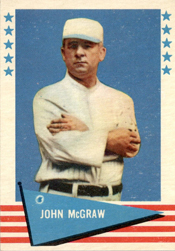
Technically, John McGraw turned down an offer to manage the Cardinals. Actually, though, he was their de facto manager for part of a season.

The question of whether McGraw was or wasn’t the Cardinals’ manager made headlines in August 1900. After manager Patsy Tebeau resigned, Cardinals president Frank Robison said publicly that McGraw, the Cardinals’ captain and third baseman, agreed to be player-manager. McGraw said Robison was mistaken.

A peculiar compromise was reached: A member of the Cardinals’ business staff, Louis Heilbroner, who had no baseball experience, became manager and sat on the bench in that role during games. McGraw made out the lineups, decided which pitchers to use and ran the team on the field.

“It appears McGraw is manager with a scapegoat in the person of Mr. Heilbroner … in case he fails to make the team win,” the St. Louis Republic declared.

Two months later, after the Cardinals went 23-25 in the 48 games managed by the Heilbroner/McGraw tandem, McGraw departed St. Louis for Baltimore. He eventually went on to become manager of the New York Giants, attaining three World Series titles and 10 National League pennants.

McGraw totaled 2,763 wins, though none were credited to him for his role with the Cardinals. Only Connie Mack (3,731) and Tony La Russa (2,902) achieved more wins as managers.

Good times, bad times

Born and raised in Truxton, N.Y., a village 65 miles west of Cooperstown, McGraw was 12 when his mother and four of his siblings died in a diphtheria epidemic. He moved in with a neighbor to escape a father who beat him.

Advancing from local sandlot baseball to the professional ranks, McGraw was 18 when he reached the majors with the 1891 Baltimore Orioles. He began as a utility player before developing into “a brilliant third baseman … who brought a keen, incisive mind to the national game, a fighter of the old school whose aggressiveness inspired his teammates,” according to the New York Times.

Nicknamed Little Napoleon by the press and Mugsy by his foes, McGraw, 26, became player-manager of the 1899 Orioles. In August, his wife, Mary, 22, died of acute appendicitis. After the season, the Orioles, a National League franchise, disbanded, and McGraw went to play for the Cardinals when the club agreed to waive from his contract the reserve clause which bound a player to a team.

Joining a club that featured three future Hall of Fame players _ left fielder Jesse Burkett, shortstop Bobby Wallace and pitcher Cy Young _ McGraw played third base and ignited the offense. His .505 on-base percentage was tops in the league. He totaled 115 hits, 85 walks and was plunked by pitches 23 times. McGraw struck out a mere nine times in 447 plate appearances.

Yet, the 1900 Cardinals were underachievers, losing 15 of 20 games in June. As the St. Louis Republic noted, “Baseball players are nervous, sensitive mortals … Despite all the hot air about … every man … pulling hard to win … it is a cinch that one-third of the team has no use or love for the other two-thirds.”

Big change is coming

The Cardinals staggered into August with a 34-42 record. Manager Patsy Tebeau had seen enough.

Born in north St. Louis near 22nd and Branch streets, Oliver Wendell Tebeau learned baseball on the Happy Hollow diamond beneath Goose Hill and became a member of the Shamrock Club team, earning the Irish nickname Patsy despite a French-Canadian surname. He went on to be a standout first baseman in the majors and managed the Cleveland club before going back to St. Louis.

Tebeau submitted his resignation to Cardinals president Frank Robison in early August 1900. Robison asked Tebeau to reconsider and to at least finish the season as manager, but Tebeau was obdurate. He and Robison agreed to stay mum about the decision until a replacement could be found.

Robison offered the job to McGraw.

On Aug. 19, 1900, the Reds won at St. Louis, 8-5, dropping the Cardinals’ record to 42-50. Afterward, Robison met in his office with seven St. Louis newspaper reporters and told them Tebeau had resigned and McGraw had accepted an offer to replace him. “Mr. McGraw will manage the club in Mr. Tebeau’s place,” Robison said. “He will have full charge of the team on the field.”

Robison also told the reporters that his secretary, Louis Heilbroner, would be business manager, acting as Robison’s representative on road trips.

That night, a St. Louis Republic reporter tracked down McGraw at the Southern Hotel, where he stayed. “I have accepted the management of the St. Louis club,” McGraw told the newsman.

Not so fast

The morning newspapers on Aug. 20 reported McGraw was manager of the Cardinals, but McGraw told the afternoon St. Louis Post-Dispatch a different story. He claimed he rejected Robison’s offer. “I would not be doing myself justice to accept the management of the team at the present time,” McGraw said to the Post-Dispatch. “I would be held responsible for any shortcomings that the team might show, and I do not care to accept this responsibility.”

As the St. Louis Republic saw it, “McGraw is evidently a bit leery of … trying to make a silk purse out of a sow’s (ear), of converting a losing team into a winning one. Though the team is strong enough to win, it is badly disorganized and full of cliques. McGraw is not sure of his ground. He doubts the fidelity of his men.”

To appease McGraw, Frank Robison and his brother, club treasurer Stanley Robison, named Louis Heilbroner as manager but all agreed McGraw would run the team on the field.

“Mr. McGraw has complete charge of the team,” Heilbroner told the St. Louis Republic. “He can … change any player, bench any player, do as he pleases with the men on the field. At least that is my understanding.”

Stanley Robison said to the Post-Dispatch, “McGraw … will have entire charge of the players when on the field. He will place the pitchers and his orders will govern their conduct during the game. Louis Heilbroner … will occupy the manager’s seat on the bench but he will not in any way interfere with McGraw’s orders.”

Most comfortable dressed in a buttoned shirt with collar and cuffs, Heilbroner was 4-foot-9, barely weighed more than 100 pounds and had a “thin, piping voice,” according to the Post-Dispatch. Many of the players he was tasked with managing  had reputations for being roughnecks.

Labeling Heilbroner, 39, as “simply a straw man,” the Republic added, “Everyone knows that Mr. Heilbroner makes not even the ordinary fan’s pretensions to knowing baseball. He is a capital business man, a first-class fellow, but he does not know baseball.”

Home alone

That afternoon, Aug. 20, “not more than 800 enthusiasts” showed up at League Park to see the visiting Reds play the Cardinals, the St. Louis Globe-Democrat reported. According to the Republic, “not enough persons were in the stands to start a game of pinochle.”

Not even McGraw was a spectator. He stayed in the clubhouse, claiming he was “under the weather,” the Globe-Democrat reported, and leaving poor Heilbroner to fend for himself in his debut as manager.

Heilbroner did a sensible thing: He gave the ball to Cy Young. Unfortunately, Young’s pitching didn’t earn any awards that day. He gave up 11 runs and was heckled from the stands before Heilbroner lifted him after six innings.

Young “dressed hurriedly and sought to even up matters in some way,” the Republic reported. “He hied himself to the grandstand and picked out a spectator who had called him a rank quitter … (Young’s) wife was seated beside the individual who roasted him while he was on the rubber. The spectator took Cy’s scolding and slunk away without making a reply.”

The Reds won, 15-7, but as the Post-Dispatch noted, “Mr. Heilbroner is not losing any sleep over the situation. He sat on the players’ bench and seemed to enjoy the game. He does not pretend to know anything about baseball from a playing standpoint (and) virtually admits that he is a figurehead.”

McGraw sat alongside Heilbroner on the bench the next day, Aug. 21, and the Cardinals beat the Reds, 9-8.

One and done

McGraw was one of two future Hall of Fame managers playing for the 1900 Cardinals. The other was his friend, catcher Wilbert Robinson, but Heilbroner remained Cardinals manager until season’s end. The Cardinals finished at 65-75 _ 42-50 with Tebeau and 23-25 with Heilbroner.

(According to John Wray of the Post-Dispatch, Heilbroner wasn’t a pushover during his stint as skipper. After Heilbroner rejected a request from pitcher Jack Powell for a pay advance, “Powell started to stuff Louie into the safe but changed his mind when the little man confronted him with such a barrage of language and threats that Big Jack fell back.”)

Because the Cardinals had waived the reserve clauses in the contracts of McGraw and Wilbert Robinson as incentive to come to St. Louis, both men became free agents after the 1900 season. McGraw returned to Baltimore, becoming part owner and player-manager of the new Orioles franchise in the American League. Robinson went with him.

In July 1902, McGraw jumped from the Orioles to the Giants and had his greatest successes, building a reputation as “the molder of championship clubs, a stickler for discipline and a martinet who saw that his orders were rigidly enforced both on and off the field,” the New York Times noted.

Patsy Tebeau never returned to baseball after leaving the Cardinals. He ran a popular saloon on North Sixth Street in St. Louis, but became despondent after his health deteriorated and his wife left him. He committed suicide at 53.

Outfielder Patsy Donovan replaced Louis Heilbroner as Cardinals manager for the 1901 season.

Heilbroner went on to scout for the Cardinals and St. Louis Browns before operating a respected baseball statistical service. He published the annual Baseball Blue Book of statistics and records. “His statistics did as much to build up the game as any one factor,” the Globe-Democrat reported.

Read Full Post »

Older Posts »