Feeds:
Posts
Comments

Archive for the ‘Executives’ Category

In the fall of 1931, President Herbert Hoover had two strikes against him. The nation was in the throes of the Great Depression and alcoholic beverages were outlawed under Prohibition. To many Americans, Hoover wasn’t doing enough to improve the economy and was an obstacle to ending the ban on booze.

When Hoover attended Game 3 of the 1931 World Series between the Cardinals and Athletics at Philadelphia, spectators in the bleachers voiced their displeasure with him, booing when he arrived and when he departed.

The reaction was significant because it demonstrated how unpopular Hoover became. Three years earlier, when elected president in 1928, Hoover got 65.2 percent of the votes in Pennsylvania. Now he was being jeered there.

Orphan to president

Born in West Branch, Iowa, Hoover was 6 when his father, Jessie, a blacksmith and farm equipment salesman, suffered a heart attack and died. Three years later, the boy’s mother, Huldah, developed pneumonia and also died. Hoover moved in with an uncle, Dr. John Minthorn, in Oregon, according to University of Kentucky associate history professor David E. Hamilton.

Hoover eventually enrolled at Stanford and majored in geology. (He married the school’s lone woman geology major.) Hoover briefly was a shortstop for the Stanford baseball team, according to the White House Historical Association. Then he became a student manager for the university’s baseball and football teams.

Hoover used his geology degree to make a fortunate in mining.

The outbreak of World War I brought Hoover into public service. He organized the Committee for the Relief of Belgium, raising millions of dollars for food and medicine to help war-stricken Belgians. In 1917, President Woodrow Wilson, a Democrat, chose Hoover to run the U.S. Food Administration, leading the effort to feed America’s European allies. After the war, Hoover headed the European Relief and Rehabilitation Administration. “In this capacity, Hoover channeled 34 million tons of American food, clothing and supplies to Europe, aiding people in 20 nations,” according to historian David E. Hamilton.

Hoover then served as secretary of commerce in the administrations of President Warren Harding and President Calvin Coolidge.

In 1928, Hoover was the Republican nominee in the presidential race against Democrat Al Smith. A campaign circular proclaimed Hoover would put “a chicken in every pot and a car in every garage,” according to historian David E. Hamilton.

At a September 1928 game in Washington between the Yankees and Senators, a photographer asked Hoover to pose with Babe Ruth. Hoover agreed, but Ruth didn’t. According to the New York Times, Ruth barked, “I’m for Al Smith.”

Not even an endorsement from the popular Bambino, though, could save Smith. With the economy booming in the Roaring Twenties of the business-friendly Coolidge administration, voters overwhelmingly opted to keep a Republican in the White House. Hoover won, with 444 electoral votes to 87 for Smith.

Dark days

Hoover took in plenty of big-league baseball games as president. He threw the ceremonial first pitch on Opening Day at Griffith Stadium in Washington during each of his four years in office. Video

Hoover also became a good-luck charm for the Philadelphia Athletics. From October 1929 to July 1931, he attended five of their games and the A’s won every time. The first of those was the finale of the 1929 World Series at Philadelphia on Oct. 14. When he entered Shibe Park to see the Cubs and A’s, Hoover “received a rousing welcome … from the thousands of fans who crowded every corner of the stands,” the New York Times reported. Boxscore

Ten days later, the stock market crashed and the Great Depression followed.

In 1930, Babe Ruth sought an $80,000 salary from the Yankees. Told that was more than Hoover made, Ruth responded, “I had a better year than he did.”

According to the Encyclopedia Britannica website, “Hoover’s reputation as a humanitarian _ earned during and after World War I as he rescued millions of Europeans from starvation _ faded from public consciousness when his administration proved unable to alleviate widespread joblessness, homelessness and hunger in his own country during the early years of the Great Depression.”

In his book, “My Florida,” Ernie Lyons, editor of The Stuart (Fla.) News, told the story of the “Hoover chicken” to illustrate the hardships residents of his community experienced.

“Back in the closing days of the Hoover administration, the promise of ‘a chicken in every pot’ had fallen through so dismally that anything edible in the countryside was substituted,” Lyons wrote. “In our part of South Florida, the gopher tortoise, an edible land turtle, was a life-saver for genuinely poverty stricken families … The Hoover chicken resided _ and still does _ in long tunnels slanted back into the spruce terrain of high, dry backwoods sections … During the Great Depression, the gopher tortoise hunter was a common sight in our woods as he prowled with a long, limber hook-pole over his shoulder, carrying a croaker sack and a shovel. When he found a gopher tortoise hole, he would push the pole down the tunnel and fiddle around, sometimes for half an hour, to hook the tortoise by the carapace and haul it out.”

The consequences of the economic collapse took its toll on Hoover. In the book “The Powers That Be,” journalist David Halberstam wrote, “As the Depression grew worse, Hoover turned inward. He had been unable to deal with the terrifying turn of events. Immobilized politically by his fate, he grew hostile and petulant.”

Hoover attended Game 1 of the 1930 World Series between the Cardinals and Athletics at Philadelphia, but unlike the reception he got the year before, “it was a very quiet, undemonstrative crowd and … the entry of (Hoover) drew only a modest cheer,” The Sporting News reported. Boxscore

Philly flop

By 1931, the Great Depression had reached “panic proportions,” according to the book “Baseball: The Presidents’ Game” by William B. Mead and Paul Dickson. “More than 2,200 banks had failed in 1931 alone, stripping families of their savings. Unemployment was continuing to rise … Hoover was now a president besieged, his name part of the vocabulary of the Depression: shantytowns of the homeless were known as Hoovervilles.”

Hoover had committed to attend Game 3 of the 1931 World Series between the Cardinals and A’s at Philadelphia on Oct. 5, but he wasn’t in the mood. On Oct. 4 in Washington, he’d met late into the night with banking officials, but made no progress. In his memoirs, Hoover recalled, “I returned to the White House after midnight more depressed than ever before.”

Traveling to Philadelphia in the morning for a ballgame had no appeal. “Although I like baseball,” Hoover wrote in his memoirs, “I kept this engagement only because I felt my presence at a sporting event might be a gesture of reassurance to a country suffering from a severe attack of jitters.”

A few minutes before the start of the game, Hoover and his entourage were escorted onto the playing field at Shibe Park through a private entrance and proceeded through a lane of policemen to their box seats.

Light applause from the grandstand greeted his arrival, but then boos came from the bleachers. “Out of the first spontaneous applause there comes an unmistakable note of derision and this note is taken up by more timid souls until ultimately it becomes a vigorous full-rounded melody of disparagement,” Joe Williams of the New York World-Telegram reported.

As Paul Gallico of the New York Daily News put it, Hoover “entered the ballpark to the low, snarling rumble of popular disapproval.”

In “Baseball: The Presidents’ Game,” authors Mead and Dickson noted, “The booing became almost a roar.” Joe Williams wrote, “The catcalls and boos continue until Hoover and his party have taken their seats.”

Then a chant came from the bleacher sections: “We want beer.”

Prohibition was in its 12th year. It started in 1919 through an act of Congress, which overrode President Wilson’s veto. By 1931, many wanted the alcohol ban to end. Hoover, who supported Prohibition, was unmoved by the calls from Shibe Park spectators. “He sat there with his hands folded across his tum-tum and smiled, as if to reply, ‘Try and get it,’ ” Joe Williams noted.

Hoover was seated just as the Cardinals were finishing fielding practice. According to the Philadelphia Inquirer, Cardinals owner Sam Breadon, manager Gabby Street and equipment manager Butch Yatkeman went over to greet him. Street asked Hoover to autograph a baseball. Yatkeman brought three balls to autograph.

Then it was time for Hoover to throw the ceremonial first pitch from his box seat to A’s catcher Mickey Cochrane on the field. “He took a straight Republican windup, but he threw like a Bolshevik,” John Kieran wrote in the New York Times. “The ball went yards over Mickey Cochrane’s head and fell among four umpires.”

It was that kind of a day for Hoover. He didn’t even provide his customary good luck for the A’s. Burleigh Grimes held the A’s hitless for the first seven innings. Boxscore

With the Cardinals ahead, 4-0, after eight, Hoover decided to leave. A ballpark announcer bellowed over the loudspeakers, “Silence, please!” and requested that all spectators remain in their seats until Hoover and his entourage exited.

“This was the signal for another rousing shower of razzberries,” Joe Williams reported. Paul Gallico described the booing as “determined and violent.”

“A polite pattering of applause” from the grandstand was countered by “an undercurrent of growling” from other sections of the ballpark, Gallico observed.

In his memoirs, Hoover recalled, “I left the ballpark with the chant of the crowd ringing in my ears: ‘We want beer!’ ”

A year later, Franklin D. Roosevelt (472 electoral votes) thumped Hoover (59 votes) in the 1932 presidential election. The only large state to go for Hoover was Pennsylvania, with its 36 electoral votes.

Read Full Post »

Technically, John McGraw turned down an offer to manage the Cardinals. Actually, though, he was their de facto manager for part of a season.
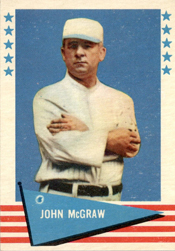
The question of whether McGraw was or wasn’t the Cardinals’ manager made headlines in August 1900. After manager Patsy Tebeau resigned, Cardinals president Frank Robison said publicly that McGraw, the Cardinals’ captain and third baseman, agreed to be player-manager. McGraw said Robison was mistaken.

A peculiar compromise was reached: A member of the Cardinals’ business staff, Louis Heilbroner, who had no baseball experience, became manager and sat on the bench in that role during games. McGraw made out the lineups, decided which pitchers to use and ran the team on the field.

“It appears McGraw is manager with a scapegoat in the person of Mr. Heilbroner … in case he fails to make the team win,” the St. Louis Republic declared.

Two months later, after the Cardinals went 23-25 in the 48 games managed by the Heilbroner/McGraw tandem, McGraw departed St. Louis for Baltimore. He eventually went on to become manager of the New York Giants, attaining three World Series titles and 10 National League pennants.

McGraw totaled 2,763 wins, though none were credited to him for his role with the Cardinals. Only Connie Mack (3,731) and Tony La Russa (2,902) achieved more wins as managers.

Good times, bad times

Born and raised in Truxton, N.Y., a village 65 miles west of Cooperstown, McGraw was 12 when his mother and four of his siblings died in a diphtheria epidemic. He moved in with a neighbor to escape a father who beat him.

Advancing from local sandlot baseball to the professional ranks, McGraw was 18 when he reached the majors with the 1891 Baltimore Orioles. He began as a utility player before developing into “a brilliant third baseman … who brought a keen, incisive mind to the national game, a fighter of the old school whose aggressiveness inspired his teammates,” according to the New York Times.

Nicknamed Little Napoleon by the press and Mugsy by his foes, McGraw, 26, became player-manager of the 1899 Orioles. In August, his wife, Mary, 22, died of acute appendicitis. After the season, the Orioles, a National League franchise, disbanded, and McGraw went to play for the Cardinals when the club agreed to waive from his contract the reserve clause which bound a player to a team.

Joining a club that featured three future Hall of Fame players _ left fielder Jesse Burkett, shortstop Bobby Wallace and pitcher Cy Young _ McGraw played third base and ignited the offense. His .505 on-base percentage was tops in the league. He totaled 115 hits, 85 walks and was plunked by pitches 23 times. McGraw struck out a mere nine times in 447 plate appearances.

Yet, the 1900 Cardinals were underachievers, losing 15 of 20 games in June. As the St. Louis Republic noted, “Baseball players are nervous, sensitive mortals … Despite all the hot air about … every man … pulling hard to win … it is a cinch that one-third of the team has no use or love for the other two-thirds.”

Big change is coming

The Cardinals staggered into August with a 34-42 record. Manager Patsy Tebeau had seen enough.

Born in north St. Louis near 22nd and Branch streets, Oliver Wendell Tebeau learned baseball on the Happy Hollow diamond beneath Goose Hill and became a member of the Shamrock Club team, earning the Irish nickname Patsy despite a French-Canadian surname. He went on to be a standout first baseman in the majors and managed the Cleveland club before going back to St. Louis.

Tebeau submitted his resignation to Cardinals president Frank Robison in early August 1900. Robison asked Tebeau to reconsider and to at least finish the season as manager, but Tebeau was obdurate. He and Robison agreed to stay mum about the decision until a replacement could be found.

Robison offered the job to McGraw.

On Aug. 19, 1900, the Reds won at St. Louis, 8-5, dropping the Cardinals’ record to 42-50. Afterward, Robison met in his office with seven St. Louis newspaper reporters and told them Tebeau had resigned and McGraw had accepted an offer to replace him. “Mr. McGraw will manage the club in Mr. Tebeau’s place,” Robison said. “He will have full charge of the team on the field.”

Robison also told the reporters that his secretary, Louis Heilbroner, would be business manager, acting as Robison’s representative on road trips.

That night, a St. Louis Republic reporter tracked down McGraw at the Southern Hotel, where he stayed. “I have accepted the management of the St. Louis club,” McGraw told the newsman.

Not so fast

The morning newspapers on Aug. 20 reported McGraw was manager of the Cardinals, but McGraw told the afternoon St. Louis Post-Dispatch a different story. He claimed he rejected Robison’s offer. “I would not be doing myself justice to accept the management of the team at the present time,” McGraw said to the Post-Dispatch. “I would be held responsible for any shortcomings that the team might show, and I do not care to accept this responsibility.”

As the St. Louis Republic saw it, “McGraw is evidently a bit leery of … trying to make a silk purse out of a sow’s (ear), of converting a losing team into a winning one. Though the team is strong enough to win, it is badly disorganized and full of cliques. McGraw is not sure of his ground. He doubts the fidelity of his men.”

To appease McGraw, Frank Robison and his brother, club treasurer Stanley Robison, named Louis Heilbroner as manager but all agreed McGraw would run the team on the field.

“Mr. McGraw has complete charge of the team,” Heilbroner told the St. Louis Republic. “He can … change any player, bench any player, do as he pleases with the men on the field. At least that is my understanding.”

Stanley Robison said to the Post-Dispatch, “McGraw … will have entire charge of the players when on the field. He will place the pitchers and his orders will govern their conduct during the game. Louis Heilbroner … will occupy the manager’s seat on the bench but he will not in any way interfere with McGraw’s orders.”

Most comfortable dressed in a buttoned shirt with collar and cuffs, Heilbroner was 4-foot-9, barely weighed more than 100 pounds and had a “thin, piping voice,” according to the Post-Dispatch. Many of the players he was tasked with managing  had reputations for being roughnecks.

Labeling Heilbroner, 39, as “simply a straw man,” the Republic added, “Everyone knows that Mr. Heilbroner makes not even the ordinary fan’s pretensions to knowing baseball. He is a capital business man, a first-class fellow, but he does not know baseball.”

Home alone

That afternoon, Aug. 20, “not more than 800 enthusiasts” showed up at League Park to see the visiting Reds play the Cardinals, the St. Louis Globe-Democrat reported. According to the Republic, “not enough persons were in the stands to start a game of pinochle.”

Not even McGraw was a spectator. He stayed in the clubhouse, claiming he was “under the weather,” the Globe-Democrat reported, and leaving poor Heilbroner to fend for himself in his debut as manager.

Heilbroner did a sensible thing: He gave the ball to Cy Young. Unfortunately, Young’s pitching didn’t earn any awards that day. He gave up 11 runs and was heckled from the stands before Heilbroner lifted him after six innings.

Young “dressed hurriedly and sought to even up matters in some way,” the Republic reported. “He hied himself to the grandstand and picked out a spectator who had called him a rank quitter … (Young’s) wife was seated beside the individual who roasted him while he was on the rubber. The spectator took Cy’s scolding and slunk away without making a reply.”

The Reds won, 15-7, but as the Post-Dispatch noted, “Mr. Heilbroner is not losing any sleep over the situation. He sat on the players’ bench and seemed to enjoy the game. He does not pretend to know anything about baseball from a playing standpoint (and) virtually admits that he is a figurehead.”

McGraw sat alongside Heilbroner on the bench the next day, Aug. 21, and the Cardinals beat the Reds, 9-8.

One and done

McGraw was one of two future Hall of Fame managers playing for the 1900 Cardinals. The other was his friend, catcher Wilbert Robinson, but Heilbroner remained Cardinals manager until season’s end. The Cardinals finished at 65-75 _ 42-50 with Tebeau and 23-25 with Heilbroner.

(According to John Wray of the Post-Dispatch, Heilbroner wasn’t a pushover during his stint as skipper. After Heilbroner rejected a request from pitcher Jack Powell for a pay advance, “Powell started to stuff Louie into the safe but changed his mind when the little man confronted him with such a barrage of language and threats that Big Jack fell back.”)

Because the Cardinals had waived the reserve clauses in the contracts of McGraw and Wilbert Robinson as incentive to come to St. Louis, both men became free agents after the 1900 season. McGraw returned to Baltimore, becoming part owner and player-manager of the new Orioles franchise in the American League. Robinson went with him.

In July 1902, McGraw jumped from the Orioles to the Giants and had his greatest successes, building a reputation as “the molder of championship clubs, a stickler for discipline and a martinet who saw that his orders were rigidly enforced both on and off the field,” the New York Times noted.

Patsy Tebeau never returned to baseball after leaving the Cardinals. He ran a popular saloon on North Sixth Street in St. Louis, but became despondent after his health deteriorated and his wife left him. He committed suicide at 53.

Outfielder Patsy Donovan replaced Louis Heilbroner as Cardinals manager for the 1901 season.

Heilbroner went on to scout for the Cardinals and St. Louis Browns before operating a respected baseball statistical service. He published the annual Baseball Blue Book of statistics and records. “His statistics did as much to build up the game as any one factor,” the Globe-Democrat reported.

Read Full Post »

As Cardinals manager, Branch Rickey either was ahead of his time or hopelessly out of step with the times. Take your pick. Either way, Cardinals owner and president Sam Breadon decided Rickey no longer should be manager.

On May 30, 1925, Breadon changed managers, replacing Rickey with Rogers Hornsby. Rickey remained with the club in a front-office role.

The shakeup turned out to be good for the Cardinals. Player-manager Hornsby led them to their first National League pennant and World Series championship in 1926. Focused on baseball operations, vice president Rickey built the Cardinals into a perennial contender.

On shaky ground

After managing the St. Louis Browns (1913-15), Rickey joined the Cardinals and became their manager in 1919. In his first six years, he piloted the club to three winning seasons: 1921 (87-66), 1922 (85-69) and 1923 (79-74). Then the Cardinals took a big step backwards, finishing 65-89 in 1924 and drawing a mere 272,885 at its home games.

Knowing Breadon was considering a change, Rickey offered to resign during 1925 spring training but reconsidered, according to St. Louis Post-Dispatch columnist John Wray. “I look at this team I have put together and I can visualize it winning the flag,” Rickey told Breadon. “I have the stuff here and I want another chance. I think I deserve it because I assembled all this talent.”

Breadon wasn’t convinced. In his autobiography, “My War With Baseball,” Hornsby said Rickey sought his help with Breadon. “I went to Breadon and said that Rickey was the smartest man in baseball,” Hornsby recalled. “Breadon suggested I take the job as manager, but I wasn’t interested.”

Before spring training ended, Breadon formerly offered Hornsby the job, but he declined. “I recommended that Breadon keep Rickey,” Hornsby said in his autobiography. “I also told Breadon that if the Good Lord himself were to … manage this club, he couldn’t do any better. It was a lousy team.”

Decision time

The 1925 Cardinals won five of their first eight, then nosedived, losing seven in a row at home before mostly small crowds.

When the Cardinals were in Pittsburgh for a series with the Pirates, Breadon showed up. On Friday, May 29, Hornsby was having breakfast at the Hotel Schenley when traveling secretary Clarence Lloyd approached him and said Breadon wanted to meet. In his autobiography, Hornsby recalled that as he passed by the table of Rickey and coach Burt Shotton, Rickey said to him, “Breadon wants you to manage the team.”

Hornsby replied, “I don’t want to manage. He knows that.”

“Then will you ask Breadon to give me another chance?” Rickey said to Hornsby. “If he won’t, see if you can get him to let Shotton here be the manager.”

Hornsby said, “OK.”

(In addition to coaching, Shotton managed the Cardinals on Sundays, because Rickey promised his mother before signing his first professional contract that he would abstain from baseball activities on Sundays.)

Hornsby met in Breadon’s room and was offered the job. Hornsby said no.

According to the book “Branch Rickey: A Biography” by Murray Polner, Breadon barked back, “I won’t have any goddamned Sunday school teacher running my team. You’re going to run it.”

In his autobiography, Hornsby said he and Breadon had the following exchange:

Hornsby: “You mean, Rickey’s through?”

Breadon: “That’s exactly right _ as manager.”

Hornsby: “What about Shotton as manager?”

Breadon: “I don’t want any Rickey man either.”

It was agreed Hornsby should think over the proposal and inform Breadon of the decision the next day. “I went back down and told Rickey what Breadon had said,” Hornsby recalled in his autobiography. “Rickey didn’t cuss or anything, but he got pretty mad and said he would sell all his stock in the Cardinals.”

According to the Rickey biography, Rickey said to Hornsby, “Judas priest, the man (Breadon) is stabbing me in the back.”

At the ballpark that day, Hornsby slugged a two-run home run, but the Cardinals lost, dropping their record to 13-23. It turned out to be the last game Rickey would manage. Boxscore

Making the switch

According to his autobiography, Hornsby went to Breadon on Saturday, May 30, and told him “the only way I would be interested in becoming manager would be if I could buy Rickey’s stock … Then baseball could be my business for life.” Breadon assured him that would be arranged. The two agreed Hornsby would become player-manager, effective Sunday, May 31. “I expect him to put new fight into the Cardinals,” Breadon told the Associated Press.

In reporting on the managerial switch, James M. Gould of the St. Louis Star-Times wrote, “The pupil succeeds the master.”

Hornsby, 29, became the youngest manager in the National League. He was a few months older than player-manager Bucky Harris, 28, of the American League’s Washington Senators. Other player-managers in the majors in 1925 included Dave Bancroft of the Braves, Ty Cobb of the Tigers, Eddie Collins of the White Sox, George Sisler of the Browns and Tris Speaker of the Indians.

“I feel that with Rickey as vice president and business manager, and Hornsby as playing manager, we have one of the greatest combinations in baseball,” Breadon told the Post-Dispatch.

He also said to the Associated Press, “Rickey is a valuable man and we want to utilize his knowledge of baseball and his great judgment of players. He is a great organizer and a builder, and that is his sphere.”

Breadon’s words, though, didn’t appease Rickey, who resented being ousted as manager. According to Rickey’s biography, he described Breadon’s action as “clumsily brutal.”

According to author Murray Polner, Rickey felt betrayed and considered leaving the Cardinals to become athletic director at Northwestern University, but his wife Jane talked him out of it.

In his book “Mr. Rickey’s Redbirds,” author Mike Mitchell wrote that Rickey later said, “My fault as a manager … was due to my apparent zeal. I discussed the game every day … as if the game coming up was the game of the year.”

With Rickey out and Hornsby taking over effective May 31, coach Shotton was tasked with managing the Cardinals in the May 30 Saturday doubleheader at Pittsburgh, according to “Mr. Rickey’s Redbirds.” The Pirates won both, totaling eight triples in Game 2. Boxscore

Rickey’s reviews

Reaction to the managerial move mostly was favorable:

_ J. Roy Stockton, Post-Dispatch: “The Cardinals should do well under Hornsby. He will not overmanage the team. If there was any just criticism of Branch Rickey’s regime, it was that he burdened the team with too much management. He tried to pitch for the pitchers and to catch for the catchers … He lacked poise when directing his men … He decided on a plan of action and then … he hesitated, pondered over the danger and changed the plan.”

_ Tommy Holmes, Brooklyn Eagle: “Some attribute the failure of the team to Rickey’s attempt to mastermind the Cardinals. He wanted to do all the thinking that was to be done on the team … Branch exercised his managerial authority by requiring the batter to keep in constant touch with his wagging from the bench. A hitter up there with the bases full, to bust it and nothing else, had to strain his neck getting the signal on every ball pitched.”

_ Henry Farrell, United Press: “Rickey had a lot of trick ideas about handling of a ballclub that made some of the older athletes feel like they were being treated like children. He not only had blackboard talks on baseball but he extended his skull practice to include arithmetic and the grammar school arts and sciences.”

_ John B. Foster, Dayton Daily News: “The greatest weakness of (Rickey) was … his lack of playing instinct. He usually managed to change pitchers at the wrong time … Almost every manager in the National League figured upon his doing the wrong thing at the wrong time … Opposing managers figured they would get away with games if they forced Rickey to change pitchers.”

_ The Sporting News: “The elevation of Hornsby to the management was the most popular choice that could have been made for the fans.”

Different approach

Indeed, fans gave Hornsby a big reception when he was led to the plate by St. Louis mayor Victor Miller and presented with several floral pieces before the start of his managerial debut on Sunday, May 31. During the game, the Post-Dispatch noted “a new spirit exhibited by the players” and “a dash that had been missing for some time.” Hornsby contributed two hits, two walks, two runs scored and a RBI in a 5-2 Cardinals victory over the Reds. Boxscore

The next day, Hornsby started Jesse Haines against the Reds. In four starts for Rickey in 1925, Haines was yanked from the games and lost all four. In his first start for Hornsby, he pitched a complete game and won. Boxscore

A week later, Hornsby bought 1,167 shares of Rickey’s Cardinals stock at $43 a share, a total investment of $50,181, the St. Louis Globe-Democrat reported. As author Mike Mitchell noted, “Upset about being removed as manager, Rickey made an emotional and short-sighted decision.”

Meanwhile, Hornsby canceled the daily team meetings and daily morning workouts that had been the norm when Rickey managed. “You can’t drill for two hours and then get out in the afternoon with all your pep and play some more,” Hornsby explained to the Star-Times.

The Cardinals won 15 of their first 19 games with Hornsby as manager and finished at 77-76. Hornsby’s hitting helped, too. In 1925, he was named recipient of the National League Most Valuable Player Award and led the league in batting average, on-base percentage and slugging percentage for the sixth year in a row.

Read Full Post »

In a race to determine the slowest runner in the National League, the loser was the commissioner of baseball, and he didn’t even run.

A pair of catchers, Del Rice of the Cardinals and Rube Walker of the Dodgers, were the contestants in what Bob Broeg of the St. Louis Post-Dispatch described as “a snail versus tortoise match race.”

When some of the Cardinals made small, friendly wagers with their Dodgers counterparts on which of the two leadfoots would win, heavy-handed baseball commissioner Ford Frick initiated a gambling investigation.

Frick backed down quickly after baseball writers mocked him in their newspaper stories for being unable to see the difference between harmless fun and scandal.

Slow going

Signed by Cardinals scout Frank Rickey, brother of general manager Branch Rickey, Del Rice was 18 when he began his pro baseball career in the minors in 1941. Rice reached the majors with the Cardinals four years later.

Listed as 6-foot-2, Rice also played one season (1945-46) of pro basketball with the Rochester Royals. His teammates included Red Holzman (the future head coach of the St. Louis Hawks and New York Knicks), Otto Graham (better known as quarterback of the Cleveland Browns) and Chuck Connors (the big-league first baseman who became TV’s “The Rifleman”). Rochester won the National Basketball League (NBL) championship that season. (In 1949, the NBL merged with the Basketball Association of America and became the National Basketball Association, or NBA.)

Like Rice, Rube Walker also was 18 when he became a pro baseball player, signing with the Cubs in 1944 and advancing to the majors with them four years later. Joe Donnelly of Newsday described him as “a large man with a twinkle in his eye and a heart that reached out to people.”

Rice and Walker were good defensive catchers who didn’t hit much. In 17 seasons in the majors, mostly with the Cardinals and Braves, Rice batted .237. Walker hit .227 in his 11 seasons with the Cubs and Dodgers.

Both also were notorious plodders on the base paths. “Neither could outrun me,” Dodgers owner Walter O’Malley, who chain-smoked cigars, said to Dan Daniel of The Sporting News. (Rice managed to steal bases twice in the majors; Walker did it three times.) A good case could be made for either being the slowpoke of the league. Their teammates decided to settle the matter with a footrace.

Amazing race

During warmups before their game on May 17, 1955, at St. Louis, the Cardinals and Dodgers got into some good-natured bantering about who was the slowest man in the league. Rice and Walker were coaxed into having a 50-yard race across the outfield.

(Walker was not the type to back down from a test. According to the New York Times, “he once challenged manager Walter Alston to a billiards match after Alston had taken 130 shots without missing.”)

Members of the teams lined up in two rows _ Cardinals on one side; Dodgers on the other _ forming a lane for Rice and Walker to rumble through, the New York Times reported.

Cardinals manager Eddie Stanky joined some of his players in making bets with Dodgers on who would win, according to the Post-Dispatch. Most of the wagers were for $5. “All told, it was guessed that $45 rested on the outcome,” the St. Louis Globe-Democrat reported.

(Dick Young of the New York Daily News noted that the wagers on the Rice-Walker footrace were pocket change compared with what went on in earlier times. When speedy outfielder Ben Chapman was with the Yankees in the 1930s, he’d routinely race all challengers and usually won. According to Young, “Babe Ruth used to bet hundreds of dollars on every race.” Chapman’s teammate, Dixie Walker, told Young, “The first time, Babe bet against Chapman and lost. After that, Babe always bet on Chapman, and cleaned up.”)

In the St. Louis contest, Rube Walker trudged out to a lead but Rice steamed ahead at the finish and won by a yard. One of the observers, 19-year-old Dodgers rookie Sandy Koufax, recalled to the New York Times years later, “They didn’t go fast enough for a photo finish. It was a study in slow motion.”

Little big man

Walker took his loss in good spirit. “I once was a gazelle,” he told the New York Times. However, baseball commissioner Ford Frick was not amused when he learned wagering was involved. He decided to investigate. According to the Daily News, the wires Frick sent to managers Stanky and Alston read: “You are ordered to submit names and amounts bet by the ballplayers.”

While Frick awaited the reports from the managers, the newspapers ridiculed him for overreacting.

_ Dan Parker, syndicated columnist: “Ford Frick is a man of fine character, but a sense of humor forms no part of it.”

_ Morris McLemore, Miami News: “It would appear Ford Frick might have more to do than worry about the footrace between Del Rice and Rube Walker.”

_ Whitney Martin, Associated Press: “Frick probably feels that from such molehills mountains grow, and that the first thing you know the boys will be … gambling that when they put a penny in a (vending) machine a stick of gum will come out.”

_ Dick Young, New York Daily News: “Frick may have been watching too many ‘Dragnet’ shows.”

Soon after, Frick dropped the investigation, the Jersey Journal reported.

Changes afoot

Stanky, Rice and Walker made headlines for a variety of other reasons in the days following the slowest man contest.

On May 27, 1955, the Cardinals fired Stanky. A week later, they traded Rice to the Braves. (The footrace had nothing to do with either move.)

On June 30, 1955, Walker was carted off the field and sent to a hospital for treatment of a gashed shoulder after Willie Mays ran over him while trying to score. “Walker went down flat on his back, clutching the ball grittily,” the Daily News reported.

(Four years later, in June 1959, Rice suffered a broken left leg in a collision with Mays near home plate. Mays slid hard into Rice, who was straddling the line while awaiting a throw. “It wasn’t his fault,” Rice told the Associated Press. “He had to slide _ that’s baseball _ but he certainly slides hard.”)

After his playing days, Walker coached in the majors for 21 seasons. He was the pitching coach for the 1969 World Series champion Mets. He later was a scout for the Cardinals when Whitey Herzog was their manager.

Rice ended his playing career with the 1961 Angels. He was the first player signed by the American League expansion franchise and was the starting catcher in their first regular-season game. Boxscore

According to the Los Angeles Times, during his stint as an Angels coach in the 1960s, Rice “etched his name into the club’s lore by organizing and winning a golf tournament played in the halls of the team’s Boston hotel (Rice wore golf spikes, glove, hat and pajamas), with the players putting into cocktail glasses.”

After four seasons managing in the minors, Rice was the Angels’ manager in 1972, Nolan Ryan’s first season with the club after being coached by Rube Walker with the Mets.

Read Full Post »

Looking for a good time in St. Louis when their team came to play the Cardinals, Reds fans rolled out the barrels and got busted.

One hundred years ago, in April 1925, Reds owner Garry Herrmann and seven others associated with the Reds Rooters fan club were arrested at the Hotel Statler for possessing real beer.

Home to breweries such as Anheuser-Busch and Falstaff, St. Louis was synonymous with suds, but not during the Prohibition era in the U.S.

Herrmann and the Reds Rooters found out the hard way when federal agents raided their roost before a game.

Dry land

Influenced by repressive religious groups, particularly Christian denominations, and temperance organizations, federal lawmakers approved an amendment to the Constitution that prohibited the production, importation, transportation and sale of alcoholic beverages. The Prohibition era lasted from 1920 to 1933 and prompted gangsters to fill the void with violent bootlegging businesses.

In his book “Mr. Rickey’s Redbirds,” author Mike Mitchell noted, “The battle over Prohibition pitted rural versus urban, Protestant versus Catholic, native-born Americans versus newly arrived immigrants … War gave a final push toward a national prohibition. Those who wanted to ban alcohol often made no distinction between America’s enemies in World War I and brewers in the United States with European heritage.”

St. Louis breweries Anheuser-Busch and Falstaff survived Prohibition by producing near beer, a malt beverage which typically had an alcohol content of less than 0.5 percent, and other products, such as soda pop. (The Anheuser-Busch near beer was called Bevo.) Most other St. Louis beer producers, including Lemp, a major lager brewer, went out of business.

Prohibition didn’t stop the Reds Rooters from carrying on a tradition of traveling to the city where the team played its first road series of the season. About 110 of them went by train from Cincinnati to St. Louis for the four-game set between the Reds and Cardinals April 22-25, 1925.

Beer and bratwurst

The Reds Rooters booked rooms at the elegant Hotel Statler at the corner of Washington Avenue and Ninth Street in downtown St. Louis. Built in 1917, Hotel Statler was the first air-conditioned hotel in the United States.

Another feature of the grand hotel was its 17th floor, which was designated for sample rooms used by traveling salesmen to display products. The Reds Rooters reserved the entire floor and converted it into a party clubhouse for their stay.

According to the St. Louis Post-Dispatch, the Reds Rooters brought with them “several kegs of sauerkraut, barrels of pickles and great quantities of sausages, pretzels and cheeses.”

That’s not all. To quench their thirst, the Cincinnatians also brought 25 half barrels of beer. Real beer.

An informant tipped off John Dyott, special assistant attorney general in charge of federal Prohibition cases, that the Reds Rooters were guzzling illegal brew. Dyott contacted federal law enforcement agents and ordered them to investigate.

At 1:30 p.m. on April 24, 1925, four agents arrived on the 17th floor, where they found 40 Reds Rooters about to leave for the ballpark, the Post-Dispatch reported. The Cincinnati group included Reds owner Garry Herrmann.

Down the drain

Orphaned at age 11, August Herrmann had worked as an errand boy filling salt stacks and then as a printer’s apprentice, where he got the nickname Garibaldi (shortened to Garry), according to the National Baseball Hall of Fame. He went into politics, becoming a Cincinnati city administrator, and rose to prominence with his creation of a modern waterworks system.

Herrmann was the life of any party. According to the Cincinnati Enquirer, “He was considered the greatest host in Cincinnati and he entertained his friends lavishly.”

In the raid on the Reds Rooters, agents found two half kegs of beer on tap and 11 more half kegs in an ice box waiting to be tapped, the Post-Dispatch reported. After taking samples for analysis, the agents poured all the brew down the drain.

Tests showed the beer had a 3.94 percent alcohol by volume (ABV) and qualified as illegal real beer, the St. Louis Star-Times reported. (Before Prohibition, a typical ABV for beer was 4.5 percent to 6 percent. In the early 1930s, a weaker, 3.2 percent beer gained prominence as a legal alternative in states that repealed dry laws before federal Prohibition ended.)

“We were under the impression that the stuff was near beer,” Herrmann told the Star-Times. “It was just an unfortunate mistake.”

Herrmann, five members of the Reds Rooters who were in charge of the arrangements, and two employees of the group were arrested on federal warrants charging possession of intoxicating alcohol. Herrmann posted a bond of $500 immediately after the warrant was served on him. A hearing in federal court in St. Louis was set back to the fall.

Costly pitchers

In October 1925, Herrmann led a contingent of Cincinnatians to Pittsburgh for the World Series between the Senators and Pirates. According to columnist Westbrook Pegler, when Herrmann arrived at Hotel Schenley, friends approached and asked, “Where are the kegs?” Herrmann replied, “Ever since that time they took the kegs away from the Cincinnati boys in St. Louis, I go without kegs.”

Later that month, Herrmann and the other defendants appeared for their hearing in the St. Louis courtroom of U.S. district judge Charles Breckenridge Faris, a former prosecutor who was appointed by President Woodrow Wilson in 1919.

Charges against Herrmann and the five members of the Reds Rooters were dismissed on the grounds that they were not in physical possession of beer when the agents raided the clubroom.

The two Reds Rooters employees, John Rosskopf and Leonard Schwab, who were in their shirt sleeves and wearing the aprons of bartenders when the agents came, pleaded guilty to charges of possession of alcohol. Each was fined $390.

According to testimony reported in the St. Louis newspapers, agents said they saw Rosskopf at a tapped keg with a foaming pitcher of beer in his hand and Schwab also had a pitcher filled with suds.

After the hearing, Herrmann told the Post-Dispatch, “We feel no malice toward St. Louis for our difficulties in this case. You can tell the world the Reds Rooters are still loyal. They’ll be back in the spring.”

Read Full Post »

When he was ready to leave the Athletics, Tony La Russa was intending to manage the 1995 Red Sox.

“At the end of nine years, the A’s had given me permission to interview with the Red Sox, and I was going to Boston,” La Russa recalled to Cardinals Yearbook in 2014. “We even had a discussion about free agents … The one free agent we wanted was Larry Walker.”

If La Russa had gone through with the move, he likely never would have joined the Cardinals, the club he managed to three National League pennants, two World Series championships and a franchise-record 1,408 wins.

A lunch conversation with Athletics owner Walter Haas prompted La Russa to change his plans.

The times they are a-changin’

From 1988-90, La Russa led the Athletics to three consecutive American League pennants and a World Series title, but they finished 68-94 in 1993 and 51-63 in strike-shortened 1994. Though the 1994 Athletics had players such as Dennis Eckersley, Rickey Henderson and Mark McGwire, the club had a dismal 19-43 record until winning 19 of its next 22.

La Russa’s two-year contract with the Athletics expired at the end of 1994 and he was thinking it might be time to leave Oakland. “I came to realize that once you start amassing time _ eight or 10 years in one place _ there becomes a very real perception that the scene needs a change, more for the people around you than for yourself,” La Russa recalled to Cardinals Yearbook. “Fans get tired of reading your same quotes. The media starts to know what you’re going to say before you even say it. Players grow tired of you.”

Also, the Athletics were for sale and the uncertainty that created gave La Russa another reason to consider departing. “If the Haas’ (family) were still in Oakland, I’d still be there,” La Russa told Cardinals Yearbook in 2014.

After the players’ strike halted the season in August 1994, La Russa took his family on an extended vacation to England a month later “amid growing speculation that he could become Boston’s next manager,” the Sacramento Bee reported. “La Russa did nothing to downplay the speculation, acknowledging there are some ‘attractive situations’ out there. He sounded absolutely unsure if he will return to the A’s or seek grander challenges elsewhere.”

The Red Sox were seeking a replacement for Butch Hobson, who never produced a winning record in three seasons as their manager.

“I don’t think that Hobson’s firing will have any impact on our negotiations (with La Russa),” Athletics general manager Sandy Alderson told the Oakland Tribune.

Alderson also said to the Sacramento Bee, “Most of the Boston speculation is just that _ speculation.”

Please come to Boston

Actually, La Russa was the first choice of Red Sox general manager Dan Duquette, who viewed him as the person to lead the franchise to its first World Series crown since Babe Ruth played there in 1918. “The Red Sox are dying to hire La Russa and are willing to pay him a record-setting salary,” Baltimore Sun columnist Tom Keegan noted.

In explaining why La Russa would consider joining the Red Sox, Sacramento Bee columnist Mark Kreidler wrote, “Win it all in Boston, and La Russa’s fame is set for eternity, perhaps even the Hall of Fame … La Russa is not a man without ego. He would go into baseball-rabid Boston and he would own it within a year; and he would be paid millions; and he would work for a franchise that has the money and is willing to spend it in service of a diamond-encrusted ring. Heady stuff.”

Though it went unreported at the time, La Russa made up his mind to accept Boston’s offer. Before sealing the deal, he accepted an invitation to lunch with Walter Haas, the club owner who hired him to manage the Athletics in 1986 after La Russa was fired by the White Sox.

“(Haas) had always treated Elaine (La Russa’s wife) and me like family,” La Russa recalled to Cardinals Yearbook. “At this point, he was having serious health problems. He said he had one more year and he wanted me to manage the team. Going home, I told Elaine what Walter had said. At the time, I didn’t really know if he was talking about his health, selling the franchise, or both.”

Regardless, La Russa decided to honor Haas’ request. “I called Boston and declined the job,” he told Cardinals Yearbook.

Haas gave La Russa a three-year contract with a protective clause that enabled the manager to depart if there was an ownership change, the San Francisco Examiner reported.

As columnist Mark Kreidler noted, “You don’t have to make Tony La Russa a prince for accepting $1.25 million (per year) to continue managing the A’s, but know this: Finances and all, La Russa still made a decision of loyalty and personal feeling not to jump to the waiting Boston Red Sox.”

On the same day the Athletics signed La Russa, the Red Sox named Kevin Kennedy, formerly of the Rangers, as their manager.

“The specter of La Russa haunts Kennedy as Kennedy takes over the fabled Boston franchise,” wrote Boston Globe columnist Dan Shaughnessy. “It is well known that the Red Sox coveted the A’s manager above all others.”

Twists and turns

About the time he decided to stay with the Athletics, La Russa, a vegetarian and animal rights activist, caused a stir when he hammed it up in a national TV commercial for Wendy’s and its new chicken, bacon and Swiss cheese sandwich. “It was stupid on my part,” he told the Associated Press. “I screwed up.”

La Russa claimed he was misled, saying he thought the commercial was for a salad bar and baked potatoes, but Wendy’s spokesman Denny Lynch said Tony was full of baloney. “He knew that it was a chicken sandwich commercial,” Lynch told the Associated Press.

During the 1995 season, the Haas family completed the sale of the Athletics to Ken Hofman and Steve Schott. On Sept. 20, Walter Haas, 79, died. After that, the Athletics lost their last nine games and finished at 67-77, La Russa’s third consecutive losing season. “It wasn’t like the guys weren’t trying; they were grieving,” La Russa recalled to Cardinals Yearbook.

Meanwhile, Kevin Kennedy’s Red Sox, with a roster that included ex-Athletics slugger Jose Canseco as the designated hitter and former Cardinals such as second baseman Luis Alicea, pitcher Rheal Cormier and outfielder Willie McGee, were 1995 East Division champions at 86-58.

La Russa left Oakland after the season and became Cardinals manager. His first World Series appearance with them was in 2004. Their opponent was the Red Sox. Managed by Terry Francona, Boston swept, becoming World Series champions for the first time in 86 years.

Eventually, La Russa worked for the Red Sox, joining them in November 2017 as special assistant to president of baseball operations Dave Dombrowski. The Red Sox then won the 2018 World Series championship.

Read Full Post »

« Newer Posts - Older Posts »