Feeds:
Posts
Comments

Archive for the ‘Executives’ Category

When he was ready to leave the Athletics, Tony La Russa was intending to manage the 1995 Red Sox.
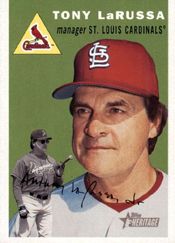
“At the end of nine years, the A’s had given me permission to interview with the Red Sox, and I was going to Boston,” La Russa recalled to Cardinals Yearbook in 2014. “We even had a discussion about free agents … The one free agent we wanted was Larry Walker.”

If La Russa had gone through with the move, he likely never would have joined the Cardinals, the club he managed to three National League pennants, two World Series championships and a franchise-record 1,408 wins.

A lunch conversation with Athletics owner Walter Haas prompted La Russa to change his plans.

The times they are a-changin’

From 1988-90, La Russa led the Athletics to three consecutive American League pennants and a World Series title, but they finished 68-94 in 1993 and 51-63 in strike-shortened 1994. Though the 1994 Athletics had players such as Dennis Eckersley, Rickey Henderson and Mark McGwire, the club had a dismal 19-43 record until winning 19 of its next 22.

La Russa’s two-year contract with the Athletics expired at the end of 1994 and he was thinking it might be time to leave Oakland. “I came to realize that once you start amassing time _ eight or 10 years in one place _ there becomes a very real perception that the scene needs a change, more for the people around you than for yourself,” La Russa recalled to Cardinals Yearbook. “Fans get tired of reading your same quotes. The media starts to know what you’re going to say before you even say it. Players grow tired of you.”

Also, the Athletics were for sale and the uncertainty that created gave La Russa another reason to consider departing. “If the Haas’ (family) were still in Oakland, I’d still be there,” La Russa told Cardinals Yearbook in 2014.

After the players’ strike halted the season in August 1994, La Russa took his family on an extended vacation to England a month later “amid growing speculation that he could become Boston’s next manager,” the Sacramento Bee reported. “La Russa did nothing to downplay the speculation, acknowledging there are some ‘attractive situations’ out there. He sounded absolutely unsure if he will return to the A’s or seek grander challenges elsewhere.”

The Red Sox were seeking a replacement for Butch Hobson, who never produced a winning record in three seasons as their manager.

“I don’t think that Hobson’s firing will have any impact on our negotiations (with La Russa),” Athletics general manager Sandy Alderson told the Oakland Tribune.

Alderson also said to the Sacramento Bee, “Most of the Boston speculation is just that _ speculation.”

Please come to Boston

Actually, La Russa was the first choice of Red Sox general manager Dan Duquette, who viewed him as the person to lead the franchise to its first World Series crown since Babe Ruth played there in 1918. “The Red Sox are dying to hire La Russa and are willing to pay him a record-setting salary,” Baltimore Sun columnist Tom Keegan noted.

In explaining why La Russa would consider joining the Red Sox, Sacramento Bee columnist Mark Kreidler wrote, “Win it all in Boston, and La Russa’s fame is set for eternity, perhaps even the Hall of Fame … La Russa is not a man without ego. He would go into baseball-rabid Boston and he would own it within a year; and he would be paid millions; and he would work for a franchise that has the money and is willing to spend it in service of a diamond-encrusted ring. Heady stuff.”

Though it went unreported at the time, La Russa made up his mind to accept Boston’s offer. Before sealing the deal, he accepted an invitation to lunch with Walter Haas, the club owner who hired him to manage the Athletics in 1986 after La Russa was fired by the White Sox.

“(Haas) had always treated Elaine (La Russa’s wife) and me like family,” La Russa recalled to Cardinals Yearbook. “At this point, he was having serious health problems. He said he had one more year and he wanted me to manage the team. Going home, I told Elaine what Walter had said. At the time, I didn’t really know if he was talking about his health, selling the franchise, or both.”

Regardless, La Russa decided to honor Haas’ request. “I called Boston and declined the job,” he told Cardinals Yearbook.

Haas gave La Russa a three-year contract with a protective clause that enabled the manager to depart if there was an ownership change, the San Francisco Examiner reported.

As columnist Mark Kreidler noted, “You don’t have to make Tony La Russa a prince for accepting $1.25 million (per year) to continue managing the A’s, but know this: Finances and all, La Russa still made a decision of loyalty and personal feeling not to jump to the waiting Boston Red Sox.”

On the same day the Athletics signed La Russa, the Red Sox named Kevin Kennedy, formerly of the Rangers, as their manager.

“The specter of La Russa haunts Kennedy as Kennedy takes over the fabled Boston franchise,” wrote Boston Globe columnist Dan Shaughnessy. “It is well known that the Red Sox coveted the A’s manager above all others.”

Twists and turns

About the time he decided to stay with the Athletics, La Russa, a vegetarian and animal rights activist, caused a stir when he hammed it up in a national TV commercial for Wendy’s and its new chicken, bacon and Swiss cheese sandwich. “It was stupid on my part,” he told the Associated Press. “I screwed up.”

La Russa claimed he was misled, saying he thought the commercial was for a salad bar and baked potatoes, but Wendy’s spokesman Denny Lynch said Tony was full of baloney. “He knew that it was a chicken sandwich commercial,” Lynch told the Associated Press.

During the 1995 season, the Haas family completed the sale of the Athletics to Ken Hofman and Steve Schott. On Sept. 20, Walter Haas, 79, died. After that, the Athletics lost their last nine games and finished at 67-77, La Russa’s third consecutive losing season. “It wasn’t like the guys weren’t trying; they were grieving,” La Russa recalled to Cardinals Yearbook.

Meanwhile, Kevin Kennedy’s Red Sox, with a roster that included ex-Athletics slugger Jose Canseco as the designated hitter and former Cardinals such as second baseman Luis Alicea, pitcher Rheal Cormier and outfielder Willie McGee, were 1995 East Division champions at 86-58.

La Russa left Oakland after the season and became Cardinals manager. His first World Series appearance with them was in 2004. Their opponent was the Red Sox. Managed by Terry Francona, Boston swept, becoming World Series champions for the first time in 86 years.

Eventually, La Russa worked for the Red Sox, joining them in November 2017 as special assistant to president of baseball operations Dave Dombrowski. The Red Sox then won the 2018 World Series championship.

Read Full Post »

Immediately after the Cardinals beat the Dodgers in the playoff game that decided the 1946 National League pennant, Dodgers general manager Branch Rickey and his assistant, Arthur Mann, hustled into the home team clubhouse at Ebbets Field.

Rickey wanted to talk with Dodgers manager Leo Durocher, but the door to Durocher’s office was closed and locked. Rickey and Mann plopped down on a trunk filled with uniforms and waited.

Finally, when the door swung open, Rickey rose and started in, but was brushed aside by a small, brusque man.

“Just a minute, Pop,” the man said to Rickey. “Stand back.”

Startled, Rickey obeyed.

As the man pressed ahead, another followed close behind. As the second man passed, he said, “Hello, Branch.”

According to Mann in a piece published in the Newark Star-Ledger, the following exchange took place:

Rickey: “Who was that?”

Mann: “The little fellow in the front was Killer Gray, the bodyguard.”

Rickey: “And what body was he guarding?”

Mann: “George Raft, the movie actor.”

As Mann noted, “Rickey was nettled, but not because Raft got there first. He was distressed that Raft had got there at all.”

Described by the New York Times as “the cool tough guy who specialized in gangster roles,” Raft earned millions in his film career, but as he told Lloyd Shearer of Parade magazine, “Part of the loot went for gambling, part for horses and part for women. The rest I spent foolishly.”

A passionate baseball fan, Raft became a friend of Durocher, going back to Leo’s playing days, including his time as shortstop for the Gashouse Gang Cardinals. They spent lots of time together until baseball’s commissioner put a stop to it.

Street hustler

Raft (the original name was Ranft) grew up in the tough Hell’s Kitchen section of New York City at 41st Street and 10th Avenue. “You had to fight for your life everyday,” Raft said to the Saturday Evening Post. In recalling how he survived, Raft told the Los Angeles Times, “I could run good, and I carried a rock in the toe of an old sock.”

After quitting school in the seventh grade, he sold newspapers on street corners, was a bat boy for the New York Highlanders (who became the Yankees), delivered groceries and had a stint as an electrician’s apprentice.

Eventually, Raft tried boxing. In 14 pro fights as Dutch Rauft, he had nine wins, three defeats and two draws, according to Ring magazine. In 1911, Raft turned to baseball. He had a two-day tryout with the minor-league Springfield (Mass.) Ponies but didn’t make the team, according to the Springfield Republican.

Raft found success in his next undertaking as a dancer. Fast on his feet, he was adept at dancing the Charleston and tango. Working in New York City dance halls and nightclubs as a paid partner, or gigolo, Raft “charmed well-to-do women for money and favors,” according to the New York Times.

It was during this time that Raft began associating with gangsters. As Florabel Muir of the New York Daily News noted, “He was fascinated by them _ the lavish way they lived, the mysterious and underhanded way they did business, by their power and the perilous hold they had on life.”

One of Raft’s pals, mobster Benjamin “Bugsy” Siegel, got his nickname because he was “crazy as a bedbug,” according to PBS. “He hated to be called Bugsy,” Raft told Dean Jennings of the Saturday Evening Post, “and nobody in the mob dared use that word.”

Asked if he ever picked pockets or rolled a drunk, Raft replied to Dean Jennings, “Yes, I’m sorry to say. During Prohibition, we thought all the customers in the speakeasies were fair game.”

Raft also said he delivered bootleg booze for mobster Dutch Schultz and drove a bulletproof sedan for Owney Madden, a gang leader and bootlegger who operated the Cotton Club in Harlem. “I had a gun in my pocket and I was cocky because I was working for the gang boss of New York,” Raft recalled to the Saturday Evening Post. “I was as good as any driver in the mob, and I could have steered Owney’s car on the subway tracks without getting a scratch on the enameled armor plate.”

Leo Durocher was early in his playing career with the Yankees at this time. According to the book “Leo Durocher: Baseball’s Prodigal Son” by Paul Dickson, “Raft and Durocher first met in a poolroom on 48th Street and liked each other instantly … Raft was naturally drawn to the young ballplayer, who seemed every bit as brash as he was.”

Raft’s dancing got him parts in Broadway shows and his association with Owney Madden helped get him his start in Hollywood films. “The underworld put up money so I could try my luck in Hollywood,” Raft told the Saturday Evening Post.

Going Hollywood

The role that brought Raft stardom was his portrayal of playboy gangster Guino “Little Boy” Rinaldo, performed with coin-flipping menace, in the 1932 film “Scarface.” Other strong performances came in “Bolero” (1934), “Each Dawn I Die” (1939), “Invisible Stripes” (1939) and “They Drive by Night” (1940).

In a 2018 retrospective of Raft, Josh Sims of The Rake magazine wrote, “Other men of his era _ James Cagney, Spencer Tracy, Humphrey Bogart, Cary Grant, Gary Cooper _ entered the annals of cool, but the much-less-famous Raft embodied it. They played tough; he was tough.”

Unwittingly, Raft played a part in helping Bogart become a Hollywood legend. Raft turned down the lead roles in “High Sierra” and “The Maltese Falcon.” According to the Los Angeles Times, studio boss Jack Warner considered Raft for the lead in “Casablanca.” All of those parts went to Bogart.

Raft’s acting style might best be described as deadpan. Or, as Josh Sims wrote, “Raft made self-effacement an art form.” At a Friar’s Club event, comedian George Burns cracked, “Raft once played a scene in front of a cigar store, and it looked like the wooden Indian was overacting.”

“I don’t try to act,” Raft told the Detroit Free Press. “I try to get what the fellow in the story means, but I certainly can’t act.”

On set, he took punches at fellow actors Edward G. Robinson, Wallace Beery and Peter Lorre “because I thought they were needling me about my background,” Raft told the Saturday Evening Post.

He appeared in more than 100 movies. According to Josh Sims, Raft said, “I was killed 85 times. How unlucky can you go, right? I did pretty well with the girls, but, in the pictures, always got killed.”

Though married for 47 years, Raft and his wife separated early on. Among the actresses he romanced were Marlene Dietrich, Betty Grable, Carole Lombard, Norma Shearer and Mae West.

In West’s first film, “Night After Night,” starring Raft, she wrote some, or most, of her dialogue. When West enters a joint run by Raft, the checkroom clerk, dazzled by the jewelry, says, “Goodness, what beautiful diamonds.” West replies, “Goodness had nothing to do with it, dearie.”

Buddy system

Raft and Durocher stayed in contact as both grew their careers. When Durocher played for the Cardinals in the 1934 World Series, Raft attended games in St. Louis and Detroit, signing autographs for fans in the stands.

According to the New York Daily News, Raft “will gamble on anything, but he especially likes the horses … He likes to bet on baseball and football games, too. He will bet at the drop of a hat on either side of any known chance.”

In 1939, when Durocher became Dodgers manager, he and Raft hung out often. As author Paul Dickson noted, “The friendship was such that Durocher began parting his hair, dressing and talking like Raft. Durocher visited with Raft when he was in California, and Raft stayed with Leo in New York. Durocher had a duplicate Dodgers uniform _ complete with his number 2 _ made for Raft.”

When the Dodgers reached the World Series in 1941, Durocher gave his four tickets behind the dugout to Raft. Baseball commissioner Kenesaw Mountain Landis objected because of Raft’s gambling. Raft was put in different seats. After the World Series, Durocher, without his wife, moved into Raft’s 14-room house in the Coldwater Canyon section of Beverly Hills.

“Durocher’s infatuation with Hollywood in general and George Raft in particular seemed to intensify,” wrote author Paul Dickson. “Durocher was now dressing exactly like Raft, copying all of his details … Raft’s own tailor now made Leo’s clothes as well.”

Bad for business

Raft made headlines in 1944 for two gambling incidents.

In March, while Durocher was with the Dodgers at spring training, Raft was staying at Leo’s place on East 64th Street in Manhattan. Paul Dickson described it as “a plushy terrace apartment with a built-in bar whose stools were made of catchers mitts mounted on baseball bat tripods.” After the New York premiere of his movie “Follow the Boys,” Raft gave a party at the apartment.

One of the guests, Martin Shurin Jr., an aircraft parts manufacturing executive, filed a complaint with the New York district attorney, claiming he lost $18,500 that night to Raft in a crooked dice game. Raft said the amount was $10,000 and that the dice weren’t loaded. No formal action was taken against Raft, but Durocher now was linked publicly to high-stakes gambling.

Two months later, in June 1944, police raided a Hollywood apartment and arrested Bugsy Siegel for bookmaking. Raft was in the apartment, too. At the trial, Raft testified for the defense. “I’m ready to swear on all the St. Christopher medals I wear and everything else holy that there was no bookmaking being done,” Raft said on the witness stand.

Siegel pleaded guilty to a lesser charge, a misdemeanor, and received a small fine, the New York Daily News reported.

Durocher continued to reside in Raft’s house during baseball off-seasons. They also attended the 1946 World Series between the Red Sox and Cardinals. Newspapers published photos of Durocher, Raft, saloonkeeper Toots Shor and Joe DiMaggio seated together at a game in Boston.

The Cardinals’ 20-year-old catcher, Joe Garagiola, told syndicated columnist Jimmy Cannon, “I read in the newspapers that movie stars are here watching me play. I want to get a look at them. I want to see how they look in person. I saw Chico Marx the other night and I was looking for George Raft all day.”

Breaking up

In a series of columns he wrote for Hearst newspapers, Westbrook Pegler said the relationship between Durocher and Raft was bad for baseball and would lead to a gambling scandal similar to the one that tainted the 1919 World Series.

Happy Chandler, who succeeded Kenesaw Mountain Landis as baseball commissioner, met with Durocher in November 1946 and told him to move out of Raft’s house and end all contact with him. Durocher had stayed with Raft for nine winters in a row.

Following Chandler’s orders, Durocher returned to Raft’s house to remove his belongings. According to Paul Dickson’s book, when Durocher began to explain to his friend what Chandler commanded, Raft interrupted and said, “I know what he says. You’ll hurt your career chances hanging around with me. I don’t want that to happen. You better move out.”

Durocher replied, “Yeah, I better.”

According to Paul Dickson, Durocher “packed his bags that night and moved out the next morning. The two men never were seen alone together again.”

“Twenty years of friendship out the window,” Raft lamented to Parade magazine.

In January 1947, Raft met with Chandler, hoping to get the commissioner to change his mind about his directive to Durocher, but was unsuccessful. In his autobiography, Chandler recalled Raft said to him, “I got a bum rap.” Chandler replied, “I didn’t give it to you.”

Rough stuff

Under pressure to take action for Durocher’s perceived continued involvement with underworld figures, Chandler in April 1947 suspended Durocher for one year for conduct “detrimental to baseball.”

Two months later, in June 1947, Bugsy Siegel was killed in a hail of bullets while he sat on a couch reading a newspaper near a window inside the Beverly Hills home of an acquaintance, Virginia Hill. Shortly before midnight, the killer (never identified) rested a .30-caliber carbine rifle “on a white rose trellis in the driveway of the house next door and pumped nine bullets through a window,” the New York Daily News reported.

“Half of the mobster’s face was torn away and his right eye was found 15 feet across the room on the tiled floor. He … never knew what hit him,” Florabel Muir of the New York Daily News reported from the scene.

Dr. Fredrick Newbarr, who performed the autopsy on Siegel, called it a “typical gangland slaying,” the Los Angeles Daily News reported.

Beverly Hills police chief C.H. Anderson told the Los Angeles newspaper he wanted to question Raft for information about Siegel. Bodyguard Killer Gray, speaking for the actor, said Raft didn’t know what the shooting was all about.

(During a 1940 murder trial, a $3,200 check written by Siegel and endorsed by Raft was uncovered. At the time of Siegel’s murder, speculation was Siegel may have owed Raft $100,000, the Los Angeles Times reported. Raft denied it.)

In her gossip column, noting that Hollywood producers were considering a movie about Siegel, Hedda Hopper suggested Raft “would be a natural” for the lead role.

Read Full Post »

Gabby Street knew well the highs and lows of managing professional baseball clubs in St. Louis.

In 1931, Street piloted the St. Louis Cardinals to their second consecutive National League pennant and a World Series title. Seven years later, as manager of the 1938 St. Louis Browns, his American League team had a 53-90 record before he was fired with 10 games left in the season.

That wasn’t the low point, though.

In November 1939, Street managed the St. Louis Pandas of the fledgling National Professional Indoor Baseball League.

The eight-team circuit, which had Baseball Hall of Famer Tris Speaker as its president, sought to provide fans an indoor version of professional baseball from November to March. Instead, the league folded after a month.

Winter wonder

In August 1939, the St. Louis Star-Times reported that “promoters, elated over the success of softball as an outdoor attraction during the summer, plan an indoor organization that has all the trimmings of major league baseballers.”

The National Professional Indoor Baseball League, slated to begin play in November 1939, proposed to operate franchises in eight markets: Boston, Brooklyn, New York and Philadelphia in the Eastern Division, and Chicago, Cincinnati, Cleveland and St. Louis in the Western Division.

Tris Speaker “is exuberantly enthusiastic about the venture which he confidently predicts will be a major sport during the comparatively dull, dead winter months,” International News Service reported.

Each club was scheduled to play 102 games in the season. The division champions would compete in a World Series in March for the league title.

Though the league marketed itself as a brand of professional baseball, the indoor game in 1939 was more a hybrid of softball and baseball to fit the dimensions of the arenas, fieldhouses and armories that served as game sites.

The baseball used for the indoor game was 14 inches in circumference (it’s nine inches for regulation baseball) and “quickly gets squishy,” The Sporting News noted. Also for indoor baseball:

_ The distance between the bases was 60 feet rather than 90.

_ The pitcher stood 41 feet from the plate rather than 60 feet, six inches.

_ Pitchers were required to use an underhand delivery.

_ Most of the players came from outdoor softball leagues.

St. Louis showman

The owner of the St. Louis franchise was Earl Reflow, a sports promoter who had been a professional boxer and vaudeville actor. As a youth, he stowed away on a freighter to fulfill a desire to see Australia and New Zealand. In St. Louis, he promoted ice shows, midget auto racing, boxing and rodeo, according to the St. Louis Post-Dispatch.

From 1929-32, Reflow also was secretary-treasurer of the St. Louis Flyers of the American Hockey Association. The Flyers played their home games at St. Louis Arena. Reflow’s connections to the operators of that facility enabled him to get his indoor baseball team booked there for its home games.

Like other indoor baseball franchise owners, Reflow sought someone with experience in the big leagues to manage the team. Gabby Street, 57, was a good hire for him. 

A former catcher in the majors, Street was quite familiar to St. Louis sports fans. He was a Cardinals coach in 1929 and then their manager from 1930-33 before being replaced by Frankie Frisch. Street coached the Browns in 1937 and was their manager in 1938, beating out Babe Ruth for the job.

(Street went on to broadcast Browns and Cardinals games. He was Harry Caray’s first partner on Cardinals broadcasts, starting in 1945.)

Other indoor league managers included former Indians second baseman Bill Wambsganss (who turned an unassisted triple play in the 1920 World Series) at Cleveland, former Reds catcher Bubbles Hargrave at Cincinnati, former Dodgers catcher Otto Miller at Brooklyn, former Giants outfielder Moose McCormick at New York and former Athletics first baseman Harry Davis at Philadelphia.

As a favor to Davis, A’s owner Connie Mack allowed one of his big-league players, rookie infielder Al Brancato, to play for the Philadelphia indoor team, The Sporting News reported. Brancato apparently was the only big-league player to appear in a National Professional Indoor Baseball League game.

Name of the game

In a contest to name the St. Louis franchise, the winning entry, Pandas, was submitted by W.R. “Pick” Messmer, a sign painter, who was inspired by two giant pandas brought to the Saint Louis Zoo from China. After being informed he’d won two Pandas season tickets, Messmer told the St. Louis Globe-Democrat, “I am going out to the zoo today to see a panda for the first time.”

The Pandas settled on a roster recruited primarily from neighborhood fast-pitch softball teams:

_ Pitchers: Dave McDowell, Santo Catanzaro (the oldest player at 28), Les Lees and Freddie Geldmacher.

_ Catcher: Ray Stroot.

_ Infielders: First baseman John Moynihan, second baseman Bill Hoffman, shortstop Joe Spica, third baseman Rich Egan.

_ Outfielders: Joe Herman, Joe Dennis, Barney Wallerstein.

_ Utility players: Eddie Moran, Bill Clifford.

“We hope the league will develop into a proving ground for big-time ballplayers,” Tris Speaker said to the Associated Press.

Shaky start

The Pandas were supposed to open their season with home games against Chicago on Nov. 21 and Nov. 23, but the league granted Earl Reflow’s request for a postponement because St. Louis Arena was not ready for play.

As the Globe-Democrat explained, “The rules insist that games be played on a tightly spread canvas infield. Large nets have not as yet been placed in front of the boxes and seats for the protection of fans.”

Playing their inaugural game on the road Nov. 24 against Cincinnati at Xavier University’s fieldhouse, the Pandas lost, 17-4, before 947 paid spectators. “Before the seventh inning, more than half of those who saw the start of the game had gone,” the Globe-Democrat reported. The Pandas made seven errors and struck out 17 times in the nine-inning game.

After two more losses at Cincinnati (and postponement of a game at unprepared Chicago), the Pandas returned to St. Louis for their Nov. 28 home opener. Tickets were priced at 40 cents, 75 cents and a $1.10.

The Pandas also signed Milford Wildenhauer, a second baseman in the Yankees’ farm system.

Facing Cincinnati again, the Pandas drew 2,200 for their home debut, but lost, dropping their record to 0-4.

Two nights later, in the opener of a doubleheader before 750 spectators at St. Louis Arena, the Pandas got their first win, beating Cincinnati, 7-1.

Going bust

The Pandas were scheduled to play Dec. 2 at Cleveland, but didn’t show. Skeptical of the game drawing enough people to make the trip worthwhile, the Pandas asked the league to guarantee expenses would be covered. When the league refused to do so, the Pandas stayed home.

“Cleveland is too far away to make one-night stands profitable,” Earl Reflow told the Globe-Democrat.

(The Cincinnati club filled in for the missing Pandas and played before 137 Cleveland spectators.)

With the Chicago club still unprepared to play and the St. Louis club reluctant to travel, Tris Speaker suspended the league schedule on Dec. 3.

“More and more it becomes evident that the league was not solidly organized before the schedule was started,” The Sporting News observed.

Unable to work out the problems, especially in finding suitable buildings for the dates games were scheduled, the National Professional Indoor Baseball League was dissolved on Dec. 22.

The St. Louis Pandas finished with a record of 1-5.

Read Full Post »

A right-handed pitcher and protege of Cardinals ace Harry Brecheen, Jerry Walker became the right-hand man to Cardinals general manager Walt Jocketty.

Walker was involved with professional baseball most of his adult life. At 18, he went from high school to the majors with the Orioles and was nurtured by Brecheen, the pitching coach who’d been a World Series standout with the 1946 Cardinals.
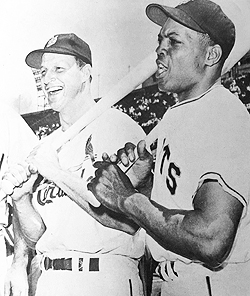
At 20, Walker became the youngest pitcher to start in an All-Star Game. He played eight seasons in the American League with the Orioles (1957-60), Athletics (1961-62) and Indians (1963-64).

After his playing days, Walker managed in the minors, then returned to the big leagues as a scout and went on to become a coach and general manager. For 13 years (1995-2007), he was an executive in the Cardinals’ front office, advising Jocketty on player personnel.

Mighty leap

Born and raised in Ada, Okla., Walker was a high school baseball phenom, posting a varsity pitching record of 52-1 and leading his club to state titles in 1956 and 1957. He hit .529 as a junior and .526 his senior season.

Most big-league teams tried to sign him, including the Red Sox, who projected Walker as a third baseman, but he chose the Orioles, in large part, because of Brecheen, an Ada resident. “Brecheen had a great deal to do with Walker’s decision,” the Baltimore Sun noted.

Brecheen told the newspaper, “I’ve known the boy and his family for a long time … I thought when I saw him in high school that he had the best curve of any kid I’d ever seen.”

After signing with the Orioles on June 28, 1957, Walker joined a pitching staff with the likes of former Negro League fastballer Connie Johnson, World War II combat veteran Hal Brown and ex-Dodgers standout Billy Loes.

A week later, Walker made a jittery big-league debut at Boston’s Fenway Park. With the Red Sox ahead, 6-2, Orioles manager Paul Richards sent Walker to pitch the seventh. He issued walks to the first two batters _ two-time American League batting champion Mickey Vernon and Jackie Jensen (past and future AL RBI leader) _ and went to a 2-and-0 count on Frank Malzone before being relieved by Art Ceccarelli, a winless left-hander. Malzone mashed a pitch that soared over the the head of right fielder Tito Francona for a triple. Boxscore

After three relief appearances, Walker made his first start, facing the hapless Athletics at Kansas City. Nervous and overanxious, he didn’t last an inning. Boxscore

Breakout game

A month later, after a few relief stints, none longer than two innings, Walker got his second start, this time at home, against the Senators. Though destined to finish in the basement, the Senators had Roy Sievers, the slugger from St. Louis who would lead the American League in home runs (42) and RBI (114) that year.

Pitching with the poise and stamina, Walker shut out the Senators for 10 innings and got the win, 1-0. He allowed four singles and a walk, totaling 111 pitches.

“Here is a kid who had never pitched nine innings in his life,” Paul Richards said to the Baltimore Sun. “The high schools where Jerry played limit their games to seven innings.”

Brecheen told the newspaper, “We knew he had a lot of ability, and he’s got a lot of heart.”

Walker dressed quickly after the game and dashed out of the clubhouse. As the Sun explained, “With a pocketful of hot change, the quiet-spoken, crew-cut kid was busting out all over in his (eagerness) to reach the nearest coin telephone to place a long-distance call to (his parents in) Oklahoma.” Boxscore

Seeing stars

After a tune-up season in the minors at Knoxville (18-4, 2.61 ERA) in 1958, Walker was one of three 20-year-old pitchers (Jack Fisher and Milt Pappas being the others) who contributed to the Orioles in 1959.

Walker sizzled early, winning his first four decisions, including a five-hitter against the Yankees. He struck out Mickey Mantle three times. Boxscore

In a rematch in July, Walker again beat the Yankees, fanning Mantle three more times and totaling 10 strikeouts for the game. “For 20 years old, you’d have to say the young man was amazing the way he struck my men out,” Yankees manager Casey Stengel said to the Sun. Boxscore

(Though he whiffed 12 times versus Walker in his career, Mantle had an on-base percentage of .500 _ 13 hits and 11 walks _ against him and slugged four home runs. Of Walker’s four career wins versus the Yankees, three came in 1959.)

A month later, Stengel, the American League manager, chose Walker to start in the All-Star Game at Los Angeles. Walker got the win, allowing one run in three innings. He twice retired the Cardinals’ Ken Boyer, struck out Eddie Mathews and got Willie Mays and Ernie Banks to ground out. Boxscore

Working overtime

On Sept. 11, 1959, the first-place White Sox, headed for an American League pennant, were at Baltimore for a Friday doubleheader on Westinghouse Night. As the Sun noted, “The air was electric with tension.”

Jack Fisher shut out the White Sox in the opener, 3-0, limiting them to three hits. Boxscore

Walker started Game 2 against a lineup headed by future Hall of Famers Luis Aparicio and Nellie Fox. He gave up two singles in the first but the White Sox never advanced another runner as far as third the rest of the night.

White Sox pitchers Barry Latman (9.1 innings) and Gerry Staley, the ex-Cardinal, were superb, too, but Walker was better. He pitched 16 scoreless innings and the Orioles prevailed, 1-0, when Brooks Robinson’s two-out single versus Staley, 39, drove in Al Pilarcik from third.

“That two 20-year-olds should pitch 25 scoreless innings in one night against the league leaders, even the light-hitting White Sox, borders on the unbelievable,” wrote Ed Brandt of the Sun.

His colleague, Lou Hatter, offered, “Walker’s performance was extra-special, incredible and then some.”

Walker told United Press International, “I could have pitched another couple of innings.” Boxscore

He finished the year 11-10 with a 2.92 ERA, but never had another winning season in the majors.

On the move

In 1960, Walker suffered from allergies “that sapped his strength,” the Sun reported, and posted a 3-4 season record. “From what they told me, I guess I was allergic to just about everything,” Walker told the Kansas City Times. “They gave me some shots and also some pills to take regularly. The shots are a long-range treatment and the doctors seem to think they should clear up the trouble completely in two or three years.”

Traded to the Athletics in April 1961, he spent two years with them, went 16-23 and got dealt again, to Cleveland, where he played his final two seasons in the majors. A highlight came on July 13, 1963, when Walker pitched four scoreless innings of relief, helping Cleveland teammate Early Wynn, 43, get career win No. 300. Boxscore

In May 1964, Walker was loaned by Cleveland to the Cardinals’ Class AAA farm club, the Jacksonville Suns, managed by Harry Walker (no relation). His teammates included pitchers Mike Cuellar, Bob Humphreys, Gordon Richardson and Barney Schultz, who went on to help the Cardinals win a pennant and World Series championship that season.

Walker was 10-9 with Jacksonville, including a one-hitter in a 1-0 victory versus Richmond in 10 innings. Called up to Cleveland in September, he pitched his final big-league games that month.

Still in the game

Walker was a manager in the Yankees’ farm system for six seasons (1968-73) and his pitchers included a pair of future American League Cy Young Award winners _ Ron Guidry and LaMarr Hoyt. Walker was a Yankees scout from 1974 to 1981, then became their pitching coach for parts of the 1981 and 1982 seasons.

From 1983-85, Walker was Astros pitching coach. His staff ace was Nolan Ryan.

After a stint from 1986-91 as special assignment scout for the Tigers, Walker was promoted to general manager by club president Bo Schembechler and tasked with rebuilding the roster. As Gene Guidi of the Detroit Free Press noted, “Walker stepped into a tough spot in Detroit. He wants to make the Tigers a better team but he has few marketable players to trade and a limited spending budget to pursue free agents.”

In Walker’s first season as general manager, the Tigers were 75-87. They improved to 85-77 in 1993, but the franchise underwent an ownership change, and Walker was fired in January 1994.

Cardinals influencer

In November 1994, Walt Jocketty, who replaced Dal Maxvill as Cardinals general manager, hired Walker to be the club’s director of major league player personnel. “He was the first guy I hired in St. Louis,” Jocketty told the Cincinnati Enquirer.

“Walker’s duties will feature special assignment scouting and recommendations to Jocketty,” the St. Louis Post-Dispatch reported.

Three years later, in February 1997, Walker was promoted, with the title of vice president of player personnel. The Post-Dispatch referred to him as Jocketty’s “right-hand man.”

According to the Cardinals 1997 media guide, Walker “assists Jocketty in personnel matters with the major league club and he is also responsible for overseeing the Cardinals player development and scouting activities.”

One of the up-and-coming Cardinals staffers in 1997 was a scouting assistant, John Mozeliak. According to the Post-Dispatch, Walker was a mentor to Mozeliak.

During Walker’s 13 years with the Cardinals, they won two National League pennants (2004 and 2006) and a World Series title (2006).

In October 2007, Jocketty was fired and replaced by Mozeliak. “One of Walt’s strong points was how he used his people,” Walker told the Post-Dispatch. “He allowed Mo (Mozeliak) to be involved, to increase his responsibilities.”

When the Reds then hired Jocketty to be team president and general manager, he brought in Walker to serve as his special assistant for player personnel.

Read Full Post »

Imagine Willie Mays and Stan Musial in the same Cardinals lineup. The Cardinals could. They tried to make it happen.

In June 1957, the Cardinals offered the New York Giants a combination of cash and players for Mays, the St. Louis Globe-Democrat reported.

In the authorized biography, “Willie Mays: The Life, The Legend,” author James S. Hirsch wrote that Giants owner Horace Stoneham “seriously considered the deal but didn’t pull the trigger because of the club’s pending transfer to San Francisco.”

Opportunity knocks

The Cardinals opened the 1957 season with rookie Bobby Gene Smith as their center fielder, but he struggled to hit and, in desperation, the club shifted Ken Boyer from third base to fill the hole in center.

Meanwhile, the Giants were looking to move from New York. In 1956 and 1957, the only major-league team that drew fewer fans than the Giants was the Washington Senators.

As Mays biographer Hirsch noted, “Unlike their money-losing years from 1948 to 1953, the Giants did squeak out profits, but they could not keep pace with their Gotham rivals. Between 1947 and 1956, the Giants earned $405,926; the Dodgers earned $3.5 million, and the Yankees, $3.6 million.”

The Giants, Hirsch added, “made money only because of their increasing media revenue, receiving $600,000 a year for their television rights.”

In May 1957, National League club owners gave permission to the Giants to move from New York to San Francisco and for the Dodgers to transfer from Brooklyn to Los Angeles after the season.

A month later, the Cardinals made their pitch for Mays.

High stakes

Cardinals executive vice president Dick Meyer and general manager Frank Lane had the approval of Cardinals owner Gussie Busch to attempt a deal for Mays.

“Mr. Busch told me that I was a good general manager and that I ought to get Mays,” Lane told the Globe-Democrat. “I told him I’d try.”

Meyer said to the newspaper, “We were really anxious to get Mays … When we first told Lane to see what he could do about getting Mays, we fixed the cash price at $500,000. That apparently wasn’t enough and we authorized Lane to increase the ante.”

Lane said negotiations started with Giants vice president Chub Feeney and then club owner Horace Stoneham got involved.

“We made four offers for Mays, including one totaling $1 million,” Lane told the Globe-Democrat.

That offer was: $750,000 cash, outfielder Wally Moon, one or two other players on the Cardinals roster and several in the minors, the Globe-Democrat reported.

(According to the Federal Reserve inflation calculator, $750,000 in 1957 would be the equivalent of about $8.1 million today.)

Mays, 26, already had sparked the Giants to two National League pennants (1951 and 1954) and a World Series title (1954). In 1957, the Gold Glove center fielder would have another stellar season, leading the league in triples (20), stolen bases (38) and slugging percentage (.626). He slammed 35 home runs and scored 112 runs that season.

What a duo he and Musial would have formed. Musial, 36, won his seventh league batting title in 1957. He hit .351 and Mays was second at .333. Musial also was the 1957 league leader in on-base percentage (.422) and Mays was runner-up (.407). Musial had 29 home runs and 102 RBI for the 1957 Cardinals.

Mays and Musial had a bond. According to Mays’ biographer, the three players Mays followed as a youth in the 1940s were Joe DiMaggio, Ted Williams and Musial. When Mays traveled with the Negro League Birmingham Black Barons in 1948, he attended his first big-league game at Sportsman’s Park in St. Louis and got to see Musial hit.

On a plane to an All-Star Game in the mid-1950s, several black players were in the rear, playing cards. According to Mays’ biographer, Musial approached them and said, “Deal me in.” That was his way of telling those players they belonged. “That told me how classy he was,” Mays said, “and I never forgot that.”

Wrong time

The Giants’ gave “serious consideration” to the Cardinals’ offer for Mays, the Globe-Democrat reported, before opting to decline. Lane said to the newspaper, “Feeney told me the last time we talked about a Mays deal that it was out of the question. As I recall, Chub told me that if they traded Mays and then moved to San Francisco, the people out there would throw them into the bay.”

Stan Isaacs of Newsday wrote that moving the Giants to San Francisco “wasn’t nearly as shocking” as considering a trade of Mays to the Cardinals. 

The San Francisco Examiner noted, “Willie certainly must be a lot of baseball player to be worth that kind of money. Since the offer made by the Cardinals was turned down, it must be assumed Stoneham thinks Willie is worth even more.”

Stoneham told International News Service he “appreciated” the offer. In explaining why he rejected it, Stoneham said, “The money was not important. We’re not broke … What we want … above all else is a winning ballclub. All ballclubs have one special player … and to us it is Willie who is that ballplayer. We can build a team around Willie. Maybe that’s the answer to why we didn’t trade him to the Cardinals or anyone else.”

Then Stoneham, in that 1957 interview with International News Service, added, “Maybe we will sell him about 15 years from now, if somebody has a few ballplayers nearly as good.”

Fifteen years later, in May 1972, the Giants dealt Mays, 41, to the Mets for pitcher Charlie Williams and $50,000.

Read Full Post »

Dizzy Dean was plenty good for the 1934 Cardinals, but he needed a helping hand from an influential source to achieve 30 wins.

In two June relief appearances Dean made for the 1934 Cardinals, National League president John Heydler credited him with wins in both, even though other pitchers appeared to qualify instead.

If not for Heydler’s unconventional decisions, Dean would have finished with 28 regular-season wins in 1934. Instead, he got 30, becoming the last National League pitcher to achieve the feat.

Save or win?

On June 21, 1934, at St. Louis, Dean beat the Dodgers, pitching a complete game and boosting his season record to 10-3. Boxscore

Two days later, with the Dodgers ahead, 3-0, in the sixth inning, Bill Hallahan relieved for the Cardinals and gave up a run, extending the Brooklyn lead to 4-0. In the bottom half of the inning, Pat Crawford batted for Hallahan and delivered a two-run single, capping a five-run rally that put the Cardinals on top, 5-4.

Dean entered in the seventh, looking to protect the lead. Hallahan figured to be in line for the win if the Cardinals held on. Dean did the job, holding the Dodgers scoreless the last three innings. Boxscore

Official scorer Martin Haley, baseball reporter for the St. Louis Globe-Democrat, awarded the win to Hallahan because the Cardinals were ahead when Dean was brought in.

As the St. Louis Post-Dispatch noted, “The official scorer, in naming Hallahan, was abiding by the scoring rules, which provide that ordinarily a pitcher shall be credited with the runs scored by his team in the inning, or innings, he pitches.”

Haley apparently had second thoughts, though, because that night he filed a report to Heydler, a former umpire, and asked him to make a decision on who should be the winning pitcher. Dean, the fourth Cardinals pitcher of the game, was the only one who held the Dodgers scoreless.

Rules to pitch by

Here is how Major League Baseball defines how a pitcher qualifies for a win:

“A pitcher receives a win when he is the pitcher of record when his team takes the lead for good _ with a couple rare exceptions. First, a starting pitcher must pitch at least five innings (in a traditional game of nine innings or longer) to qualify for the win. If he does not, the official scorer awards the win to the most effective relief pitcher.

“There is also a rarely used clause where an official scorer can deem a relief pitcher’s appearance ‘brief and ineffective.’ (For example, if a reliever relinquished a one-run lead by allowing three runs, but was still in line for a win after his team scored four runs in the following inning _ that may qualify.) If that’s the case, the scorer can award the win to a pitcher who followed that ‘brief and ineffective’ pitcher. Which relief pitcher earns the win specifically is also up to the judgment of the official scorer.”

Verdict is in

On the morning of June 27, 1934, Heydler declared Dean the winning pitcher of the June 23 game. “Dean pitched great ball … to protect (a) one-run lead,” Heydler ruled. “Hallahan pitched one inning rather poorly.”

According to the Brooklyn Daily Eagle, “Hallahan himself suggested that the credit go to Dean.”

St. Louis newspapers supported Heydler’s decision.:

_ St. Louis Star-Times: “Hallahan, like Diz, entered the contest as a relief pitcher but, unlike Diz, failed to hold the foe in check.”

_ St. Louis Post-Dispatch: “It was (Dean’s) strong arm and determination, his pitching skill and his fielding agility that made it possible for the Cardinals to win.”

Heydler’s ruling gave Dean a season record of 11-3.

That afternoon, the Cardinals played the Giants at St. Louis. The groundkeeper’s thermometer at Sportsman’s Park recorded 115 degrees on the field, the New York Daily News reported.

Dizzy started for the Cardinals and labored into the ninth inning. With the score tied at 7-7, the Giants had runners on first and second, two outs, when Jim Mooney relieved Dean.

Mooney, an ex-Giant, got the Cardinals out of the jam when he fielded Mel Ott’s sharp grounder and threw to first for the third out. Ott’s comebacker “almost knocked the pitcher down,” the Post-Dispatch reported, but he made the play.

Facing 43-year-old reliever Dolf Luque in the bottom half of the ninth, Cardinals catcher Bill DeLancey drove a pitch onto the pavilion roof in right-center for a walkoff home run. Boxscore

Decisions, decisions

Though Mooney had done the job, retiring a future Hall of Famer with the outcome on the line, and was still in the game when Delancey hit his homer, official scorer Martin Haley awarded the win to Dean.

“He had toiled 8.2 innings under a blistering sun and had pitched shutout baseball from the third to that ninth,” the Post-Dispatch noted.

He also may have pitched with a hand injury. According to Dean, an X-ray showed a small piece of bone chipped off the knuckle, the Globe-Democrat reported.

Seeking cover for his decision, Haley again asked Heydler to make the final ruling. Heydler agreed with him. Dean got the win, improving his season record to 12-3.

In his book “Diz,” Dean biographer Robert Gregory wrote that the two rulings giving wins to Dean “were controversial” and the Giants “were said to be particularly indignant.”

Dean finished the 1934 regular season with a 30-7 record. In 33 starts, he pitched 24 complete games, including seven shutouts, and was 26-5. He was 4-2, including the two Heydler rulings, in 17 relief appearances. In three starts against the Tigers in the 1934 World Series, Dean was 2-1, including a shutout in Game 7.

Read Full Post »

« Newer Posts - Older Posts »