Feeds:
Posts
Comments

Archive for the ‘Executives’ Category

In a spring training camp with Reggie Jackson, Rick Monday and Sal Bando, another hitter who caught the eye of Joe DiMaggio was Tony La Russa.

In 1968, DiMaggio was in a green and gold Oakland Athletics uniform, giving instruction to players. La Russa was trying to make the team as a reserve infielder and return to the majors for the first time in five years.

DiMaggio became one of La Russa’s biggest boosters.

Bay Area bonanza

After the 1967 season, the Athletics moved from Kansas City to Oakland. Club owner Charlie Finley approached Joe DiMaggio and offered him a front-office position with the title of executive vice president. DiMaggio accepted, signing a two-year contract.

In explaining why he took the job, DiMaggio said to the Associated Press, “Probably the biggest thing was the shift of the club to Oakland. It’s only 25 minutes from home (in San Francisco).”

During the previous six years, DiMaggio had been a visiting batting instructor at Yankees spring training in Fort Lauderdale, Fla., but when club co-owner Dan Topping asked him to take a fulltime job, “I turned him down,” DiMaggio said to The Sporting News. “I decided to join Mr. Finley and the A’s because it was home.”

Frank Lane, former general manager of the Cardinals and Kansas City Athletics, said to the San Francisco Examiner, “The smartest move Finley made when he moved to Oakland was to hire DiMaggio. That gave the club instant prestige.”

As The Sporting News noted, Finley and DiMaggio agreed to “an extremely loose arrangement as far as office responsibilities are concerned.” His duties were to include advising on personnel decisions and player transactions.

DiMaggio emphasized he wouldn’t do community relations and promotional tasks. “I’m not going around talking to groups or making appearances at banquets,” he told The Sporting News. “As I understand the job, I’ll be busy all of the time with player personnel, working on possible trades and serving as an adviser.”

At the baseball winter meetings in Mexico City in December 1967, DiMaggio “was much in evidence (as) the spokesman for the club,” The Sporting News reported. When Athletics manager Bob Kennedy asked him to be an instructor at spring training, DiMaggio said yes.

Advanced placement

On Feb. 26, 1968, when the Athletics had their first spring workout at Bradenton, Fla., DiMaggio, 53, was in uniform. According to the Bradenton Herald, he “posed obligingly for photographers, chatted freely with reporters and smilingly handed out autographs.” He also gave batting tips to a 22-year-old catcher, Dave Duncan.

United Press International columnist Milton Richman was impressed by how DiMaggio fit in. “He hangs his street clothes in the same simple wooden lockers as the players do,” Richman observed. “His locker is between those of coaches Sherm Lollar and John McNamara.”

DiMaggio became engaged in the instructor’s role. He enjoyed working with the players and connected with them.

“This kid Rick Monday is shaping up as a hell of a fine ballplayer,” DiMaggio said to Richman. “He’s only 22 and I like the way he swings the bat. He bears down all the time … This boy knows he’s good, but he’ll listen when you tell him something.

“There’s another outfielder, Reggie Jackson, I’ve been working with. He’ll take a little time to learn, but he’s going to be a good one, too.”

DiMaggio worked with Jackson on hitting, fielding and base running. “He’s such a symbol of greatness to a ballplayer, something to strive for, someone to get approval from,” Jackson said to The Sporting News. “It would be embarrassing not to hustle in front of such a man.”

After seeing DiMaggio swing the bat, Jackson told columnist Joe Falls, “He’s the Rope Man. He hangs out those frozen ropes.”

Asked about his approach to teaching, DiMaggio said to Jack Hand of the Associated Press, “There is no set way of hitting. One fellow bats one way, another has a different style. Honus Wagner, Babe Ruth, Ty Cobb, Rogers Hornsby all had different styles, but they followed the same fundamentals. The main thing is being comfortable, holding the head rigid, taking a short stride, having the bat ready to swing.

“You can’t tell anybody how to hit. Nobody ever tried to teach me. If I tried to bat like Stan Musial, all curled up in that crouch, I’d be wound up in a knot. It’s the same way with my wide stance. A lot of fellows couldn’t do it my way. I didn’t start out that way either.

“If I see a fellow who has a decided weakness, I’ll talk to him. I wouldn’t try to change a player unless he has been around a while and had not shown any improvement.”

Strong man

Tony La Russa was 18 when he debuted in the majors with the 1963 Athletics. He spent the next four seasons in the minors. Injuries played a part in stalling his career. He dislocated his right shoulder twice, tore ligaments in his right knee, and injured his back and throwing arm.

When he got to spring training in 1968, La Russa, 23, told the Oakland Tribune, “I worked pretty hard during the winter to strengthen the spots where I had my injuries. I feel 100 percent now and I don’t feel I’m injury prone.”

Working with weights at a Tampa gym, La Russa bulked up and was bigger than his listed weight of 175 pounds. The Bradenton Herald described him as having “tremendously thick forearms and wrists, and Ted Kluszewski-sized biceps.”

“I’m staying right at 195 pounds now and never felt better,” La Russa said to reporter Vince Smith. “I figured I’d better start doing something about building myself up. If I was bigger and stronger, I wouldn’t be getting hurt all the time.”

Second base was La Russa’s best position, but the Athletics had John Donaldson and Dick Green there. Manager Bob Kennedy viewed La Russa as a backup to Sal Bando at third and possibly Bert Campaneris at shortstop, and planned to play him at those spots throughout spring training.

(“I’m the most uncomfortable at third,” La Russa said to the Oakland Tribune.)

Asked about La Russa, Kennedy said to the San Francisco Examiner, “We’re looking at the kid as a top prospect for infield utility duty … We certainly don’t want to give up on him. We feel there’s a good chance he’ll help us.”

DiMaggio took an interest in La Russa. After watching La Russa take swings in the batting cage at spring training, he offered advice. “He told me he noticed I had a little hitch in my swing and I was letting the ball get by me before I had my wrists cocked,” La Russa told the Bradenton Herald. “When he tells me something like that, naturally I’m going to listen.”

DiMaggio said to the Herald, “I think he really has a chance to make it. When you get the injuries this kid has had since he started, you never really get a chance to get going. He seems to be in real good shape out here now. He swings that bat and he swings it pretty good.”

According to the Oakland Tribune, La Russa went on to lead the Athletics in hitting (.364) in spring training games and earned a spot on the 1968 Opening Day roster as a backup infielder.

Highs and lows

Near the end of spring training, DiMaggio agreed to Kennedy’s request to be a coach all season. “He will be on the bench with me,” Kennedy said to The Sporting News. “This entails a fulltime duty with the club. I can think of no better man to teach young hitters and young outfielders than Joe DiMaggio.”

In explaining why he accepted the role, DiMaggio said to the Oakland Tribune, “These kids we have are the major reason I’ve decided to coach. They’re just great. I’ve become attached to them and the club. I think I can do a service.”

In introductions before the Athletics’ home opener on April 17, 1968, DiMaggio got the loudest ovation from the crowd of 50,164. Gov. Ronald Reagan threw the ceremonial first pitch and was booed, the Oakland Tribune reported.

In the game that followed, Dave McNally of the Orioles held the Athletics to two hits _ a Rick Monday home run and pinch-hit single by La Russa. Boxscore

Three weeks later, after just three at-bats, La Russa was placed on waivers and went unclaimed. The Athletics sent him to their Vancouver farm club and called up outfielder Joe Rudi.

DiMaggio had a successful season as a coach. As The Sporting News noted, “Being a coach in uniform this year has enabled DiMaggio to escape a desk job with vague responsibilities and ill-defined duties, and make a real contribution to the team. His mere presence has inspired the young A’s players, who hold him in high esteem but not the overwhelming awe they showed him when he first appeared in spring training.”

The 1968 Athletics finished 82-80, but Bob Kennedy was fired and replaced by Hank Bauer, who had been DiMaggio’s outfield teammate with the Yankees. DiMaggio said he didn’t want to coach again in 1969, the last year of his contract, but Bauer convinced him to change his mind.

La Russa began the 1969 season in the minors at Des Moines, hit .306 and got called up to the Athletics in June after Dick Green tore knee ligaments. La Russa got only eight at-bats with the 1969 Athletics and went hitless.
Read Full Post »

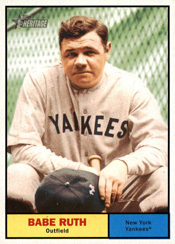
The Sultan of Swat struck out in his bid to become St. Louis Browns manager.

After finishing last in the eight-team American League in 1937, the Browns were looking for a manager and Babe Ruth wanted the job.
Considering that the Browns drew a total home attendance of 123,121 in 1937, Ruth’s willingness to manage the team in 1938 seemed a special opportunity to infuse interest in the moribund franchise, but his overture was rejected.

Manager material?

Approaching his final years as a player, baseball’s home run king wanted to manage in the majors. Ruth and Yankees manager Joe McCarthy, who took over the club in 1931, didn’t get along. Ruth began campaigning for the job, but Yankees general manager Ed Barrow was happy with McCarthy and uninterested in Ruth as a field leader.

In his book, “Babe: The Legend Comes to Life,” author Robert Creamer noted, “Ruth’s obtuseness about the Yankees managing job was almost pitiful. It was obvious Barrow was convinced he was incapable of managing.”

Other clubs thought differently. Opportunities developed for Ruth to manage the Red Sox, Tigers and Athletics, but plans went haywire.

In the summer of 1932, when the Red Sox were on their way to a 43-111 record (and Ruth, with 41 home runs, was powering the Yankees to a pennant), they talked to him about becoming player-manager, but “Babe did not want to leave” New York, Creamer reported. “The Red Sox post came up again in 1933 when Tom Yawkey bought the club. Yawkey wanted to hire Ruth but was persuaded not to by general manager Eddie Collins.”

After the 1933 season, according to Creamer, “the Tigers definitely wanted him. Tigers attendance had been declining and club owner Frank Navin felt Ruth as player-manager would help the gate and possibly help the team.”

The Yankees agreed to a deal. They “were looking for a way to dump Ruth gracefully and this seemed an ideal situation,” Creamer reported.

Navin asked Ruth to come to Detroit to work out the details, but when Ruth left instead for a planned trip to Hawaii, Navin became annoyed and changed his mind. He acquired Mickey Cochrane from the Athletics to be player-manager. (Cochrane led the Tigers to the 1934 pennant and a World Series berth against the Cardinals.)

The Yankees offered to make Ruth manager of their Newark farm club, but he told them he didn’t want to go to the minor leagues, Creamer reported.

Ruth, 39, stayed with the Yankees in 1934, hit 22 home runs and lobbied to become their manager, but club owner Jacob Ruppert reaffirmed his commitment to Joe McCarthy. An angry Ruth told Joe Williams of Scripps-Howard’s New York World-Telegram, “I’m through with the Yankees. I won’t play with them again unless I can manage. They’re sticking with McCarthy, and that lets me out.”

Amid the hullabaloo his comments caused in Gotham, Ruth said sayonara and left with an all-star team for a goodwill tour of Japan. Connie Mack, who owned and managed the Athletics, was leader of the tour, but Ruth was given the chance to manage the all-star team.

According to Creamer, Mack, nearing 72, was considering stepping down as Athletics manager “and liked the idea” of Ruth replacing him. “Ruth’s presence would help the sagging gate, and Connie had always got along well with Babe,” Creamer noted.

Mack used the Japan tour as a test to see how Ruth would do as manager, but Babe got a failing grade, in part, because he feuded with teammate Lou Gehrig, creating divisions among the all-star group.

Promises, promises

In February 1935, soon after Ruth turned 40, the Yankees released him so that he could accept an offer from the Braves to become team vice president, assistant manager and player. Ruth accepted the proposal because he was convinced Braves owner Emil Fuchs intended to make him the manager in 1936, replacing Bill McKechnie.

Early in the 1935 season, though, Ruth became disenchanted. As Creamer noted, “His duties as vice-president seemed confined to attending store openings and other such affairs to get the publicity Fuchs said the club needed. As assistant manager, all he did was tell McKechnie when he was able to play. He soon found out Fuchs had no intention of forcing McKechnie out to make way for Babe.”

On June 2, 1935, Ruth quit the Braves. “I’d still like to manage,” he told columnist Grantland Rice, “but there’s nothing in sight.”

Support for Babe

Two years later, though no offers had come to him, Ruth still was determined to manage in the majors. The Browns looked to be a possibility.

In July 1937, Browns manager Rogers Hornsby was fired and replaced by another former Cardinals player, Jim Bottomley, who had no managing experience. Former Cardinals manager Gabby Street was hired to be a coach on Bottomley’s staff and provide him with on-the-job training. 

The Browns, 25-52 with Hornsby, were 21-56 with Bottomley and finished 46-108, 56 games behind the champion Yankees. “We had two managers in 1937, and we thought we made the right guess each time, yet we finished in last place,” Browns general manager Bill DeWitt Sr. told the St. Louis Star-Times.

According to Sid Keener of the Star-Times, DeWitt and Browns owner Donald Barnes “have been advised by stockholders and friends to make a big play for important publicity by hiring none other than George Herman Ruth, The Babe himself” to be the next manager.

“Ruth would have a powerful magnet at the box office _ at the start, anyway,” Keener advised. “The Babe, back in a major-league uniform as manager of the Browns, would go over in a big way for publicity.”

Advocating for the hiring of Ruth, John Wray of the St. Louis Post-Dispatch wrote, “Some club might do worse than give The Bambino a workout. It could not go broke with a one-year experiment. The Bambino’s name might have some pulling power at the gate _ for a while.”

Wray’s Post-Dispatch colleague, L.C. Davis, suggested that choosing Ruth to manage “would make the turnstiles play a merry tune.”

Babe makes his pitch

In an interview with author William B. Mead for the 1978 book, “Even the Browns,” DeWitt (father of 2023 Cardinals owner Bill DeWitt Jr.) recalled, “Babe Ruth called me up. Out of the blue. I didn’t know him. Never met him. He said, ‘Hey, kid, this is Babe Ruth. I know you haven’t got a good ballclub, but I’d like to be your manager. I can’t get a job managing anyplace else, so I’d like to be the manager of the Browns.’ 

“I said, ‘Now, let me think about it. We’ve just about made up our minds on a guy. Let me talk to some people.’ I took his phone number.”

The guy Barnes and DeWitt wanted for the job was Gabby Street, not Ruth.

Regarding Ruth, DeWitt told Mead, “He would be a great attraction for a year, but we’d probably have to pay him a pretty good salary, and at the end of the year his attractiveness is gone. We had a lousy ballclub, and you know he’s not going to be a good manager, and we were going to try to develop some young players. So we decided not to do it.”

Barnes told the Star-Times, “We did not consider Ruth for a moment. Ruth is a great name in baseball _ or, was a great name _ but, after all, the public will only pay to see a winning ballclub.”

In comments to the Post-Dispatch, Barnes said, “We never had an idea of seeking Ruth as manager at any time. He is not the type we believe would make a successful leader.”

Sid Keener concluded in the Star-Times, “Ruth’s salary demand is considered the major stumbling block in his behalf. George Herman, no doubt, would request a contract calling for a salary in the neighborhood of $30,000.”

According to the Post-Dispatch, Joe McCarthy of the Yankees and Bill Terry of the Giants were the highest-paid managers. Each made $35,000.

Oscar Melillo, a former Browns second baseman who would become a coach for them in 1938, wanted Ruth to be their manager and told the New York Daily News, “Whatever the Browns paid Ruth would be back in the till the first time they played the Yankees in New York.”

Ruth said to the New York Journal-American, “The way I look at it, it must be because those owners want to keep the small-salaried guys in there as long as the public will stand for it.”

Street signed a one-year contract with the Browns for between $7,500 and $10,000, the Star-Times reported. The 1938 Browns were 53-90 when Street was replaced by Melillo with 10 games left in the season.

Missing out

In June 1938, the Dodgers hired Ruth, 43, to be a coach on the staff of manager Burleigh Grimes. It was a publicity stunt, but Ruth hoped it might put him in position to take over for Grimes. Instead, Leo Durocher replaced Grimes after the season and Ruth was out of a job. The chance to manage never came.

“I think I’d make a good manager,” Ruth told Jimmy Powers of the New York Daily News. “I’ve followed the game closely. I know men, I know batters, and I know pitchers.”

In his biography of Ruth, Robert Creamer wrote, “Could he have managed? Of course. Ruth had certain obvious qualities. He was baseball smart, he was sure of himself, he was held in awe by his fellow players and he was undeniably good copy. He may not have been a success _ most managers are not _ but he should have been given the chance.”

Read Full Post »

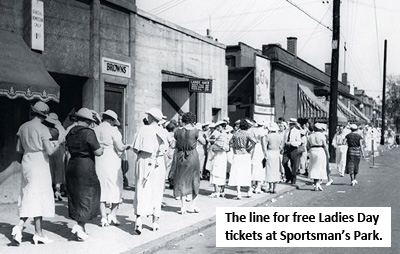
In the days before civil rights progress, the overt racism of the Cardinals took many forms, including during Ladies Day games at Sportsman’s Park in St. Louis.

The Cardinals’ advertisements for Ladies Day games promised free general admission tickets at the gate to women 16 and older. Left unsaid was that the tickets were for whites only. Women of color who came to Ladies Day games were told they’d have to pay for tickets to sit in a segregated section of the ballpark.

The bigotry was the policy of the American League St. Louis Browns, who owned Sportsman’s Park, and agreed to by their tenant, the National League Cardinals.

Customer relations

Chris von der Ahe, who owned the St. Louis franchise that became the Cardinals, initiated Ladies Day ballpark promotions as early as 1883, according to MLB.com. He allowed women to attend games for free if they came with a male escort. The man had to buy a ticket.

That was the practice until 1909, when the National League banned Ladies Day promotions because team owners wanted all women to buy tickets instead of being admitted for free, MLB.com reported.

Two years later, in 1911, Helene Britton became the Cardinals’ owner. Defying the Ladies Day ban, she reinstated the promotion in 1912. Women were allowed to attend Ladies Day Cardinals games for free and didn’t need a male escort to do so, according to MLB.com.

Britton owned the Cardinals for six years before selling to a group of investors led by former team president James C. Jones. In July 1920, car dealer Sam Breadon became principal owner and moved the Cardinals from rundown Robison Field to Sportsman’s Park.

Until May 4, 1944, blacks, or anyone defined as Negroes, attending a Cardinals home game could purchase tickets only in segregated seating areas in the Sportsman’s Park outfield bleachers or behind a screen in the outfield pavilion. Blacks weren’t allowed to sit in the double-decked grandstand, meaning any seats behind home plate and along the lines. The Cardinals and Browns were the last franchises in the majors to end segregated seating.

Send in the crowds

During the Great Depression, the Cardinals regularly designated select weekday afternoon games as Ladies Day events, not for humanitarian reasons but because it was good for business.

“The concession proceeds are almost equal to the gate receipts on Ladies Day, for what the women save on admissions they appear to spend on refreshments,” the St. Louis Post-Dispatch reported in July 1931. “They may attend for the bargain, but they buy plenty to eat and drink.”

An example was the Ladies Day game between the Braves and Cardinals on a Friday afternoon, June 12, 1931, at Sportsman’s Park. The paid attendance was 4,445, but the total attendance, swelled by the free Ladies Day admissions, was 17,927, according to the Post-Dispatch. Boxscore

The Cardinals experienced a boon in concession sales that afternoon because of all the women customers in the ballpark. As the Post-Dispatch noted, league rules required the home team to share with the visiting club 25 percent of each cash ticket sold, but the Cardinals kept all concession revenue.

“The reason for Ladies Day is that baseball clubs today have other things to sell other than baseball,” the Post-Dispatch reported in 1931.

Nowhere in its advertising of the many Ladies Day games did the Cardinals indicate that free admissions were for white women only. Apparently it was assumed that no one would expect black women to be allowed to sit in general admission areas rather than in the segregated outfield seats.

(According to the Cardinals yearbook, the club offered five ticket options. From cheapest to most expensive, those were: right-field pavilion, bleachers, general admission, reserved and box seat. After men complained about not getting the same free tickets as women, Sam Breadon declared on July 9, 1931, that any [white] man buying a general admission ticket to that Thursday’s Cardinals home doubleheader against the Reds would be given an upgrade to a reserved seat, the Post-Dispatch reported.)

Tears, not cheers

The Cardinals, who, like all big-league clubs, refused to sign black players, won the 1931 World Series championship. The St. Louis Argus, a newspaper serving the black community, used the opportunity to call them out for their racist Ladies Day policy.

In an October 1931 editorial that also was published in the Baltimore Afro American, the editors of the Argus wrote, “Following the Cardinals’ victory over the Athletics in the seventh game of the World Series, there was much rejoicing … We found no pleasure in the Cardinals’ victory. Not that we have anything against the members of the team … It is their home surroundings and environment which are so insulting to us. We make particular reference to the so-called Ladies Day.

“Colored ladies who venture to attend these games are insulted by being told at the gate, ‘This is Ladies Day, but …’ This statement is followed by a discourteous demand for 75 cents as a premium on her color if she desires to enter Sportsman’s Park to see a game of ball.

“This is an insult of the rankest sort, and we don’t see how any person of color could possibly, under any circumstances, find any pleasure in going to, or milling around, Sportsman’s Park.”

Noting that quality seats were denied to men and women of color for all Cardinals home games, the Argus editorial made clear, “This we have always regarded as an insult to the entire colored race. Therefore, games and other athletic sports at this park have no appeal to us. Hence, even the great victory of the Cardinals over the Athletics brought no pleasure to our heart.”

The editorial concluded with, “It is rather unfortunate that such a big team as the Cardinals has to claim as its home a park which is controlled by such little men as the owners of Sportsman’s Park. If the owners were real sportsmen, there would be no discrimination as to seats.”

In a sidebar, Bill Gibson of the Baltimore Afro American noted that discrimination at the World Series took place in other ways, too. He wrote, “When police officers were asked to help handle the crowd at the 1930 World Series in Philadelphia, some of the officers who arrived were black. (The Philadelphia police force was integrated in the 1880s.) White officers were allowed inside, but black officers were told their place was outside. In the 1931 World Series, when the same request was made for police help, it was put in writing, ‘White officers only,’ and the order was filled in that manner.”

Read Full Post »

In the early days of baseball on television, Cardinals owner Fred Saigh was one of the first to go dialing for dollars.

In November 1952, Saigh tried to get a form of revenue sharing started among National League franchises regarding broadcast rights fees.
To Saigh, baseball’s television audience was an extension of the ballpark audience, and he wanted a split of the television money that home teams were getting for broadcasting Cardinals road games.

If Saigh was denied a share of those television revenues, he threatened to unplug the broadcasts.

On the air

The first televised major-league game was Aug. 26, 1939, when New York’s NBC station aired the Reds versus the Dodgers from Brooklyn, but it wasn’t until after World War II ended that TV sets became widely available and more affordable to mass markets.

The first television station in St. Louis, and the 13th in the United States, was KSD-TV, Channel 5. A NBC affiliate, the station was owned by Pulitzer Publishing, also the owners of the St. Louis Post-Dispatch. Pulitzer became the first to own both a newspaper and a television station.

(In 1979, when Pulitzer sold the station, its call letters were changed to KSDK.)

KSD-TV began broadcasting on Feb. 8, 1947, with a 90-minute local information afternoon program. In one of the program’s segments that day, Post-Dispatch sports editor J. Roy Stockton interviewed Cardinals catcher and future broadcaster Joe Garagiola.

The KSD-TV studio was located with the Post-Dispatch building on Olive Street in St. Louis. According to the station, the newspaper’s press operators also handled the studio lights. Sometimes, when needed to put out the latest edition of the afternoon paper, they’d leave the studio, delaying the start of a local program.

Show time

KSD-TV management recognized immediately the potential audience and advertising value of baseball programming, and entered into agreements with the Browns of the American League and the Cardinals of the National League to televise some of their games.

The first televised games in St. Louis were KSD-TV broadcasts of two Browns versus Cardinals exhibitions at Sportsman’s Park in St. Louis on April 12-13, 1947, just before the start of the regular season.

KSD-TV also broadcast the Browns’ season opener against the Tigers on April 15 in St. Louis, and the Cardinals’ home opener against the Cubs on April 18.

From then on, Browns and Cardinals games in 1947 were a programming staple on KSD-TV.

Rights and wrongs

Sam Breadon, who made the deal with KSD-TV for the Cardinals, sold the club to Robert Hannegan and Fred Saigh in November 1947. Hannegan died in 1949, leaving Saigh as majority owner.

Saigh had no options in negotiating a local TV deal for the Cardinals. By 1952, St. Louis had 372,000 TV sets but still only one television station, KSD-TV. According to The Sporting News, the franchises reaping the most in broadcast rights fees then were all in New York _ the Yankees ($500,000), Giants ($375,000) and Dodgers ($300,000).

Baseball had no unified television policy then. “Each team signs private agreements with the others, giving the home club permission to televise the games,” Saigh explained to The Sporting News.

In the summer of 1952, a Cardinals versus Giants series became a flashpoint for a broadcasting battle.

“We signed an agreement permitting the Giants to televise our games at the Polo Grounds in New York,” Saigh told The Sporting News, “but were turned down by the Giants when we asked to televise our games in New York back to St. Louis. Our reaction was to prohibit the Giants from televising our two remaining games in New York. The Giants said they would televise anyway. So we threatened to keep our team off the field. The commissioner (Ford Frick) stepped in and warned us that these games would be forfeited if our team failed to take the field.”

Saigh stewed about what he viewed as bullying by the Giants to control broadcast revenue, and was determined to fight back.

Show me the money

In November 1952, Saigh said he would seek compensation from the Giants for the two home games they televised without the Cardinals’ permission.

Saigh also said he would refuse to allow any team to televise a Cardinals road game in 1953 unless the home club agreed to share its broadcast revenue with the Cardinals. At that time, a home club received all revenue from its telecasts.

“Saigh proposed to the National League that television and radio revenues be regarded as part of the gate receipts and that visiting clubs be cut in on these funds as they had been on the box-office takes,” The Sporting News reported.

Predictably, most team owners called Saigh’s idea “socialism,” The Sporting News noted.

One exception was maverick Browns owner Bill Veeck, who usually was in conflict with Saigh in competing for a chunk of the St. Louis baseball market. Veeck supported Saigh’s suggestion that visiting teams share in the broadcast revenue. “It is odd to find Veeck and Saigh on the same side of any campaign, but they are fighting for a split of the TV and radio money,” The Sporting News reported.

Saigh suggested a visiting team get 30 percent of a home team’s broadcast revenue, or 50 percent when the home team was the Giants or Dodgers.

Meet the new boss

Saigh succeeded in changing some minds. The Cubs and Reds agreed to share broadcast revenues with the Cardinals. The Phillies were close to joining in, too, the Associated Press reported.

Owners of the Giants and Dodgers “were aghast” and showed “no intention of backing down on their determination not to pay Saigh a dime for permitting the telecasts of Cardinals games at their parks,” The Sporting News reported.

Saigh had a bigger problem than broadcast revenue rights. On Jan. 28, 1953, he was sentenced to 15 months in prison and fined $15,000 for federal income tax evasion. Unable to keep the team, he apparently considered an offer from buyers who wanted to move the franchise to Milwaukee, but sold the Cardinals to St. Louis brewery Anheuser-Busch, which was run by Gussie Busch

Eager to ingratiate himself into the old boys network of club owners, Busch reversed the revenue sharing stance of Saigh. Busch said he would not demand a share of TV revenue for any Cardinals road game televised by a home club. “Anything we can do to bring the game to more and more people, we hope to be able to do,” Busch told The Sporting News.

Busch had a business reason for his decision. He viewed televised baseball games as an outlet for pitching Anheuser-Busch products to a broad audience. “Under the new ownership, Cardinals television will become a vital asset,” Dan Daniel wrote in the New York World-Telegram and Sun.

Learning to share

In 1966, Major League Baseball sold its first national television package, netting $300,000 per team.

Soon after the players’ strike in 1994, the capitalists who own Major League Baseball and its franchises entered into a comprehensive revenue sharing arrangement. It eventually included the evenly split sharing of revenue from sources such as broadcasts, merchandising and Internet.

Baseball socialism wasn’t so bad, management discovered. In 2022, each team got $110 million from revenue sharing.

Read Full Post »

Given a chance to become a division rival of the Cardinals, the Royals balked. 

In November 1997, the Brewers moved from the American League to the National League, joining the Cardinals, Astros, Cubs, Pirates and Reds in the Central Division.
The Brewers went because the Royals said no.

Musical chairs

After deciding to expand by adding the Tampa Bay Rays for the 1998 season, the American League had a geography problem. The Rays, naturally, belonged in the East Division, but five teams already were situated there. Same with the Central. The West had four teams, but putting the Rays there wasn’t practical.

Major League Baseball officials, of course, devised a convoluted solution.

To open a spot for the Rays in the East, the plan was to shift the Detroit Tigers to the Central. To create a spot for the Tigers, it was decided to move a franchise from the American League Central to the National League Central.

Because the Royals were strong proponents of realignment, the American League invited them to be the franchise that moved to the National League.

What appealed to the Royals was the possibility of an in-state division rivalry with the Cardinals, a scenario that had Royals chief executive officer David Glass “picturing a happy life in the National League,” the Kansas City Star reported.

In 1997, baseball had interleague play for the first time, and “our three best gates were when the Cardinals were here Labor Day weekend,” Glass told the Kansas City newspaper.

The Royals “agonized over their decision,” but opted to remain in the American League for two reasons:

_ Public sentiment, including among season ticket-holders, was for the Royals to stay put, general manager Herk Robinson told the Kansas City Star.

_ The Royals, run by a five-person limited partnership since the death of owner Ewing Kauffman in 1993, were for sale and the “timing wasn’t right” to switch leagues, Glass told the Kansas City newspaper. “It would be most helpful if we had an owner in place that could help in this decision,” Glass said.

When the Royals, who had played in the American League since 1969, opted to stay, the Brewers volunteered to be the franchise that switched leagues.

Turn back the clock

On Nov. 5, 1997, Major League Baseball’s executive council voted unanimously to move the Brewers to the National League.

Milwaukee had experienced many changes as a major-league franchise. In 1901, the Milwaukee Brewers were an original American League member. After one season, they became the St. Louis Browns.

In 1953, after unsuccessfully trying to lure the Cardinals from St. Louis, Milwaukee became a National League city when the Braves moved there from Boston. The Milwaukee Braves won two National League pennants and a World Series title before the franchise moved again to Atlanta for the 1966 season.

Big-league baseball returned to Milwaukee in 1970 when the Seattle Pilots of the American League relocated there and were renamed the Brewers. In 1982, the Brewers won their only American League pennant, but the Cardinals prevailed in the World Series.

Having the Brewers become a National League team was a hit with those who appreciated Milwaukee’s years as a Braves franchise.

Brewers owner Bud Selig, who also was the acting baseball commissioner, told the Associated Press, “Those of us old enough to remember the glory days of Hank Aaron, Eddie Mathews, Johnny Logan, and Warren Spahn and Lew Burdette, we view this as coming home.”

Aaron called it “a great day for Milwaukee.”

The Brewers became the first major-league team to switch leagues in the 1900s.

Polling found that 75 percent of fans in Milwaukee favored realignment, the Associated Press reported, and Selig said such overwhelming public support was an important factor in the Brewers volunteering to move to the National League.

Roots of a rivalry

Asked about the Brewers transferring rather than the Royals, Cardinals owner Bill DeWitt Jr. said to the St. Louis Post-Dispatch, “Either one would have been a good choice. They’re cities which have good baseball histories and which are good Midwestern markets. Both would have fit into the Central Division.”

Five months earlier, the Brewers and Cardinals played a regular-season interleague game against one another for the first time.

Played at County Stadium in Milwaukee on a Monday night before 23,503, the Brewers arranged for four players from the 1982 World Series (Cecil Cooper and Gorman Thomas of the Brewers, and Bob Forsch and Darrell Porter of the Cardinals) to sign autographs before the game. Porter caught the ceremonial first pitch from Selig, no small feat because Selig threw the ball in the dirt, five feet from the plate.

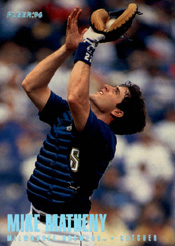
The Brewers won the game, 1-0, with Mike Matheny catching the combined shutout of Ben McDonald and Bob Wickman. Boxscore

The next night, 38,634 came to watch, with the teams wearing replicas of their 1982 World Series uniforms (Brewers in pinstripes and Cardinals in robin-egg blue). The Cardinals’ left fielder was Willie McGee, 38. As a rookie, he had hit two home runs and made a leaping catch against the wall in Game 3 of the 1982 World Series at Milwaukee. McGee had two hits in the regular-season interleague game, but the Brewers won, 4-3, beating Fernando Valenzuela. Boxscore

In the series finale, after franchise icon Robin Yount made the ceremonial first pitch, the Brewers completed the sweep, winning 8-4. Boxscore

Win some, lose some

The first time the Brewers faced the Cardinals as National League rivals was at St. Louis in May 1998. Spectators received pins recognizing the Brewers’ first season in the league. Todd Stottlemyre and Jeff Brantley pitched a combined shutout, and Ron Gant, Brian Jordan and Ray Lankford hit home runs in a 7-0 Cardinals triumph. Boxscore

The Cardinals were 8-3 versus the Brewers in 1998, the most wins they had against any opponent that season, but the Astros won the Central Division title. (The Astros switched to the American League starting with the 2013 season, reducing the National League Central to five teams.)

Since joining the National League, the Brewers have not won a pennant.

Read Full Post »

(Updated Nov. 10, 2024)

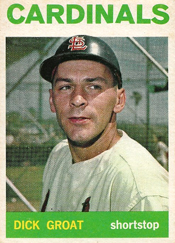
A power struggle within the front office nearly cost the Cardinals a chance to get the shortstop they needed to win a championship.

On Nov. 19, 1962, the Cardinals acquired shortstop Dick Groat and reliever Diomedes Olivo from the Pirates for pitcher Don Cardwell and shortstop Julio Gotay.

With his exceptional hitting and base running, Groat helped the Cardinals become World Series champions in 1964.

At the urging of manager Johnny Keane, Cardinals general manager Bing Devine made the trade over the objections of consultant Branch Rickey.

From a baseball perspective, Devine and Keane made the right move _ Groat was a key contributor to the Cardinals becoming contenders _ but it cost them. The trade widened a rift between Devine and Rickey, and Keane and Groat eventually had a falling out.

Terrific talent

Born and raised in the Pittsburgh area, Groat went to Duke University and became an all-America in baseball and basketball. A 5-foot-10 guard, he averaged 26 points and 7.6 assists per game as a senior for the basketball team.

Branch Rickey was the Pirates’ general manager when Groat signed with them in June 1952 and went directly from the Duke campus to the major leagues. Picked by the Fort Wayne Pistons in the first round of the NBA draft, Groat played in 26 games for them in the 1952-53 season, averaging 11.9 points.

After two years of military service, Groat chose to focus on baseball and resumed his big-league career with the Pirates in 1955.

The Pirates nearly traded Groat to the Athletics for Roger Maris in December 1959, but called off the deal at the last minute. The Athletics then swapped Maris to the Yankees. Groat won the National League Most Valuable Player Award in 1960, Maris was named the American League MVP, and the Pirates prevailed in the World Series against the Yankees.

Your move

On Oct. 7, 1962, Bob Broeg of the St. Louis Post-Dispatch broke the story that the Cardinals offered starting pitcher Larry Jackson to the Pirates for Groat.

Jackson led the 1962 Cardinals in wins (16) and innings pitched (252.1). Groat produced 199 hits, including 34 doubles, and batted .294 for the 1962 Pirates.

According to The Pittsburgh Press, the Pirates countered, offering backup shortstop Dick Schofield, a former Cardinal, but Devine and Keane were interested only in Groat.

When the Pirates dawdled, the Cardinals on Oct. 17 dealt Larry Jackson, Lindy McDaniel and Jimmie Schaffer to the Cubs for George Altman, Don Cardwell and Moe Thacker.

Pirates general manager Joe Brown admitted the swap of Jackson to the Cubs “surprised him” and he “didn’t know the trade was in the making,” The Sporting News reported, but he liked Cardwell as much as he did Jackson.

According to the Pittsburgh Post-Gazette, “Brown called Devine and said he thought there was still basis on which the clubs could make a trade.”

Power plays

While Devine was trying to acquire Groat, Cardinals owner Gussie Busch was on a business trip to Los Angeles and met with a friend, Bob Cobb, owner of the Brown Derby restaurant. Cobb suggested to Busch that he should hire Branch Rickey, 80, as a consultant, the Post-Dispatch reported. “He’ll help you win a pennant more than any other person could,” Cobb said to Busch.

The Cardinals hadn’t won a pennant since Busch bought the franchise in 1953 and he was tired of waiting. Acting on the advice of the restaurateur, Busch hired Rickey, who had built the Cardinals into a powerhouse before departing for the Dodgers in October 1942. In the consultant role, Rickey would advise Devine on player personnel matters and report to Busch.

In his autobiography, “The Memoirs of Bing Devine,” Devine said, “To be honest, I rather resented that Rickey was back … I was still in charge, but Rickey still had Busch’s ear.”

The relationship was rocky from the start. Rickey acted like he was Devine’s boss, and they disagreed on personnel matters.

Devine had gotten the Pirates to agree to trade Groat, 32, but Rickey thought the Cardinals would be better keeping Julio Gotay, 23, as their shortstop.

“Rickey hated giving up young players for veteran players,” Devine said in his book. “I had to set it up so that Rickey would approve the Groat deal and take it to Mr. Busch.”

At the Florida Instructional League in St. Petersburg, director of player development Eddie Stanky, coach Harry Walker and others joined Devine in approaching Rickey and making a case for Groat.

In his book, Devine recalled that Rickey said to him, “You’ve kind of loaded this meeting for me, haven’t you?”

Devine replied, “I know it looks like that way, but we need Groat to make this team go.”

After a long discussion, Rickey said, “I’ll talk to the boss … I’ll tell him you feel strongly about it and that he should do what he wants to do.”

Busch approved the trade for Groat, but Rickey wasn’t happy. “The Groat trade started cooling the relationship between Rickey and me,” Devine said in his book.

Getting it done

Though, as The Sporting News noted, “Groat still has the reputation of being the best hit-and-run man in the league,” he led National League shortstops in errors five times with the Pirates. Devine and Keane were hoping Groat’s knowledge of playing the hitters would compensate for the errors and a lack of range.

Pittsburgh Press sports editor Chester L. Smith wrote of Groat after the trade, “Maybe he has slowed up a half stride or so, perhaps his hands aren’t quite as sure as they once were, but he plays the hitters so well that he minimizes any loss of speed. He reminds you a great deal of Lou Boudreau when the artful codger was on the downside of the hill and was using his head to get the results his legs had produced in his youth.”

Groat said to Sports Illustrated, “I’m aware of my shortcomings. I’m not fast. I have limited range and my arm isn’t strong.”

As it turned out, Groat was everything Devine and Keane hoped he’d be for the 1963 Cardinals, who placed second with 93 wins, their most since 1949.

In the book “We Played the Game,” Groat said, “I went to St. Louis with the intention of showing Joe Brown that he made a very bad mistake trading me. In 1963, I had the best year of my career, a better year than in 1960. I hit the ball with more authority.”

Groat produced career highs in hits (201), doubles (43), triples (11), RBI (73) and on-base percentage (.377) for the 1963 Cardinals. He and teammates Bill White, Julian Javier and Ken Boyer were the starting infielders for the National League in the All-Star Game. “We were really proud of that because we were chosen by our peers, not the fans,” Groat told author Danny Peary.

In his autobiography “Stan Musial: The Man’s Own Story,” Musial said, “I’d learned to respect Dick playing against him, but not until I played with him my last year did I realize fully how smart and thorough he is … Groat and Bill White are the best players the Cardinals obtained by trade in my many years with the club.”

In his book “Few and Chosen,” Tim McCarver said of Groat, “I learned more about base running from him than from anybody else … I never saw anybody as good as Groat going from first to third. He did everything instinctively on the bases.”

Ken Boyer said to Sports Illustrated, “It adds to your confidence to have a player of Dick’s stature standing next to you.”

Plots and schemes

The underachieving Cardinals had a losing record at the all-star break in 1964 and a rift developed between Groat and Keane. Because of how well Groat could handle a pitch, Keane allowed him to call a hit-and-run play when he wanted to while batting. Eventually, Keane decided Groat abused the privilege and took it away. That angered Groat and he sulked. In his book “October 1964,” author David Halberstam wrote that Keane “saw Groat as a challenge to his control.”

At a team meeting in the clubhouse, Keane confronted Groat, accusing him of undermining the manager. Groat apologized, and the the matter appeared settled.

A month later, Gussie Busch learned of the incident from his daughter, who heard about it from the player she was dating, Braves third baseman Eddie Mathews. Petty and paranoid, Busch accused Devine of hiding the matter from him. Meanwhile, Rickey, on the outs with Devine, was advising Busch to get another general manager.

On Aug. 17, 1964, Busch fired Devine and replaced him with Rickey’s choice, Bob Howsam. Busch schemed to replace Keane with Leo Durocher after the season.

“That Groat situation was an issue,” Devine said in his autobiography, “but I don’t think that’s why Busch fired me. I really think it had more to do with us being so far back in August.”

Helped by Groat, who hit .282 in September and .417 in October, the Cardinals surged and won the National League pennant on the last day of the season. After prevailing in the World Series against the Yankees, Keane quit and became Yankees manager.

Groat hit .292 with 35 doubles and 70 RBI for the 1964 Cardinals but he also made a career-high 40 errors.

After the 1965 season, he was traded by Howsam to the Phillies.

Groat had 2,138 hits in 14 seasons in the majors and batted .302 against the Cardinals.

Read Full Post »

« Newer Posts - Older Posts »