Feeds:
Posts
Comments

Archive for the ‘Executives’ Category

(Updated Feb. 27, 2023)

In a union of Hall of Famers, Stan Musial hired Warren Spahn to be a manager in the Cardinals organization.
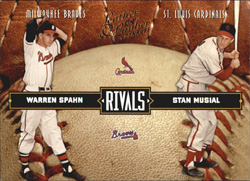
spahn_musialOn Feb. 25, 1967, a month after he was named Cardinals general manager, Musial bypassed Sparky Anderson and selected Spahn to be manager of Class AAA Tulsa.

Anderson had managed the Cardinals’ Class A St. Petersburg club to a league championship in 1966 and reportedly was the top internal candidate for the Tulsa opening.

Spahn, who never had managed, was the recommended choice of Tulsa owner A. Ray Smith.

Though Cardinals executives such as farm director George Silvey had input, Musial, as general manager, had the final decision regarding who to hire as manager for the Cardinals’ top affiliate.

Matchup of marvels

In Spahn, Musial chose the candidate who had been his respected nemesis during their Hall of Fame playing careers.

Spahn, who pitched 21 seasons in the major leagues, primarily with the Braves, is the all-time leader in career wins (363) among left-handers. Musial, who played 22 seasons in the major leagues, all with the Cardinals, is the all-time leader in total bases (6,134) among left-handed batters.

Their matchups spanned the 1940s to 1960s. Musial has a career .318 batting average and .412 on-base percentage against Spahn, according to the Web site retrosheet.org. Musial has more hits (104), doubles (23), triples (6) and walks (50) versus Spahn than any other player. Only Willie Mays (18) hit more home runs against Spahn than Musial (17) did.

In his 1964 book “Stan Musial: The Man’s Own Story,” Musial called Spahn “the best National League pitcher of my era.”

“Spahnie was more than a student of pitching,” Musial said. “He was a scientist.”

Musial concluded, “It was a great challenge to hit against this cunning guy … and I’m proud to have done well.”

Spahn told writer Roger Kahn, “Musial was just the hardest man to fool … I tried to upset Stan’s timing with breaking stuff and changeups. Once Musial started timing fastballs, your infielders’ lives were in jeopardy.”

Pressure on Stan

If not for Bob Howsam’s departure, Musial and Spahn might never have worked together and Anderson might not have left the Cardinals.

On Jan. 22, 1967, Howsam resigned as Cardinals general manager and became executive vice president and general manager of the Reds. Musial, a Cardinals vice president, took on the additional role of general manager.

One of Howsam’s cronies was Tulsa manager Charlie Metro, who was waiting in the wings in case Cardinals manager Red Schoendienst faltered. Metro followed Howsam to the Reds, accepting a job as a scout.

With spring training close to opening, Musial and the Cardinals had to scramble to find a replacement for Metro in Tulsa.

Spahn, 45, was residing on his 2,800-acre cattle ranch in Hartshorne, Okla., about 120 miles from Tulsa. He made it known he wanted to get back into baseball. Smith was thrilled by the possibility of having a baseball icon manage his club, so the Oilers owner went to work on trying to convince Musial to make it happen.

On Feb. 20, 1967, Musial said Smith’s request was under review and he hoped to announce a choice soon, The Sporting News reported.

Musial was pressured to select a candidate from within the Cardinals’ organization, “but we fought a hard fight” for Spahn, Smith told the Associated Press.

Though Anderson was “first choice for the position,” according to The Sporting News, Spahn got the Tulsa job. Anderson was assigned to manage the Cardinals’ Class A club at Modesto, Calif.

Rookie manager

Spahn’s hiring was announced by Smith at a news conference at Tulsa’s prestigious Southern Hills Country Club.

“The Oilers and Tulsa are mighty lucky to get a man of Spahn’s caliber,” Smith said.

Said Spahn: “I’ve always wanted an opportunity to manage. The ranch is great, but it’s more like a plaything. I’d like to manage in Tulsa for 10 years. Naturally, I’m for a major-league job someday, but first I’ve got to earn that.”

Tulsa opened the 1967 season with a roster featuring pitchers Tracy Stallard and Wayne Granger; catchers Pat Corrales and Sonny Ruberto; infielders Elio Chacon, Bobby Dews and Coco Laboy; and outfielder Danny Napoleon.

Other managers in the Pacific Coast League in 1967 included Chuck Tanner of the Seattle Angels, Whitey Lockman of the Tacoma Cubs, Bob Skinner of the San Diego Padres and Mickey Vernon of the Vancouver Mounties.

Under Spahn, Tulsa had a dismal 1967 season (65-79), though he did receive high marks for helping to develop starting pitchers Mike Torrez (10 wins) and Hal Gilson (15 wins). Silvey noted Spahn “must have helped Torrez quite a bit. Mike has added a curve and he’s faster.”

Anderson led Modesto to a 79-61 record and a league championship in 1967. After the season, Anderson joined the Reds as manager of their Class AA Asheville club.

Anderson “was so upset at being bypassed (for the Tulsa job) that he quit the Cardinals organization,” The Sporting News reported.

Two years after leaving the Cardinals, Anderson was named manager of the Reds and went on to build a Hall of Fame career.

Ups and downs

In 1968, Spahn took Tulsa from worst to first. The Oilers finished 95-53 and won the league championship.

Spahn managed Tulsa in 1969 (79-61), 1970 (70-70) and 1971 (64-76) before he was fired by Cardinals general manager Bing Devine.

“Devine said I had been here five years and there were young prospective managers in the organization who needed to move up,” Spahn said.

Though Spahn went on to work as a coach and instructor with other organizations, Tulsa would be the only team he would manage.

Previously: Warren Spahn and his Cardinals connection
 

Read Full Post »

(Updated July 28, 2020)

As a player, Stan Musial rose to the challenge of converting from a pitcher to an outfielder. The move saved his career and launched him on a path to becoming the all-time greatest Cardinal. As an executive, Musial continued to take on challenges. He joined the Cardinals’ front office as a vice president in 1963 and four years later accepted another role.

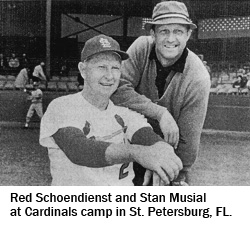
musial_schoendienst2Musial, 46, surprised many when he became Cardinals general manager on Jan. 23, 1967. Musial took the job a day after it was announced Bob Howsam, the Cardinals’ general manager since August 1964, had resigned to become executive vice president and general manager of the Reds.

At the time, Musial had many business and civic ventures. He owned a restaurant, hotel and sports equipment company, and he was an ambassador in promoting physical fitness for President Lyndon Johnson.

“The main reason I took the job is that I found myself with nothing to do,” Musial said to columnist Dick Young in The Sporting News. “I’d go into the restaurant, spend an hour or so there, and then have a lot of time on my hands for the rest of the day. All my other interests are pretty much running themselves … I needed something to do.”

Lillian Musial, Stan’s wife, explained her husband’s decision was driven by a desire “to be closer to baseball again.”

Ready or not

When Howsam informed the Cardinals in January 1967 he was departing, club owner Gussie Busch said it took 15 minutes to decide Musial should become general manager. “We called a meeting of the executive committee and we decided right away,” Busch told the St. Louis Post-Dispatch.

Musial, whose first full season in the big leagues was 1942, said, “It’s taken me 25 years to reach this station and, you know, I kind of think I deserve it.”

As vice president, Musial developed “an increasingly larger voice in the direction of the club, especially in regard to making trades.” the Post-Dispatch reported. “Musial indicated he could have had the general manager job much earlier.”

Said Busch: “He has become familiar with front office operations. He has served an apprenticeship as few men have in baseball.”

Stan and friends

Musial agreed to work with no contract _ “I might say that Mr. Busch’s word is better than a contract,” Musial said _ and for a salary of about $35,000.

As general manager, Musial’s first move was to hire Bob Stewart as executive assistant. Stewart, a former athletic director at St. Louis University, earned Musial’s trust and respect as administrator of the President’s Council on Physical Fitness and Sports.

Stewart’s role was key, because Musial “will concentrate on the playing personnel instead of devoting considerable time to routine administrative phases of the club’s operation,” the Post-Dispatch reported.

Musial had another trusted ally in Cardinals manager Red Schoendienst. They were longtime friends and had been road roommates as players.

Schoendienst entered the 1967 season, his third as Cardinals manager, with a one-year contract. The club hadn’t contended since he replaced Johnny Keane.

“It is only fair to say that both Stan and Red fully understand that record _ and not personal friendship _ will be the judge of the future,” Busch said.

Unfazed, Musial said, “Red has had a couple of years under his belt in rebuilding the ballclub and I’m sure we’ll work together well and be together a long time.”

Said Schoendienst: “I know Stan well and he knows me well. He just might make me work harder.”

Tough enough

Media reaction to Musial’s hiring was supportive but cautious.

Bob Broeg, Post-Dispatch sports editor, wrote, “For Musial, stepping in to run a ballclub rather than into the batter’s box, is a risk for which The Man must be prepared. … It’ll be no easy job.”

The Sporting News suggested, “Musial is risking his hero toga in moving behind the GM desk for the club to which he contributed so much on the field.”

Asked whether his nice guy reputation might conflict with being a general manager, Musial told Young, “I can be as tough as I have to be, but that’s overdone. You don’t have to be tough at trade talks. I’ve sat in on enough of them to know. The hardest part is cutting some player’s pay.”

Broeg revealed a comment Musial made when they had worked together on his autobiography: “Most friends … think I don’t want to be a manager because I’d find it too hard not to be easy on the players,” Musial confided. “I’m afraid I’d be too demanding.”

That’s a winner

In Musial’s lone season in the dual role of vice president and general manager, the Cardinals won the 1967 National League pennant and World Series title. Though the roster largely was built by his predecessors _ Bing Devine and Howsam _ Musial did more as general manager than he usually gets credited for doing.

Musial created an atmosphere of confidence and professionalism that enabled players and staff to perform at their best. It was quite a contrast to Howsam, who hounded players with memos on how to dress, stand and sit. Howsam made it known he had a friend, minor-league manager Charlie Metro, waiting in the wings to take over for Schoendienst.

In a rebuke of Howsam, Broeg said, “Musial became general manager in an atmosphere of ridiculous distrust and mistrust, foolish front-office nitpicking and rising player dissatisfaction over contract terms and methods of salary negotiations.”

Howsam was the executive who acquired right fielder Roger Maris for the 1967 Cardinals, but it was Musial who closed the deal. Maris was considering retiring when the Yankees traded him to St. Louis. After Howsam departed, Musial listened to Maris’ concerns without pressuring him, made him feel appreciated and convinced the skittish slugger to report to spring training.

Said Maris: “It should be good working with men like Musial and Schoendienst because they know all about the game.”

Read Full Post »

A skilled administrator unafraid to make bold trades involving prominent players, Cardinals general manager Bob Howsam also was unpopular with many on the club and was second-guessed by bosses who restricted his authority and threatened his job security.

howsam_gibsonJumping at an offer for a higher salary, a multi-year contract and the opportunity to be fully in charge of baseball operations, Howsam left the Cardinals on Jan. 22, 1967, and joined the Reds as executive vice president and general manager.

The club Howsam left behind won the 1967 National League pennant and World Series title. Two players acquired by Howsam, first baseman Orlando Cepeda and right fielder Roger Maris, were important contributors to that Cardinals championship squad.

With Cincinnati, Howsam enjoyed his greatest success, building the Big Red Machine teams that won four pennants (1970, 1972, 1975 and 1976) and two World Series crowns (1975 and 1976).

Not welcome

A minor-league executive in Denver, Howsam replaced ousted Cardinals general manager Bing Devine in August 1964. Branch Rickey, a Cardinals consultant and former general manager, had recommended Howsam to club owner Gussie Busch.

Devine, who had acquired for the Cardinals key players such as outfielders Lou Brock and Curt Flood and infielders Bill White, Julian Javier and Dick Groat, was well-liked by club employees and media. After Devine departed, the Cardinals won 31 of 45 regular-season games, clinched the pennant and defeated the Yankees in the World Series.

Cardinals manager Johnny Keane and most players were upset Howsam, not Devine, was the general manager celebrating the championship. Howsam contributed only “three cheers” to the title run and his relationship with Keane was so sour their conversations consisted of two kinds: “little and none,” sports editor Bob Broeg of the St. Louis Post-Dispatch reported.

Howsam angered many when he attempted to take some credit for the 1964 success. According to the Post-Dispatch, Howsam said, “My personal feeling is Devine’s firing led us to the pennant and world championship. It fired up everybody _ the manager, the players and the entire Cardinals staff. They got to thinking about contracts for the next season and they simply produced.”

St. Louis shakeup

In 1965, Howsam’s first full season as general manager, the Cardinals finished in seventh place at 80-81. After the season, Howsam created an uproar when he traded three-fourths of the Cardinals’ infield: White, Groat and Ken Boyer. Most of the players St. Louis received in return were busts.

“He had nerve, if not judgment,” Broeg wrote.

Howsam worsened matters when he tried to defend the trade of White by claiming the first baseman was older than he was. In my 2011 interview with White, he said Howsam’s remarks upset him and he challenged the general manager.

The Post-Dispatch reported White “denounced Howsam and said he no longer could have any respect for him.”

Cardinals vice president Stan Musial had been “brought late into trade talks,” and “said he felt badly about the Bill White deal because he felt that he and others had been misled by Howsam’s approach to the deal,” the Post-Dispatch reported.

Hot seat

Howsam created ill will with players who “resented efforts to trim salaries in times of plenty,” Broeg reported, and were upset to receive notes from Howsam “telling them how to dress on the field, for instance, and how to sit in the bullpen.”

Howsam was successful in helping the Cardinals open a stadium in 1966 and with developing promotions to attract women and children to games.

However, when the Cardinals floundered early in the 1966 season _ they lost 14 of their first 22 games _ Howsam was “close to being fired,” Broeg reported.

What saved him was the trade he made on May 8, 1966, when the Cardinals got Cepeda from the Giants for pitcher Ray Sadecki. With Cepeda providing run production, the Cardinals improved, finishing with an 83-79 record, though in sixth place.

Ties that bind

Busch and the Cardinals’ hierarchy, including executive vice president Dick Meyer, lost confidence in Howsam and blocked two major trades he tried to make.

Before trading for Cepeda, Howsam tried to deal pitchers Steve Carlton and Nelson Briles, outfielder Mike Shannon and infielder Phil Gagliano to the Reds for shortstop Leo Cardenas, first baseman Gordy Coleman and pitcher Joey Jay, but the Cardinals’ “high command” vetoed the trade, The Sporting News reported.

After the 1966 season, Howsam wanted to trade Carlton, Briles and outfielders Bobby Tolan and Alex Johnson to the Cubs for outfielder Billy Williams, but again was stopped. “The price in promising young talent was too high, ownership concluded,” Broeg wrote.

The consolation prize was Maris, whom Howsam acquired from the Yankees for third baseman Charlie Smith.

Reds to rescue

For its Jan. 1, 1967, edition, the Post-Dispatch asked Howsam to respond to a story that listed him as the top candidate to become Reds general manager. “It’s news to me,” Howsam replied, adding he’d had no contact with the Reds.

Bill DeWitt Sr., a St. Louisan, had been owner of the Reds until selling the club to a syndicate led by Cincinnati Enquirer publisher Francis Dale in December 1966. DeWitt Sr. suggested the new owners pursue Howsam, calling him “one of the 10 best baseball men around.”

The Reds contacted Busch, who gave permission for them to approach Howsam. On Jan. 11, 1967, Howsam was interviewed by a Reds committee.

Soon after, the Reds offered Howsam a three-year contract at $50,000 per year. Howsam, working without a contract and receiving a $35,000 Cardinals salary, gave Busch a chance to match the offer, but he was uninterested.

“I wish him the best of luck except when his team plays ours,” Busch said.

A day after Howsam was hired by the Reds, Musial was named general manager of the Cardinals.

Read Full Post »

(Updated Sept. 10, 2022)

In a move made as much for its public relations value as for on-field leadership, the Cardinals, in effect, hired two managers to replace Rogers Hornsby.

bob_ofarrellA week after Sam Breadon created an uproar when he traded Hornsby rather than agree to his contract demands, the Cardinals’ owner attempted to quell the controversy by naming one of the club’s most popular players as manager.
On Dec. 27, 1926, Bob O’Farrell, a Cardinals catcher and recipient of the 1926 National League Most Valuable Player Award, was chosen as Hornsby’s successor. At the same time, Bill McKechnie, former Pirates manager, was hired as Cardinals coach and assistant to O’Farrell.

O’Farrell, 30, had no experience managing. McKechnie, 40, had managed the Pirates for five seasons (1922-1926) and led them to a NL pennant and World Series championship in 1925. The Pirates produced winning records every year under McKechnie and finished no lower than third place. He was fired when the defending champion Pirates placed third, 4.5 games behind the first-place Cardinals, in 1926.

McKechnie had been considered a candidate to replace Hornsby, but Breadon opted instead for a manager who already was well-liked by fans and players.

Like latter-day Cardinals catchers such as Tim McCarver, Ted Simmons and Yadier Molina, O’Farrell was smart, talented and respected.

O’Farrell batted .293 with 30 doubles for the 1926 Cardinals, handled the pitching staff superbly and led NL catchers in putouts. In the 1926 World Series against the Yankees, O’Farrell hit .304 and threw out Babe Ruth attempting to steal, ending Game 7 and sealing the Cardinals’ championship.

Who’s the boss?

Few could have predicted the Cardinals would be seeking a manager in December 1926.

Hornsby, a second baseman who won the NL batting title in six consecutive seasons (1920-25) with the Cardinals, became their player-manager in 1925, replacing Branch Rickey.

After Hornsby, 30, led the Cardinals to their first pennant and World Series crown in 1926, he demanded a three-year contract. Breadon offered a one-year deal. When Hornsby persisted, Breadon traded him to the Giants on Dec. 20, 1926, incurring the wrath of Cardinals fans. The St. Louis Chamber of Commerce was so upset it asked Breadon to withdraw his membership in the group.

In the book “The Glory of Their Times,” O’Farrell said, “Hornsby was a great manager as far as I’m concerned. That (1926) year in St. Louis he was tops. He never bothered any of us. Just let you play your own game.”

Breadon offered O’Farrell a one-year contract to be player-manager. The catcher called Hornsby and sought his approval. Hornsby assured O’Farrell he wouldn’t be disloyal if he accepted the offer. Breadon was relieved when he did.

O’Farrell told author Lawrence Ritter, “I didn’t want to be the manager. I was in the prime of my (playing) career, and managing always takes something away from your playing.”

Likeable leader

In the St. Louis Star-Times, James Gould wrote, “The naming of O’Farrell undoubtedly will be as popular a choice as could be made under the circumstances … None is better liked by his teammates.”

The St. Louis Post-Dispatch called O’Farrell “the only man perhaps who was sure to be received pleasantly by the fans and the players.”

Breadon was “as jubilant as a 2-year-old” when he got both O’Farrell and McKechnie, the Star-Times reported.

“The offer I made to O’Farrell was positively the only one I made to anyone since Hornsby was traded,” Breadon said. “… He is absolutely the only man who could be chosen for the post. But the greatest joy of all was the signing of McKechnie.”

Breadon said McKechnie “ought to help O’Farrell guide the Cards to their second pennant.”

Unfair to O’Farrell

O’Farrell said “I never dreamed” of inheriting a World Series championship team. “I consider Hornsby the greatest manager I ever saw and just as he let the club play its own games I will let the fellows do their own thinking.” O’Farrell said. “You can’t think for 25 men.”

Hornsby, who also had no managing experience when he got the job, said O’Farrell was “a fine choice” and “he ought to make a good manager.”

Noting his proven skill in working with pitchers, The Sporting News suggested O’Farrell “probably knows more about the pitching part … in a day’s workout than Hornsby would learn second hand in a year.”

Set back by injuries and with his focus on managing, O’Farrell was limited to 61 games in 1927. Splitting the catching chores with Frank Snyder and Johnny Schulte, O’Farrell hit .264 with 10 doubles.

As manager, O’Farrell led the 1927 Cardinals to a 92-61 record _ better than the 89-65 mark of the 1926 championship club _ but St. Louis finished in second place, 1.5 games behind the Pirates.

Breadon replaced O’Farrell with McKechnie and gave O’Farrell a pay raise to remain on the team as a catcher in 1928. His tenure, though, was short-lived. In May 1928, O’Farrell was traded to the Giants. McKechnie led the Cardinals to the 1928 pennant.

Read Full Post »

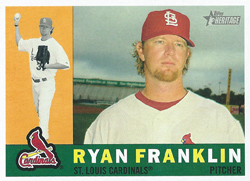
Acquired by the Cardinals to be a starting pitcher, Ryan Franklin appeared in 285 regular-season games for them and never made a start. Instead, Franklin established himself as a reliable setup reliever, then a closer and, when his playing career ended, a key member of the front-office staff.

ryan_franklin3In five seasons (2007-2011) as a Cardinal, Franklin had a 21-19 record with 84 saves and a 3.52 ERA. His best season was 2009 when, as the Cardinals closer, he was 4-3 with 38 saves and a 1.92 ERA in 62 appearances for the National League Central Division champions.
John Mozeliak, Cardinals general manager, saw in Franklin an ability to identify and assess talent, especially pitching. In 2012, Franklin became a special assistant to Mozeliak. Franklin has been in that role ever since.

Through the efforts of Daniel Shoptaw, founder of United Cardinal Bloggers, Mozeliak agreed after the 2016 season to answer questions from Cardinals bloggers.

In response to my question about the role Franklin performs, Mozeliak replied, “Franky has made a nice adjustment from his playing days to working in our baseball operations. He continues to grow as a professional both on the scouting and player development side. He obviously has expertise on pitching and we try to leverage that in the draft and in pro scouting decisions.”

Seeking a stopgap

When Franklin was signed as a free agent by the Cardinals in January 2007, no one could have envisioned he eventually would develop into a trusted advisor to the general manager. Franklin wasn’t even guaranteed a spot on the team.

The 2007 Cardinals, defending World Series champions, headed into spring training with a starting rotation of Chris Carpenter, Kip Wells, Anthony Reyes and Adam Wainwright.

The Cardinals were seeking someone to fill in as the fifth starter for Mark Mulder, who was recovering from shoulder surgery and was projected to return late in the 2007 season.

The Cardinals signed Franklin, 33, to a one-year, $1 million contract and planned to have him compete with Braden Looper and Brad Thompson for the No. 5 starter role.

Fitting role

Franklin had averaged 200 innings per season as a Mariners starter from 2003 to 2005. Though a workhorse, he wasn’t a winner. In 30 starts for the 2005 Mariners, Franklin had an 8-15 record and 5.16 ERA.

He split the 2006 season as a reliever for the Phillies (1-5, 4.58 ERA) and the Reds (5-2, 4.44 ERA).

The Cardinals hoped the right-hander would transform into an effective starter under the guidance of pitching coach Dave Duncan in much the way Jeff Weaver had in 2006.

Franklin “will be given the chance to win a starting job in spring,” Cardinals manager Tony La Russa told the St. Louis Post-Dispatch.

Said columnist Bernie Miklasz: “It’s possible … Franklin will hold Mulder’s spot and head to the bullpen when Mulder re-enters. That’s why Franklin’s low-budget addition makes so much sense.”

However, in spring training, Looper won a starting role and Franklin earned a spot in the bullpen.

Franklin pitched well throughout most of the 2007 season _ his ERA was 1.33 entering August _ and he finished with a 4-4 record and 3.04 ERA, convincing the Cardinals to keep him.

Previously: 2011 Cards came long way since Ryan Franklin in bullpen

Read Full Post »

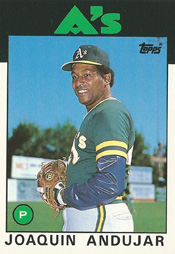
Heading into the 1985 winter meetings, the Cardinals were willing to trade ace Joaquin Andujar for either a left-handed starting pitcher or a first-string catcher. They found a club willing to give them both.

joaquin_andujar8On Dec. 10, 1985, the defending National League champion Cardinals dealt Andujar to the Athletics for catcher Mike Heath and pitcher Tim Conroy.

Heath, 30, was acquired to replace Darrell Porter, who had been released. Conroy, 25, was expected to compete for a spot in the Cardinals’ 1986 rotation alongside John Tudor, Danny Cox, Bob Forsch and Kurt Kepshire.

Neither Heath nor Conroy worked out the way the Cardinals had hoped and Andujar never achieved with the Athletics the success he had with St. Louis.

Behind the numbers

Though Andujar, 32, had an impressive regular season for the 1985 Cardinals _ 21-12 record with 10 complete games and 269.2 innings pitched _ his performance in the second half and in the postseason triggered concern.

For example:

_ Andujar was 1-3 with a 5.30 ERA in six September starts in 1985 and 0-2 with a 7.88 ERA in two regular-season October starts.

_ In the NL Championship Series against the Dodgers, Andujar was 0-1 with a 6.97 ERA in two starts. In the World Series versus the Royals, he made two appearances and was 0-1 with a 9.00 ERA.

_ He had a meltdown in Game 7 of the World Series, getting into a confrontation with home plate umpire Don Denkinger and being ejected. Peter Ueberroth, commissioner of baseball, suspended Andujar for the first 10 games of the 1986 season. Video at the 1:38 mark

Look the other way

At home in the Dominican Republic, Andujar told Braves shortstop Rafael Ramirez that people from Anheuser-Busch, the brewery that owned the Cardinals, called him and said he’d never pitch for the club again, columnist Peter Gammons reported in The Sporting News.

Dal Maxvill, Cardinals general manager, denied being told to trade Andujar. “There has not been interference from above,” Maxvill said to The Sporting News.

In comments about Andujar to St. Louis reporter Rick Hummel, Maxvill added, “I know he’s kind of crazy and I know he’s unusual, but you have to look the other way when the performance is there.”

In his 1987 book “White Rat: A Life in Baseball,” Cardinals manager Whitey Herzog admitted, “It’s been reported that Maxvill and I were ordered to trade Joaquin and I won’t deny that. I will say, though, that he might well have been traded anyway. The other players were tired of his griping and his bitching. It had gotten to the point where he was dividing the clubhouse.”

No deal

The White Sox approached the Cardinals and proposed a deal of left-handed starter Britt Burns for Andujar and pitcher Ricky Horton. Burns was 18-11 for the 1985 White Sox. The Cardinals, however, “backed off because they were concerned about a hip injury of which Burns complains,” Hummel reported.

The Cardinals approached the Red Sox and offered Andujar, Horton, Kepshire and reliever Jeff Lahti for left-handed starter Bruce Hurst, who was 11-13 for Boston in 1985.

The Red Sox rejected the offer because they were given “an immediate take-it-or-leave-it deadline” by the Cardinals and they “were afraid of taking on Andujar” and his problems, Gammons reported.

Headcases OK

The Athletics were seeking a proven winner for their rotation. They offered their starting catcher, Heath, and one selection from a pool of pitchers. The Cardinals chose Conroy.

To the Athletics, Andujar’s pitching trumped his image.

“There’s nothing wrong with a headcase or two _ as long as you don’t have eight,” Sandy Alderson, Athletics general manager, told the Sacramento Bee. “This was not a multi-headcase deal.”

To the San Jose Mercury News, Alderson said, “Flamboyance is not criminal.”

Herzog had advice for Athletics pitching coach Wes Stock, who had been Herzog’s teammate with the Orioles. “Whitey told me Joaquin still needs to be coddled,” Stock said. “He told me not to forget that.”

Asked his reaction to the trade, Andujar told St. Louis radio station KMOX, “I feel surprised. Like I always said, I wanted to die in St. Louis … I leave my heart in St. Louis.”

Unhappy Heath

Heath hit .250 with 13 home runs and 55 RBI for the 1985 Athletics. He caught 38 percent of runners attempting to steal.

According to The Sporting News, Heath asked to be traded. He feuded with Oakland management after being told he’d play only versus left-handed pitching in 1986.

“I felt I was an everyday player and I felt I would not be happy,” Heath said.

In a parting shot at the Athletics, Heath added, “When Mike Heath steps on the field, his No. 1 objective is to win. No. 2 is to win and No. 3 is to win. With the A’s, No. 1 was being compatible and No. 2 was winning.”

Change for Conroy

Conroy was 0-1 with a 4.26 ERA in 16 games for the 1985 Athletics. At Class AAA Tacoma that season, Conroy was 11-3 in 22 starts.

A first-round selection of the Athletics in the 1978 draft, Conroy made his major-league debut at age 18. In five seasons with the Athletics, Conroy was 10-19 with a 4.37 ERA.

“We probably pushed him too quickly,” Alderson said.

Conroy “had to get out of our organization … The mental strain had become too great,” Stock told the San Francisco Chronicle.

Said Herzog: “We’ve liked Conroy for a long time … We feel he was rushed in Oakland and was under too much pressure to succeed.”

The results

Heath hit .205 with four home runs and 25 RBI for the 1986 Cardinals. He caught 33 percent of runners attempting to steal.

On Aug. 10, 1986, the Cardinals traded Heath to the Tigers for pitcher Ken Hill and first baseman Mike Laga.

Conroy was 5-11 with a 5.23 ERA in 25 appearances for the 1986 Cardinals. He was 3-2 with a 5.53 ERA for St. Louis in 1987, his last big-league season. In two years with the Cardinals, Conroy was 8-13 with a 5.31 ERA.

Andujar was 12-7 with a 3.82 ERA in 28 appearances for the 1986 Athletics. He was 3-5 with a 6.08 ERA for Oakland in 1987. In two seasons with the Athletics, Andujar was 15-12 with a 4.46 ERA.

Previously: How Hub Kittle got Joaquin Andujar to Cardinals

Read Full Post »

« Newer Posts - Older Posts »