Feeds:
Posts
Comments

Archive for the ‘Executives’ Category

When the 1945 Cardinals reported to spring training at Cairo, Ill., they found the outfield better suited for fishing than for chasing fly balls. Unable to have fielding or batting practice because of flooding at Cotter Field, the Cardinals abandoned the Illinois river town and conducted spring training at Sportsman’s Park in St. Louis.
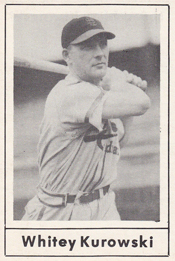
whitey_kurowskiIn March 1945, the defending World Series champion Cardinals planned to hold spring training in Cairo for the third consecutive year. St. Petersburg, Fla., was the Cardinals’ spring training base, but the Redbirds, like all big-league clubs, trained at sites closer to home from 1943-45 in order to conserve resources through reduced travel during World War II.

Training at Cairo worked well for the Cardinals in 1943 and 1944. They had more than 100 wins and earned a National League pennant in each of those years, including a World Series title in 1944.

River runs through it

Cairo is located on the southern tip of Illinois, where the Ohio River flows into the Mississippi River. In March 1945, rain swelled the rivers. Even with walls and levees protecting the town, water seeped into the ballpark used by the Cardinals.

The stages of the rivers were 10 feet above the level of the ballpark, according to the Associated Press. Under orders from club owner Sam Breadon, Cardinals traveling secretary Leo Ward searched throughout Cairo for an alternative spot to conduct batting and fielding practice, “but he mired in mud and returned gloomily to the hotel.”

“There was talk of moving the training camp back to St. Louis as early as March 13, the second day the players were in camp,” The Sporting News reported. “However, Breadon gave the Cairo people a few days more to get their park in shape.”

Losing battle

Cairo Mayor E.A. Smith and city fire and street departments “did everything they knew to get the field in shape. They dug draining ditches and put the fire pumps to work in the outfield, but each morning a new film of seepage water covered the infield,” The Sporting News wrote.

In a story filed on March 19, 1945, the Associated Press reported, “The outfield of the practice diamond was under four feet of water and it appeared doubtful that the park would be useable for baseball during the two weeks the team will be in town.”

Among those in camp for the Cardinals were pitchers Max Lanier, Blix Donnelly and Bud Byerly, first baseman Ray Sanders, second baseman Emil Verban, third baseman Whitey Kurowski, outfielder Debs Garms and rookie Red Schoendienst.

A picture in The Sporting News showed Kurowski, Lanier and Sanders casting fishing lines in the outfield water.

Ohio option

Coach Mike Gonzalez was running the club while manager Billy Southworth was at home in Sunbury, Ohio, after spending weeks in New York while joining in a mission to search for his son, who was killed in a crash of a B-29 he was piloting.

Southworth was trying to find a training site for the Cardinals in Ohio. “Breadon announced Southworth is looking for a place and that the squad will leave (Cairo) if satisfactory arrangements can be made,” the Associated Press reported.

The Sporting News revealed Southworth wanted to bring the Cardinals to Miami University in Oxford, Ohio, where the minor-league Columbus and Rochester teams were training.

“Miami University officials hustled around to find living quarters for the Cardinals and a series of games among the three clubs was being worked up,” The Sporting News wrote. “Manager Billy Southworth … believed the arrangement was set, but owner Sam Breadon vetoed the move to Oxford.”

Homeward bound

Breadon ordered the team instead to return to St. Louis. The last time the Cardinals had spent spring training at home was in 1919. The reason then was lack of finances.

Wrote The Sporting News of the deteriorating conditions in Cairo: “For a week, the Redbirds had no real baseball work. They indulged in pepper games on a hard cinder footing, did some throwing, running and calisthenics but had no batting practice or real infield workout … A soggy infield, no batting practice for five days and fishing in the outfield quickly convinced (Breadon) that he had to act quickly.”

Said Breadon: “Oh for a return to good old St. Petersburg.”

The Cardinals began workouts at Sportsman’s Park on March 26, 1945, and opened the season on April 17 at Chicago.

The disrupted spring training didn’t appear to hurt them much. The 1945 Cardinals had 95 wins and finished in second place, three games behind the Cubs.

Previously: Why the Cardinals chose Cairo, Ill., for spring training

Previously: Why Billy Southworth managed Cardinals with heavy heart

Read Full Post »

(Updated Feb. 18, 2019)

As an infielder who struggled to hit, Dal Maxvill overcame the odds and started in 21 World Series games for the Cardinals. As a coach with no experience as a baseball executive, Maxvill again overcame the odds and became general manager of the Cardinals.

dal_maxvill3On Feb. 25, 1985, Maxvill was the surprise choice of the Cardinals to replace Joe McDonald as general manager. Maxvill was a coach with the Atlanta Braves when the Cardinals approached him about becoming their top baseball executive.

“It seemed a rather sizeable leap to go from third-base coach to general manager,” Rick Hummel wrote in The Sporting News.

In his book “White Rat: A Life in Baseball,” Cardinals manager Whitey Herzog said, “I had my doubts about him when he was hired … He’d never made a trade, never negotiated a contract and I wondered what the hell was going through their minds when they hired him.”

Baseball and business

Maxvill, 46, said he hadn’t applied for the job and was approached by club officials. Team owner Gussie Busch said he was seeking a candidate who knew both baseball and the Cardinals organization and also had business experience.

To Busch, Maxvill met the criteria.

Maxvill played for the Cardinals from 1962-72. Replacing the injured Julian Javier, he started seven games at second base in the 1964 World Series. He started seven games at shortstop in the 1967 World Series and again in the 1968 World Series. Maxvill won a Gold Glove Award in 1968. He hit .220 as a Cardinal.

Maxvill was a Cardinals coach from 1979-80 and an instructor in 1981. He and former Cardinals reliever Joe Hoerner were co-owners of a St. Louis travel agency. Maxvill earned a degree in electrical engineering from Washington University in St. Louis and worked for a St. Louis engineering company during his off-seasons as a Cardinals player in the 1960s.

The Cardinals offered Maxvill a one-year contract.

“Of all the people we considered, myself and the other members of the executive committee unanimously agreed that Dal Maxvill has the qualifications we were looking for in a general manager,” Busch told the Associated Press.

Fred Kuhlmann, chief operating officer of the Cardinals, said Tal Smith, a consultant hired to lead the search for a general manager, gave Maxvill “as enthusiastic a recommendation as there could be.”

“We were looking for someone with a sense of business ability to go along with his baseball experience, the innate ability to cope with the business aspects of being general manager,” Kuhlmann said to the St. Louis Post-Dispatch.

Cardinals connections

Two other former Cardinals players _ broadcasters Tim McCarver and Joe Torre _ were considered before Maxvill was offered the position, The Sporting News reported.

“I’ve been a Cardinals fan since I was 3,” said Maxvill, a native of Granite City, Ill. “My mother and father took me to see Enos Slaughter, Terry Moore and Red Schoendienst.”

Schoendienst, a Cardinals coach in 1985, was Maxvill’s manager from 1965-72.

“Once, I was his boss,” Schoendienst said. “Now, he’s mine.”

Asked his opinion of the Cardinals hiring Maxvill, former general manager Bing Devine told Bob Broeg of the Post-Dispatch, “Why shouldn’t he be a good general manager? He always has done everything better than any of us expected. I think the selection was excellent.”

Good deal

On April 2, 1985, Maxvill made his first trade, acquiring infielder Jose Oquendo from the Mets for infielder Angel Salazar and minor-league pitcher John Young.

The Cardinals won two pennants, 1985 and 1987, with Maxvill as general manager.

“He turned out to be a hell of a baseball executive,” Herzog said. “… Maxie is smart and he caught on fast.”

Maxvill was Cardinals general manager from 1985-94 until he was fired by team president Mark Lamping and replaced by Walt Jocketty.

Read Full Post »

(Updated May 24, 2019)

The first night home game for the Cardinals had two unintended consequences: It prompted the dismissal of their manager and led to a ban on serving beverages in glass bottles.

sportsmans_park2On Jan. 31, 1940, the National League Cardinals and the American League Browns agreed to share the $150,000 cost to install lights at Sportsman’s Park in St. Louis.

Stupp Brothers Bridge and Iron Company of St. Louis was hired to do the structural work and Westinghouse Electrical Supply Company was given the job of putting in the reflectors and floodlights on eight steel towers.

“It will require electrical energy totaling 1,176,000 watts per hour, not including lighting in the stands, to turn night into day at the historic old Grand Boulevard establishment,” The Sporting News reported. “This, it is said, would be sufficient juice to take care of the lighting needs of a city of 25,000 persons.”

The Browns got the honor of playing the first night game in St. Louis on May 24, 1940, against the Indians. Before 24,827 spectators on a Friday night, Bob Feller pitched a seven-hitter, struck out nine and hit his first big-league home run, leading the Indians to a 3-2 victory. Boxscore

“Baseball under the floodlights has made its bow at Sportsman’s Park and everybody is very happy about it,” the St. Louis Post-Dispatch reported. “The barber and the butcher and the man who works in an office or factory are very pleased to know night baseball.”

Most everyone praised the brightness of the lights and the Post-Dispatch noted, “The lights’ reflection in the sky was visible for many blocks from the park and residents as far as four blocks away said it would be an easy matter for them to play cards in their backyards.”

Eleven nights later, the Cardinals got their first chance to play under the lights at home.

Dark times

On June 4, 1940, 23,500 spectators turned out on a Tuesday night to see the Cardinals open a series against the Dodgers. The Cardinals had a 14-22 record and owner Sam Breadon was becoming increasingly impatient with manager Ray Blades.

Seeking a sharp, winning performance before the large crowd in the club’s first night home game, Breadon saw just the opposite. The Dodgers scored five in the first against Mort Cooper.

As the Dodgers continued to add to the lead, “pop bottles thrown from the bleachers littered the outfield,” The Sporting News reported, “partly because the Dodgers rattled long drives off the wall and partly because of (inconsistent) umpiring.”

According to the St. Louis Star-Times, “debris of all kinds filtered from the stands” and “the barrage continued for almost three minutes before a squadron of police detailed to the park appeared and stopped the tossing.”

The grounds crew picked up “several hundred bottles _ 10 bushel baskets full,” the Star-Times reported.

Though Cardinals cleanup batter Joe Medwick went 5-for-5 with three doubles, the Cardinals stranded 14 and the Dodgers won, 10-1, behind Vito Tamulis, who scattered 11 hits. Boxscore

Changing times

Disheartened by the debacle, Breadon made up his mind to fire Blades, The Sporting News reported. The announcement of Blades’ firing came three days later, surprising general manager Branch Rickey, who hadn’t been informed by Breadon of the decision. Billy Southworth, managing the Cardinals’ minor-league club at Rochester, was Breadon’s choice to replace Blades.

Breadon also announced the Cardinals would use paper cups instead of bottles for serving cold drinks in the Sportsman’s Park bleachers.

The 1940 Cardinals played seven home night games, winning three.

Their first home night win occurred on a Tuesday, July 2, 1940, when Bill McGee pitched a seven-hit shutout and contributed a two-run single, beating the Reds, 4-0, before 14,944. Boxscore

A look at the Cardinals’ other five night home games in 1940:

_ Harry Danning had three hits, including two doubles, and a RBI for the Giants in an 8-6, 11-inning victory on Thursday night July 11 before 10,363. Boxscore

_ Hugh Mulcahy pitched a five-hit shutout in a 3-0 Phillies win on Wednesday night July 17 before 7,113. Boxscore

_ Joe Orengo tied the score with a solo home run in the bottom of the ninth and the Cardinals got a run in the 11th to beat the Pirates, 7-6, on Wednesday night Aug. 14 before 11,077. Boxscore

_ Al Glossop had two RBI and rookie Nick Strincevich pitched a five-hitter, leading the Braves to a 3-1 triumph on Monday night Aug. 26 before 8,472. Boxscore

_ Johnny Mize and Marty Marion each had two RBI, lifting the Cardinals to a 4-2 win over the Cubs on Wednesday night Sept. 4 before 16,197. Boxscore

Previously: Rift with Branch Rickey led Cards to oust Frankie Frisch


Read Full Post »

(Updated Oct. 30, 2024)

In January 1985, the Cardinals forced out general manager Joe McDonald, friend and working partner of Whitey Herzog. The move signaled to Herzog, the Cardinals’ manager, that he, too, was vulnerable and could be ousted if his club didn’t contend in 1985.

joe_mcdonaldHerzog responded by leading the Cardinals to National League pennants in two of the next three seasons (1985 and 1987), securing his reputation as an innovative winner and capping a managerial career that would lead to his election to the National Baseball Hall of Fame.

Front office upheaval

On Jan. 3, 1985, Cardinals owner Gussie Busch said McDonald, the franchise’s general manager since 1982, had resigned and would remain with the club as a consultant. While vaguely acknowledging McDonald had made “a number of contributions to the team,” Busch also said “a change was needed to build the club into a pennant winner.”

In The Sporting News, Rick Hummel noted Busch’s statement “did not sound as if the move (by McDonald) was voluntary.” McDonald, 55, confirmed as much, telling the Associated Press he’d “look for another job” and was “too young to retire.”

Internal strife

After the Cardinals won the World Series championship in 1982 with Herzog as manager and McDonald as general manager, they finished fourth in the six-team NL East in 1983 and third in 1984.

Expectations were the Cardinals would finish out of contention in 1985, too. After the 1984 season, closer Bruce Sutter became a free agent and bolted the Cardinals for the Braves and McDonald dealt the club’s top run producer, right fielder George Hendrick, to the Pirates.

Concern about the direction the Cardinals were headed was one reason Busch was unhappy with McDonald. Another: Busch was irked McDonald hadn’t informed him about personal problems plaguing Cardinals outfielder David Green, who was entering a treatment center.

In his book, “That’s a Winner,” Cardinals broadcaster Jack Buck wrote, “McDonald made the mistake of not informing Mr. Busch before the story was in the news. Busch had made it clear he did not want to be surprised by anything he heard about his team. He wanted the information first _ and that was one of the reasons McDonald was fired as general manager.”

Committee rules

In a story headlined “Herzog’s Future Could Be In Doubt,” Hummel wrote, “Now that Joe McDonald has resigned, or been fired, as the St. Louis Cardinals general manager, what will become of manager Whitey Herzog, McDonald’s close friend? … Herzog couldn’t be blamed for wondering what the future of the Cardinals is … His input in the organization seems to have been lessened considerably in the past couple of years.”

A three-man executive committee of Busch, attorney Lou Susman and chief operating officer Fred Kuhlmann played a larger role in key Cardinals decisions.

Wrote Hummel, “Herzog and McDonald found it increasingly difficult to work within that framework because they had to get approval from the executive committee on most proposed transactions and, as often as not, they could not find all three members of the committee in town at the same time.”

In his book “White Rat: A Life in Baseball,” Herzog said, “I’d never seen an organization that was as screwed up as ours was when 1985 began.”

Met as Mets

McDonald and Herzog worked together in the Mets organization from 1966-72. In 1967, Bing Devine, the former Cardinals general manager who had become a Mets executive, named McDonald director of scouting and Herzog director of player development.

Herzog went on to become a big-league manager. McDonald became general manager of the Mets in 1975, replacing Bob Scheffing, and held that position through 1979 until new ownership replaced him with Frank Cashen.

McDonald and Herzog were reunited in 1980 when McDonald joined the Cardinals as assistant to Herzog, who was both general manager and manager.

In February 1982, Herzog, tired of negotiating player contracts, suggested to Busch that McDonald should become general manager. Busch agreed and the announcement was made in April 1982.

(Years later, in recalling how he relinquished the general manager job, Herzog said to Cardinals Yearbook, “He (Busch) tore up my contract and gave me a $75,000 raise. I gave up one job and got a $75,000 raise. Pretty good deal, huh?”)

Life after Cardinals

After the Cardinals ousted McDonald, they contracted with consultant Tal Smith to assist them in a search for a replacement. On Feb. 25, 1985, Dal Maxvill, the former Cardinals shortstop, was named general manager.

Meanwhile, McDonald pursued his plan to find another front-office job.

In 1987, McDonald joined the Tigers as director of player development. He replaced Bill Lajoie as Tigers general manager in 1991 and held that position for two years before he was replaced by Jerry Walker.

After leaving the Tigers, McDonald became a scout for the Angels, Rockies and Red Sox. He was a Red Sox scout when they won World Series championships against the Cardinals in 2004 and 2013.

Previously: Why Gussie Busch fired Bing Devine in championship year

Read Full Post »

david_ecksteinIn December 2004, the Angels did the Cardinals a favor, opting not to re-sign their shortstop, David Eckstein, making him a free agent.

The Cardinals, needing to replace shortstop Edgar Renteria, a free agent who signed with the Red Sox, hardly could believe their good fortune.

Eckstein filled two needs. He replaced Renteria at shortstop and he also batted leadoff. Like Renteria, Tony Womack, who batted leadoff for the 2004 Cardinals, became a free agent. Womack signed with the Yankees.

Pouncing on the opportunity to acquire a player described by general manager Walt Jocketty as “a perfect fit,” the Cardinals signed Eckstein on Dec. 23, 2004, two days after he became available.

It was a move that felt right from the moment it occurred.

Eckstein ignited the Cardinals with his hustle, heart and smarts, leading them to two postseason appearances and a 2006 World Series championship.

Shortstop roulette

Though Eckstein had sparked the Angels to their only World Series title in 2002 and had led American League shortstops in fielding percentage in 2004, the Angels sought an upgrade, citing Eckstein’s lack of arm strength as a liability.

Meanwhile, Renteria, a three-time all-star with the Cardinals, had bolted to the Red Sox, who gave him a four-year, $40 million contract.

With Renteria joining Boston, Orlando Cabrera, the shortstop who helped the Red Sox sweep the Cardinals in the 2004 World Series, declared for free agency. The Angels pursued him, offering a four-year, $32 million deal. When Cabrera accepted, Eckstein became expendable.

According to the Associated Press, the Cardinals, unable to find a suitable replacement for Renteria, were considering signing shortstop Barry Larkin, 40, who had become a free agent after 19 seasons with the Reds. When Eckstein became available, the Cardinals called with a three-year, $10.2 million offer.

Eckstein, 29, accepted and it was a bargain for the Cardinals.

“They were very aggressive,” Eckstein said to the St. Louis Post-Dispatch. “They were pretty much the first team to call … It was clear that this was a good fit. The best fit.”

John Mozeliak, the Cardinals’ assistant general manager, said, “David was the player we focused on right away after Cabrera signed.”

Said Jocketty: “We felt this was the guy, the perfect fit for our club for a lot of reasons. For his personality, for the way he goes about playing the game. He’s a gamer through and through. He’s the kind of player St. Louis will embrace. I think he will become a cult hero with our fans. He’s a hustler.”

Disappointed with the decision to discard a player popular with the team based near Disneyland, San Bernardino Sun columnist Paul Oberjuerge wrote, “The Angels just shot Bambi.”

Size doesn’t matter

Eckstein, 5 feet 6, 170 pounds, had 156 hits in 142 games for the 2004 Angels. He seldom struck out (49 times in 637 plate appearances) and fielded effectively (six errors).

In the 2002 World Series against the Giants, Eckstein batted .310 with nine hits, three walks and six runs scored for the Angels.

Post-Dispatch columnist Bernie Miklasz wrote, “Eckstein is the kind of old-school player who commands such great respect and appreciation in St. Louis, a traditional baseball town.”

Rex Hudler, an Angels broadcaster who had been a hustling utilityman for the Cardinals from 1990-92, told Miklasz he’d named his son, David, in honor of Eckstein.

“He’s going to be revered as the new Huckleberry Finn of St. Louis and Missouri,” Hudler said of Eckstein.

Hudler said his 8-year-old daughter cried when she learned Eckstein was leaving the Angels. “Kids are his biggest fans,” Hudler said. “The children look up to him and relate to him because he’s so small … He inspires all of those kids who have been told they aren’t good enough.”

Asked about Eckstein’s subpar arm, Hudler replied, “He’s so smart. Extremely intelligent. He studies the hitters. He positions himself perfectly. He’s always in the right place. The ball comes right to him. I’ve never seen him make a mental mistake.”

Said Eckstein: “I don’t really look like your typical pro athlete. It means I always have to prove myself … I don’t want to lose that edge.”

St. Louis sparkplug

Cardinals manager Tony La Russa was delighted by the acquisition, calling Eckstein “a winning player.”

After speaking with La Russa, Eckstein told the Associated Press, “Mr. La Russa just said to play my game, be a pest at the plate and play solid defense.”

That’s exactly what Eckstein did for the Cardinals.

In three seasons (2005-07) as the St. Louis shortstop, Eckstein twice was named an all-star. He batted .297 with 465 hits in 398 career games for the Cardinals. He had a .357 on-base percentage with them. In 2005, Eckstein ranked second among National League shortstops in both assists (517) and double plays turned (123).

His crowning achievement came in 2006 when he was named winner of the World Series Most Valuable Player Award. Eckstein hit .364 in the five-game series versus the Tigers, with four RBI and three runs scored.

“He’s the heart and soul of this ball club,” Cardinals second baseman Aaron Miles said to Sports Illustrated.


Read Full Post »

(Updated Jan. 21, 2026)

Branch Rickey is well known for being the Dodgers executive who broke baseball’s color barrier by bringing Jackie Robinson to the major leagues. What is less known is Rickey was the Cardinals executive who made Mike Gonzalez the first Cuban manager in the major leagues.

mike_gonzalezGonzalez, a Havana native, had three stints with the Cardinals as a catcher: 1915-18, 1924-25 and 1931-32. He also played for the Braves, Reds, Giants and Cubs.

During his 17-year playing career in the majors, Gonzalez developed a reputation for his baseball savvy. It was while scouting for the Giants that Gonzalez wired a report to manager John McGraw about a prospect: “Good field, no hit.” The phrase became part of baseball’s lexicon.

Shrewd strategist

In 1934, Gonzalez became a coach on the staff of Cardinals manager Frankie Frisch. Four years later, when Frisch was fired on Sept. 11, 1938, Rickey chose Gonzalez to manage the Cardinals.

Though it was a stopgap measure _ most reports indicated Rickey would hire someone from within the minor-league system to manage the 1939 Cardinals _ the move was significant.

In reporting that Gonzalez, 47, was the first Cuban to manage in the big leagues, The Sporting News described him as “a shrewd diamond strategist, a keen judge of talent and a capable instructor.”

Frisch called Gonzalez “a great guy, loyal and true and one of the smartest birds I ever knew.”

Citing his stellar reputation as a coach for the Cardinals, The Sporting News wrote of Gonzalez, “The athletes who have played under his coaching direction have learned to respect his judgment and to take his orders implicitly.”

Gonzalez also had the ability to decode signs flashed by opponents. “One year, the Cardinals won almost all their games with one of the second-division clubs, largely because Gonzalez was able to call virtually every pitch and tell exactly when the enemy was going to hit-and-run or try to steal,” The Sporting News noted.

In the book “Baseball’s Greatest Teams,” author Tom Meany noted that, in addition to his cagey baseball skills, Gonzalez was “a most remarkable poker player.”

Successful start

Gonzalez made his debut as Cardinals manager on Sept. 14, 1938, in the first game of a doubleheader at Philadelphia. Despite yielding nine runs and 13 hits, starter Max Macon pitched a complete game and got the win in a 12-9 Cardinals victory. Boxscore

The Cardinals swept the doubleheader, winning the second game, 3-2, behind Mort Cooper, who pitched a three-hitter while walking eight in his big-league debut. Boxscore

Gonzalez led the Cardinals to wins in his first five games as manager, then lost six in a row. He finished with an 8-8 record.

Ray Blades became manager of the 1939 Cardinals and kept Gonzalez as a coach.

Second stint

In June 1940, Blades was fired and Gonzalez was named to his second stint as Cardinals manager. Again, it was an interim role. The Cardinals were 1-5 under Gonzalez in 1940 before Billy Southworth took over as Cardinals manager. Gonzalez stayed as a coach.

The Cardinals won two World Series titles and three pennants under Southworth, who earned election to the National Baseball Hall of Fame.

In 1946, Southworth left the Cardinals to become manager of the Braves. He was replaced by Eddie Dyer, who maintained Gonzalez as a coach.

The 1946 season was the 13th and final season for Gonzalez as a Cardinals coach. It ended memorably. In Game 7 of the 1946 World Series, Enos Slaughter scored the winning run on a dash from first base on a hit by Harry Walker. Slaughter credited Gonzalez, the third-base coach, for waving him to home plate as soon as he reached third. It was redemption for Gonzalez, who was criticized after Game 4 when two baserunners he waved home were thrown out at the plate.

Cuban managers

Gonzalez was the first of seven Cubans who managed in the majors, according to baseball-reference.com. The others:

_ Preston Gomez: 1969-72 Padres, 1974-75 Astros and 1980 Cubs.

_ Marty Martinez: 1986 Mariners (one game).

_ Cookie Rojas: 1988 Angels and 2001 Marlins (one game).

_ Tony Perez: 1993 Reds and 2001 Marlins.

_ Carlos Tosca: 2002-04 Blue Jays.

_ Fredi Gonzalez: 2007-10 Marlins and 2011-16 Braves.

On Oct. 25, 2021, Oliver Marmol became the first minority manager of the Cardinals since Mike Gonzalez. Marmol, born and raised in the United States, traces his lineage to the Dominican Republic.

Read Full Post »

« Newer Posts - Older Posts »
