Feeds:
Posts
Comments

Archive for the ‘Executives’ Category

(Updated May 2, 2023)

After managing the Cardinals, Whitey Herzog decided to extend his baseball career as an executive with the Angels.
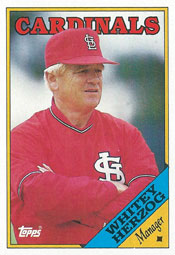
whitey_herzog4Herzog joined the Angels one year after his last season as Cardinals manager. He led the Cardinals to three National League pennants and one World Series title, quitting in midseason with the team mired in last place in July 1990.

Job confusion

In September 1991, Herzog was named senior vice president and director of player personnel of the Angels.

Herzog said he believed he was overseeing the entire Angels baseball operation.

Instead, he found himself in a power struggle.

Dan O’Brien was the Angels’ senior vice president for baseball operations when Herzog was hired.

Herzog thought O’Brien primarily would be his assistant, handling paperwork.

In his book “You’re Missin’ a Great Game,” Herzog said, “I made sure I worked out every detail in advance … I’d be in complete charge of baseball operations: the minor-league system, the hiring and firing of coaches and scouts, the ballclub’s trades and drafts.”

O’Brien thought Herzog primarily would be evaluating players, leaving O’Brien to direct most of the baseball operations, including approval of trades and free-agent signings.

Herzog won the battle _ O’Brien eventually was fired _ but lost the war, resigning before the Angels could become contenders.

Work from home

His friends, Angels owners Gene and Jackie Autry, hired Herzog with the goal of bringing the franchise its first American League pennant and World Series title.

Herzog was given an apartment in Anaheim, but kept his residence in the St. Louis area and did most of his work from that home. He didn’t have an office at the Angels ballpark.

“Whitey doesn’t want to be an office person and he doesn’t have to be,” Angels president Richard Brown told the Los Angeles Times. “My exact words to him were, ‘If I see you in Anaheim in the office, you’re not doing your job.’ He has to be on the road a lot. I’m going to be relying on him constantly to evaluate our young players, and I don’t want him reading scouting reports. I want him evaluating what he saw.”

O’Brien did have an office at the Angels ballpark.

In a March 1992 interview, six months after Herzog was hired, O’Brien told the Los Angeles Times, “You can’t do things in this business in 1992 as you did in 1990 because it’s in a constant state of change. Contracts, more than anything else, keep getting in the way. The talent is probably now one of the easier things to analyze.”

In 1992, Herzog’s first full season with the team, the Angels finished 72-90 and ranked last in the American League in hitting and runs scored.

The next year wasn’t much better. The 1993 Angels finished 71-91. Herzog and O’Brien remained at odds. Bob Nightengale of the Los Angeles Times described the working relationship of the two senior vice presidents as “deteriorated beyond repair.”

O’Brien ouster

In mid-September 1993, Brown convinced the Autrys to fire O’Brien. Bill Bavasi, the Angels’ farm director, was promoted to general manager, reporting to Herzog. Bavasi was to handle administrative duties. Herzog was given the title of vice president in charge of baseball operations and was allowed to continue to work primarily from his suburban St. Louis home.

Wrote Nightengale, “The Herzog-O’Brien conflict was set in motion by the Angels two years ago when they appointed Herzog as vice president in charge of player personnel. Herzog was told that he would be in charge of all baseball operations, but O’Brien carried the title of vice president in charge of baseball operations and never relented in his duties, creating the impression within baseball that no one was in charge.”

Said Angels manager Buck Rodgers: “It was doomed from Day 1 … They are two good baseball men, but it’s hard to succeed when you don’t have one guy in control. You have to have a No. 1 guy.”

(A year later, in a November 1994 interview with Nightengale, O’Brien said he was surprised by his firing. “The thing that I find funny is that people kept saying that Whitey and I never got along,” O’Brien said. “That wasn’t true. I mean, Whitey was never around. He did things his way and I did things my way. All I know is that I was there every day in the office.”)

In his book, Herzog said, “They never told (O’Brien) what my duties were until I’d arrived. He got protective of his job, cut me out of meetings and fought my authority for two years.”

Old-school dropout

With O’Brien gone, Herzog gave an ill-advised multi-year contract to pitcher Joe Magrane, the former Cardinal. (Magrane would have elbow surgery 12 days before spring training began.) Herzog also created a stir by exploring the possibility of acquiring another former Cardinal, outfielder Vince Coleman, who had flopped with the Mets. (It didn’t happen.)

Herzog’s old-school tactics backfired with some players or their agents. He also may have felt restricted by a reduced player payroll. In January 1994, four months after O’Brien was fired, Herzog resigned, stunning the Angels. Bavasi replaced him.

In a blistering column, Mike Penner of the Los Angeles Times opined, “Herzog was baseball’s first absentee general manager _ he ran a ballclub based in Anaheim from his den in St. Louis _ and the best thing he generally managed from there was his leisure time.”

Said Herzog: “I don’t really want to be traveling all over and going back and forth to California or anywhere else.”

Wrote Nightengale, “Herzog was told that the Angels’ budget would have to be slashed to about $19 million, and instead of acquiring players in the free-agent market, he couldn’t even secure his own. He alienated several of his players in negotiations with his brash, sometimes abusive, style. He screamed at starter Mark Langston in a closed-door session. He slammed the phone in reliever Steve Frey’s ear. He bullied agents.”

“He had a great deal of respect and recognition among his peers, but the reality now is that this is a different era, and he hasn’t crossed that bridge,” said Steve Comte, Frey’s agent.

Said Arn Tellem, Langston’s agent: “Whitey’s strengths were finding and evaluating players, but not in the art of diplomacy dealing with lawyers and agents.”

In his book, Herzog took credit for identifying Angels minor leaguers Garret Anderson, Tim Salmon, Jim Edmonds and Gary DiSarcina as prospects and for preparing them to advance to the majors.

Said Herzog, “When I finally handed the reins over to Billy Bavasi in ’94 _ I’d been grooming him to replace me _ he said, ‘Man, you’re leaving at the wrong time. You’re the guy who put this together and it’s ready to blossom.’ I knew it was, but I didn’t need any credit.”
Read Full Post »

In 35 years as a major-league manager, Tony La Russa was fired once. The White Sox replaced him with Jim Fregosi.

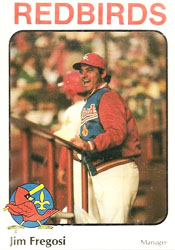
jim_fregosiFregosi managed the Cardinals’ Class AAA club at Louisville from 1983 until he replaced La Russa as White Sox manager in June 1986. Among the prospects managed by Fregosi at Louisville were Vince Coleman, Danny Cox, Ken Dayley, Ricky Horton, Tito Landrum, Greg Mathews, Jose Oquendo, Terry Pendleton, Andy Van Slyke and Todd Worrell. Seventeen of the players on the 1985 National League championship Cardinals club played for Fregosi at Louisville.

Path to the majors

An all-star shortstop for the Angels in the 1960s, Fregosi managed the Angels from 1978-81, leading them to their first division title in 1979, before he was fired and replaced by Gene Mauch. After sitting out the 1982 season while running a food brokerage business, Fregosi became Louisville manager in 1983. Lee Thomas, the Cardinals’ director of player development, had been an Angels teammate of Fregosi and was instrumental in bringing him into the St. Louis organization.

Louisville won back-to-back American Association championships (1984-85) under Fregosi, but with Whitey Herzog entrenched as Cardinals manager Fregosi’s best hope of managing again in the major leagues was with another organization. The Mariners contacted him, but Fregosi wanted an opportunity with a franchise prepared to win.

In June 1986, White Sox general manager Ken “Hawk” Harrelson fired La Russa and pitching coach Dave Duncan. The White Sox were 26-38 and Harrelson had been clashing with La Russa and Duncan. “The record is not indicative of the talent involved,” Harrelson told the Chicago Sun-Times.

Fregosi was Harrelson’s first choice. Harrelson had sent scouts to Louisville and their reports on Fregosi were glowing, the Sun-Times reported.

Tireless teacher

Here is what others said about Fregosi’s work in the Cardinals system:

_ Rick Bozich, columnist, Louisville Courier-Journal: “When you roll the highlights films of what Fregosi has accomplished in Louisville, the two American Association championships won’t even make the top 10. No, the lingering images will be of the consistently long hours he worked developing the young players who carried the St. Louis Cardinals to the 1985 National League pennant and the wonderfully tranquil clubhouses he presided over. There was never a reason to check Fregosi’s time card. He reported to Cardinal Stadium at 2 every afternoon. One day he’d be in the cage convincing Vince Coleman he could make millions chopping down on the ball; the next day you could find him in the bullpen tinkering with Todd Worrell’s fastball grip.”

_ Mo Mozzali, Cardinals scout: “As fantastic as Jimmy has been for baseball in Louisville, he’s done even more for the players in the Cardinals organization. I’ve never seen anybody better working with young players.”

_ Dyar Miller, Louisville pitching coach: “Jim is a great teacher. He works on the field for three or four hours before every game, on theories of hitting, turning the double play, getting ready to pitch in the bullpen, whatever.”

_ Tony La Russa to the Sun-Times after learning Fregosi had replaced him: “When Jim Fregosi was in this league (as Angels manager), I thought he did an outstanding job. He’s been ready to manage in the big leagues for several years.”

Tales from Tony

White Sox owner Jerry Reinsdorf said La Russa told him, “If you have to fire me, hire Jim (Fregosi) or Jim Leyland … Fregosi is a good manager. I like him.”

La Russa went to the Athletics and won three American League pennants and a World Series title before joining the Cardinals. La Russa won two World Series titles and three National League pennants with the Cardinals and was elected to the National Baseball Hall of Fame.

Fregosi managed the White Sox from 1986-88 before stints as manager of the Phillies (1991-96) and Blue Jays (1999-2000). He won a National League pennant with the 1993 Phillies.

In 1996, La Russa’s first season as Cardinals manager, he was asked by the St. Louis Post-Dispatch about Fregosi during a series with the Phillies. La Russa replied, “The old line had me asking, ‘What does Fregosi have that I don’t have?’ The answer was, ‘Your job.’ “

Read Full Post »

Desperate for revenue and suspicious of new technology, the Cardinals joined the Browns in banning radio broadcasts of their games.

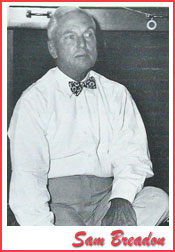
sam_breadon2On Feb. 3, 1934, the National League Cardinals and American League Browns declared that radio broadcasts were having a negative impact on attendance at their games at Sportsman’s Park in St. Louis.

In 1933, with America reeling from the Great Depression, the Cardinals drew 256,171 in 77 home games, even though they had a winning record (82-71) and were just two years removed from a World Series championship. It was their lowest home attendance since moving to Sportsman’s Park from Robison Field in 1920.

The 1933 Browns, a last-place finisher at 55-96, attracted 88,113 in 77 home games.

Radio broadcasts of Cardinals and Browns games had been carried since 1926, five years after the first broadcast of a major-league game, the Phillies vs. the Pirates, on Pittsburgh station KDKA in 1921.

Under the headline “St. Louis Clubs Sign Off on Radio,” The Sporting News reported in its Feb. 8, 1934, edition that “this decision was reached with dramatic suddenness by Sam Breadon, president of the Cardinals, and Louis B. von Weise, who holds a similar title with the Browns.”

“There, no doubt, was a time when the microphones did us some good,” Breadon said. “That was in the high times. But now we are at a point where we are willing to experiment a season without the mikes.”

Strong reactions

St. Louis radio executives were stunned and disappointed.

“We feel that it was a service the public appreciated and that radiocasting of the games helps more than it damages attendance,” said Jack Van Valkenburg, president of KMOX.

Added Thomas Patrick Convey of St. Louis station KWK: “Nobody has worked harder than myself to try to get people out to the ballpark.”

In an editorial, The Sporting News supported the right of the St. Louis clubs to choose whether to permit radio broadcasts of games. “Like other sports, baseball long has been in doubt as to the value of broadcasts,” The Sporting News wrote. “… The opinion has been growing stronger within the past two years that, whatever good the radio may have done the game in the past, conditions now have changed and its tendency to cause the fan to sit in front of the loudspeaker instead of in the stands is beginning to outweigh all its advantages.”

Most of the mail Breadon received in reaction to the decision opposed the radio ban.

Business and marketing

Breadon, a native New Yorker, may have been influenced by the decisions of all three New York clubs _ the American League Yankees and the National League Dodgers and Giants _ to ban radio broadcasts of their games.

Teams in Boston, Chicago, Cincinnati and Detroit were continuing game broadcasts. Walgreens paid Chicago radio station WGN $45,000 to sponsor game broadcasts for the 1934 season, The Sporting News reported.

Radio magnate Powel Crosley had purchased the Reds, with the notion of using radio to promote his team and using the broadcasts as an advertising revenue generator for his stations.

Without the broadcasts, home attendance of the Cardinals and Browns increased in 1934. The Cardinals, who won the National League pennant and World Series championship that year, drew 325,056 in 77 home games, an increase of almost 70,000. The Browns, who placed sixth at 67-85 in 1934, attracted 115,305, a spike of 27,000.

In 1935, the broadcasts of Cardinals and Browns games were restored. The business models in Chicago and Cincinnati may have convinced the St. Louis clubs to end the ban.

Capitalizing on their status as reigning World Series champions, Cardinals home attendance jumped to 506,084 in 1935. The Browns, who fell back to seventh place in 1935, drew 80,922 to 76 home games that year, including 300 to a Friday afternoon game on May 10 against the Athletics. Boxscore

Read Full Post »

(Updated Oct. 23, 2020)

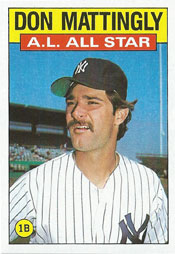
If general manager Dal Maxvill had been willing to part with pitcher Joe Magrane, Don Mattingly might have been a first baseman for the Cardinals instead of spending his entire playing career with the Yankees.

don_mattinglyIn 1988, Mattingly was feuding publicly with Yankees owner George Steinbrenner. That fueled media speculation the Yankees were willing to trade Mattingly, who expressed interest in the Cardinals because of the proximity of St. Louis to his hometown of Evansville, Ind.

“Growing up in Evansville, I was a fan of the St. Louis Cardinals,” Mattingly told the New York Daily News.

The Cardinals admitted interest in pursuing a deal. Media reports suggested the Yankees would want shortstop Ozzie Smith or center fielder Willie McGee in return, but the player New York apparently wanted most was Magrane, who at the time was St. Louis’ prized pitching phenom.

No respect

In August 1988, Mattingly, 27, was a five-time all-star who had earned an American League Most Valuable Player Award, one batting title and three Gold Glove awards, but he became disgruntled with the way he believed Steinbrenner was treating Yankees players.

“The players get no respect around here,” Mattingly said to the Associated Press. “They (management) give you money, that’s it. Not respect. Money is not respect.”

Reports spread quickly that an angry Steinbrenner intended to trade Mattingly. The Cardinals, who had just acquired first baseman Pedro Guerrero from the Dodgers, were willing to move Guerrero to left field and open the job at first base for Mattingly.

“I see where Mattingly wants to go to St. Louis,” Cardinals manager Whitey Herzog said to the St. Louis Post-Dispatch. “That takes care of us. Steinbrenner sure wouldn’t trade him where he wants to go. You know what I mean? He’d say, ‘I’ll show him. I’ll trade him to Seattle.’ ”

Still, baseball writers produced a stream of reports that speculated on a deal between the Yankees and Cardinals.

On Sept. 4, 1988, Rick Hummel of the Post-Dispatch wrote, “The Cardinals have some players in which the Yankees would seem interested. Certainly the Yankees would want a starting pitcher. Joe Magrane probably is unavailable. But Greg Mathews, if he shows he has recovered from elbow surgery, might be.”

Hummel suggested several possible packages to land Mattingly, including Mathews, McGee and catcher Tony Pena, or Mathews and Ozzie Smith.

About a month later, under the Post-Dispatch headline, “Maxvill Says He’ll Pursue Mattingly,” the general manager told Hummel, “I definitely want to talk to them.”

Wizard a Yankee?

Two days later, in a column that rocked Cardinals Nation, Tom Wheatley of the Post-Dispatch opined, “Ozzie Smith must go. And if the Wizard of Oz can be used as bait to land a whopper such as Don Mattingly, all the better.”

Maxvill said he made more inquiries about acquiring Mattingly, but he told Hummel, ‘I don’t think they’re interested in moving him as much as everybody thinks. That’s what I thought before and it’s been reinforced to me.”

Just when it appeared the possibility of a trade had waned, Murray Chass of the New York Times, citing an anonymous American League club executive, reported the Cardinals, Cubs, Padres or Giants were close to making a deal for Mattingly.

Wrote Chass: “If the Cardinals, for example, were really serious about the pursuit of Mattingly, they would have to offer the Yankees Joe Magrane … The Cardinals, however, will not offer Magrane; therefore, no deal.”

Magrane, 24, was the National League earned-run average leader (2.18) in 1988, his second season with St. Louis.

In December 1988, the Post-Dispatch reported why a deal for Mattingly appeared dead: “Maxvill said the New York Yankees never had asked seriously about acquiring (Ozzie) Smith in a Don Mattingly deal. Pitcher Joe Magrane’s name, on the other hand, did come up in discussions with the Yankees. But Maxvill said the Cardinals would be highly reluctant to part with him.”

Magrane achieved a career-high 18 wins for the 1989 Cardinals. Mattingly stayed with the Yankees and completed his 14-season big-league career with them in 1995. He finished with a .307 career batting mark and 2,153 hits.

Read Full Post »

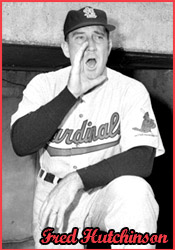
Ignoring the recommendation of general manager Bing Devine, Cardinals owner Gussie Busch ordered the firing of manager Fred Hutchinson.

fred_hutchinsonAt the press conference on Sept. 17, 1958, a distraught Devine spoke so glowingly about Hutchinson that the reporters there said it seemed like the manager was being hired, not fired.

Hutchinson had managed the 1957 Cardinals to an 87-67 record and second-place finish in the National League. Based on that performance, Busch was expecting the Cardinals to contend for a pennant in 1958.

However, the 1958 Cardinals lost 14 of their first 17 games. Lacking both power and run production, the Cardinals entered September in the second division of the eight-team league.

Busch wanted a change. Devine, in his first season as St. Louis general manager, wanted to keep Hutchinson and shake up the coaching staff instead.

Dick Meyer, an aide to Busch, called Devine and instructed him to prepare a report on his recommendations for the team. Devine was given a date and time to meet with Busch and Meyer and present the report.

Done deal

In his book “The Memoirs of Bing Devine,” Devine told writer Tom Wheatley, “So I wrote my report and I spent a lot of time on it … When we had our meeting, I handed the report to Mr. Busch. It featured rehiring Fred Hutchinson.

“Mr. Busch took the report and put it on his desk. He didn’t read it. He didn’t even open it.”

Instead, Busch told Devine, “We’re going to get rid of Fred Hutchinson. And you don’t need to think about replacing him because I already have the manager: Solly Hemus.”

Said Devine: “I was kind of hurt by the whole process of firing Hutchinson and hiring Hemus … I had made what I thought was a thorough report and the determination was made for me without my views being considered.”

On Sept. 13, Devine informed Hutchinson he would be fired during the last week of the season. When word leaked and reports appeared in the press, the Cardinals moved up the date of the dismissal, calling the press conference for Sept. 17.

Hearts and flowers

The Associated Press described Devine as “grim-faced” as he announced Hutchinson and his coaching staff were fired. (Coach Stan Hack agreed to remain as interim manager for the final 10 games.) Hutchinson, who attended the press conference, “appeared in good spirits,” the Associated Press reported.

Devine told The Sporting News, “We have no direct criticism and this is most difficult when it’s a man like Hutch, who gave us full effort, was most cooperative and 100 percent in giving young players a chance.”

According to United Press International, “It appeared clear Hutch was the victim of baseball’s strange logic: If the bus breaks down, fire the driver.”

The Cardinals, who were 69-75 when Hutchinson was fired, finished 72-82 and tied for fifth. They were last in the National League in runs (619), RBI (570) and home runs (111) and committed 151 errors, second-most in the league.

“It’s apparent the club has to score more than it did this year,” Hutchinson said. “It’s a good 50 runs behind the second-poorest offensive club in the league. Both the pitching and defense have to be steadier, too.”

Hutchinson was 232-220 in three years (1956-58) as Cardinals manager. Three years after his firing, he managed the Reds to the 1961 pennant. Hemus, a former Cardinals infielder, went 190-192 as St. Louis manager before he was fired in July 1961 and replaced by one of his coaches, Johnny Keane.

Read Full Post »

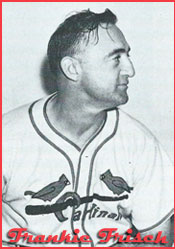
In September 1938, the relationship between Cardinals manager Frankie Frisch and executive Branch Rickey had become irreparable.

frankie_frisch2Cardinals owner Sam Breadon liked and respected Frisch, but he determined he couldn’t afford to lose Rickey.

On Sept. 11, 1938, Breadon reluctantly fired Frisch.

Frisch had been a Hall of Fame-caliber second baseman for the Cardinals and was Breadon’s favorite player. In 1933, Frisch became the Cardinals’ player-manager, replacing Gabby Street, and led them to a World Series championship the following year. The Cardinals contended in 1935 and 1936, finishing second in the National League both years.

Aggressive and feisty, Frisch managed the Cardinals’ rough-and-tumble Gashouse Gang clubs that featured colorful characters such as Dizzy Dean, Pepper Martin, Joe Medwick, Rip Collins and Leo Durocher.

Frisch was Breadon’s guy more than he was Rickey’s and he and Rickey clashed. Rickey, for instance, wanted Frisch to move center fielder Terry Moore to third base.

At a Chamber of Commerce luncheon at St. Louis in April 1938, Rickey put the heat on Frisch, telling the audience, “Except for pitching, this is the greatest ballclub the Cardinals ever had.”

Instead, the Cardinals were in sixth place in September 1938 and speculation grew Frisch wouldn’t be brought back in 1939.

Don Gutteridge, third baseman for the 1938 Cardinals, told author Peter Golenbock for the book “The Spirit of St. Louis” that “during the latter part of the season all of us were thinking Frankie might get fired …My guess is that Frisch wanted to play certain players and Rickey wanted him to play somebody else.”

Showdown with Breadon

After Labor Day, Frisch went to Breadon, seeking to learn whether he had the owner’s support. “I have the greatest admiration for the old man (Breadon),” Frisch told The Sporting News. “He’s been swell to me right along and we never had a cross word, but I had heard reports a new manager was to be brought in for 1939 and on Sept. 9 I decided to find out where I stood.

“I told the old man that if he was planning a change I would like to be free now so that I could get lined up with some other club. Breadon said he would give me his answer Sunday (Sept. 11). You know the rest.”

According to multiple published reports, Breadon told Frisch he would have to accept a pay cut if he wanted to return in 1939. When Frisch and Breadon were unable to agree on salary terms, Breadon told Frisch before the Pirates-Cardinals game at Sportsman’s Park on Sept. 11 that the manager would be replaced.

In a Page 1 article headlined “Sam Breadon Fires Frisch to Keep Peace With Rickey,” The Sporting News reported that Clarence “Pants” Rowland, a representative of Cubs owner P.K. Wrigley, had met three times with Rickey. Rowland, acting on instructions from Wrigley, offered Rickey either the job of president or general manager of the Cubs, The Sporting News surmised.

Breadon figured it was easier to replace a manager than it was to find a substitute for Rickey, but he didn’t like making the move.

As Frisch prepared to leave the ballpark after his termination, Breadon “put his arms around Frankie, bade him goodbye and there was mist in his eyes when he turned quickly and hustled out of the room,” The Sporting News reported.

“A good manager”

“I do not blame (Frisch) for the position of the club this year,” Breadon told The Sporting News. “He has not done anything we can find fault with and he has been a good manager.”

(In six seasons as Cardinals manager, Frisch had a record of 458-354, a .564 winning percentage.)

Rickey remained in the background and didn’t talk with reporters about Frisch’s departure. Frisch declined to discuss his strained relationship with Rickey.

“I leave St. Louis with the best of feeling toward the club officials, players and fans,” Frisch said. “… You know how it is _ a manager’s welcome often wears out with the front office.”

Wrote Jack Cuddy of The Pittsburgh Press: “When (Frisch) received his walking papers from president Sam Breadon and marched into the dressing room during Sunday’s game at St. Louis, the Gashouse Gang died a sudden death. His dismissal meant the final triumph of Branch Rickey in a long-standing feud. Rickey … always has been opposed to the hell-for-leather philosophies of the Gas House Gang on or off the field.”

Mike Gonzalez, the Cardinals’ Cuban-born coach, took over as manager for the rest of the 1938 season. Rickey selected Ray Blades, manager of the Cardinals’ Rochester farm club, to manage St. Louis in 1939.

Frisch was part of the Braves’ radio broadcast team in 1939 and became manager of the Pirates in 1940.

Previously: Why Cardinals dealt Dizzy Dean to Cubs 75 years ago

Read Full Post »

« Newer Posts - Older Posts »