Feeds:
Posts
Comments

Archive for the ‘Executives’ Category

(Updated Aug. 14, 2026)

With the Cardinals in need of a public relations boost, Stan Musial went to bat for Red Schoendienst.

red_schoendienst8As usual, Musial delivered.

On Oct. 20, 1964, the Cardinals hired the popular Schoendienst to replace Johnny Keane as their manager. Four days earlier, Keane stunned the Cardinals by resigning less than 24 hours after leading St. Louis to a World Series championship.

Schoendienst, 41, a former second baseman who was a coach on Keane’s staff, had no managerial experience. “I never had really thought about managing,” Schoendienst said in his book “Red: A Baseball Life.”

According to broadcaster Harry Caray, in his book “Holy Cow,” the Cardinals had told Schoendienst that summer they wanted him to get experience managing in the minor leagues. Schoendienst said he told the Cardinals he had no desire to manage and would prefer to remain a major league coach for the next 25 years.

Fan favorite

Keane quit because Cardinals owner Gussie Busch fired general manager Bing Devine in August and plotted to replace Keane with former St. Louis shortstop Leo Durocher after the season. Even though Busch changed his mind about firing Keane after the Cardinals rallied to win the National League pennant and World Series crown, Keane refused to stay. His surprise departure triggered a firestorm of criticism against Busch and general manager Bob Howsam.

Desperate to repair the damage, Busch ordered Howsam to fire consultant Branch Rickey, who had advocated for Devine’s dismissal, and he formed a six-person executive committee to seek a replacement for Keane.

Musial, in his first year as Cardinals vice president after a stellar playing career, and Howsam were the key members of the committee. Joining them were Busch, club executive Dick Meyer and Cardinals board of directors members Jim Conzelman and Mark Eagleton (father of future U.S. Senator Thomas Eagleton).

According to multiple sources, Howsam favored hiring either White Sox scout Charlie Metro, who had managed for Howsam in the minor leagues at Denver, or former Giants manager Alvin Dark, a one-time Cardinals shortstop.

Musial advocated for Schoendienst, who was Musial’s friend and road roommate during their playing days together for St. Louis.

In the book “The Man Stan Musial Then and Now,” Musial said of Schoendienst, “He knew the game and had the field foreman’s greatest virtue _ patience.”

Asked whether nice-guy Schoendienst was tough enough for the job, Musial told Bob Burnes of the St. Louis Globe-Democrat, “That would be one of the least of my worries about Red. He’s down to earth about baseball. He knows how the game is played. He knows what he wants and he can say so. He won’t have any problems with discipline.”

Said Schoendienst: “With Musial leading my support, it came down to as much a public relations decision as a baseball one and that’s where I had the advantage … The prevailing thought was the new manager needed to be someone who was a favorite of the fans.”

Quick decision

Schoendienst got tipped off by a Busch relative, Ollie Von Gontard, that the committee was considering him as a serious candidate. Harry Caray told Schoendienst, “Red, if you keep your nose clean with all the craziness that’s going on here, you’re going to wind up being manager of this club.”

Schoendienst said Busch called and asked to meet at the ballpark. Schoendienst said he met with Busch and Howsam. After Howsam quizzed Schoendienst about game strategies and player personnel evaluations, Schoendienst said the general manager “suddenly jumped up from his chair and asked how I would like to manage. I said that would be great and he said, ‘You’re my new manager.’ It happened so quickly I really didn’t have time to think about it.”

Said Schoendienst: “I felt comfortable that I could do the job and was ready to put my full-time energy and devotion into the post.”

Take my advice

Ed Spiezio, a Cardinals infielder, told Larry Harnly of The Journal-Register of Springfield, Ill., he didn’t expect Schoendienst to be elevated from coach to manager. “It really surprised me when they named Schoendienst manager,” Spiezio said. “… I never thought of him being the manager. He was so close to all the guys. Then all of a sudden he’s the manager.”

Cardinals players, who respected and supported Keane, were tolerant of Schoendienst, who avoided micro-managing while learning on the job.

In his book “Stranger to the Game,” pitcher Bob Gibson said, “The only problem I had with Schoendienst was that he wasn’t Johnny Keane, but he was a good man and a good man for us … Schoendienst, like Keane, respected our intelligence and our professionalism. His only rules were ‘Run everything out’ and ‘Be in by 12.’ Somehow, we got the words tangled up and lived instead by the motto ‘Run everything in and be out by 12.’ ”

Schoendienst said to the Globe-Democrat, “Managers don’t make rules on major league clubs. The players do. If the players show that they need to have a lot of regulations, I’ll issue those regulations. From what I’ve seen, though, most players don’t need a lot of tough regulations.”

Schoendienst also listened to his players. Said Gibson: “Red was uncertain of himself in the beginning, a fact which the ballplayers were well aware.”

Gibson said he and catcher Tim McCarver would sit on either side of Schoendienst in the dugout and offer suggestions to one another about game strategy. “We never actually told him to make a move; we were just there as birdies in the ear, now and then providing information he needed to make his decision,” Gibson said.

Center fielder Curt Flood, in his book “The Way It Is,” said of Schoendienst, “When he was required to think two or three moves ahead, as in choosing pinch-hitters or replacing pitchers, he accepted advice readily. It was given matter-of-factly, with every consideration for Red’s position.”

In the book “Few and Chosen,” McCarver said, “Red is one of the nicest people in the world, and that’s how he was as a manager. He was like a member of the family … and his approach to managing was fatherly or avuncular.”

The Cardinals finished seventh and sixth in Schoendienst’s first two years as manager, then won two consecutive pennants and a World Series title. He managed the Cardinals from 1965-76 and for parts of 1980 and 1990. His 1,041 wins rank second to Tony La Russa (1,408 wins) among Cardinals managers.


Read Full Post »

(Updated Oct. 20, 2018)

Gussie Busch broke Johnny Keane’s cardinal rule and Keane couldn’t forgive him.

johnny_keane2On Oct. 16, 1964, just 19 hours after the Cardinals won the World Series championship, Keane resigned as manager, stunning Busch, the club owner, who had expected to sign Keane to a contract extension that day.

Loyalty was sacrosanct to Keane. He had been loyal to the Cardinals, serving the franchise for 35 years. When Busch became disloyal to him, Keane’s personal code of conduct required he take action: He quit.

Surprising news

In the celebration that immediately followed the Cardinals’ World Series Game 7 victory over the Yankees on Oct. 15, Busch announced he would hold a news conference at the Anheuser-Busch brewery the next morning. Busch intended to present Keane with a three-year contract extension for $50,000 per year.

When Keane arrived at the brewery, he handed Busch a resignation letter 30 minutes before the news conference. Busch, in a hurry to begin the event, gave the letter to an assistant without reading it, according to the book “October 1964.” The assistant read the letter and insisted the owner do the same.

Flanked by Keane and general manager Bob Howsam, Busch, visibly shaken, announced Keane’s resignation to the surprised gathering, who were expecting a contract signing.

“This really has shocked me,” Busch said. “I didn’t know a thing about it until I saw Johnny this morning. All I can say is that I’m damned sorry to lose Johnny.”

Said Keane: “I told Mr. Busch not to make any offer. I handed him my resignation and said my decision was firm _ that I didn’t want to embarrass him _ but that no offer would be acceptable.”

In his book “Uppity,” Cardinals first baseman Bill White said, “I wasn’t there, but I was told Busch and Howsam looked as if Johnny had just kicked them in the teeth _ which, in effect, he had.”

The resignation letter was dated Sept. 28 _ the day after the Cardinals had completed a five-game sweep of the Pirates, with six games remaining in the regular season.

The decision had been made 10 days before then.

Higher calling

Keane, a St. Louis native, briefly studied for the priesthood at St. Louis Prepatory Seminary. At 18, he signed a Cardinals contract and was assigned to the minor leagues.

“I’ve been asked about that often,” Keane told The Sporting News. “Did I give up the priesthood for baseball? The answer is no. I knew after consultation with the priests at the seminary that the life was not for me.”

Keane was a baseball lifer. More specifically, a Cardinals lifer, or so it seemed.

He was an infielder in the St. Louis organization from 1930 until becoming a Cardinals minor league player-manager in 1938. He spent 21 seasons as a manager in the St. Louis farm system and had winning records in 17 of those years.

In 1959, Keane made it to the major leagues for the first time as a coach on the staff of Cardinals manager Solly Hemus. Keane replaced Hemus as St. Louis manager in July 1961.

Matter of principle

In August 1964, Busch, thinking the fifth-place Cardinals were out of contention, fired general manager Bing Devine and business manager Art Routzong. Both were friends of Keane.

Though Keane remained manager, published reports indicated Busch planned to replace Keane after the season with Dodgers coach and former Cardinals shortstop Leo Durocher. In his book “Nice Guys Finish Last,” Durocher said he and Busch met in St. Louis at the end of August and Busch told him he would become Cardinals manager after the season.

Keane felt betrayed.

In early September 1964, Yankees general manager Ralph Houk and club president Dan Topping decided to fire manager Yogi Berra but wanted to wait until after the season to tell him. Their top two candidates to replace Berra were Keane and Giants manager Al Dark. Houk and Topping sought and received permission from Busch and Giants owner Horace Stoneham to talk with Keane and Dark and had a “trusted emissary” conduct “a number of conversations with both in the ensuing weeks,” the Associated Press later reported.

Keane later told the St. Louis Post-Dispatch he hadn’t been in contact with Yankees officials before his resignation, but “other people, not the Yankees management, told me the Yankees were interested in me” as early as Sept. 22.

On Sept. 18, with the Cardinals 6.5 games behind the first-place Phillies, Keane and his wife privately agreed Keane would resign after the Cardinals’ final game, regardless of his job status.

On Sept. 25, Houk and Topping decided they’d hire Keane, according to the Associated Press. Three days later, on Sept. 28, Keane wrote and dated his resignation letter and put it aside.

Hold that letter

The Cardinals won four of their final six games, including a sweep of the Phillies, and clinched the pennant on the last day of the regular season.

The late-season surge prompted Busch to change course and he frantically tried to get Keane to accept a contract extension to remain Cardinals manager. On Oct. 2, with three games left in the regular season, Busch met Keane in the clubhouse and offered “a new contract at a substantial pay increase,” but Keane said he preferred to wait until after the World Series to discuss a contract offer, the Post-Dispatch reported.

On Oct. 4, after the Cardinals clinched the pennant that day with a win against the Mets, Busch approached Keane at the team party and offered him “whatever you want,” but Keane again said he wouldn’t talk terms until after the World Series, according to the Post-Dispatch.

In the World Series, the Cardinals won four of seven against the Yankees, clinching their first title in 18 years.

At the news conference the next day, Keane told reporters a series of “little things” led to his resignation. Pressed for details, Keane admitted Devine’s firing and Busch’s open flirtation with Durocher were factors that caused him to depart.

Devine and Keane became friends in 1949 when Devine was general manager of the Cardinals’ minor league club at Rochester and Keane was the manager.

In his book “The Memoirs of Bing Devine,” Devine said, “As a person, Keane impressed me as Stan Musial did … I’m talking about basic traits as a person.

“I didn’t think he needed to _ or should have _ quit the Cardinals because of me. But Johnny Keane was a loyal guy _ and that’s how he felt.”

Most Cardinals players said Keane’s resignation surprised them, but pitcher Roger Craig told United Press International he had predicted Keane’s decision in August when it became known Busch wanted Durocher as manager. “Knowing the pride he has,” Craig said of Keane, “I knew this would happen.”

In his book “Stranger to the Game,” pitcher Bob Gibson said, “My anger toward the ballclub _ and it was tangible _ stemmed largely from the needless nature of Keane’s departure … I stayed mad through the winter.”

Hours after Keane’s resignation became public, the Yankees fired Berra. Three days later, on Oct. 19, Houk met with Keane to discuss the job and the next day, Oct. 20, 1964, Keane was hired to replace Berra.


Read Full Post »

Blinded by impatience, insecurity and inability to quell internal politics, Cardinals owner Gussie Busch ousted the general manager who built the team that two months later would win the franchise’s first World Series title in 18 years.

bing_devineOn Aug. 17, 1964, Busch fired general manager Bing Devine.

“It was a travesty,” St. Louis journalist Bob Broeg wrote in recalling the firing 40 years later. “A lot of the players on the team felt the same way.”

Trades engineered by Devine brought to the Cardinals core players on the championship club. They included outfielders Lou Brock and Curt Flood, infielders Bill White, Julian Javier and Dick Groat and pitchers Curt Simmons, Roger Craig, Ron Taylor and Barney Schultz.

Under Devine’s leadership, the minor-league system also developed essential Cardinals such as pitchers Bob Gibson, Ray Sadecki and Ray Washburn as well as outfielder Mike Shannon and catcher Tim McCarver. In the pipeline were prospects such as pitchers Steve Carlton and Nelson Briles.

Busch became convinced in August 1964 the Cardinals needed to dump Devine (and replace manager Johnny Keane with Leo Durocher after the regular season) in order to produce a champion.

The Cardinals were 62-55, nine behind the first-place Phillies, in the National League when Busch fired Devine. From there, the Cardinals went 31-14, finishing in first place at 93-69, one game ahead of both the Reds and Phillies.

In his book “October 1964,” author David Halberstam wrote, “Devine went quietly. It was something he had always expected. He had been dealing for the last seven years from a position of limited strength and the pressure to produce a winner had grown every year. Life under as volatile a man as Gussie Busch was like living on a precipice, he thought.”

The three key reasons why Busch fired Devine:

Impatience

The Cardinals hadn’t won a pennant since Busch took control of the club in February 1953. Devine had been general manager since replacing Frank Lane in November 1957.

After the Cardinals placed second in 1963, Busch had high expectations for the following year. His frustration reached a boiling point in August 1964.

“I have been worried about the Cardinals for a long time,” Busch said to The Sporting News after firing Devine. “The club has not been making any progress.”

In his book “The Memoirs of Bing Devine,” Devine said, “There’s no question in my mind I got fired because Mr. Busch was frustrated. He’d always had success with Anheuser-Busch. He’d owned the Cardinals for 10 years and he was tired of not succeeding in this other business.”

Insecurity

A mid-season incident involving Groat hurt Devine’s relationship with Busch.

Keane had given Groat approval to call for the hit-and-run play when he saw an opportunity to execute it. Groat handled the bat well, but, in Keane’s view, Groat abused the privilege.

When Keane banned Groat from calling the hit-and-run, Groat groused openly and often. Devine learned of Groat’s unhappiness and told Keane to conduct a team meeting and confront Groat. Keane did and the matter was resolved when Groat apologized to Keane and the team and stopped his complaining.

Devine didn’t inform Busch of the incident because he viewed such squabbles as commonplace in clubhouses. Besides, the problem wasn’t lingering.

Braves third baseman Eddie Mathews, though, was friendly with Groat and heard of Groat’s initial unhappiness. Mathews was dating Busch’s daughter, Elizabeth, and told her of the conflict. She, in turn, told her father.

Busch was angry Devine hadn’t informed him. He became suspicious, wondering what else Devine wasn’t telling him.

“Busch was upset and that may have affected his thinking about me,” Devine said.

According to Halberstam, Busch “was more than a little paranoid anyway; it seemed to go with the territory with a man who had so much power in, but knew so little about, the high-profile business of baseball.”

Internal politics

Busch had hired Branch Rickey, the former longtime Cardinals general manager, as a consultant. Rickey, 82, and Devine clashed. Rickey meddled and criticized Devine in talks with Busch.

Rickey had built the Cardinals’ minor-league system in the 1920s and his influence was evident in remarks Busch made after Devine was fired.

“I am concerned that we cannot trade our way to a pennant,” Busch said to The Sporting News in August 1964. “We must depend on production out of our own system and I have been disappointed with the operation of our farm department. There just seems to be a gap someplace between the signing of players, their development and their progress to the Cardinals as men ready to do a major league job.”

Busch insisted Rickey didn’t trigger his decision to fire Devine. “Rickey had nothing to do with it,” he said. “I did not consult him until I’d made up my mind.”

Few bought that explanation. “He (Rickey) was undercutting Bing,” wrote Broeg. “We all knew that.”

Wrote Halberstam, “Rickey gradually increased the tempo of his drive against Devine … The veteran players, who liked Devine, and who did not think the team needed two general managers, were not amused. They knew that the more senior they were, the more likely Rickey was to get rid of them at the end of the season.”

In his book “Stranger to the Game,” Gibson said, “The players were hurt by Devine’s firing, but we decided that instead of packing it in for the year, we would dedicate ourselves to redeeming Devine with a strong finish.”

According to the book “The Spirit of St. Louis,” Busch asked broadcaster Harry Caray to become general manager. Caray declined and suggested Busch hire former St. Louis Browns owner Bill Veeck, but Veeck demanded a controlling interest of the stock in the Cardinals.

On Rickey’s suggestion, Bob Howsam, who had joined Rickey in a failed bid to start a third major league, the Continental League, was named general manager.

“Howsam did nothing to win the pennant after he became GM,” Broeg wrote. “He led the league in cheers.”

After the Cardinals won the World Series title, beating the Yankees in four of seven games, Keane resigned, rather than accept a contract extension, in protest of Devine’s dismissal. Keane accepted an offer to manage the Yankees.

Humiliated, Busch ordered Howsam to fire Rickey, and he did so.

Devine joined the Mets front office.

Howsam lasted with the Cardinals for two years, then went to the Reds. Stan Musial replaced him.

When Musial resigned in triumph after the Cardinals won the 1967 World Series title, Devine was rehired by Busch to be the Cardinals general manager.

Read Full Post »

(Updated May 2, 2023)

After managing the Cardinals, Whitey Herzog decided to extend his baseball career as an executive with the Angels.
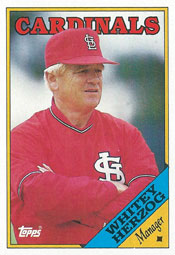
whitey_herzog4Herzog joined the Angels one year after his last season as Cardinals manager. He led the Cardinals to three National League pennants and one World Series title, quitting in midseason with the team mired in last place in July 1990.

Job confusion

In September 1991, Herzog was named senior vice president and director of player personnel of the Angels.

Herzog said he believed he was overseeing the entire Angels baseball operation.

Instead, he found himself in a power struggle.

Dan O’Brien was the Angels’ senior vice president for baseball operations when Herzog was hired.

Herzog thought O’Brien primarily would be his assistant, handling paperwork.

In his book “You’re Missin’ a Great Game,” Herzog said, “I made sure I worked out every detail in advance … I’d be in complete charge of baseball operations: the minor-league system, the hiring and firing of coaches and scouts, the ballclub’s trades and drafts.”

O’Brien thought Herzog primarily would be evaluating players, leaving O’Brien to direct most of the baseball operations, including approval of trades and free-agent signings.

Herzog won the battle _ O’Brien eventually was fired _ but lost the war, resigning before the Angels could become contenders.

Work from home

His friends, Angels owners Gene and Jackie Autry, hired Herzog with the goal of bringing the franchise its first American League pennant and World Series title.

Herzog was given an apartment in Anaheim, but kept his residence in the St. Louis area and did most of his work from that home. He didn’t have an office at the Angels ballpark.

“Whitey doesn’t want to be an office person and he doesn’t have to be,” Angels president Richard Brown told the Los Angeles Times. “My exact words to him were, ‘If I see you in Anaheim in the office, you’re not doing your job.’ He has to be on the road a lot. I’m going to be relying on him constantly to evaluate our young players, and I don’t want him reading scouting reports. I want him evaluating what he saw.”

O’Brien did have an office at the Angels ballpark.

In a March 1992 interview, six months after Herzog was hired, O’Brien told the Los Angeles Times, “You can’t do things in this business in 1992 as you did in 1990 because it’s in a constant state of change. Contracts, more than anything else, keep getting in the way. The talent is probably now one of the easier things to analyze.”

In 1992, Herzog’s first full season with the team, the Angels finished 72-90 and ranked last in the American League in hitting and runs scored.

The next year wasn’t much better. The 1993 Angels finished 71-91. Herzog and O’Brien remained at odds. Bob Nightengale of the Los Angeles Times described the working relationship of the two senior vice presidents as “deteriorated beyond repair.”

O’Brien ouster

In mid-September 1993, Brown convinced the Autrys to fire O’Brien. Bill Bavasi, the Angels’ farm director, was promoted to general manager, reporting to Herzog. Bavasi was to handle administrative duties. Herzog was given the title of vice president in charge of baseball operations and was allowed to continue to work primarily from his suburban St. Louis home.

Wrote Nightengale, “The Herzog-O’Brien conflict was set in motion by the Angels two years ago when they appointed Herzog as vice president in charge of player personnel. Herzog was told that he would be in charge of all baseball operations, but O’Brien carried the title of vice president in charge of baseball operations and never relented in his duties, creating the impression within baseball that no one was in charge.”

Said Angels manager Buck Rodgers: “It was doomed from Day 1 … They are two good baseball men, but it’s hard to succeed when you don’t have one guy in control. You have to have a No. 1 guy.”

(A year later, in a November 1994 interview with Nightengale, O’Brien said he was surprised by his firing. “The thing that I find funny is that people kept saying that Whitey and I never got along,” O’Brien said. “That wasn’t true. I mean, Whitey was never around. He did things his way and I did things my way. All I know is that I was there every day in the office.”)

In his book, Herzog said, “They never told (O’Brien) what my duties were until I’d arrived. He got protective of his job, cut me out of meetings and fought my authority for two years.”

Old-school dropout

With O’Brien gone, Herzog gave an ill-advised multi-year contract to pitcher Joe Magrane, the former Cardinal. (Magrane would have elbow surgery 12 days before spring training began.) Herzog also created a stir by exploring the possibility of acquiring another former Cardinal, outfielder Vince Coleman, who had flopped with the Mets. (It didn’t happen.)

Herzog’s old-school tactics backfired with some players or their agents. He also may have felt restricted by a reduced player payroll. In January 1994, four months after O’Brien was fired, Herzog resigned, stunning the Angels. Bavasi replaced him.

In a blistering column, Mike Penner of the Los Angeles Times opined, “Herzog was baseball’s first absentee general manager _ he ran a ballclub based in Anaheim from his den in St. Louis _ and the best thing he generally managed from there was his leisure time.”

Said Herzog: “I don’t really want to be traveling all over and going back and forth to California or anywhere else.”

Wrote Nightengale, “Herzog was told that the Angels’ budget would have to be slashed to about $19 million, and instead of acquiring players in the free-agent market, he couldn’t even secure his own. He alienated several of his players in negotiations with his brash, sometimes abusive, style. He screamed at starter Mark Langston in a closed-door session. He slammed the phone in reliever Steve Frey’s ear. He bullied agents.”

“He had a great deal of respect and recognition among his peers, but the reality now is that this is a different era, and he hasn’t crossed that bridge,” said Steve Comte, Frey’s agent.

Said Arn Tellem, Langston’s agent: “Whitey’s strengths were finding and evaluating players, but not in the art of diplomacy dealing with lawyers and agents.”

In his book, Herzog took credit for identifying Angels minor leaguers Garret Anderson, Tim Salmon, Jim Edmonds and Gary DiSarcina as prospects and for preparing them to advance to the majors.

Said Herzog, “When I finally handed the reins over to Billy Bavasi in ’94 _ I’d been grooming him to replace me _ he said, ‘Man, you’re leaving at the wrong time. You’re the guy who put this together and it’s ready to blossom.’ I knew it was, but I didn’t need any credit.”
Read Full Post »

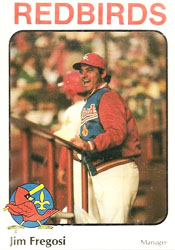
In 35 years as a major-league manager, Tony La Russa was fired once. The White Sox replaced him with Jim Fregosi.

jim_fregosiFregosi managed the Cardinals’ Class AAA club at Louisville from 1983 until he replaced La Russa as White Sox manager in June 1986. Among the prospects managed by Fregosi at Louisville were Vince Coleman, Danny Cox, Ken Dayley, Ricky Horton, Tito Landrum, Greg Mathews, Jose Oquendo, Terry Pendleton, Andy Van Slyke and Todd Worrell. Seventeen of the players on the 1985 National League championship Cardinals club played for Fregosi at Louisville.

Path to the majors

An all-star shortstop for the Angels in the 1960s, Fregosi managed the Angels from 1978-81, leading them to their first division title in 1979, before he was fired and replaced by Gene Mauch. After sitting out the 1982 season while running a food brokerage business, Fregosi became Louisville manager in 1983. Lee Thomas, the Cardinals’ director of player development, had been an Angels teammate of Fregosi and was instrumental in bringing him into the St. Louis organization.

Louisville won back-to-back American Association championships (1984-85) under Fregosi, but with Whitey Herzog entrenched as Cardinals manager Fregosi’s best hope of managing again in the major leagues was with another organization. The Mariners contacted him, but Fregosi wanted an opportunity with a franchise prepared to win.

In June 1986, White Sox general manager Ken “Hawk” Harrelson fired La Russa and pitching coach Dave Duncan. The White Sox were 26-38 and Harrelson had been clashing with La Russa and Duncan. “The record is not indicative of the talent involved,” Harrelson told the Chicago Sun-Times.

Fregosi was Harrelson’s first choice. Harrelson had sent scouts to Louisville and their reports on Fregosi were glowing, the Sun-Times reported.

Tireless teacher

Here is what others said about Fregosi’s work in the Cardinals system:

_ Rick Bozich, columnist, Louisville Courier-Journal: “When you roll the highlights films of what Fregosi has accomplished in Louisville, the two American Association championships won’t even make the top 10. No, the lingering images will be of the consistently long hours he worked developing the young players who carried the St. Louis Cardinals to the 1985 National League pennant and the wonderfully tranquil clubhouses he presided over. There was never a reason to check Fregosi’s time card. He reported to Cardinal Stadium at 2 every afternoon. One day he’d be in the cage convincing Vince Coleman he could make millions chopping down on the ball; the next day you could find him in the bullpen tinkering with Todd Worrell’s fastball grip.”

_ Mo Mozzali, Cardinals scout: “As fantastic as Jimmy has been for baseball in Louisville, he’s done even more for the players in the Cardinals organization. I’ve never seen anybody better working with young players.”

_ Dyar Miller, Louisville pitching coach: “Jim is a great teacher. He works on the field for three or four hours before every game, on theories of hitting, turning the double play, getting ready to pitch in the bullpen, whatever.”

_ Tony La Russa to the Sun-Times after learning Fregosi had replaced him: “When Jim Fregosi was in this league (as Angels manager), I thought he did an outstanding job. He’s been ready to manage in the big leagues for several years.”

Tales from Tony

White Sox owner Jerry Reinsdorf said La Russa told him, “If you have to fire me, hire Jim (Fregosi) or Jim Leyland … Fregosi is a good manager. I like him.”

La Russa went to the Athletics and won three American League pennants and a World Series title before joining the Cardinals. La Russa won two World Series titles and three National League pennants with the Cardinals and was elected to the National Baseball Hall of Fame.

Fregosi managed the White Sox from 1986-88 before stints as manager of the Phillies (1991-96) and Blue Jays (1999-2000). He won a National League pennant with the 1993 Phillies.

In 1996, La Russa’s first season as Cardinals manager, he was asked by the St. Louis Post-Dispatch about Fregosi during a series with the Phillies. La Russa replied, “The old line had me asking, ‘What does Fregosi have that I don’t have?’ The answer was, ‘Your job.’ “

Read Full Post »

Desperate for revenue and suspicious of new technology, the Cardinals joined the Browns in banning radio broadcasts of their games.

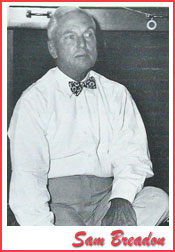
sam_breadon2On Feb. 3, 1934, the National League Cardinals and American League Browns declared that radio broadcasts were having a negative impact on attendance at their games at Sportsman’s Park in St. Louis.

In 1933, with America reeling from the Great Depression, the Cardinals drew 256,171 in 77 home games, even though they had a winning record (82-71) and were just two years removed from a World Series championship. It was their lowest home attendance since moving to Sportsman’s Park from Robison Field in 1920.

The 1933 Browns, a last-place finisher at 55-96, attracted 88,113 in 77 home games.

Radio broadcasts of Cardinals and Browns games had been carried since 1926, five years after the first broadcast of a major-league game, the Phillies vs. the Pirates, on Pittsburgh station KDKA in 1921.

Under the headline “St. Louis Clubs Sign Off on Radio,” The Sporting News reported in its Feb. 8, 1934, edition that “this decision was reached with dramatic suddenness by Sam Breadon, president of the Cardinals, and Louis B. von Weise, who holds a similar title with the Browns.”

“There, no doubt, was a time when the microphones did us some good,” Breadon said. “That was in the high times. But now we are at a point where we are willing to experiment a season without the mikes.”

Strong reactions

St. Louis radio executives were stunned and disappointed.

“We feel that it was a service the public appreciated and that radiocasting of the games helps more than it damages attendance,” said Jack Van Valkenburg, president of KMOX.

Added Thomas Patrick Convey of St. Louis station KWK: “Nobody has worked harder than myself to try to get people out to the ballpark.”

In an editorial, The Sporting News supported the right of the St. Louis clubs to choose whether to permit radio broadcasts of games. “Like other sports, baseball long has been in doubt as to the value of broadcasts,” The Sporting News wrote. “… The opinion has been growing stronger within the past two years that, whatever good the radio may have done the game in the past, conditions now have changed and its tendency to cause the fan to sit in front of the loudspeaker instead of in the stands is beginning to outweigh all its advantages.”

Most of the mail Breadon received in reaction to the decision opposed the radio ban.

Business and marketing

Breadon, a native New Yorker, may have been influenced by the decisions of all three New York clubs _ the American League Yankees and the National League Dodgers and Giants _ to ban radio broadcasts of their games.

Teams in Boston, Chicago, Cincinnati and Detroit were continuing game broadcasts. Walgreens paid Chicago radio station WGN $45,000 to sponsor game broadcasts for the 1934 season, The Sporting News reported.

Radio magnate Powel Crosley had purchased the Reds, with the notion of using radio to promote his team and using the broadcasts as an advertising revenue generator for his stations.

Without the broadcasts, home attendance of the Cardinals and Browns increased in 1934. The Cardinals, who won the National League pennant and World Series championship that year, drew 325,056 in 77 home games, an increase of almost 70,000. The Browns, who placed sixth at 67-85 in 1934, attracted 115,305, a spike of 27,000.

In 1935, the broadcasts of Cardinals and Browns games were restored. The business models in Chicago and Cincinnati may have convinced the St. Louis clubs to end the ban.

Capitalizing on their status as reigning World Series champions, Cardinals home attendance jumped to 506,084 in 1935. The Browns, who fell back to seventh place in 1935, drew 80,922 to 76 home games that year, including 300 to a Friday afternoon game on May 10 against the Athletics. Boxscore

Read Full Post »

« Newer Posts - Older Posts »