(Updated Dec. 27, 2015)
Sam Breadon was principal owner of the Cardinals from 1920 through 1947.
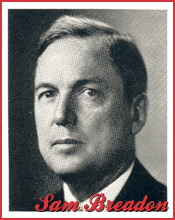 Born July 26, 1876, in New York City, Breadon, nearly penniless, went to St. Louis in 1902 to join a friend in the garage business. Backed by customers impressed by his work and demeanor, Breadon started his own automobile and garage business in 1903 and soon became successful. He also became a fan of the local National League baseball club, the Cardinals.
In 1917, Breadon paid $2,000 to become an investor in the Cardinals. Three years later, he rose to principal owner and president of the franchise.
Though he was tight-fisted with finances and sometimes displayed a cold demeanor (“The fear of poverty haunted him all through his years, even after he could write a check for seven figures,” The Sporting News surmised), Breadon was, by most accounts, an effective and savvy executive.
Here are five more facts about Breadon:
1. The Cardinals won nine National League pennants and six World Series titles while Breadon was their principal owner. To put that in perspective, the National League won eight World Series titles between 1926-46. The Cardinals won six of those. (The others were the 1933 Giants and 1940 Reds.)
In his obituary in May 1949, The Sporting News wrote of Breadon, “His name was synonymous with baseball success.”
2. In May 1925, Breadon boldly elevated second baseman Rogers Hornsby to player-manager, replacing Branch Rickey, who returned to the front office. A year later, Hornsby led the Cardinals to their first pennant and first World Series championship. Rickey, meanwhile, began building the franchise-controlled farm system that would supply the Cardinals with top talent for decades. (By 1939, Breadon owned 16 farm teams outright and had working agreements with 12 others.)
Though he traded Hornsby to the Giants (for Frankie Frisch) after the World Series when Hornsby demanded a three-year contract rather than the one-year deal offered, Breadon’s promotion of Hornsby to manager created a culture change, with long-term implications.
“It gave us our first pennant, it made our players pennant-conscious and it enabled Rickey to move into the front office, where he had a much better opportunity to develop and exercise his talents,” Breadon said to The Sporting News.
3. Shortly after gaining control of the Cardinals, Breadon made a deal that solidified the financial foundation of the franchise. The Cardinals had been playing their home games at dilapidated Robison Field. Breadon convinced Phil Ball, owner of the St. Louis Browns of the American League, to take in the Cardinals as a tenant at Sportsman’s Park.
That enabled Breadon to demolish Robison Field and sell most of the property to the city for $200,000 (the city planned to build a high school on the site) and sell the rest of the land for $75,000 to a trolley company for a loop that would provide access to the school.
“It was the most important move I ever made on the Cardinals,” Breadon told The Sporting News. “… It gave us money to clean up our debts, and something more to work with. Without it, we never could have purchased the minor-league clubs, which were the beginning of our farm system.”
4. Breadon pinched pennies, but his generosity also quietly helped several former Cardinals.
For years, Breadon sent a monthly check to Grover Cleveland Alexander, the Cardinals’ hero of the 1926 World Series, when the pitcher was in financial trouble, The Sporting News reported.
Though ace pitcher Mort Cooper had bolted the Cardinals because of a contract dispute in 1945, prompting them to trade him, Breadon came to Cooper’s aid when Cooper was arrested and charged with passing bad checks in 1948. Breadon bailed Cooper out of jail, covered the reimbursements on the bad checks and sent Cooper monthly payments to help him get out of a financial hole, The Sporting News reported.
5. In 1939, Breadon prevented Rickey from dealing Marty Marion to the Cubs. At the time, Marion and Bobby Sturgeon were shortstops in the Cardinals’ farm system. According to The Sporting News, Rickey thought Sturgeon was the better prospect and wanted to offer Marion to the Cubs for cash.
“No,” Breadon responded, “if we sell one of them, we’ll sell Sturgeon.”
In a compromise (at this point in their working relationship, Breadon and Rickey often were clashing), the Cubs were allowed to make a choice between the two shortstops. To Breadon’s relief, Chicago chose Sturgeon. Marion, who would earn the nickname “Mr. Shortstop” because of his stellar fielding, would join the Cardinals in 1940 and help them to four pennants and three World Series titles.
“He’s the best ever,” Billy Southworth, who managed the Cardinals to three consecutive pennants (1942-44), said of Marion to The Sporting News. “He anticipates plays perfectly, can go to his right or left equally as well and has a truly great arm. Some of the things he does have to be seen to be believed.”
 Shannon, who would win the third base job, played until 1970. After a year as the franchise’s assistant director of promotions and sales, Shannon
 RetroSimba