Feeds:
Posts
Comments

Archive for the ‘Games’ Category

Dean Stone earned a save in his Cardinals debut, flirted with a no-hitter in his lone start for them and was the victim of a rare hitting feat.

A left-hander, Stone pitched in 18 games for the Cardinals in 1959, spent the next two seasons in their minor-league system and did well enough to earn a return to the majors with the Houston Colt .45s when the National League expanded from eight teams to 10 in 1962.

Stone pitched eight seasons in the big leagues with the Senators (1953-57), Red Sox (1957), Cardinals (1959), Colt .45s (1962), White Sox (1962) and Orioles (1963), composing a 29-39 record, 12 saves and a 4.47 ERA.

He was 0-1 with a save and a 4.20 ERA for the 1959 Cardinals.

All-star quality

Stone had his best major-league season in 1954 with the Senators and was named to the American League all-star team.

In the eighth inning of the All-Star Game at Cleveland on July 13, 1954, the National League led 9-8 and had Red Schoendienst on third base and Alvin Dark on first with two outs and Duke Snider at the plate. Stone was brought into the game by manager Casey Stengel to face Snider, a left-handed batter.

As Stone was about to throw his third pitch to Snider, Schoendienst broke from third and attempted a steal of home. Stone made a quick throw to catcher Yogi Berra, who applied the tag on Schoendienst for the third out. National League coaches Leo Durocher and Charlie Grimm claimed Stone committed a balk in his rush to throw home, but umpire Bill Stewart rejected their argument.

In the bottom half of the inning, the American League rallied for three runs and an 11-9 lead. Virgil Trucks pitched a scoreless ninth, earning the save, and Stone was credited with a win, even though he didn’t retire a batter. Boxscore

Stone finished the 1954 season with a 12-10 record, 3.22 ERA and 10 complete games. He slipped to 6-13 in 1955 and 5-7 in 1956 and was dealt by the Senators to the Red Sox on April 29, 1957.

After posting a 1-3 record and 5.27 ERA for the Red Sox in 1957, Stone spent all of 1958 with their farm club at Minneapolis and was 13-10 with a 3.18 ERA and three shutouts.

Meet me in St. Louis

Minneapolis was in the American Association and so was Omaha, the Cardinals’ affiliate managed by Johnny Keane. When Keane became a Cardinals coach on manager Solly Hemus’ staff in 1959, he recommended Stone to general manager Bing Devine.

On March 14, 1959, the Cardinals traded pitcher Nelson Chittum to the Red Sox for Stone.

The Boston Globe described the trade as a “transaction of no great magnitude.” Devine agreed and told the St. Louis Post-Dispatch, “It’s not a sensational move, of course, but any time we get a chance to look at a pitcher who might augment our left-handed staff we’ve got to consider it … Johnny Keane thought he might help us.”

Stone, 28, was assigned to Omaha where he was managed by Joe Schultz. After losing his first three decisions, Stone won nine of his next 12 and had a 9-6 record and 3.87 ERA in 121 innings when he got called up to the Cardinals in July 1959.

Positive impression

Stone made his National League debut on July 11, 1959, pitching 3.2 scoreless innings in relief of starter Marshall Bridges in a 4-3 Cardinals victory over the Phillies at Philadelphia. Stone yielded two hits, walked none, struck out five and got a save in what the Post-Dispatch described as “a brilliant relief job.” Boxscore

Stone used an “overpowering fastball” against the Phillies, the Sporting News reported.

“Funny thing, when we talked about bringing up Dean from Omaha, Joe Schultz said he had the stuff to help, but questioned his ability to relieve because of only one thing _ control,” Cardinals business manager Art Routzong said.

Stone yielded one run over his first 10 innings of relief work for the Cardinals and after five appearances had an ERA of 0.90.

No mercy

When Cardinals starter Vinegar Bend Mizell developed an aching back, Hemus gave Stone a start against the Braves on July 31, 1959, at Milwaukee.

Stone held the Braves hitless for five innings and was locked in a scoreless duel with Braves starter Bob Buhl.

In the sixth, Del Crandall led off with the Braves’ first hit, a double. After Buhl struck out, Bobby Avila walked and Felix Mantilla dribbled a grounder past shortstop Alex Grammas and into left field for a single, scoring Crandall and advancing Avila to third. Grammas told the Post-Dispatch he should have fielded the ball. “I couldn’t make up my mind whether to backhand the ball,” Grammas said. “I don’t know whether I could have thrown him out, but I should have stopped the ball.”

Hank Aaron followed with a weak single to left, scoring Avila with the second run and moving Mantilla to second. “By this time, Stone couldn’t have been expected to keep holding off the mighty Braves any more than Custer was expected to keep cutting down the Indians,” the Post-Dispatch wrote.

Joe Adcock followed with a three-run home run, capping the Braves’ five-run sixth. Stone went seven innings, giving up five runs on five hits and two walks, and Buhl pitched a shutout in a 6-0 Braves triumph. Boxscore

Ups and downs

Two days later, on Aug. 2, 1959, Bill Bruton of the Braves hit a pair of bases-loaded triples, one against Mizell and the other off Stone. Bruton became the second big-league batter since 1900 to hit two three-run triples in a game, according to The Sporting News. Boxscore

After the 1959 season, the Cardinals removed Stone from their roster and assigned him to Rochester. He was 9-7 with a 3.67 ERA in 130 innings for Rochester in 1960 and 12-8 with a 2.73 ERA in 178 innings for the Cardinals’ affiliate in San Juan and Charleston, W.Va., in 1961.

On Nov. 27, 1961, the Colt .45s selected Stone in the Rule 5 minor-league draft. He opened the 1962 season in their starting rotation and pitched 21.1 consecutive scoreless innings, including back-to-back shutouts versus the Cubs, before the Cardinals scored four runs against him in the fourth inning on April 25. Boxscore

Read Full Post »

They came from places one might find in a John Grisham novel, but Wilmer Mizell of Vinegar Bend, Ala., and Ed Bailey of Strawberry Plains, Tenn., were real and they were central characters in an unusual game between the Cardinals and Reds.

On Sept. 1, 1958, in the opening game of a doubleheader at St. Louis, Mizell established a National League record for most walks in a shutout, issuing nine in a 1-0 Cardinals victory.
One reason Mizell was able to thrive despite a lack of command was his ability to retire Bailey in key situations. Three times, Bailey batted with two on and two outs and Mizell got him out each time.

Path to success

Mizell was from Leakesville, Miss., located along the Chickasawhay River in the southeast part of the state near the Alabama border. The nearby town of Vinegar Bend, Ala., became Mizell’s adopted home because Leakesville was on the Vinegar Bend mail route.

At 16, Mizell began playing baseball in Sunday leagues in Vinegar Bend and from then on he became known as Vinegar Bend Mizell.

A left-handed pitcher, Mizell signed with the Cardinals in 1949 when he was 18 and established himself as a top prospect. He was 12-3 with a 1.98 ERA for Albany (Ga.) in 1949 and also had strong seasons for Winston-Salem (17-7, 2.48) in 1950 and Houston (16-14, 1.97) in 1951.

Mizell got to the major leagues with the Cardinals in 1952, posted a 10-8 record and issued the most walks (103) of any National League pitcher. After composing a 13-11 record for the Cardinals in 1953, Mizell spent two years in military service and rejoined the Cardinals in 1956.

Windmill windup

Mizell brought an 8-11 record into his Labor Day start against the Reds in 1958. He faced his first challenge in the first inning when Bailey batted with two outs and runners on first and second.

Bailey, a left-handed batter, was born and raised in Strawberry Plains, about 20 miles from Knoxville, and made his major-league debut with the Reds in 1953. He became their starting catcher in 1956 when he hit 28 home runs.

Mizell got Bailey to fly out to right and escaped the first inning unscathed.

The Cardinals scored the lone run in the second against hard-luck Reds left-hander Joe Nuxhall, whose defense let him down. Ken Boyer led off, grounded to third baseman Alex Grammas and reached safely when Grammas booted the ball. After Joe Cunningham flied out, Gene Green hit a roller to second baseman Johnny Temple, who was thinking he could turn a double play, but when he went to scoop the ball it got past him for an error. Boyer advanced to third and Green was safe at first.

Wally Moon followed with a high chopper to the right of the mound. As Nuxhall reached for the ball, Boyer streaked to the plate and Nuxhall’s only play was to throw to first to retire Moon.

In the third, Bailey came up with two outs and runners on first and third, and again he flied out to right.

Mizell, described by the Cincinnati Enquirer as a “big left-hander with the windmill windup,” walked six in the first four innings, but had a no-hitter entering the fifth.

Escaping trouble

In the fifth, Temple singled for the Reds’ first hit, but was erased on Jerry Lynch’s double-play grounder. Pete Whisenant followed with a single, stole second and also stole third. Frank Robinson walked and stole second, giving the Reds runners on second and third with two outs and Bailey at the plate.

Bailey grounded out to second, ending the Reds’ best threat. He would hit .140 (7-for-50) against Mizell in his big-league career.

The Reds put a runner on base in every inning except the ninth and stranded 11. They had nine walks, five stolen bases and four singles but no runs, snapping a six-game winning streak.

The Post-Dispatch described the game as “an unusual thriller” and The Sporting News reported it as “a weird duel.” Boxscore

Mizell threw 150 pitches.

The major-league record for most walks issued in a shutout is 11 by Lefty Gomez of the American League Yankees on Aug. 1, 1941, in a 9-0 victory over the Browns at New York. Boxscore

Read Full Post »

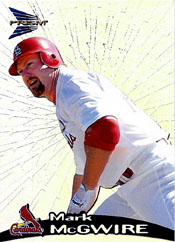
Deep into his tainted pursuit of a home run record, Mark McGwire refused to heed an umpire’s repeated warnings to cease arguing a call and got ejected, prompting a dangerous outburst from some of the St. Louis spectators.

On Aug. 29, 1998, fans at Busch Memorial Stadium threw baseballs, bottles and helmets onto the field when umpire Sam Holbrook tossed McGwire for arguing a called third strike in the first inning of a game between the Braves and Cardinals.
McGwire, well aware he was the reason many had paid to attend the game, could have avoided ejection and protected the umpires from fan backlash if he had acted on any of Holbrook’s three warnings to return to the dugout and stop arguing.

When McGwire continued to rage while standing at home plate, Holbrook, a rookie umpire, banished him from the game.

Crossing a line

A crowd of 47,627 packed into Busch Stadium and thousands more tuned in to a national telecast to watch McGwire, who was in a neck-and-neck race with the Cubs’ Sammy Sosa in a bid to be first to break Roger Maris’ single-season home run mark of 61.

McGwire entered the game with a season total of 54 home runs. He eventually was the first to break Maris’ mark and finished with 70 home runs in what was trumpeted as a feel-good story that brought baseball back from the ill will of the 1994 players’ strike. Years later, McGwire admitted he cheated in pursuit of the record by using banned performance-enhancing drugs to boost his performance.

In retrospect, it’s natural to wonder whether steroids fueled McGwire’s relentless ranting at Holbrook in the game against the Braves.

McGwire, batting third in the Cardinals’ order, came to the plate with two outs in the first inning, worked the count to 3-and-2 and struck out looking against Tom Glavine.

McGwire protested vehemently to Holbrook and used his bat to make a mark in the batter’s box to indicate the pitch was out of the zone. Manager Tony La Russa ran from the dugout to the plate to protect his player. Holbrook warned La Russa to back off, but La Russa ignored him and was ejected. Holbrook asked McGwire to return to the dugout, but McGwire wouldn’t leave.

“The first ejection was La Russa,” Holbrook said to the St. Louis Post-Dispatch. “That could have ended it right there if (McGwire) had walked away.”

Holbrook said to La Russa, “Please get (McGwire) out of here. If you don’t, I’m going to have to eject him.”

La Russa tried but McGwire kept arguing.

“I warned him again,” said Holbrook, who gave McGwire a total of three warnings. “When he continued after that, that’s when I ejected him.”

Cardinals pitching coach Dave Duncan was yelling at Holbrook from the dugout and Holbrook ejected him, too.

“The furthest thing from my mind was to eject Mark McGwire,” Holbrook said. “I bent over backwards not to. I did everything I could to keep him in the game, but at some point I had to draw the line. I tried to walk away a couple of times and he still came back around and continued arguing.”

Said McGwire: “Did I cross the line? Yeah, I probably did. I probably deserved what I got.”

Justice for all

On the national telecast, broadcaster Josh Lewin said, “Do you throw Batman out of Gotham City? That’s what Sam Holbrook just did.”

Post-Dispatch columnist Bernie Miklasz wrote, “The fact that McGwire has a chance to break a home run record is irrelevant. Umpires aren’t supposed to hold players to different standards. They can’t go out of their way to protect McGwire. There should be no special treatment.”

Umpire crew chief Harry Wendelstedt said Holbrook “worked an excellent game” and McGwire “was given ample time to argue.”

“The rules have to stay the same for everybody,” Wendelstedt said.

La Russa, who disagreed with the strike call but not the ejections, said, “I’ve seen umpires get upset, but I watched Sam and he was in control.”

Dumb and dumber

Some of the fans, though, lost control and threw objects onto the field. “It was ugly there for a while,” said Braves outfielder Ryan Klesko.

In the second inning, as the barrage continued, Wendelstedt stopped the game, players scurried into the dugouts and announcements were made over the public-address system and on the scoreboard, informing fans to stop throwing objects onto the field or else a forfeit could be declared.

“For long minutes, the threat of forfeit hung heavy over Busch,” Mark Bradley of the Atlanta Constitution wrote.

Said Wendelstedt: “A forfeit is a very last resort for an umpire … but we don’t want someone to get hurt.”

The St. Louis Police Department called in 15 to 20 extra officers to keep order, the Post-Dispatch reported, and stadium security director Joe Walsh said several fans were ejected.

In addition, about 2,000 spectators departed in the second inning because McGwire no longer was in the game, according to the Atlanta Constitution.

After a 10-minute delay, fans quieted, the game resumed and the Braves went on to win, 4-3. Boxscore

“A national TV audience had to be watching and wondering whether St. Louis really is the best baseball town in America,” the Post-Dispatch opined.

Miklasz described the fan actions as “disgraceful” and added, “If you can’t control yourself, please stay away from Busch Stadium in the future because the rest of us don’t want to be injured as a result of your temporary insanity, your acts of cowardice.”

McGwire said of the fans who threw objects, “That’s wrong … We don’t need that in baseball.”

Miklasz wondered, “Is McGwire Mania officially out of control? … Have we created a monster? Or are we now the monster?”

Read Full Post »

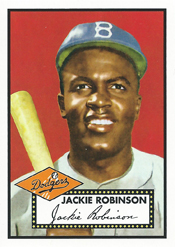
Jackie Robinson hit for the cycle one time in his major-league career and he did it in inverse order against four different Cardinals pitchers.

On Aug. 29, 1948, Robinson produced a home run, triple, double and single for the Dodgers in the first game of a doubleheader at Sportsman’s Park in St. Louis. Robinson also scored three runs, drove in two and had a stolen base, propelling the Dodgers to a 12-7 victory.
In the second game, Robinson had two singles, a sacrifice bunt and a run scored, helping the Dodgers sweep with a 6-4 triumph in 10 innings and lifting them into first place in the National League.

Making a move

The Dodgers won the 1947 National League pennant under manager Burt Shotton, who filled in while Leo Durocher was suspended for association with gamblers. Durocher returned in 1948 and the Dodgers started poorly, losing 19 of their first 31 games. On July 2, they were in last place at 27-35.

On July 16, 1948, Shotton came back to the Dodgers after Durocher departed to manage the Giants. The Dodgers surged and were back in contention entering the doubleheader against the Cardinals.

The first game of the doubleheader matched Dodgers rookie Paul Minner against Cardinals ace Harry Brecheen and attracted 33,826, the biggest crowd of the season at Sportsman’s Park.

Billy Cox opened the game for the Dodgers with a single and Robinson followed with his home run, a line drive over the wall in left. Pee Wee Reese reached on shortstop Marty Marion’s error and Bruce Edwards connected on a two-run home run, giving the Dodgers a 4-0 lead and driving Brecheen out of the game without recording an out.

Until then, Brecheen had yielded three home runs all season.

Extra incentive

Robinson, “spurred by constant boos from the crowd,” according to the New York Daily News, led off the third inning with a triple against Ted Wilks.

In the fourth, Robinson doubled to left against Al Brazle, swiped third and scored on Reese’s line out to center.

Robinson lined out to center in the sixth against Red Munger before he completed the cycle with a single in the eighth off Gerry Staley.

Robinson’s last at-bat of the game in the ninth resulted in a fly out against Jim Hearn.

Described by Bob Broeg of the St. Louis Post-Dispatch as “the nimble Negro star,” Robinson was 4-for-6 in the game.

“He was simply poison to the Cardinals hurlers in the opener,” the Associated Press reported. Boxscore

Pennant push

In the second game, Robinson’s two hits brought his batting average to .300 for the season and the Dodgers’ sweep of St. Louis pulled them into a virtual first-place tie with the Braves. The Dodgers had a 66-51 record and .564 winning percentage and the Braves were 69-54 and .561.

Robinson, in his second Dodgers season after breaking the major league’s segregation practices the year before, finished the 1948 season with a batting mark of .296. He hit .329 in 19 games against the Cardinals in 1948.

After winning 39 of 55 games in their surge from last place to first, the Dodgers eventually faded and finished in third place at 84-70. The Braves won the pennant with a 91-62 record and the Cardinals placed second at 85-69.

Read Full Post »

(Updated Nov. 26, 2024)

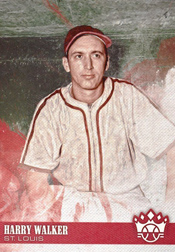
Harry Walker and Vince DiMaggio, members of prominent baseball families, displayed dazzling speed and skills in making plays against one another in a game between the Cardinals and Pirates.

On Aug. 31, 1943, at Pittsburgh, Walker drove a ball past DiMaggio in center field and circled the bases for a two-run inside-the-park home run, lifting the Cardinals to a 4-2 victory.

Walker might have had another inside-the-park home run earlier in the game, but DiMaggio made a sensational catch to deprive him.

All in the family

Harry Walker made his major-league debut with the Cardinals in 1940. After spending parts of three seasons (1940-42) with the Cardinals, he was their starting center fielder in 1943.

Harry was the fourth member of his family to play in the big leagues. His father, Ewart Walker, was a pitcher with the Senators from 1909-12 and his uncle, Ernie Walker, was an outfielder with the Browns from 1913-15. Harry’s brother, Dixie Walker, was the best-known, playing 18 seasons (1931 and 1933-49) in the majors as a hard-hitting outfielder with the Yankees, White Sox, Tigers, Dodgers and Pirates. Dixie’s given name was Fred and he was eight years older than Harry.

Vince DiMaggio was the oldest of three brothers who became outfielders in the big leagues. Vince made his major-league debut with the Braves in 1937. Joe DiMaggio, two years younger than Vince, got to the big leagues first, with the Yankees in 1936, and played 13 seasons in a Hall of Fame career. Dom DiMaggio, five years younger than Vince, played for the Red Sox for 11 years after debuting with them in 1940.

In the book “My Greatest Day in Baseball,” Cardinals pitcher Dizzy Dean said a nightclub owner, Johnny Perkins, bet him he wouldn’t strike out Vince DiMaggio the first time he came up in a game at Boston.

“I did, and when I went back to the bench I made motions to (Perkins) I’d double the bet the next time,” Dean said. “I struck (DiMaggio) out again, and I put everything back on a third bet, and I fanned him three straight times.

“Then Perkins wanted to make it all or nothing, so I took him, and when DiMaggio came up again he lifted a pop foul back of the plate. I thought (Bruce) Ogrodowski was going to catch it, and I ran and hollered, ‘Let it go, let it go.’ He couldn’t get the ball anyway, as it turned out, because it hit the screen, but I’d have bumped him sure as hell if he’d got under it. I wanted to win that bet. I struck DiMaggio out on the next pitch. Four straight times!” Boxscore

Vince was dealt by the Braves to the Yankees on Feb. 4, 1939, and was assigned to their minor-league club at Kansas City. Vince never did join Joe on the Yankees. On Aug. 5, 1939, Vince was acquired by the Reds and, nine months later, in May 1940, the Reds traded him to the Pirates. Vince became the Pirates’ starting center fielder, succeeding Lloyd Waner. In 1941, Vince produced 21 home runs and 100 RBI.

On the run

In the 1943 game at Pittsburgh, the Cardinals had runners on second and third, one out, when Harry Walker faced Pirates starter Bob Klinger in the third inning at Forbes Field. Walker, a left-handed batter, lined a pitch to right-center and Vince DiMaggio gave chase.

“DiMaggio was racing backward at full speed when he glanced back, leaped” and speared the ball on the dead run, the St. Louis Post-Dispatch reported.

The Pittsburgh Press said, “If Vince hadn’t made that final stretch, Walker would have had an inside-the-park homer.”

According to the Post-Dispatch, “DiMaggio made as fine a catch as you’ll ever see on a ballfield.”

Marty Marion tagged and scored from third on the play, giving the Cardinals a 1-0 lead, and Walker was credited with a RBI.

Finding the gap

In the ninth, with the score tied at 2-2, the Cardinals had pitcher Red Munger on second base with two outs and Walker at the plate against Klinger. Walker hit a drive to left-center and DiMaggio again took off in pursuit.

“Vince made a desperate lunge for the ball,” the Post-Dispatch reported, but it landed just beyond his reach and skidded to the wall.

Munger scored easily from second with the go-ahead run and Walker circled the bases for an inside-the-park home run and a 4-2 Cardinals lead. Munger retired the Pirates in order in the bottom half of the inning, sealing the victory for St. Louis. Boxscore

The home run was the second of Walker’s big-league career. A line-drive hitter who sprayed the ball to all fields rather than an upper-cut swinger, Walker hit 10 home runs, including two inside the park, in 11 major-league seasons.

Read Full Post »

The career paths of pitcher Curt Davis and outfielder Ernie Koy intersected in two prominent ways for the Cardinals.

The first occurred on Aug. 24, 1938, when Davis pitched a one-hitter for the Cardinals against the Dodgers. Koy produced the only hit, a bunt single.

Two years later, on June 12, 1940, Davis and Koy were part of a blockbuster trade between the Cardinals and Dodgers. The Cardinals sent Davis and slugger Joe Medwick to the Dodgers for Koy, third baseman Bert Haas, pitchers Carl Doyle and Sam Nahem, and $125,000.

It was the second time Davis was part of a major Cardinals trade. On April 16, 1938, the Cardinals dealt pitcher Dizzy Dean to the Cubs for Davis, pitcher Clyde Shoun, outfielder Tuck Stainback and $185,000.

Though Davis wasn’t the caliber of future Hall of Famers Medwick and Dean, he was a successful starting pitcher who achieved 11 double-digit win seasons after getting a late start to his major-league career.

Late bloomer

Davis was born in Greenfield, Mo., and moved with his family to a farm near Salem, Ore., when he was 3. As a young adult, Davis held a variety of jobs, including picking apples, lumberjacking and driving a truck at a logger camp, according to a biography by the Society for American Baseball Research.

A right-handed pitcher, Davis played semipro baseball and signed his first minor-league contract when he was 24. He made his major-league debut with the 1934 Phillies at age 30 and had an impressive rookie season, with 19 wins and a 2.95 ERA for a seventh-place club.

Davis had 16 wins for the 1935 Phillies, was traded to Cubs for slugger Chuck Klein in May 1936, and won 11 for the Cubs in 1936 and 10 in 1937. When the Cubs had a chance to get the sore-armed Dean on the eve of the 1938 season, they jumped at the chance. Cardinals fans were disappointed to see Dean depart and took out their frustrations on Davis, whom they viewed as an inadequate replacement for the colorful ace.

Tough to handle

Davis, 34, took a 9-6 record and 4.48 ERA into his start against the Dodgers at Sportsman’s Park in St. Louis. He’d started two days earlier, Aug. 22, 1938, against the Reds and yielded five runs and eight hits in 3.2 innings.

The Cardinals and Dodgers both had losing records and the Wednesday game on a sweltering afternoon drew a paid crowd of 1,403. Another 1,183 boys and girls were admitted for free, putting the total attendance at 2,586.

With one out in the second inning, Koy, a rookie, pushed a drag bunt between the first-base line and the pitcher’s mound. As Koy, a former running back for the University of Texas football team, barreled toward the bag, first baseman Johnny Mize fielded the slow roller and tossed the ball to Davis, who was covering first.

“I hesitated an instant on my way over to first to let Mize get the ball out of his glove,” Davis said to the St. Louis Star-Times. “For a split second, I was afraid the throw would go behind me.”

The throw was on target, but Davis fumbled the ball as Koy streaked across the base and was called safe by umpire George Magerkurth.

Davis disagreed with the call, telling the Star-Times, “I thought I had Koy beat … Just as I caught the ball, I felt a thud behind me and naturally I thought it was an out.”

According to the Brooklyn Daily Eagle, “Davis never did get his hands on the throw,” and both the New York Daily News and The Sporting News reported Davis mishandled the ball.

Magerkurth said Koy beat Mize’s throw to the bag and would have been safe even if Davis caught the ball cleanly, so the official scorer ruled the play a hit and not an error.

High quality

Medwick led off the bottom half of the second with a home run against Luke Hamlin, giving the Cardinals a 1-0 lead. It was all the support Davis needed.

The Dodgers’ only other baserunner, Cookie Lavagetto, drew a walk with one out in the fifth and was picked off first by Davis.

The Cardinals got a two-run double from Stu Martin in the fifth, a RBI-single by Davis in the seventh and a final run driven in by Lynn Myers in the eighth, winning, 5-0, in a game played in 1:40.

Davis’ line: nine innings, one hit, one walk, four strikeouts and 28 batters faced. Boxscore

Two months earlier, on June 15, 1938, the Reds’ Johnny Vander Meer pitched a no-hitter against the Dodgers and walked eight. Davis’ gem on one day’s rest “was a far better pitching performance than the no-hit game,” the Daily Eagle declared.

That’s a winner

Davis finished with a 12-8 record and 3.63 ERA for the 1938 Cardinals. In 1939, he was 22-16 for the Cardinals.

The Cardinals got off to a dismal start in 1940 and by June the club was looking to deal veteran players for cash. Davis was 0-4 with a 5.17 ERA and Medwick was sulking and losing fan support when the Dodgers offered to take them.

Davis pitched the last seven seasons (1940-46) of his career with the Dodgers and was 66-54 for them. In 1941, when the Dodgers won the National League pennant, Davis was 13-7 with a 2.97 ERA.

In 13 seasons in the major leagues, Davis had a 158-131 record.

Read Full Post »

« Newer Posts - Older Posts »