Feeds:
Posts
Comments

Archive for the ‘Games’ Category

Though relief pitcher Clay Carroll was successful in his lone season with St. Louis, his most significant Cardinals connection came as an opponent.
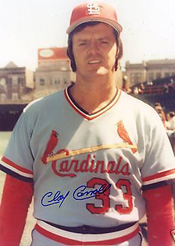
clay_carrollOn May 30, 1969, in what The Sporting News described as a storybook feat, Carroll hit the only home run of his big-league career. The improbable shot was struck against Bob Gibson in the 10th inning and it carried the Reds to a 4-3 victory over the Cardinals.

Eight years later, Carroll was traded to the Cardinals and excelled for them as a consistently reliable reliever.

Heavy lumber

Carroll’s home run against Gibson occurred in the opener of a series between the Reds and Cardinals at St. Louis. With the Cardinals ahead, 3-0, in the seventh inning, Johnny Bench tied the score with a three-run home run _ his first career hit against Gibson.

Carroll relieved Wayne Granger in the eighth and the game became a duel between Carroll and Gibson.

After Gibson retired the first two batters in the 10th, Carroll stepped to the plate with a bat he borrowed from teammate Alex Johnson, a former Cardinal. Johnson’s bats, Carroll explained to the St. Louis Post-Dispatch, “have a lot more wood in them than the one I had been using.” Johnson’s bats “normally are about as heavy as any in baseball _ some weighing as much as 40 ounces,” the Cincinnati Enquirer reported.

With the count 3-and-2, Carroll swung at a high fastball and lifted a fly ball to left. “I don’t want to brag, but when I hit the ball I knew it was gone,” Carroll said to United Press International. “Did you see it take off?”

The ball hit the top of the fence at Busch Stadium and bounced over the wall, giving the Reds a 4-3 lead.

“I was just swinging, trying to get on,” said Carroll. “Usually when I face Gibson, I just chop at the ball. That’s about all you can do against him.”

Said Reds manager Dave Bristol: “You should have seen the smile on Carroll’s face when he returned to the dugout. It looked like a cut watermelon.”

In the bottom half of the 10th, Carroll got Joe Hague to fly out before walking Lou Brock. Curt Flood grounded out, moving Brock into scoring position at second, before Vada Pinson, Carroll’s former Reds teammate, lined out to shortstop, ending the game.

Carroll pitched three hitless innings to earn the win. Boxscore

Championship caliber

Carroll was an important contributor to Reds teams that won pennants in 1970, 1972 and 1975. In 14 World Series appearances for the Reds, Carroll was 2-1 with a save and a 1.33 ERA over 20.1 innings. He was the winning pitcher in Game 7 of the 1975 World Series, shutting out the Red Sox for two innings.

Dealt by the Reds to the White Sox in December 1975, Carroll produced a 4-4 record, six saves and a 2.56 ERA for Chicago in 1976.

On March 23, 1977, the Cardinals acquired Carroll, 35, from the White Sox for pitcher Lerrin LaGrow. The Cardinals projected Carroll to set up closer Al Hrabosky.

“This is obviously what we’ve been after _ consistency and experience from a right-handed reliever, a guy who’s been under fire in championship play,” said manager Vern Rapp. “We had nobody on our staff who fit those qualifications.”

Said Carroll: “I want to work as often as possible because the more I work the more consistent I am. I like the Cardinals, especially because they’re an aggressive team at bat and on the bases.”

Carroll reported to camp at 215 pounds, according to the Post-Dispatch. Rapp wanted him to be at 200 pounds when the season began. He instructed Carroll to run extra laps each day during spring training.

A master at locating his pitches, Carroll delivered for the 1977 Cardinals. “When Carroll wasn’t saving games, he at least was dousing huge blazes to keep the Cardinals in the games,” The Sporting News reported. “The tighter the situation, the more (Carroll) seemed to enjoy it.”

Noting how Carroll got batters to swing at pitches out of the zone, Bristol said, “Carroll would rather eat a green fly at home plate than throw a strike.”

Carroll was 4-2 with four saves and a 2.50 ERA in 51 appearances for the Cardinals before they traded him back to the White Sox on Aug. 31, 1977.

3-for-1

The trade created “a lot of eyebrow raising” because Carroll had been the Cardinals’ most consistent reliever, The Sporting News reported.

The Cardinals were 10 games out of first place with about a month remaining in the season when the deal was made. The White Sox wanted Carroll because they were in contention for a division title, two games behind the first-place Royals.

St. Louis got three players in the deal: pitchers Silvio Martinez and Dave Hamilton and outfielder Nyls Nyman.

Carroll was disappointed to leave the Cardinals. “I thought I did a good job,” he said. “I guess they’re planning to go with a younger pitching staff next year.”

Read Full Post »

Two years after he made his big-league debut against St. Louis as a winner in a game that ended Bob Gibson’s career, Buddy Schultz surprised the Cardinals by becoming one of their most effective relievers.

buddy_schultzOn Feb. 28, 1977, Schultz was traded by the Cubs to the Cardinals for minor-league pitcher Mark Covert.
A left-hander, Schultz, 26, was acquired to pitch for the Cardinals’ top farm club.

When given a chance to fill in for an injured pitcher early in the Cardinals’ season, Schultz capitalized on the opportunity and gained the confidence of manager Vern Rapp.

On a staff with established talent such as Bob Forsch, John Denny and Al Hrabosky, it was Schultz who emerged as the Cardinals’ leader in earned run average that season.

Name game

Charles Budd Schultz was born Sept. 19, 1950, in Cleveland. “The middle name was for my Uncle Bud and they fancied it up by adding the extra ‘d,’ ” Schultz told Dick Kaegel of the St. Louis Post-Dispatch.

Schultz received a baseball scholarship from Miami University in Oxford, Ohio, where he earned a bachelor’s degree in industrial arts. In a game for Miami against Wright State, Schultz struck out 26 batters.

The Cubs selected Schultz in the sixth round of the June 1972 amateur free-agent draft.

Win vs. Gibson

Schultz made his big-league debut for Chicago on Sept. 3, 1975, at St. Louis. In the sixth inning, with the score tied at 6-6, Schultz relieved Tom Dettore and got Bake McBride to ground out to second, ending the inning.

In the seventh, the Cubs struck for five runs against Gibson, who had relieved Ron Reed. Pete LaCock, batting for Schultz, hit a grand slam off Gibson, giving the Cubs an 11-6 lead. Paul Reuschel shut out the Cardinals over the last three innings, preserving the win for Schultz. Boxscore

Gibson, 39, never pitched in a big-league game again, ending a career that led to induction into the National Baseball Hall of Fame.

A week later, on Sept. 10, 1975, Schultz pitched 1.1 scoreless innings in relief of Steve Stone and got his second win in the Cubs’ 7-5 triumph over the Cardinals at Chicago. Boxscore

In two seasons (1975-76) with the Cubs, Schultz was 3-1 with a 6.14 ERA in 35 games.

Getting a break

On the eve of spring training in 1977, Schultz got into a contract squabble, prompting the Cubs to make him available. Cardinals general manager Bing Devine took a chance on Schultz, signed him to a minor-league contract and instructed him to report to the Class AAA New Orleans Pelicans.

“Devine asked me what I wanted and I told him and I signed in one minute,” Schultz said. “Maybe I should have asked for more.”

On March 31, 1977, Schultz worked a scoreless eighth inning in a 2-1 Cardinals spring training victory over the Mets. He caught Rapp’s attention by retiring all three batters he faced, striking out two. “You had to like what Schultz did,” said Rapp.

However, when the 1977 big-league season opened, the Cardinals kept rookie relievers John Urrea and Johnny Sutton on the roster. Schultz stayed behind at the minor-league camp in Florida.

On April 9, two days after the Cardinals’ season opener, pitcher John D’Acquisto injured his right calf and was placed on the disabled list. Schultz was called up to replace him.

Good stuff

Mixing a slider with a fastball and palmball, Schultz pitched consistently well in long relief for the Cardinals.

On May 12, 1977, he combined with D’Acquisto and Hrabosky on a one-hitter against the Reds at St. Louis. Relieving D’Acquisto, who started and pitched four hitless innings, Schultz held the Reds hitless until Ken Griffey doubled with two outs in the eighth.

“The fastball Griffey hit was up in his eyes,” Schultz said.

Hrabosky pitched a hitless ninth, preserving the win for Schultz, who was 2-0 with a 1.23 ERA. Boxscore

A month later, the Cardinals made a series of moves that blindsided Schultz.

Strikeout artist

On June 15, 1977, the Cardinals acquired a starter, Tom Underwood, from the Phillies and a reliever, Rawly Eastwick, from the Reds.

Eastwick joined three other high-profile veterans _ Hrabosky, Clay Carroll and Butch Metzger _ in the St. Louis bullpen. Needing to open a roster spot for the newcomers, the Cardinals demoted Schultz (3-1, 1.41 ERA) to New Orleans, with instructions to use him as a starter.

Stunned, Schultz took out his frustration on American Association batters.

In his first start for New Orleans, on June 18, 1977, Schultz struck out 15 in a 9-3 victory over Denver. Schultz also contributed a double, single and RBI. “Maybe they sent me down here to work on my hitting,” he said to The Sporting News.

In his second start, Schultz struck out 10 before a blister developed on a left finger, causing him to depart in the sixth.

Over two starts for New Orleans, Schultz struck out 25 in 14.2 innings.

When John Denny pulled a hamstring and was placed on the disabled list, the Cardinals recalled Schultz to replace him.

Triumphant return

On June 28, 1977, the Cardinals gave Schultz his first big-league start in the opener of a doubleheader against the Pirates at St. Louis. Schultz, who held the Pirates to a run over 7.1 innings in a 6-1 Cardinals victory, departed to a standing ovation.

“With that, he suddenly produced a two-arm victory thrust and yelled, ‘I’m back,’ ” Neal Russo of the Post-Dispatch reported.

Before he could make a second start for St. Louis, Schultz pulled a leg muscle and was placed on the disabled list. When he returned, the Cardinals utilized him primarily as a reliever.

“He’s much too valuable to take out of the bullpen,” said Cardinals pitching coach Claude Osteen.

Schultz finished the 1977 season with a 6-1 record and a team-leading 2.32 ERA.

Previously: Bob Gibson and his final days with Cardinals

Read Full Post »

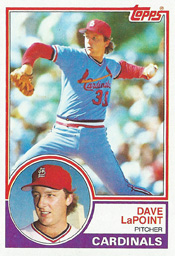
Looking to rebuild his reputation, Dave LaPoint returned to the organization where he felt the most comfortable and had enjoyed his greatest success.

dave_lapointOn Jan. 19, 1987, LaPoint, a free agent, signed with the Cardinals, who expected him to compete for a spot in their starting rotation.
At 27, his career was at a crossroads.

Five years earlier, LaPoint, a left-hander, helped the Cardinals win the 1982 National League pennant and World Series championship.

After the Cardinals traded him in February 1985, LaPoint’s career spiraled. He pitched for three teams in two years, posting losing records at each stop, got traded twice and released once.

Out of shape and labeled a clubhouse jester, LaPoint said he was committed to rededicating himself to becoming a winner and was seeking a nurturing environment in which to attempt that comeback.

The 1987 Cardinals and manager Whitey Herzog provided the setting LaPoint sought.

Cards contributor

LaPoint’s tenure with the Cardinals began in December 1980 when he was acquired from the Brewers in a deal engineered by Herzog. The Cardinals traded Rollie Fingers, Ted Simmons and Pete Vuckovich for Sixto Lezcano, David Green, Lary Sorensen and LaPoint.

LaPoint’s breakthrough year was 1982. He began the season as a reliever and joined the starting rotation in May. LaPoint appeared in 42 games, including 21 as a starter, for the 1982 Cardinals and had a 9-3 record and 3.42 ERA. He started Game 4 of the 1982 World Series against the Brewers, yielded one earned run in 6.1 innings and got no decision in a 7-5 Milwaukee victory.

LaPoint earned 12 wins for the Cardinals in both 1983 and 1984.

When the Cardinals, seeking a run producer to replace George Hendrick, had a chance to get Jack Clark before the start of the 1985 season, they sent LaPoint, Green, Jose Uribe and Gary Rajsich to the Giants.

Rick Hummel of the St. Louis Post-Dispatch later reported the Cardinals parted with LaPoint because they “thought he might be influencing young players unduly.”

Hummel described LaPoint as a “leader in clubhouse revelry” and “a top consumer of the owner’s (Anheuser-Busch’s) product.”

Prodigal son

LaPoint had a 7-17 record for the 1985 Giants, who traded him to the Tigers after the season.

LaPoint and Tigers manager Sparky Anderson were a bad match. “I couldn’t get along with Sparky,” LaPoint said. After posting a 3-6 record and 5.72 ERA for the Tigers, LaPoint was traded to the Padres in July 1986. He was 1-4 for the Padres, who released him after the season.

LaPoint decided to make changes. Weighing between 230 and 240 pounds, he dropped to 220.

The Expos and Giants wanted to sign LaPoint, but he chose the Cardinals, whose offer of a base salary of $125,000 was a cut from his $550,000 contract in 1986.

“It feels finally that I’m back where I belong,” LaPoint said. “… In talking to Whitey, he said he would use me like he did in ’82. That’s fine with me. It got me a World Series ring.”

Asked his reaction to LaPoint rejoining the Cardinals, center fielder Willie McGee said, “I like him … He’s kind of a clown, but that’s Dave LaPoint.”

It’s a reputation LaPoint said he was determined to change.

“I used to mess around during drills and I don’t do that anymore,” LaPoint said after reporting to Cardinals camp. “… It was time to put a stop to it.”

Redbird reliever

LaPoint had a successful spring training. He was 2-0 with a 2.34 ERA in 15.1 innings pitched in Grapefruit League exhibition games.

The Cardinals opened the 1987 regular season with five left-handers: starters John Tudor and Greg Mathews and relievers Ricky Horton, Pat Perry and LaPoint. (Ken Dayley, another left-handed reliever, was on the disabled list.)

In his first appearance for the 1987 Cardinals, on April 10 against the Pirates at Pittsburgh, LaPoint took the loss when he yielded a RBI-double to Sid Bream in the bottom of the ninth. Boxscore

LaPoint was scheduled to make a start April 25, 1987, versus the Mets at New York, but that plan was scratched when the Cardinals called up Joe Magrane from the minors and put the rookie left-hander into the rotation.

LaPoint remained in the bullpen and largely was ineffective.

He got a win on April 18, 1987, against the Mets at St. Louis, but didn’t perform well. In the 10th, LaPoint threw a wild pitch, enabling Al Pedrique to score from third with the go-ahead run. LaPoint was rescued when the Cardinals scored five times off Jesse Orosco in the bottom half of the inning. Tom Pagnozzi’s RBI-single tied the score at 8-8 and Tommy Herr’s grand slam made LaPoint the winner. Boxscore

On the road again

With his ERA at 6.75 after four relief appearances, LaPoint was demoted to Louisville on April 27, 1987. LaPoint had the option of declaring himself a free agent, but agreed to return to the minor leagues for the first time since 1981.

Placed in the starting rotation by Louisville manager Dave Bialas, LaPoint lost his first three decisions, but found his groove. He completed four of his last five starts for Louisville and had a 5-5 record when he was recalled by the Cardinals on July 8, 1987.

“It was the best thing in the world for me,” LaPoint said of his stint in the minors. “… I’ve learned to pitch a little different style.”

LaPoint made two July starts for the Cardinals and got no decision in either.

On July 30, 1987, the Cardinals traded LaPoint to the White Sox for minor-league pitcher Bryce Hulstrom.

“LaPoint’s main problem has been control,” the Post-Dispatch reported. “If he gets the ball up, he gets hammered. It usually takes him a couple of innings to find the strike zone and by then the game usually is out of control.”

After posting a 1-1 record and 6.75 ERA for the 1987 Cardinals, LaPoint was 6-3 with a 2.94 ERA for the 1987 White Sox.

The Cardinals, helped by a combined 30 wins from left-handed starters Mathews, Tudor and Magrane, finished 95-67 and won the pennant.

Previously: Trade for Jack Clark shook Cards from their slumber

Read Full Post »

(Updated Feb. 26, 2023)

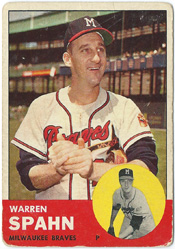
Given a choice of facing Del Ennis or Stan Musial with runners in scoring position and the game on the line, Warren Spahn did what no other big-league pitcher had done before him: He opted to pitch to Musial.

warren_spahnIt was the only time in Musial’s illustrious 22-year Cardinals career that a pitcher intentionally walked a batter in order to get to him.

It happened on Aug. 17, 1957, when the Cardinals and Braves played at Milwaukee’s County Stadium.

Pennant race

The slumping Cardinals, who had lost nine in a row, were fighting to remain in the 1957 National League pennant race when they went to Milwaukee for a four-game series in August. The Braves, riding a 10-game winning streak, were in first place, 7.5 games ahead of the Cardinals.

St. Louis won the series opener, 6-2, behind the slugging of Ennis, who hit a three-run home run off Juan Pizarro.

Game 2 of the series matched Larry Jackson of the Cardinals against Lew Burdette. The Cardinals jumped ahead with three runs in the first, but the Braves came back with two in the sixth and one in the eighth, tying the score at 3-3.

Managerial moves

Don McMahon, a rookie, relieved Burdette in the ninth. After Eddie Kasko grounded out, Jackson hit a broken-bat pop fly to right that fell safely in front of Bob Hazle for a single. The next batter, Ken Boyer, reached base when shortstop Felix Mantilla booted a grounder for an error.

With Wally Moon at the plate, McMahon’s first pitch eluded catcher Del Crandall for a passed ball. Jackson advanced to third on the play and Boyer to second.

Braves manager Fred Haney lifted McMahon and brought in Spahn, a left-hander, to face Moon, a left-handed batter, with the count at 1-and-0.

Two nights earlier, on Aug. 15, Spahn started against the Reds at Cincinnati and pitched a complete game in an 8-1 Braves victory. With one day of rest, the Braves ace was making his fourth and final relief appearance of the season.

Unforgettable ploy

Cardinals manager Fred Hutchinson countered by bringing in Ennis, who batted from the right side, to replace Moon.

Ennis, batting .275 with 17 home runs, was a threat, but he was no Musial. At 36, Musial was batting .333 and would finish the year at .351, earning his seventh National League batting crown.

With first base open, Spahn issued an intentional walk to Ennis, loading the bases with one out and bringing Musial, a left-handed batter, to the plate.

In his autobiography “Stan Musial: The Man’s Own Story,” Musial said the sight of Spahn walking Ennis to face him is one “I’ll never forget.”

Musial rapped a groundball to the second baseman, friend and former teammate Red Schoendienst, who fielded the ball and flipped it to Mantilla for the force of Ennis at second. Mantilla’s relay throw to first baseman Frank Torre was in time to retire Musial, completing the inning-ending double play.

“He’s the only pitcher ever to walk a batter to face me,” Musial said in his book.

Musial told writer Roger Kahn, “Spahnie knew everything about his profession, and he was smart enough to change before he had to … He began tinkering with a screwball, and as the fastball began to go, he’d come at you with the screwgie. Then came the slider.”

Back and forth

The drama wasn’t over. Braves center fielder Hank Aaron had a large role to play in the outcome.

In the 11th, with Spahn pitching, Don Blasingame led off and stretched a single into a double. Kasko grounded out to second, advancing Blasingame to third.

Jackson was due up next, but Hutchinson sent Walker Cooper, 42, to bat for the pitcher. Cooper lifted a sacrifice fly to left, scoring Blasingame and giving the Cardinals a 4-3 lead.

Billy Muffett, a rookie, was Hutchinson’s choice to pitch the bottom half of the inning. Muffett retired the first batter, Schoendienst, on a pop-up.

The next batter, Frank Torre, hit a low line drive to left. Ennis lumbered in, got a glove on the ball and dropped it. Torre, credited with a single, was replaced by pinch-runner Hawk Taylor.

Eddie Mathews followed with a single to center and Taylor advanced to third.

That brought Aaron to the plate.

Hank hammers

Aaron was angry. In the ninth, Jackson moved Aaron off the plate with a high, tight pitch. Aaron, in comments to the Associated Press, accused Jackson of “trying to stick one in my ear.”

“It’s on purpose,” Aaron said. “I can tell when they’re throwing at me.

“If that’s the only way they can win a ballgame, they ought to get other jobs. I don’t mind being brushed back _ you expect that _ but I don’t like them balls aimed at my head. We don’t knock Stan Musial down, so why do they do it to me?”

Aaron hit Muffett’s first pitch into right-center for a two-run double, giving the Braves a 5-4 victory and making a winner of Spahn. Boxscore

The Braves went on to clinch the pennant Sept. 23 on Aaron’s 11th-inning walkoff home run against Muffett. Boxscore

Previously: Del Ennis provided power in Cardinals lineup

Read Full Post »

Three days after making his major-league debut with his hometown team, infielder Bob Sadowski was traded by the Cardinals for a player they thought could challenge Curt Flood for the center field job.

robert_sadowskiThe deal sent Sadowski on an odyssey during which he played for three big-league clubs in the next three years before returning to the minors, including a second stint in the Cardinals system.
Talented infielder

Born and raised in St. Louis, Sadowski played baseball at Webster Groves High School and with the Maplewood American Legion team. A teammate on both clubs was future Cardinals outfielder Charlie James.

In 1955, when Sadowski was 18, he impressed the Cardinals at a tryout camp and they signed him to a contract.

A left-handed batter who could play multiple positions, especially third base and second base, Sadowski established himself as a prime prospect with a strong season for the Billings Mustangs of the Class C Pioneer League in 1957. Sadowski batted .302 and produced 20 doubles, 13 triples and 15 home runs for Billings.

Sadowski caught the attention of the Cardinals again in 1959 when he batted .290 with 24 doubles and 12 triples for Omaha of the Class AAA American Association.

Omaha manager Joe Schultz tabbed Sadowski as a player with a bright future. The Sporting News declared him “a talented infielder.” After the 1959 season, the Cardinals put Sadowski on their big-league roster.

Cardinals call

At Cardinals spring training camp in 1960, Sadowski developed astigmatism, making objects at a distance appear blurry or wavy, and eyeglasses were prescribed for him, The Sporting News reported.

He opened the 1960 season with the Cardinals’ affiliate at Rochester in the Class AAA International League. Batting .223 after 51 games, Sadowski was loaned to the White Sox Class AAA farm club in San Diego. He revived his career with the Pacific Coast League team, batting .340 in 64 games.

Impressed, the Cardinals promoted Sadowski to the big leagues in September 1960.

Debut at home

On Sept. 16, 1960, a Friday night at Busch Stadium in St. Louis, Sadowski, 23, lived a dream by making his major-league debut for the Cardinals.

After five innings, in a game delayed an hour and 32 minutes by rain, the Giants led, 6-0. Cardinals manager Solly Hemus made several substitutions, including putting in Sadowski at second base to replace Julian Javier.

Sadowski led off the St. Louis half of the sixth against reliever Stu Miller, formerly of the Cardinals, and grounded out to third baseman Jim Davenport.

In the eighth, Orlando Cepeda reached on an error by Sadowski. In the Cardinals’ half of the inning, Sadowski reached on a walk. He was stranded when Miller struck out Bill White and got Stan Musial and Ken Boyer on pop-outs. Boxscore

That one game would be Sadowski’s lone appearance with the Cardinals.

Trade bait

With Javier at second and Boyer at third, the Cardinals were strong in the two positions Sadowski played best. What the Cardinals thought they needed was to bolster the center field position. Flood, the everyday center fielder, hit .237 for the 1960 Cardinals. Hemus was seeking better production from that position.

On Sept. 19, 1960, the Cardinals acquired center fielder Don Landrum from the Phillies for Sadowski and four players on their Rochester roster _ outfielder Jim Frey, second baseman Wally Shannon, infielder Billy Harrell and pitcher Dick Ricketts.

Landrum, 24, had spent the 1960 season with the Phillies’ Class AAA farm club at Buffalo, where he batted .292 and led the International League in hits (178), doubles (35) and runs scored (112).

The Sporting News praised Landrum as being “a capable fly chaser who can also swing the bat.”

On the day of the trade, Landrum joined the Cardinals in time for their game that night against the Dodgers at St. Louis. He produced three singles and a stolen base. Two nights later, Landrum hit a home run and a triple off the Dodgers’ Don Drysdale.

Versatile prospect

Like the Cardinals, the Phillies had an established starter at second base in Tony Taylor. Sadowski was acquired to be a backup.

Under the headline “Phils Bolster Infield, Land Keystone Kid,” The Sporting News reported: “Because of his versatility, it is possible Sadowski might land a utility infield spot” with the 1961 Phillies.

Sadowski batted .130 in 16 games for the 1961 Phillies. He was traded to the White Sox after the season and hit .231 with six home runs for them in 79 games in 1962. Selected by the Angels in the Rule 5 draft, Sadowski hit .250 in 88 games for them in 1963.

Back where he began

Sadowski spent the rest of his playing days in the minor leagues. After starting the 1968 season with the Syracuse Chiefs, Sadowski rejoined the Cardinals’ organization and was assigned to the Class AAA Tulsa Oilers of the Pacific Coast League.

Playing for manager Warren Spahn, Sadowski, 31, filled a utility role and helped Tulsa to the league championship. “Sadowski’s hitting perked up the Oilers, especially over short stretches,” The Sporting News noted.

In 1969, his last season in organized baseball, Sadowski returned to the Angels’ organization as an infielder for the Class AA El Paso Sun Kings, who were managed by former Cardinals catcher Del Rice.

The Cardinals reacquired Sadowski in June 1969 and he finished the season with Class AA Arkansas and Class A Cedar Rapids.


Read Full Post »

(Updated July 29, 2018)

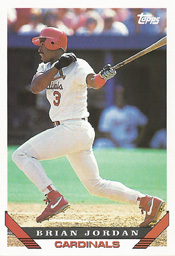
Brian Jordan produced his most important hit for the Cardinals against one of the all-time best relief pitchers.

brian_jordanFacing Trevor Hoffman in the ninth inning of Game 3 of the 1996 National League Division Series, Jordan hit a two-run home run, breaking a 5-5 tie and lifting the Cardinals to their first postseason series championship in nine years.

With 42 saves and nine wins, Hoffman had factored in 55 percent of the 92 regular-season victories achieved by the 1996 Padres.

In 2018, Hoffman was elected to the National Baseball Hall of Fame. His 601 saves rank second all-time behind the 652 by Mariano Rivera of the Yankees.

In a career filled with successes, one of Hoffman’s most glaring stumbles was in his first postseason against the Cardinals.

Key catch

After winning the first two games at St. Louis, the Cardinals were in position to clinch the best-of-five NL Division Series with a victory against the Padres at San Diego on Oct. 5, 1996.

The Padres led 4-1 after five innings, but the Cardinals rallied for three runs in the sixth and one in the seventh, taking a 5-4 lead.

In the eighth, Ken Caminiti hit a home run against Cardinals reliever Rick Honeycutt, tying the score. The Padres had a runner on second with two outs when Jody Reed hit a line drive to right-center. Jordan, the right fielder, dived and made an inning-ending catch. Video

“I think that was the most important play of the ballgame,” Jordan told the St. Louis Post-Dispatch. “If that ball gets by me, they’re going to score.”

Bruce Bochy, the Padres’ manager, brought in Hoffman to pitch the ninth. Hoffman got Ozzie Smith to line out to left before Ron Gant drew a walk. “I was high in the zone to Gant,” Hoffman told the San Diego Union-Tribune. “That wasn’t necessarily where I wanted to be.”

Up next was Jordan.

Delivering a dagger

Jordan led the 1996 Cardinals in RBI, with 104. He hit .367 with runners on base.

As a result of his diving catch the previous inning, Jordan’s neck and left shoulder stiffened when he got back to the dugout, but a quick massage from trainer Gene Gieselmann got Jordan ready to face Hoffman.

After working the count to 3-and-2, Jordan lined a pitch foul down the left-field line.

Jordan expected the next delivery to be a fastball, but Hoffman threw a slider.

Hoffman: “I hung it right over the middle.”

Jordan: “He threw me a slider up and I kept my hands back.”

Hoffman: “It wasn’t a high hanger. Brian had to go down and get it.”

Jordan: “If I miss that, I’m throwing my hat and my helmet down.”

Timing it right, Jordan swung and lofted the ball over the left-field wall. Boxscore

TV broadcaster Bob Costas described the home run as “a dagger through the heart” of the Padres. Video

Bernie Miklasz, Post-Dispatch columnist, rated Jordan’s jolt “the biggest St. Louis home run” since Jack Clark’s pennant-clinching shot against the Dodgers in the ninth inning of Game 6 of the 1985 NL Championship Series.

“I’ve always wanted to play in pressure situations,” Jordan said. “… To see that ball come down, over the fence, it was satisfying.”

Said Hoffman: “On 3-and-2, he’s looking to drive the ball and I gave him a pitch to do it … It was the right pitch in that situation. Unfortunately, the execution wasn’t quite there and I got bit in the butt.”

Previously: Cardinals dealt Trevor Hoffman first defeat

Previously: How Tony Gwynn tormented Dennis Eckersley

Previously: Why Jack Clark got chance to put Cards in World Series

Read Full Post »

« Newer Posts - Older Posts »