Feeds:
Posts
Comments

Archive for the ‘Games’ Category

Cardinals third baseman Scott Rolen followed the most consistently excellent regular-season performance of his career with a postseason effort that was extraordinarily erratic.
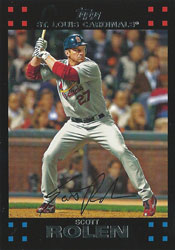
scott_rolen2In 2004, the Cardinals won three of four games against the Dodgers in the National League Division Series, even though Rolen went hitless.

Super season

In the 2004 regular season, Rolen achieved career highs in home runs (34), RBI (124), batting average (.314), on-base percentage (.409) and slugging percentage (.598). His RBI total was second only to the 131 of the Rockies’ Vinny Castilla in the National League.

Rolen also was named a National League all-star in 2004, won a Gold Glove Award and finished fourth in the league’s Most Valuable Player Award balloting, behind Barry Bonds of the Giants, Adrian Beltre of the Dodgers and teammate Albert Pujols.

However, Rolen missed 16 games from Sept. 11 through Sept. 27 because of a calf strain. He still was experiencing soreness in the calf when the Cardinals opened the Division Series versus the Dodgers on Oct. 5, but he told the St. Louis Post-Dispatch he was “close to being close” to 100 percent.

Like 0-for-a-zillion

What happened next was unexpected. Rolen played in all four game of the Division Series and was hitless in 12 at-bats. He did walk six times, so along with a .000 batting average for the series Rolen had a .333 on-base percentage.

Batting in the cleanup spot, Rolen drew three walks in Game 4, a 6-2 Cardinals victory that eliminated the Dodgers and advanced St. Louis to the National League Championship Series versus the Astros. Boxscore

Said Rolen, who had sat out most of the 2002 postseason because of a shoulder injury: “I’m standing here after going 0-for-a-zillion and this feels so much better (than 2002). We’ve put ourselves in a position to do something special and I’m just glad to be part of it.”

Asked by Derrick Goold of the Post-Dispatch how he planned to end his slump before facing the Astros, Rolen replied, “I’m going to assess, approach, focus … Oh, that sounded pretty corny. A LaRussaism. He’s getting it in my head. That’s what Tony would say.”

Actually, what Cardinals manager Tony La Russa told Goold was: “Sometimes you have to go beyond the stats. (Rolen) was not a hitless hitter in the Dodgers series. You watch his at-bats, he had tough bases on balls.”

Timing is key

Cardinals hitting coach Mitchell Page said he told Rolen that six walks are as good as six singles.

“What six walks tells you is that they were pitching him careful,” Page said. “They weren’t just going to put something down the middle for him to hit.”

Rolen, though, acknowledged he had fouled off pitches he should have stroked for hits.

“My timing might have been here and there,” said Rolen. “I’m pulling some balls foul that I don’t normally pull foul.”

Rolen recovered, hitting .310 (9-for-29) with three home runs and six RBI in the League Championship Series. He produced the key hit, a two-run home run off Roger Clemens that snapped a 2-2 tie in the sixth inning of Game 7 and lifted St. Louis to a 5-2 pennant-clinching victory. Boxscore

Then, in the World Series versus the Red Sox, Rolen slumped again, going hitless in 15 at-bats.
Read Full Post »

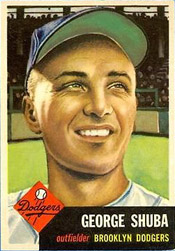
George “Shotgun” Shuba wasn’t an all-star, but he played like one against the Cardinals.

george_shubaIn seven seasons (1948-50, 1952-55) as a Dodgers outfielder, Shuba hit .259.

His career batting average against the Cardinals: .337 (33-for-98).

As a rookie in 1948, Shuba hit .267 in 63 games for the Dodgers.

Against the Cardinals that season, Shuba hit .385 (10-for-26), including .471 (8-for-17) at St. Louis’ Sportsman’s Park.

In his 1971 book “The Boys of Summer,” Roger Kahn wrote of Shuba, “His abiding love was hitting. All the rest was work. But touching a bat, blunt George became The Shotgun, spraying line drives with a swing so compact and so fluid that it appeared as natural as a smile.”

Two of the best performances of Shuba’s career came versus the Cardinals as a rookie.

Double trouble

On July 18, 1948, in the second game of a doubleheader at St. Louis, Shuba, a left-handed batter, was a prominent part of a Dodgers onslaught.

Brooklyn scored 13 runs in the first two innings. Each of the first 17 Dodgers batters reached base safely. Each of the three outs in the five-run Dodgers first was recorded on the base paths. The 17 reached base on four doubles, five singles, six walks and two force outs.

In the first, after Pee Wee Reese doubled and Jackie Robinson walked, Jim Hearn’s first two pitches to Gene Hermanski missed the plate.

Cardinals manager Eddie Dyer lifted Hearn and replaced him with Al Brazle. Hermanski drew a walk, loading the bases.

Shuba then ripped a two-run double.

In the second, with Gerry Staley pitching, Shuba doubled again, scoring Robinson, who had singled.

Shuba finished 3-for-5 with 3 RBI and 2 runs scored, sparking the Dodgers to a 13-4 triumph. Boxscore

Cardinals nemesis

The next month, Aug. 30, 1948, Shuba led the Dodgers to an improbable comeback victory versus the Cardinals in the first game of a doubleheader at St. Louis.

Cardinals starter Murry Dickson carried a 5-2 lead into the ninth. Hermanski led off with a single and Shuba followed with a double, advancing Hermanski to third. Pete Reiser doubled, driving in Hermanski and Shuba and cutting the Cardinals’ lead to 5-4.

Ted Wilks relieved Dickson. After the Dodgers tied the score at 5-5, Shuba came to the plate with Arky Vaughan on third and Bruce Edwards on first, one out.

Shuba singled to right, scoring Vaughan with the run that completed a four-run ninth and brought the Dodgers a 6-5 victory. Boxscore

Of all the Cardinals pitchers Shuba raked during his career, Wilks was his favorite. Shuba hit . 833 (5-for-6) with 4 RBI vs. Wilks.

Shuba had two other noteworthy games against the Cardinals.

He drove in three runs, including a two-run, two-out home run off Joe Presko, in a 10-4 Dodgers victory over the Cardinals on Aug. 24, 1952, at St. Louis. Boxscore

A year later, Aug. 1, 1953, Shuba was 3-for-4 with two runs scored in the Dodgers’ 11-4 win against the Cardinals at St. Louis. Boxscore

Previously: How Andy Pafko gave Cardinals inside-the-glove home run

Previously: Duke Snider, Stan Musial put on big show

Read Full Post »

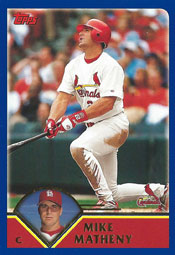
mike_matheny8Catcher Mike Matheny played a big role for the Cardinals in the 2004 National League Division Series versus the Dodgers.

On Oct. 5, 2004, Matheny contributed a solo home run against reliever Elmer Dessens in the Cardinals’ 8-3 victory in Game 1 of the best-of-five series at St. Louis.

Cardinals fans rewarded him with an ovation and urged a curtain call. A hesitant Matheny went to the top step of the dugout and acknowledged the sustained applause.

“It’s a huge honor,” Matheny, 34, said to the St. Louis Post-Dispatch. “It’s taken me five years (with the Cardinals) and this is the first year I’ve had one. I didn’t know how to get out there.” Boxscore

Hot hitter

Two days later, on Oct. 7, 2004, the Cardinals entered Game 2, knowing a victory would give them control of the series.

In the fifth inning, with the Cardinals ahead, 4-3, Matheny batted against starter Jeff Weaver with the bases loaded, two outs, and stroked a two-run single to center, giving the Cardinals a 6-3 lead and knocking Weaver out of the game.

“He gets fired up,” Cardinals manager Tony La Russa said.

Dan Haren, who followed starter Jason Marquis and Cal Eldred, held the Dodgers scoreless in the fifth and sixth, stabilizing the game for St. Louis. It was an impressive effort for a pitcher making his first postseason appearance.

A grateful La Russa called Haren, 24, “a cool dude” and “tough as nails” and said Haren’s shutdown of the Dodgers “turned the momentum.”

Said Matheny: “He came into a tough situation and made pitches right away.”

RBI record

In the seventh, the Cardinals, looking to stretch their three-run lead, had Reggie Sanders on second and Edgar Renteria on third, with two outs. Though first base was open and pitcher Ray King was on deck, the Dodgers decided to pitch to Matheny and he singled to left off a first-pitch curve from Giovanni Carrera, scoring both runners. The Cardinals won by the same score as the opener, 8-3. Boxscore

“The hit (Matheny) got off Weaver, he hit a good pitch,” said Dodgers manager Jim Tracy. “It was a breaking ball down and away and he got it. In the seventh, that wasn’t a good pitch.”

Wrote Post-Dispatch columnist Bernie Miklasz: “The Dodgers probably wonder how it is that Matheny became Johnny Bench.”

Matheny became the first Cardinals hitter to produce four RBI in a Division Series game.

“I know that I haven’t put up huge (regular-season) numbers offensively, but I also know what my purpose is on this team,” Matheny said. “First of all, it’s behind the plate _ and I put a whole lot more pressure and expectations on myself back there.”

The Cardinals eliminated the Dodgers with a Game 4 triumph, advancing to the National League Championship Series against the Astros. The Cardinals beat the Astros in four of seven games, winning their first pennant in 17 years and progressing to the World Series against the Red Sox.

Previously: Why Mike Matheny ended his playing career as a Giant

Previously: Pitcher for 1964 Cardinals was mentor to Mike Matheny

Read Full Post »

On the final day of the 1934 season, in a feat that combined endurance with skill, Dizzy Dean carried the Cardinals to the National League pennant by pitching his second shutout in the span of 48 hours.

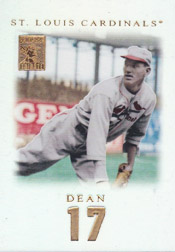
dizzy_dean6On Sept. 30, 1934, Dean earned his 30th win of the year in the Cardinals’ 9-0 victory over the Reds at St. Louis. Dean became the last National League pitcher to achieve 30 wins in a season and the first since Grover Cleveland Alexander of the 1917 Phillies.

Dean’s performance enabled the Cardinals to finish a game ahead of the Giants and propelled them into the World Series against the Tigers.

September sizzle

The Cardinals, who trailed the first-place Giants by seven games on Sept. 7, won nine of 10 between Sept. 16 and Sept. 25.

On Sept. 28, the Cardinals were a half-game behind the idle Giants entering a Friday afternoon game against the Reds at St. Louis. Dean started and pitched a shutout. The 4-0 victory moved the Cardinals into a first-place tie.

The next day, after the Cardinals beat the Reds and the Giants lost to the Dodgers, St. Louis was alone in first place with a game remaining.

Cardinals manager Frankie Frisch chose Dean to start the Sept. 30 finale. It would be Dean’s fifth appearance in eight days.

Personal quest

In the book “Ol’ Diz,” author Vince Staten wrote, “Diz had made it his personal quest to pitch the Cardinals into the World Series. He wanted the ball every day.”

The Cardinals could clinch the pennant _ their fifth in nine years _ on Sept. 30 with a win over the Reds, or a Giants loss to the Dodgers. If the Cardinals lost and the Giants won, a playoff would be needed to determine the league champion.

“Give me a couple or three runs _ there ain’t going to be any playoff,” Dean said to his teammates.

Playing at the Polo Grounds, the Giants scored four in the first, but the Dodgers rallied. The score was tied at 5-5 after nine innings.

At St. Louis, before a packed house of 35,274, Dean and the Cardinals were cruising. Bill DeLancey drove in four runs. Rip Collins hit a two-run home run for his 200th hit of the season.

Fastballs like pistol shots

Entering the ninth, the Cardinals led, 9-0.

In the book “Diz,” author Robert Gregory wrote, “He was working on a five-hitter, his second straight shutout, and with fastballs that sounded like pistol shots he had made it a calm, effortless, one-sided game.”

The Reds, though, opened the ninth with two hits and a walk, loading the bases.

“Grinning in that cocksure way of his, Dizzy arose to the heights,” the Associated Press reported.

Dean struck out Clyde Manion.

Ted Petoskey was up next.

With the count 0-and-2, the scoreboard posted the final from the Polo Grounds:

Dodgers 8, Giants 5, in 10 innings.

The loss eliminated the Giants and assured the Cardinals the pennant.

All that remained to be settled was whether Dean would get the shutout.

Finish with a flourish

Petoskey struck out.

Sparky Adams followed by fouling out to the catcher.

Dean completed the shutout in 2:01. Boxscore

“A few minutes later … five cops were escorting Diz to the dugout as thousands of fans swept onto the field,” Gregory wrote.

The Cardinals celebrated their pennant by swigging soda pop.

Dean, though, “his eyes glazed with fatigue, was unusually quiet and bumming cigarettes.”

The final stats for Dean that season: 30-7 record, 2.66 ERA, 50 games pitched, 33 starts, 24 complete games, seven shutouts and 311.2 innings pitched.

Dean won Games 1 and 7 of the 1934 World Series and was chosen the recipient of the National League Most Valuable Player Award.

Previously: Cardinal cool: How Dizzy Dean survived armed robbery

Previously: Why Cardinals dealt Dizzy Dean to Cubs

Read Full Post »

(Updated Sept. 27, 2019)

In late September 1964 the Cardinals were five games behind the first-place Phillies entering a five-game series against the Pirates at Pittsburgh.

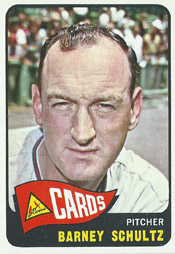
barney_schultzWith 11 games remaining in the regular season, Cardinals outfielder Bob Skinner said to teammate Dick Groat, “OK, Dick, the only thing we have to do is sweep the Pirates in five,” according to the book “October 1964.”

Skinner and Groat, both former Pirates, knew how unlikely it was for any club to accomplish such a task at Pittsburgh.

However, the Cardinals won both games of a doubleheader versus the Pirates on Sept. 24 and followed that with wins at Pittsburgh on Sept. 25 and Sept. 26.

In the series finale, played in a light rain on Sept. 27, 1964, the Cardinals started Roger Craig, who’d lost four consecutive decisions.

Craig delivered a stellar start, holding the Pirates scoreless and limiting them to six singles through 7.2 innings.

Save for Schultz

In the eighth, with the Cardinals ahead, 3-0, the Pirates had runners on first and second, two outs, when Cardinals manager Johnny Keane brought in knuckleball specialist Barney Schultz to face Roberto Clemente, who represented the tying run.

The odds seemed stacked in favor of Clemente, who hit .361 with runners in scoring position in 1964, but Schultz struck him out. Throwing nothing but knucklers, Schultz got Clemente to lunge for one and miss on a 2-and-2 count.

The Cardinals scored twice in the ninth and Schultz retired the Pirates in order in the bottom half of the inning, preserving a 5-0 St. Louis victory. Boxscore

In sweeping the five games at Pittsburgh, the Cardinals played nearly flawless baseball, committing one error and holding the Pirates to eight total runs.

“That was a disgrace in Pittsburgh,” Phillies scout Don Hoak, a former Pirates third baseman, said to Groat. “They just handed you five games.”

Groat replied, “You forgot to mention the most important thing about those five games _ that we didn’t make a single mistake in all five of them.”

Pennant push

The sweep moved the Cardinals 1.5 games behind the Reds, who had gone into first place as the fading Phillies lost their seventh in a row.

Pirates manager Danny Murtaugh said the Cardinals “looked like they mean business. They’re putting everything together,” the Pittsburgh Press reported.

Arriving at the St. Louis airport after their flight from Pittsburgh, the Cardinals were greeted by an adoring crowd of at least 8,000, The Sporting News reported.

“The adrenaline was flowing,” Cardinals outfielder Carl Warwick said to Peter Golenbock in the book “Spirit of St. Louis.” “All of a sudden you’re saying, ‘We’re not out of this thing.’ ”

Craig told the St. Louis Post-Dispatch, “Our guys believe they can win. They know we have the best club in the league.”

Finishing the season in St. Louis, the Cardinals won four of their last six against the Phillies and Mets, winning the pennant by a game over both the Phillies and Reds.

Previously: Why Gussie Busch fired Bing Devine in championship year


Read Full Post »

Grant Dunlap possessed a variety skills. He was a winning coach in multiple sports, an accomplished author and a pinch-hitter deluxe for the Cardinals.

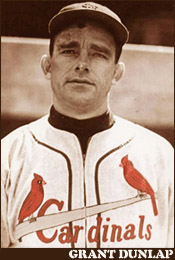
grant_dunlapDunlap played his lone big-league season with the 1953 Cardinals.

A Stockton, Calif., native, Dunlap, 17, was signed by the Reds in 1941. He was given an $870 bonus and used the money to pay for surgery for his mother. A year later, he joined the Marines, became an officer and served in the South Pacific and China during World War II.

In 1952, Dunlap was the Texas League batting champion, hitting .333 for Shreveport. The first baseman, a right-handed hitter, was purchased by the Cardinals in December 1952 and placed on the big-league roster. The Cardinals said Dunlap would compete with Steve Bilko and Dick Sisler for the everyday first base role.

Ready to hit

A 29-year-old rookie, Dunlap made a favorable impression when he joined the Cardinals at their spring training camp at St. Petersburg, Fla., in February 1953.

In its March 11 edition, The Sporting News reported, “Perhaps the outstanding ‘sleeper’ in camp is Grant Dunlap … In the early batting drills, he attracted attention and in the first squad game he swung at the first pitch and whacked the ball far over the left field wall into Tampa Bay. Dunlap looks like a hitter. He poises his bat and is ready for every pitch.”

Said Cardinals manager Eddie Stanky: “Dunlap looks pretty shifty around first base, too.”

Two weeks later, The Sporting News wrote, “Grant Dunlap is another substantial hitter on the Cardinals squad and may remain because of his prowess with the war club.”

Wounded warrior

Late in spring training, during an exhibition game against the Braves, Dunlap suffered an injury that derailed his chances of winning the first base job. After stroking a single, Dunlap was on first when Hal Rice hit a grounder to second baseman Jack Dittmer. Dunlap braked to avoid a tag and Dittmer threw out Rice at first.

First baseman Joe Adcock then pursued Dunlap, who got trapped in a rundown. In the frenzy, Adcock accidently stepped on Dunlap’s left foot. Dunlap suffered “a five-suture spike wound” near the instep and was “carried off the field on a stretcher to minimize bleeding,” The Sporting News reported.

Bilko opened the season as the Cardinals’ starting first baseman. Stanky kept Dunlap on the roster as a pinch-hitter.

St. Louis slugger

Dunlap’s first two big-league hits were significant.

In his third big-league at-bat, Dunlap got his first hit _ a pinch-hit home run off Ken Raffensberger in a 5-2 Reds victory at Cincinnati on May 10, 1953. Boxscore

A month later, Dunlap got his second hit and it produced a Cardinals victory.

On June 12, 1953, at New York’s Polo Grounds, the Giants led the Cardinals, 1-0. In the seventh, with Cardinals runners on first and second, one out, Dunlap drove a pinch-hit triple off the right field wall against Dave Koslo. Ray Jablonski and Rip Repulski scored, giving the Cardinals a 2-1 lead. Pitcher Harvey Haddix ran for Dunlap and scored on Solly Hemus’ sacrifice fly. The Cardinals won, 3-1. Boxscore

Used primarily as a pinch-hitter, Dunlap batted .353 (6-for-17) for the Cardinals, but couldn’t displace Bilko at first base and wasn’t getting at-bats. In August, the Cardinals sent Dunlap to their minor-league affiliate at Houston. Stanky predicted Dunlap would be “a terrific man” for Houston given the chance to play regularly.

On Aug. 11, 1953, Dunlap went 5-for-5 for Houston in a game against Dallas. He hit .277 in 35 games for Houston.

Life after baseball

After the season, the Cardinals sold Dunlap’s contract to their Rochester affiliate. In December 1953, Rochester traded Dunlap to another Class AAA club, Minneapolis, for pitcher Bill Connelly.

Dunlap spent the 1954 and 1955 seasons in the minor leagues. Then he began a successful second career.

An all-conference baseball and basketball player at Occidental College, Dunlap returned to the Los Angeles school in 1955 and coached both sports teams.

In 30 years as Occidental baseball coach, Dunlap had a 510-316 record and won nine conference titles. He was 205-156 with five league championships in 16 years as Occidental basketball coach. Dunlap also was the Occidental athletic director from 1971-76. He retired in 1984.

Dunlap wrote an acclaimed mystery novel “Kill the Umpire” that was published in 1998. Dunlap was praised for his vivid, lively prose, drawing on his minor-league experience to recreate the feel of the Texas League towns of the 1940s and what it was like to be a ballplayer in that time. The book is available on Amazon.

Previously: Like Polish Falcons, 2013 Cardinals soar with doubles

Previously: The story of how Tom Alston integrated Cardinals

Read Full Post »

« Newer Posts - Older Posts »