Feeds:
Posts
Comments

Archive for the ‘Games’ Category

(Updated April 7, 2016)

In 1963, Cardinals starters opened the season by pitching shutouts in the team’s first three games.

curt_simmons2The 1963 Cardinals and 2016 Dodgers are the only major-league teams to start a season with three consecutive shutouts, according to the Elias Sports Bureau.

The Cardinals opened with wins of 7-0 and 4-0 over the Mets and 7-0 against the Phillies. Surprisingly, Bob Gibson didn’t pitch any of those games.

The Cardinals’ consecutive trio of shutouts were pitched by Ernie Broglio, Ray Washburn and Curt Simmons. Gibson, the Cardinals’ ace, had fractured his ankle in September 1962 and was being given extra time by manager Johnny Keane before making his first 1963 start. (Gibson’s 1963 debut came in the Cardinals’ sixth game.)

In previewing the 1963 season, The Sporting News had predicted success for the Cardinals’ rotation:

Keane does seem to have a fine front line of pitchers. (Ernie) Broglio, Bob Gibson and Ray Washburn are good enough to be named now among the National League hurlers likely to win 20 games in 1963. All have pitched brilliantly in exhibition games. Broglio is throwing with the smoothness that marked his work in 1960 and Gibson has given no indication that the fractured ankle will bother him at all. Washburn profited greatly by his two months in the winter instructional league.

Here’s how the 1963 Cardinals opened their season:

_ Cardinals 7, Mets 0, April 9, 1963, at New York: Broglio limited the Mets to two hits, both by second baseman and leadoff batter Larry Burright. Broglio retired 20 in a row from the second inning to the ninth. He walked two and struck out eight.

Burright led off the first with a single and Broglio held the Mets hitless until Burright led off the ninth with a double.

Broglio preserved the shutout by striking out catcher Choo Choo Coleman and retiring outfielders Ed Kranepool and Duke Snider on groundouts after Burright’s double. Boxscore

“We had trouble hitting, which is going to be a big problem all year,” Mets manager Casey Stengel said to the Associated Press after the game.

_ Cardinals 4, Mets 0, April 10, 1963, at New York: Washburn held the Mets to four singles (two by Kranepool and one each by Coleman and first baseman Tim Harkness) and retired 17 in a row from the second inning to the eighth. He walked one and struck out five. Boxscore

Wrote The Sporting News: Washburn’s route-going performance was especially eye-popping because he went all the way in only two of his 25 starts in his rookie campaign a year ago.

“I had good stuff and kept it all the way,” Washburn said. “I made some real good pitches on (slugger) Frank Thomas. He used to bother me quite a bit.”

Cardinals catcher Gene Oliver said Washburn’s successful outing was “mostly a matter of confidence and experience, knowing that he can throw any kind of pitch in a given situation instead of coming in with a fastball or slider most of the time.”

_ Cardinals 7, Phillies 0, April 13, 1963, at St. Louis: After a two-day break, the Cardinals won their home debut. Simmons pitched a five-hitter, walked two and struck out four. No Phillies baserunner reached third base. Boxscore

It was Simmons’ 10th win in 11 decisions against the Phillies since he signed with the Cardinals after his release by Philadelphia in May 1960.

Simmons set the tone in the first inning when Don Hoak, the Phillies’ third baseman and No. 2 batter, dropped to the ground to avoid being struck by a high and tight pitch. Hoak subsequently struck out.

“He (Simmons) has been doing that to me for years and I’ve taken all I’m going to,” Hoak said to The Sporting News. “The next time, I’m going after him.”

Unfazed, Simmons responded, “He’s not a good enough hitter to bother throwing at.”

Previously: Kyle Lohse effort is similar to Ernie Broglio classic in 1963

Read Full Post »

(Updated Jan. 13, 2025)

Lacking an “h” in his first name was one of many differences between Cris Carpenter and the successful Cardinals ace of the similar name, Chris Carpenter. Still, there was a time when Cris Carpenter was regarded as a top talent in the St. Louis system.

cris_carpenterChris Carpenter, signed as a free agent by the Cardinals in December 2002, posted a 95-44 regular-season record in nine years with St. Louis (2004-2012)

Cris Carpenter, from the University of Georgia, was a first-round pick of the Cardinals in the 1987 amateur draft. He was the 14th overall selection, ahead of No. 1 picks such as the Astros’ Craig Biggio (22nd overall), the Orioles’ Pete Harnisch (27th) and the Tigers’ Travis Fryman (30th).

“No way I thought he would last until 14th, but he did,” Cardinals scouting director Fred McAlister told Cardinals Yearbook in 1988. “He might be the best pitcher in that draft.”

Afterward, Cris Carpenter spent the summer of 1987 pitching for Team USA in the Pan American Games. He was 6-1 with five saves and a 1.37 ERA. He signed with the Cardinals in September 1987.

Cris Carpenter began his first professional season as a starter for Class AAA Louisville in 1988. After seven appearances, he was called up to the Cardinals and started against the Braves in his major-league debut on May 14, 1988. The Braves were the boyhood favorite of Cris Carpenter, who grew up in Gainesville, Ga.

“It’s hard to believe I’ll be pitching against the Braves,” Cris Carpenter said to the St. Louis Post-Dispatch. “I watched Dale Murphy on television for so many years, but to see him in person and pitch against him … It’s going to be fun.”

Cris Carpenter’s debut game turned out to be one of the most memorable in Cardinals lore. The Braves won, 7-5, in 19 innings. Infielder Jose Oquendo pitched the final four innings for St. Louis and took the loss. Carpenter yielded five runs in six innings. Murphy was 0-for-2 with a walk against Carpenter. Boxscore

In five years (1988-92) with St. Louis, Cris Carpenter was 21-15 with a 3.66 ERA, primarily as a reliever. Under manager Joe Torre, Carpenter was 10-4 with a 4.23 ERA in 59 relief appearances in 1991 and 5-4 with a 2.97 ERA in 73 relief appearances in 1992.

The Cardinals made Cris Carpenter available in the National League expansion draft in November 1992 and he was selected by the Marlins. “He lost his confidence and tried to guide the ball,” Torre said. “When he gets into that mode of trying to guide the ball, he gets burned.”


Read Full Post »

One of the most glorious seasons in Cardinals history was the most painful in the 13-year big-league career of Gus Triandos.

gus_triandosTriandos was a catcher with the 1964 Phillies, whose late-season collapse enabled the Cardinals to surge to the National League pennant and a World Series title.

A right-handed batter who three times slugged more than 20 home runs in a season for the Orioles, Triandos, 34, was nearing the end of his playing days when he platooned with Clay Dalrymple on the 1964 Phillies.

Though he broke into the majors with the Yankees in August 1953, Triandos never had appeared in a World Series. He spent most of his career with the Orioles before he was traded with outfielder Whitey Herzog to the Tigers in November 1962.

After a season with Detroit, he was dealt with pitcher Jim Bunning to the Phillies in December 1963.

The Phillies had finished last in the National League each season from 1958 through 1961. They hadn’t won a pennant since 1950. But amazing things began to happen for Triandos and the 1964 Phillies.

Triandos dubbed 1964 “the season of the blue snow,” an apparent reference to the Paul Bunyan and blue ox folklore.

What that meant, Triandos told the Chicago Tribune in a 2005 interview, was “so many odd things happened that year” he wouldn’t have been surprised if snow turned blue.

On June 21, 1964, Triandos caught Bunning’s perfect game against the Mets at Shea Stadium. Triandos also drove in two runs and scored a run. Boxscore

Triandos told The Sporting News that Bunning was so relaxed “he was jabbering like a magpie.”

“On the bench before the ninth,” Triandos related, “(Bunning) said, ‘I’d like to borrow (Sandy) Koufax’s hummer for that last inning.’ Then he’s out there with two hitters to go and he calls me out and says I should tell him a joke or something, just to give him a breather.”

The Phillies finished that day in first place. They entered September with a 5.5-game lead over the second-place Reds and were seven ahead of the fourth-place Cardinals.

Holding a 6.5-game lead over the Cardinals and Reds with 12 to play, a pennant seemed a near certainty for the Phillies.

Then they lost 10 in a row.

In that stretch was a three-game sweep by the Cardinals over the Phillies at St. Louis.

The middle game of the set was on Sept. 29, 1964. The Phillies had lost eight straight and had fallen into third place. Behind Ray Sadecki, seeking his 20th win, the Cardinals took a 3-0 lead.

In the fourth, the Phillies made a desperate bid to regain momentum and salvage their season. They loaded the bases on three walks. With two outs and Dalrymple due up, manager Gene Mauch called on Triandos to pinch hit. He singled to center, scoring two and pulling the Phillies within one.

But the Cardinals held on, winning, 4-2, and moved into a first-place tie with the Reds.

The next night, Sept. 30, the Cardinals prevailed, 8-5, over Bunning and the Phillies, while the Pirates beat the Reds, 1-0, in 16 innings. The Cardinals gained sole possession of first place.

Four days later, on the final day of the season, St. Louis clinched the pennant. The Cardinals had won 10 of their final 13, including a stretch of eight in a row.

“Everybody looked at each other and was like, ‘What happened?’ ” Triandos said to the Chicago Tribune in 2005.

The Phillies ended their season with Bunning’s shutout in a 10-0 victory over the Reds. Both the Phillies and the Reds finished a game behind the Cardinals.

In the locker room after the game, Triandos told the Associated Press, “I guess I was more disappointed than anyone. Anybody my age feels that way. There might not be another chance.

“It’s not snowing blue.”

Previously: 1964 Cardinals were menace to Dennis Bennett

Read Full Post »

(Updated April 4, 2019)

Devastated by the assassination of Dr. Martin Luther King Jr., Cardinals pitcher Bob Gibson still fulfilled his professional obligations and pitched the day after King’s death and the day after King’s funeral.

bob_gibson12King was murdered on April 4, 1968, in Memphis. The civil rights leader and clergyman was 39.

In his 1968 book “From Ghetto to Glory,” Gibson said he was in his room at spring training camp in St. Petersburg, Fla., when he thought he heard a television report about King’s death. Uncertain of what he heard, Gibson went to teammate Lou Brock’s room. “Orlando Cepeda was there and from the expressions on their faces I knew I had heard correctly,” Gibson said.

“I think the emotions I felt most strongly were bitterness and frustration.”

In his 1994 book “Stranger to the Game,” Gibson said, “I reeled from the impact of the assassination _ the cold-blooded murder of the one man in my lifetime who had been able to capture the public’s attention about racial injustice, break through some of the age-old social barriers and raise the spirits and hopes of black people across the country.”

On Friday April 5, the day after King’s death, the Cardinals and Tigers proceeded with a scheduled spring training exhibition game at St. Petersburg. Gibson and another black pitcher, the Tigers’ Earl Wilson, were the starters.

Cardinals catcher Tim McCarver, a Memphis native, is quoted in “Stranger to the Game” as recalling an intense conversation before the game with Gibson about King’s death. Said McCarver:

“Everybody on the club was dismayed by what happened to Martin Luther King. It was a very disorienting time in many respects and that was probably the hardest moment. Bob and I had a very serious discussion in the clubhouse that morning. He was very emotional and initially he turned his back on me.

“Probably the last person he wanted to talk to that morning was a white man from Memphis, of all places. But I confronted him on that, as I knew he would have done if the tables had been turned. I told him that I had grown up in an environment of severe prejudice, but if I were any indication, it was possible for people to change their attitudes.

“He didn’t really want to be calmed down and told me in so many words that it was plainly impossible for a white man to completely overcome prejudice … I found myself in the unfamiliar position of arguing that the races were equal and that we were all the same.  It was a soul-searching type of thing and I believe Bob and I reached a meeting of the minds that morning. That was the kind of talk we often had on the Cardinals.”

In “From Ghetto to Glory,” Gibson said, “Some of the white players on the Cardinals felt his death was a shame, but their feeling was not the same as ours. I guess there were more who didn’t care one way or the other than there were those who did care and that’s the whole trouble _ there are too many white people who don’t care.”

On the afternoon of April 5, Gibson pitched four innings against the Tigers and yielded a run on three hits. He also drove in a run with a sacrifice fly. McCarver caught and also produced two singles and scored a run. The Cardinals won, 3-2, on Bobby Tolan’s ninth-inning RBI-single.

The Cardinals and Tigers played again the next afternoon, April 6, in a game won by Detroit, 4-2, at Lakeland, Fla. Brock led off the game with an inside-the-park home run.

President Lyndon Johnson declared Sunday, April 7, a day of national mourning for King. All spring training exhibition games were canceled that day.

The 1968 major-league regular season was scheduled to begin with three Opening Day games on Monday April 8 and eight more openers, including the Braves vs. the Cardinals at St. Louis, on Tuesday April 9. King’s funeral was April 9 in Atlanta.

Gibson said some Cardinals players gathered in Cepeda’s apartment and decided to inform Cardinals management they wouldn’t open the season as scheduled.

But, before the players expressed that view, the major leagues moved back the entire slate of openers to Wednesday, April 10.

Cardinals general manager Bing Devine said it was a time “when unity of thinking, purpose and action is desirable,” the Associated Press reported.

A day after King was buried in Atlanta, the Atlanta Braves faced the Cardinals before 34,740 at Busch Stadium. Among the prominent African-American players in the lineups were Gibson, Brock and Curt Flood for the Cardinals and Hank Aaron for the Braves.

In an interview with the Newspaper Enterprise Association, Aaron said King “could walk with kings and talk with presidents. He wasn’t for lootings and bombings and fights, but he wasn’t afraid of violence either. He was 20 years ahead of his times.”

Gibson never hesitated in making the start in the 1968 opener.

“As disturbed as I was about Dr. King, I knew, also, that I couldn’t let it undermine my pitching,” Gibson said.

Gibson held the Braves to three hits and an unearned run in seven innings and was lifted with the Braves ahead, 1-0. The Cardinals rallied for a run in the eighth on Cepeda’s RBI-double and won, 2-1, on a RBI-single by Dave Ricketts in the ninth. Boxscore

“I had tremendous admiration for Dr. King, for the great work he was doing,” Gibson said in his 1968 book. “His was one approach to the problem and there are others with different approaches and I think you have to have all types if the fight is to be successful. You have to have the non-violent and you have to have the violent. If it could be accomplished the way Martin Luther King wanted it done, that would be the best way.”

The 1968 season turned out to be Gibson’s greatest. He was 22-9 with a 1.12 ERA, pitched 13 shutouts and won both the Cy Young Award and the Most Valuable Player Award in the National League.

Read Full Post »

Unconcerned about potential wear and tear on his arm, a Cardinals starter pitched a nine-inning no-hitter in a spring training exhibition.

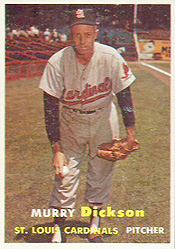
murry_dicksonUsing a knuckleball, curve and slider, Murry Dickson became the second major-league pitcher to produce a nine-inning no-hitter in a spring training game. He baffled the Yankees in a 7-0 Cardinals victory on March 30, 1948, before 1,948 at Al Lang Field in St. Petersburg, Fla.

Dickson received slugging support from Stan Musial (three-run inside-the-park home run) and Red Schoendienst (three-run double).

Cardinals manager Eddie Dyer told The Sporting News he had intended to pitch Dickson for six innings. After Dickson pitched a hitless seventh, Dyer gave his approval for Dickson to pitch the eighth and the ninth.

Dyer received criticism for stretching Dickson in an exhibition game. National League president Ford Frick looked into the matter and was told by Dickson he wanted to test his arm by pitching nine innings.

“From all I hear, it wasn’t a hard game he had to work,” Frick said. “It was a warm day, he didn’t have to bear down too much and apparently he wasn’t trying for a no-hitter.”

(Cy Blanton of the Pirates pitched the first nine-inning no-hitter in a spring training exhibition. It occurred on Easter Sunday, April 9, 1939, at New Orleans, against the Indians. Pirates manager Pie Traynor later told The Sporting News he regretted allowing Blanton to go the distance because Blanton soon lost his effectiveness. After an 11-7 record for the 1938 Pirates, Blanton was 2-3 for the 1939 Pirates.)

Dickson struck out six, hit a batter and walked five (including Joe DiMaggio twice). He faced 30 batters. The Yankees hit into three double plays and stranded three.

DiMaggio smoked a line drive “straight at shortstop Tommy Glaviano” for the hardest-hit out, according to the Associated Press. DiMaggio and Phil Rizzuto were two future Hall of Fame players in the Yankees lineup that day.

In the ninth, Dickson got Lonny Frey to fly out to center and Ed Stewart to line out to second before Johnny Lindell flied out to center for the final out.

Dan Hall, covering the game for the St. Petersburg Times, wrote, “Dickson’s curve was breaking beautifully and he used a slider and a knuckleball delivery to cross up the Yankees sluggers.”

Del Wilber caught the first five innings for the Cardinals and Del Rice caught the last four. Asked by The Sporting News about Dickson’s knuckleball, Wilber replied, “Dickson really puts a lot of speed on it and the ball is tough to catch … (It)  wobbles all over the place.”

Facing sore-armed Bill Bevens, the Cardinals scored all seven runs in the first inning. After Schoendienst walked and Erv Dusak singled, Musial “drove a pitch to the 450-foot sign in the right-center field corner and raced around the paths for an inside-the-park home run,” reported the St. Petersburg Times.

Dickson drove in the fourth run on a bases-loaded walk and Schoendienst, batting for the second time in the inning, followed with a bases-clearing double.

The United Press wire service wrote, “For Bevens, the game may have marked the end of a Yankees career that has been nothing but one bad break after another.”

Five months earlier, on Oct. 3, 1947, Bevens was one out away from pitching the first no-hitter in World Series history. In Game 4 at Brooklyn, Bevens held the Dodgers hitless for 8.2 innings and was protecting a 2-1 Yankees lead. The Dodgers had two runners on base _ the ninth and 10th walks given by Bevens _ when Cookie Lavagetto, batting for Eddie Stanky, doubled both home, lifting the Dodgers to a 3-2 victory. Boxscore

(Bevens, 31, didn’t fully recover from the arm ailment that hampered him in that exhibition game against the Cardinals. He never again appeared in the major leagues after the 1947 World Series, though he did pitch in the minors until 1952, including a stint in the Cardinals’ organization in 1949 for Houston, where his manager was Del Wilber.)

Meanwhile, Dickson’s stock rose after his spring training no-hitter. United Press wrote, “The nigh-perfect performance virtually assured Dickson of ranking as the ace of the Cardinals’ staff.”

Dickson earned the Opening Day start and pitched a complete-game shutout in the Cardinals’ 4-0 triumph over the Reds at St. Louis on April 20, 1948. Boxscore

The hot start wasn’t sustainable. Dickson went 1-5 in July, finished 12-16 with a 4.14 ERA and was sent to the Pirates after the season.


Read Full Post »

In a tragic twist of fate, a deadly boating accident during spring training led the Cardinals to acquire outfielder Mark Whiten.

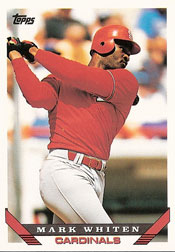
mark_whitenOn March 22, 1993, Indians pitcher Steve Olin was killed and pitchers Tim Crews and Bob Ojeda were injured severely in a boating accident on a Florida lake. Crews died the next day.

After the accident, Cardinals general manager Dal Maxvill called his counterpart with the Indians, John Hart, who asked whether pitcher Rene Arocha was available. Maxvill replied, “No.”

“He said, ‘We really need pitching now,’ ” Maxvill told the St. Louis Post-Dispatch. “I said, ‘Which one of our pitchers are you interested in?’ And he said, ‘Anybody, really.’ ”

Maxvill wanted an outfielder to back up projected starters Ray Lankford, Brian Jordan and Bernard Gilkey. Maxvill was about to make a deal for Braves outfielder Keith Mitchell, who was ticketed to open the 1993 season in the Atlanta farm system.

Hart was offering to trade Whiten, the Indians’ starting right fielder, to the Cardinals if Maxvill would offer a pitcher Hart liked.

Maxvill and Hart had discussed a possible deal during the winter meetings in December 1992. At that time, Hart asked about pitcher Mark Clark, who was 3-10 with a 4.45 ERA for the 1992 Cardinals.

Remembering that exchange, Maxvill offered Clark to the Indians. Hart wanted a second player added to the deal. When Maxvill suggested minor-league infielder Juan Andujar, Hart accepted.

Maxvill contacted the Braves and nixed the proposed trade for Mitchell. On March 31, seven days before the 1993 season opener, the Cardinals sent Clark and Andujar to Cleveland for Whiten.

“It was a shock for me,” Whiten said of the trade.

Whiten, 26, was joining his third major-league club. (He had played for the Blue Jays before joining the Indians.) He had a strong throwing arm, speed and power, but generally was considerd a raw talent. “I’m still learning,” Whiten conceded.

The acquistion of Whiten ended Ozzie Canceso’s spring training quest to make the Cardinals’ Opening Day roster as a reserve outfielder. Canseco produced four home runs and 14 RBI for St. Louis in spring training exhibition games, but admitted, “My defense is lacking … It’s something I realize I have to improve.”

Whiten became a standout for the 1993 Cardinals, generating 25 home runs, 99 RBI and 15 stolen bases. On Sept. 7, 1993, in the second game of a doubleheader at Cincinnati, Whiten hit four home runs and drove in 12 while batting sixth in the order. Whiten, who hit a grand slam, two three-run home runs and a two-run home run, tied the major-league single-game RBI record established by Cardinals first baseman Jim Bottomley in 1924. Boxscore

Clark finished 7-5 with a 4.28 ERA for the 1993 Indians. In three seasons with Cleveland, Clark was 27-15. Andujar never reached the big leagues.

In two seasons with St. Louis, Whiten had 39 home runs and 152 RBI. On April 9, 1995, the Cardinals traded Whiten and pitcher Rheal Cormier to the Red Sox for third baseman Scott Cooper and pitcher Cory Bailey.

Previously: Mark Whiten, Josh Hamilton: Same feat, different path

Read Full Post »

« Newer Posts - Older Posts »