Feeds:
Posts
Comments

Archive for the ‘Games’ Category

(Updated June 8, 2024)

Center fielder Willie McGee batted .294 with 1,683 hits and 301 stolen bases in 13 years with the Cardinals, helping them win three National League pennants and a World Series crown.

Whitey Herzog, his manager on those 1980s title teams, told Cardinals Magazine, “Willie gave me everything I asked for and more. He was one great guy, a great ballplayer. He is the most popular guy during my time (with the Cardinals). If you’re going to talk about the Cardinals, you’re going to talk about (Stan) Musial, (Red) Schoendienst and (Enos) Slaughter, and then along came (Bob) Gibson and (Lou) Brock and Ozzie (Smith). But I don’t think anybody was as dear to the fans’ hearts as Willie McGee.”

Here are five fun facts about McGee’s Cardinals playing career:

McGEE VS. CARLTON

Twice, McGee hit two home runs in a game. Most remember the two homers he ripped against former Cardinal Pete Vuckovich in Game 3 of the 1982 World Series against the Brewers in Milwaukee. What may not be so well-known are the two homers he hit against another former Cardinal, Steve Carlton.

On July 21, 1986, at St. Louis, Carlton, 41, who had been released by the Phillies in June after 15 seasons with Philadelphia, was making his third start for the Giants.

McGee, who would hit just seven home runs in 1986, hit a solo shot into the upper deck in left off Carlton in the first inning and added a two-run blast to right-center in the fourth, tying the score at 3-3. The Cardinals went on to win, 8-3 Boxscore

“I wasn’t swinging for homers,” McGee told the Associated Press. “I was just trying to hit the ball good and just trying to do my job.”

LAUNCH OF LA RUSSA ERA

McGee was the first batter in the first regular-season game Tony La Russa managed with the Cardinals.

Batting leadoff against Bobby Jones, McGee grounded out to shortstop in the first inning of the season opener against the Mets on a rainy, cold April 1, 1996, at New York.

McGee, playing right field, went 2-for-5 with three RBI and two runs scored. In the fourth, he smacked a three-run homer off Jones, giving St. Louis a 6-0 lead before the Mets rallied for a 7-6 victory.

McGee, who made the first out of the game, also made the last out of the game, grounding out to shortstop Rey Ordonez, who made a diving stop of a ball up the middle. Boxscore

HELLO, MAD HUNGARIAN

McGee, called up to the Cardinals from Class AAA Louisville in May 1982, went hitless in his first four big-league at-bats. He broke through in dramatic fashion against the Braves on May 13, 1982, at Atlanta.

In the fifth inning, the Cardinals led 6-5 and had the bases loaded with one out. Herzog called on McGee, a switch-hitter, to bat for Tito Landrum, even though Landrum had three RBI in the game.

Braves manager Joe Torre countered by lifting Preston Hanna and bringing in Al Hrabosky, the former Cardinals closer. McGee greeted the “Mad Hungarian” with a RBI-single to left. St. Louis went on to a 10-9 victory. Boxscore

Asked about lifting Landrum for McGee, Herzog said, “It worked, didn’t it?”

Said McGee: “That was my first big-league hit and I’ve got to feel pretty good about it. I know I can play defense and run the bases. I just hope I can get some bat experience.”

GRAND BEGINNING

By mid-summer of 1982, McGee had become the everyday center fielder and was sparking St. Louis toward its first postseason appearance since 1968.

On July 20, 1982, at St. Louis, the Braves scored five runs in the first against John Stuper. The Cardinals came back with six runs in the bottom of the first. The big blow was McGee’s first big-league home run, a grand slam off fellow rookie Ken Dayley. Boxscore

Dayley would be traded to the Cardinals in 1984 and would team with McGee to help the Cardinals win two more pennants.

THE LAST HOME RUN

On July 26, 1998, at Denver, after entering the game as a replacement for left fielder John Mabry in the eighth, McGee slammed a solo home run off Dave Veres (a future Cardinals closer) with two out in the ninth, helping St. Louis to a 3-1 victory over the Rockies. It was the first homer Veres had yielded since May 31. Boxscore

McGee would have 51 more at-bats in 1998 and 271 at-bats in 1999, but he never would hit another big-league home run.

Read Full Post »

A pair of former Cardinals, Andy Van Slyke and Mike LaValliere, combined to stun St. Louis by making one of baseball’s most sensational defensive plays, one so rare it wouldn’t be accomplished again for 23 years.

On Aug. 21, 2011, in the ninth inning of a game at Detroit, the Indians had runners on second and third with one out when Tigers center fielder Austin Jackson caught a fly ball by Matt LaPorta and unleashed a rocket to catcher Alex Avila, who tagged out Kosuke Fukudome at the plate, completing a double play and sealing an 8-7 win.
According to research by Baseball-Reference.com, it was the first time a major-league game had ended on a double play with a center fielder throwing out a runner at the plate since Sept. 27, 1988, when Van Slyke accomplished the feat.

On April 1, 1987, the Cardinals traded Van Slyke, LaValliere and pitcher Mike Dunne to the Pirates for catcher Tony Pena. The deal helped the Cardinals win the 1987 National League pennant and it also helped the Pirates begin a transformation from also-ran to contender.

On Sept. 27, 1988, the Cardinals were finishing out the final week of the season on their way to a fifth-place finish in the NL East. The Pirates would secure second place, their highest finish since 1983.

Before a Tuesday night crowd of 8,994 at Three Rivers Stadium, the Pirates took a 3-2 lead into the ninth. Pittsburgh closer Jim Gott, seeking his 34th save, issued a leadoff walk to Jose Oquendo. After Curt Ford struck out, John Morris singled to right, advancing Oquendo to third.

Luis Alicea, a switch-hitting rookie second baseman who had entered the game in the sixth, stepped to the plate and smashed a rising liner to center field _ “a drive,” wrote Paul Meyer of the Pittsburgh Post-Gazette, “that seemed more than deep enough to score Oquendo.”

It seemed everyone in the ballpark, except Van Slyke and LaValliere, thought Oquendo would advance on the sacrifice, tying the score.

“I didn’t think he (Van Slyke) had a chance,” Pirates right fielder Glenn Wilson told Meyer.

Said Pirates manager Jim Leyland: “I thought he (Van Slyke) had no chance, to be honest with you.”

Here’s what Van Slyke said to Meyer:

“I always think I have a chance _ except when I’m standing on the warning track. I threw it as hard as I could. What made it a difficult play was that it was a line drive, and I couldn’t set up (to throw).”

As Oquendo streaked down the third-base line, he saw LaValliere standing motionless at the plate, trying to make it appear a play wasn’t imminent.

“When Andy let the ball go, I caught the runner out of the corner of my eye,” LaValliere said to Meyer. “… I tried to deke the runner to get as much of an advantage as I could. You want the runner to see the plate, so he’ll slide.”

Just before receiving the throw, LaValliere blocked the plate with his left foot. As Oquendo slammed into a shin guard, LaValliere applied the tag and umpire Doug Harvey ruled an out, giving the Pirates a 3-2 victory. Boxscore

“Unbelievable, the way he (LaValliere) kept him off there,’ said Leyland. “That was the key.”

Said Van Slyke: “When I saw Doug Harvey ring him up, it surprised the heck out of me. Mike made just as good a play as I did.”

Cardinals manager Whitey Herzog told the Associated Press, “It was a heck of a play on both ends. Andy made a great throw and he doesn’t get him if Mike doesn’t block the plate.”

In his lead to his game story, Meyer wrote:

You know him as Andy Van Slyke. Tuesday night, though, the Pirates center fielder was Andy Van Strike _ because that’s what he threw to the plate in the ninth inning for the final out of a 3-2 victory over St. Louis that clinched second place for the Pirates.

Twenty-three years later, when the play happened again, the teams and the players were different, but one of the managers was the same. Jim Leyland, Tigers skipper, was the winning manager in both games.

Read Full Post »

(Updated July 29, 2018)

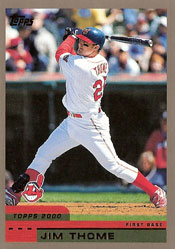
Jim Thome didn’t face the Cardinals often in a 22-year big-league career, but he usually pounded St. Louis pitching when given the opportunity. Of his 612 career home runs, 18 were hit against the Cardinals in 29 games.

Thome, elected to the National Baseball Hall of Fame in 2018, batted .430 (43-for-100) against the Cardinals, with 40 RBI, a .565 on-base percentage and a 1.010 slugging percentage.
Of his 18 home runs against St. Louis, three were hit against Matt Morris. Chris Carpenter and Dan Haren surrendered two apiece.

Thome hit three home runs against the Cardinals _ two off Morris and another off Mike James _ in the Indians’ 14-2 victory on July 6, 2001, at Cleveland. All three were two-run shots. Boxscore

In the eighth, Thome struck out against Steve Kline, missing a chance to become the first American League player to hit four home runs in a game since Rocky Colavito of the Indians in 1959.

“When everybody wants you to hit a home run, it’s pretty tough to do,” Thome told the Associated Press.

The next day, Thome walked in his first four plate appearances. He led off the 10th inning with a home run against Dave Veres, lifting Cleveland to a 7-6 victory over the Cardinals. Boxscore

“It was supposed to be a sinker away,” Veres said. “I missed my spot by, like, four feet.”

Said Thome: “I wanted to get a pitch up and drive it, and I did.”

Thome’s 18th and last home run against the Cardinals was perhaps his most devastating. On June 22, 2006, at Chicago, the Cardinals’ Anthony Reyes pitched a one-hitter _ and lost. The hit was a solo home run by Thome with one out in the seventh, giving the White Sox a 1-0 victory. Boxscore

“I was fortunate it was in the middle of the plate,” Thome said.

Said Reyes: “I just missed a little bit over the plate and you can’t really do that up in this league.”

Thome’s home runs against the Cardinals:

DATE………………..PITCHER

June 14, 1997……Matt Morris

June 25, 1998……Manny Aybar

June 25, 1998……Bobby Witt

June 2, 2000…….Darryl Kile

July 6, 2001……..Matt Morris

July 6, 2001……..Matt Morris

July 6, 2001……..Mike James

July 7, 2001……..Dave Veres

Aug. 15, 2003……Pedro Borbon

Aug. 16, 2003……Dan Haren

Aug. 17, 2003……Brett Tomko

Aug. 22, 2003……Dan Haren

Aug. 22, 2003……Steve Kline

April 29, 2004…..Chris Carpenter

May 4, 2004……..Chris Carpenter

May 6, 2004……..Jeff Suppan

June 21, 2006…..Jason Marquis

June 22, 2006…..Anthony Reyes

Read Full Post »

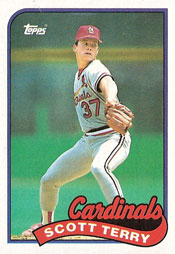
The last Cardinals pitcher to give up five home runs in a game was Scott Terry.

On June 4, 1989, at St. Louis, Terry started for the Cardinals against the Cubs and gave up six hits in 4.1 innings _ five of those hits were home runs.
Ryne Sandberg and Shawon Dunston each hit two solo homers against Terry and Mitch Webster added a two-run shot in the Cubs’ 11-3 victory. Boxscore

Terry entered the game having allowed three homers in 58.2 innings over 10 starts that season.

“Not only does it hurt your confidence,” Terry told The Sporting News, “but it’s embarrassing.”

Said Cardinals manager Whitey Herzog to the Associated Press: “There were no cheap ones. Those hits were deep. I’ve never seen the ball carrying like that.”

After Sandberg smacked his second solo homer with one out in the fifth, giving Chicago a 6-3 lead, Herzog lifted Terry for Frank DiPino, a former Cub. DiPino threw a waist-high brushback pitch to the first batter he faced, Mark Grace, who charged the mound, prompting both benches to empty.

Though the melee was brief, it was costly. Grace partially separated his shoulder and was ejected. St. Louis third baseman Terry Pendleton bruised his elbow and left the game.

“It was not my intention to hit him,” DiPino said, “but I’ve got to show some protection for myself. They’ve just hit five home runs ahead of me and I’m going to lay one over the middle of the plate? It doesn’t work that way. It was a purpose pitch. I threw it where I wanted to throw it. But I didn’t do it so he would charge the mound.”

Said Grace: “(DiPino) didn’t like me last year, even when we were teammates.”

DiPino responded: “We weren’t the best of friends … I just don’t like guys who are cocky.”

Cardinals ace Bob Gibson never gave up five home runs in a game, but he did allow four multiple times.

On Aug. 28, 1963, when the Giants beat St. Louis, 5-3, at San Francisco, Tom Haller hit two solo homers, Orlando Cepeda hit one and Chuck Hiller hit a two-run shot against Gibson. Boxscore

The Giants also hit four homers against Gibson on May 8, 1973, at San Francisco. Bobby Bonds hit two homers _ a solo shot on Gibson’s first pitch of the game and a two-run homer _ and Willie McCovey and Dave Kingman each launched solo homers against Gibson in the Giants’ 9-7 victory. Boxscore

“If you get one hit off Bob Gibson, it’s a good night,” Bonds said, “so this one is great.”

In the other game in which Gibson allowed four homers, the Cardinals beat the Mets, 8-5, at St. Louis. Charlie Smith hit a two-run homer and Jesse Gonder, Johnny Lewis and Jim Hickman all had solo shots against Gibson. Boxscore

Read Full Post »

(Updated April 9, 2019)

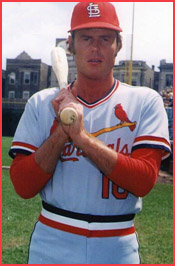
Dave Campbell’s brief career with the Cardinals was most notable for what he didn’t do.

In 21 at-bats for the 1973 Cardinals, Campbell failed to get a hit.

Campbell went 45 consecutive at-bats without a hit in 1973. His streak occurred while playing for three teams.
In 2019, Chris Davis of the Orioles set a major-league record for a position player by extending his hitless streak to 47 consecutive at-bats.

Campbell, an ESPN baseball broadcaster from 1999-2010, began his seventh big-league season in 1973 as an infielder for the Padres. He went hitless in his last 17 at-bats for San Diego before he was traded to the Cardinals for infielder Dwain Anderson on June 7, 1973.

In 24 plate appearances in 13 games for St. Louis, the best Campbell could achieve was a walk, a sacrifice bunt and a sacrifice fly.

Campbell’s lone batting highlight as a Cardinal came on July 10, 1973, against the Dodgers at Los Angeles. In the top of the seventh, with the Dodgers ahead 2-1, the Cardinals had Jose Cruz on third, Mike Tyson on first and one out when manager Red Schoendienst called on Campbell to pinch-hit for pitcher Tom Murphy.

Facing Dodgers starter Claude Osteen, Campbell hit a sacrifice fly to center, scoring Cruz with the tying run. The Cardinals went on to a 5-4 victory. Boxscore

Campbell’s final at-bat as a Cardinal came on Aug. 17, 1973, at St. Louis against the Padres. After San Diego scored twice in the 13th inning, snapping a 2-2 tie, the Cardinals had Ted Simmons on second and Hector Cruz on first with two out. Schoendienst chose Campbell to pinch-hit for pitcher Diego Segui. Campbell popped out to second base, ending the game. Boxscore

The next day, the Cardinals traded Campbell to the Astros for outfielder Tommie Agee. St. Louis, in first place in the National League East, was seeking to bolster its bench for a pennant push.

“It’s tough to leave a club that is in first place and has a shot at the big money,” Campbell told The Sporting News. “But due to my past association with (Astros coach) Preston Gomez it could be a break for me. Preston was the manager at San Diego when I was a regular there for four years. So he knows what I can do.”

After a 17 at-bat hitless streak for the Padres and a 21 at-bat hitless streak for the Cardinals, Campbell went hitless in his first seven at-bats for the Astros, tying the major-league mark of 45 consecutive hitless at-bats by a non-pitcher.

On Sept. 19, 1973, in the opener of a doubleheader against the Padres at Houston, Campbell hit a two-run double against Clay Kirby in the first inning, breaking his drought. Boxscore  Campbell had four hits in the doubleheader: two in each game.

In an eight-year big-league career, Campbell batted .213.

Read Full Post »

(Updated Sept. 3, 2018)

Bill Greason had a short, but important, stint with the Cardinals. He was the first African-American Cardinals pitcher.

Greason, 29, made his major-league debut with the Cardinals on May 31, 1954, as the starter in the first game of a Memorial Day doubleheader at Chicago’s Wrigley Field.

He yielded three home runs _ two to Hank Sauer and one to Ernie Banks _ and the Cubs beat the Cardinals, 14-4. Boxscore

Greason, an Atlanta native who served with the Marines in Iwo Jima in World War II, began pitching Negro League baseball in 1947. As a teammate of Willie Mays on the 1948 Birmingham Black Barons, Greason posted a 6-4 record with a 3.30 ERA for the Negro American League champions. The lanky right-hander earned Birmingham’s only win in the 1948 Negro World Series against the Homestead Grays.

After stints in the Negro League and the Mexican League, Greason became the second black to play in the Texas League. In 1953, he was 16-13 with a 3.61 ERA and 193 strikeouts for Oklahoma City, catching the attention of the Cardinals.

On Oct. 13, 1953, the Cardinals acquired Greason from Oklahoma City for three minor league players.

In an article headlined “Cards, Reshuffling Hands, Get Texas Negro Ace In Deal,” Bob Broeg wrote in The Sporting News: “Greason, frequently mentioned in the past as highly promising, is likely to become the first Negro player ever to perform for the Cardinals.”

Pitching for Santurce in the Puerto Rico Winter League, Greason further impressed. On Jan. 6, 1954, after Tommy Lasorda pitched Santurce to a 4-3 victory over Caguas in the opener of a doubleheader, Greason won the second game, 3-2, holding Caguas to three singles, one by Hank Aaron.

On Jan. 20, 1954, The Sporting News wrote of Greason: “The big Negro hurler purchased by the Cardinal organization from Oklahoma City last fall has accounted for approximately half of Santurce’s conquests and is rated a good chance to make the Cardinal staff.”

Two weeks later, the magazine reported: “With the purchase of first baseman Tom Alston from San Diego (Pacific Coast), the Cardinals now have 14 Negro players in their organization. Alston is the only member of the parent club.”

As spring training ended, the Cardinals assigned Greason and another black pitcher, Brooks Lawrence, to Class AAA Columbus (Ohio), managed by Johnny Keane.

Alston made the Cardinals’ roster, and the first baseman became the first African-American to appear in a big-league game for the Cardinals when he started in the season opener April 13, 1954, against the Cubs at St. Louis. Boxscore

At Columbus, Greason compiled a 4-5 record, winning his last three decisions. On May 28, the Cardinals sent pitcher Mel Wright to Columbus and called up Greason.

Greason’s debut as the first African-American Cardinals pitcher started well. The Cardinals scored twice in the first. In the bottom half of the inning, Greason retired the first two batters. Then, Ralph Kiner singled and Sauer homered, tying the score.

In the third, with St. Louis leading 4-2, Greason again set down the first two Cubs batters. Then, Sauer homered, Randy Jackson singled and Banks homered, giving Chicago a 5-4 lead. In the fourth, Greason was lifted for pinch-hitter Sal Yvars.

Greason’s line: 3 innings, 6 hits, 5 runs, 1 walk and 2 strikeouts.

On June 6, a Sunday afternoon in St. Louis, Greason got the start against the Phillies, but it was a disaster. The leadoff batter, Willie Jones, homered. When Greason walked the next two batters, Richie Ashburn and Earl Torgeson, Cardinals manager Eddie Stanky removed him from the game. Boxscore

Greason sat for two weeks before making his third and final appearance, pitching a scoreless inning of relief against the Giants in New York on June 20. Boxscore

Two days later, the Cardinals sent Greason and pitcher Stu Miller to Columbus.

“They’ll have a chance to come back if they do well enough at Columbus,” Stanky said, “but they weren’t helping us enough and we had to make the move.”

Greason never appeared in the major leagues again. His career stats: 4 innings, 8 runs (6 earned), 8 hits, 4 walks, 2 strikeouts, 0-1 record, 13.50 ERA.

Greason pitched in the Cardinals’ minor-league system until 1959. After his playing career, Greason returned to Birmingham, worked in a department store and became a minister. In September 2014, Greason, 90, was honored by the Cardinals at Busch Stadium for having been a pioneer in helping break the franchise’s color barrier 60 years before.

Read Full Post »

« Newer Posts - Older Posts »