Feeds:
Posts
Comments

Archive for the ‘Games’ Category

Being a Little League phenom is no guarantee of success at the professional level. The Cardinals made that costly discovery with Art Deras.

An exceptional Little League, Pony League and high school player, Deras was signed by the Cardinals, who outbid multiple teams with the intention of grooming him to replace Ken Boyer at third base.

A right-hander who threw hard and hit with power, Deras played five seasons in the Cardinals’ system, but never reached the majors.

Super powers

When Deras grew up in Hamtramck, Mich., near Detroit in the 1940s and 1950s, the town was a Polish-American enclave. His Polish grandmother nicknamed him Pinky. “I never did learn how she picked the name Pinky, but it stuck,” Deras said to the National Polish-American Sports Hall of Fame.

In 1959, when he turned 13, Deras led Hamtramck into the Little League World Series in Williamsport, Pa.

Against San Juan, Puerto Rico, in Game 1, Deras pitched a one-hitter and struck out 17 in a 5-0 victory. In Game 2, Deras played shortstop and hit a grand slam in Hamtramck’s 8-1 triumph versus Kailua, Hawaii.

For the Game 3 championship final, Deras pitched a three-hitter, struck out 14 and hit a three-run home run in Hamtramck’s 12-0 rout of Auburn, Calif. Among those in attendance were Baseball Hall of Famers Frank “Home Run” Baker and Frankie Frisch.

In the two six-inning games Deras pitched in the Little League World Series, 31 of the 36 outs he recorded were strikeouts. He allowed four total hits and no runs.

The Sporting News described him as “this super boy from Hamtramck.”

For the season, Deras pitched 10 no-hitters, including five in a row, struck out 296 in 108 innings, and had 18 wins, including 16 shutouts, The Sporting News reported. Video

Soon after the Little League World Series, Chrysler Corporation arranged for the team to be flown to California for an appearance on The Lawrence Welk Show. Michigan-based Chrysler was a sponsor of the television program.

“They introduced us, and at the end of the show I danced with the champagne lady,” Deras recalled to the Detroit Free Press. “Can you imagine that? Twelve years old and dancing with the champagne lady. Where do you go from there?”

The beat goes on

Deras advanced to Pony League and in 1961 he led Hamtramck to a national title. One of his teammates was Tom Paciorek, who went on to hit .282 during 18 seasons (1970-87) in the majors.

In an interview with the Free Press, Paciorek described Deras as “very, very talented. A tremendously gifted athlete. At his age level, from 12 to 14, I doubt if there is any question that he was the finest athlete in the country.”

Deras continued having success in high school sports. In addition to his pitching and hitting in baseball, he was a standout running back in football. In April 1964, he signed a letter of intent to play football at Michigan State.

Big-league baseball scouts had other plans for him.

Highest bidder

“Claimed by many to be the greatest natural hitter ever to come off the Detroit sandlots,” Deras received interest from at least 10 big-league teams, the Free Press reported.

Cardinals scout Mo Mozzali recommended the club go all-out to sign Deras. Knowing it would take a substantial offer to outbid others, the Cardinals sent their 82-year-old consultant, major-league legend Branch Rickey, to Hamtramck to see the 17-year-old amateur legend and determine whether he was worth the cash.

Rickey arrived at the Hamtramck high school ballfield in a black limousine and was escorted to a roped-off area behind home plate, according to the Free Press. Rickey was impressed with what he saw, and endorsed the Cardinals’ effort to pursue Deras.

On June 1, 1964, the Cardinals came to Detroit to play the Tigers in an exhibition game to benefit amateur baseball. Wearing a Cardinals uniform, Deras worked out with the team before the game at Tiger Stadium, the Free Press reported.

Two weeks later, on June 10, Deras graduated from high school. Attending the family graduation party that night at the home of Deras’ parents were the Cardinals’ scout, Mo Mozzali, and scouts for the Red Sox and Yankees. The hometown Tigers dropped out of the chase when Deras asked for $50,000.

According to the Free Press, Deras’ father was a security guard at General Motors. Deras’ mother worked in an auto supply factory. Deras saw a big-league signing bonus as a chance to help his parents, and decided to go with the team that made the highest offer.

On June 15, 1964, the same day the Cardinals traded for Lou Brock, Deras signed with them for $80,000, $20,000 more than the other finalist, the Red Sox, offered, the Free Press and St. Louis Post-Dispatch reported.

Attending the signing ceremony were Mozzali and Cardinals director of scouting George Silvey. Deras “has the talent to reach the majors in two years,” Mozzali told the Post-Dispatch.

Cavorting with champions

Though he primarily was a pitcher in high school, the Cardinals wanted Deras to play every day because of his bat. He hit .478 his senior season.

“The Cardinals have high hopes for him at third base” as the eventual replacement for all-star Ken Boyer, the Free Press reported.

The Sporting News designated Deras and Ed Spiezio as “the best bets as eventual successor to Ken Boyer.”

Assigned to Class A Rock Hill, Deras hit .208 in 51 games in 1964. He did better at the fall Florida Instructional League, attacking pitches the way the Cardinals hoped he would, and was invited to join the big-league club at spring training in February 1965.

Placed on the 40-man winter roster, Deras, 18, joined the reigning World Series champions at their St. Petersburg, Fla., training camp. He posed for pictures with club executive Stan Musial, took batting practice from Bob Gibson, and played cards with Mike Cuellar. “He used to cheat,” Deras told the Free Press. “Whenever you’d call him on it, he’d pretend he didn’t speak English.”

Deras returned to Class A in 1965 and hit .260 with 18 stolen bases, but the Cardinals decided to move him to the outfield. “We would have preferred to keep him at third base,” farm director Sheldon Bender told The Sporting News, “but the throwing from there to first base was bothering him.”

Peaked too soon

After two seasons at Class AA Arkansas, Deras was demoted to Class A Modesto in 1968. While Deras, 21, was on the way down, his Modesto teammate, Ted Simmons, 18, another Michigan high school standout who was signed by Mo Mozzali, was on the way up.

Deras hit .269 for Modesto, then walked away from the Cardinals. “I didn’t tell them I was retiring, and they didn’t ask why,” Deras told the Free Press. “I guess they knew.”

In five seasons in the Cardinals system, Deras hit .243 with 32 home runs.

Deras had invested part of his signing bonus in a Hamtramck sporting good store, but the business collapsed, according to the Free Press. In 1974, he joined the Warren, Mich., police force. He retired as a detective in 2001.

Looking back at Deras’ time in the Cardinals’ organization, the Free Press concluded, “It was never a question of ability. It was a question of desire _ and it was gone.”

Deras said, “By the time I was 21, I had already had a full career _ playing every day, two amateur championships, a room full of trophies. I should have been reaching my prime, and I was exhausted. Looking back on it, I guess it was just a problem of getting too much too soon.”

Read Full Post »

Kenneth Morris seemed to have good luck on his side the evening of June 26, 1947.

Morris, 21, had a date with a female friend, and two reserved-seat tickets to that night’s game between the Reds and Cardinals at Sportsman’s Park in St. Louis.
The Thursday night game was a coveted event because the pitching matchup was Ewell Blackwell for the Reds against Harry Brecheen. Blackwell (11-2) had won his last nine decisions. In his two most recent starts, he followed a no-hitter against the Braves with a two-hit shutout of the Dodgers. Brecheen (9-3) had won four in a row for the reigning World Series champions.

A crowd of 25,691, big for a weeknight, gathered to see whether the Cardinals could beat the most dominant pitcher in the National League.

Wounded knee

Morris, of East Carondelet, Ill., was seated with Helen Czech, of East St. Louis, Ill., in Row 6, Section X, of the grandstand, “a short distance toward the outfield from third base,” the St. Louis Star-Times reported.

About 10 p.m. they heard a noise, like a pop, but thought nothing of it. According to the St. Louis Post-Dispatch, they believed it was an exploding firecracker.

A man seated nearby, identified by the Post-Dispatch as J.A. Widup, said he saw a puff of what appeared to be smoke or dust following the sharp noise.

Morris said he felt a sting in his right knee, but didn’t know he was wounded until Widup told him there was a spot of blood on his trouser leg.

According to the Belleville (Ill.) Daily Advocate, Morris said he thought perhaps he’d been cut by a piece of glass from a shattered bottle. He went to a first-aid station at the ballpark and was treated by the nurse on duty, Margaret Watson, for what was described as a puncture wound. After patching up Morris, the nurse advised him to see a doctor, the Post-Dispatch reported.

Still unaware of how he suffered the knee wound, Morris, an inspector for Lewin Metals Corporation, remained at the game with Helen Czech, and saw the Reds prevail, 6-3. Boxscore

Ballpark mystery

The next morning, Morris’ right knee was swollen and painful. He went to see Dr. Thomas Stines of East St. Louis. The physician sent him to St. Mary’s Hospital for X-rays. That’s when Morris learned he’d been shot.

The X-rays revealed a .32-caliber bullet lodged between two bones in the knee, the Post-Dispatch reported. An operation was scheduled to remove the bullet.

The Post-Dispatch described the case as “the mysterious wounding of Kenneth Morris.”

According to International News Service, “Detectives were baffled as to who could have shot him _ and how it could have gone unnoticed by other spectators.”

Detective Lt. John Sinclair told the Star-Times, “There are no clues as to who shot him.”

The case apparently went unsolved.

Kenneth Morris eventually married Helen Czech, and they had three sons. The family resided in Arkansas, where Kenneth Morris worked as an analyst for Alcoa in its gallium lab. Gallium is a metal, similar to aluminum, and often used in electronics. According to an obituary in the Belleville News-Democrat, he was retired when he died at 67 in July 1993 at Benton, Ark.

Read Full Post »

Two of the Cardinals’ savviest competitors, a pair of future Hall of Famers, got picked off base on successive plays.

The pitcher who nabbed them was a 22-year-old Padres right-hander, facing the Cardinals for the first time.
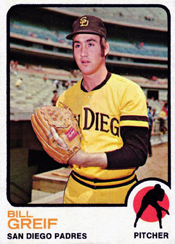
On June 9, 1972, Bill Greif picked off Bob Gibson at second base. Then he picked off Lou Brock at first base.

Premier prospect

A standout in multiple sports in high school at Austin, Texas, Greif passed up a scholarship offer to the University of Texas to sign with the Astros when he was 18. He made his big-league debut with the Astros in July 1971 and was traded to the Padres with two other prospects for pitcher Dave Roberts after the season.

“We hated to give up Greif,” Astros general manager Spec Richardson told The Sporting News. “He throws hard and has a fine sinker. He could be an outstanding pitcher.”

The Padres had finished in last place each year since joining the National League in 1969 and were headed there again in 1972. Greif looked to be one of their top talents and earned a starting rotation spot.

Padres pitching coach Roger Craig, the former Cardinal, said Greif was one of the most mature and intelligent young pitchers he had coached, the Associated Press reported. “All Greif needs is 200 innings under his belt and he’ll be quite a pitcher,” Craig predicted.

Greif told the Society for American Baseball Research, “Roger was an excellent tactician. We talked a lot about setting pitches up and which pitch to throw in each situation. It was situational pitching and that was very helpful to me.”

Greif entered his start against the Cardinals with a 3-8 record. The Padres totaled nine runs in his eight losses.

Craig, who with the Mets had 24 losses in 1962 and 22 in 1963, understood what it was like to pitch for a bad team and used that experience to try to guide Greif.

“I’ve learned more from Roger in three months than I learned all the rest of my career,” Greif told The Sporting News. “He helps a pitcher in so many ways, especially in keeping up his confidence.”

Right moves

Greif was matched against Gibson for the Friday night series opener at San Diego. Greif was 9 when Gibson got his first win in the majors in 1959.

In the third inning, the game was scoreless and the Cardinals had one out and none on when Gibson doubled. Before pitching to Brock, Greif, a rangy 6 feet 4, whirled around and fired the ball to shortstop Enzo Hernandez, who was covering the bag at second. Hernandez tagged out Gibson, who had strayed too far.

Brock followed with a single. In 1972, Brock would lead the National League in stolen bases for the sixth time, but Greif wasn’t intimidated. As Brock took his lead, Greif whipped a throw to first baseman Nate Colbert, who applied a tag before Brock could reach the bag.

“Many pitchers have been improving on their moves,” Brock told The Sporting News. “The pitchers are much more responsible for base steals than catchers.”

The Padres scored twice in the fourth, snapping Gibson’s scoreless inning streak at 25, but the Cardinals came back against Greif in the sixth. Brock led off with a triple and scored on a wild pitch. After Bernie Carbo popped out, Matty Alou crushed a home run, merely his second of the season, to tie the score at 2-2.

In the ninth, Joe Torre led off with a home run against Greif. “He has great stuff,” Torre told the St. Louis Post-Dispatch. “He just got a curve in too much. I’m sure he didn’t want to put the ball there. He’s so big that it looks as if he’s reaching out to touch you when he lets go. He’s big enough to scare you.”

Gibson sealed the victory, retiring the side in the bottom half of the inning. It was Gibson’s 210th career win, tying him with Jesse Haines for the Cardinals’ franchise lead. Boxscore

“I was studying Gibson and marveling at the stuff this man has and the way he challenges the hitters,” Greif told the Associated Press.

By dueling with Gibson into the ninth, “At least I know now that I can pitch in the majors,” Greif said, “and that’s something I didn’t know this spring.”

Mind over matter

The remainder of the 1972 season had more lows than highs for Greif. He finished with a 5-16 record and 5.60 ERA.

In five seasons with Padres, he was 29-61.

In May 1976, Greif, 26, was traded to the Cardinals for outfielder Luis Melendez. In 47 relief appearances for the Cardinals that season, his last in the majors, Greif was 1-5 with six saves.

Expressing an interest in experimental psychology, Greif attended college during the baseball off-seasons. He earned a degree in psychology from the University of Texas and a master’s from Texas State University.

He told the Austin American-Statesman, “Pitchers, in particular, might be an interesting study _ how a pitcher can program his brain to release a certain pitch the same way time after time.”

Read Full Post »

Leave it to Lou Brock to find a hole in a five-man infield.

On June 27, 1972, the Expos put five players on the infield in an attempt to escape a jam against the Cardinals.

Brock did what the Expos hoped he would _ hit a ground ball _ but it eluded the infielders and bounded into the outfield for a game-winning hit.

Stacking the infield

After a loss to Sam McDowell and the Giants dropped their record to 24-32, the Cardinals won six in a row heading into a Tuesday night doubleheader versus the Expos at Busch Memorial Stadium in St. Louis.

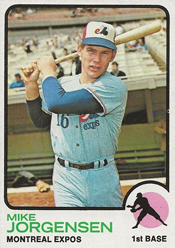
The Expos’ starting lineup in Game 1 featured a pair of former Cardinals (Tim McCarver, making his second career start at third base, and center fielder Boots Day), two future Cardinals (right fielder Ron Fairly and first baseman Mike Jorgensen) and a St. Louis native (second baseman Ron Hunt).

After the Cardinals came back from a 3-0 deficit and tied the score, the game went to extra innings.

In the 11th, with the bases loaded and one out, Brock came to bat against closer Mike Marshall, who was working his fourth inning. Marshall’s signature pitch was a screwball, which batters tended to hit on the ground.

Hoping for a ground ball to create either a force at the plate or a double play, if Marshall couldn’t get Brock to strike out or hit a pop-up, Expos manager Gene Mauch removed left fielder Jim Fairey and sent utility player Hector Torres to the infield.

Because Brock batted left-handed, the Expos put three infielders on the right side _ first baseman Mike Jorgensen, shortstop Tim Foli (positioned to the right of second base) and second baseman Ron Hunt (stationed between Jorgensen and Foli), according to the St. Louis Post-Dispatch.

On the left side were third baseman Bobby Wine (who had replaced McCarver in the sixth inning) and Torres (positioned to the left of second base).

The two outfielders, Ron Woods in center and Ken Singleton in right, played shallow in case of a pop fly.

Getting it done

Jorgensen at first base moved in a bit from his normal fielding spot so that if Brock did ground the ball to him he could attempt a short throw to the plate. Jorgensen also didn’t want to be too far from the bag in case he needed to beat Brock there to field a relay throw on a double play.

Brock, a spray hitter, did the unexpected, slashing a grounder down the first-base line. The ball zipped past Jorgensen for a single, scoring Scipio Spinks from third with the winning run. Boxscore

“He hit it to the (Expos’) strong point, the right side, and still hit it past them,” Cardinals manager Red Schoendienst said to the Post-Dispatch.

Stunned that Brock, who hit .233 for his career against Marshall, drove the ball where he did, Mauch said, “If I’d have had seven infielders, I wouldn’t have put one right there.”

Brock seemed surprised, too. “It must have been 1967 since I last hit a ball to that spot,” he told The Sporting News.

Read Full Post »

At the Polo Grounds, site of baseball magic for the hometown Giants, the Cardinals got to experience something extraordinary, too.

On June 15, 1952, the Cardinals erased an 11-0 deficit and defeated the Giants, 14-12, at the Polo Grounds, the ballpark located between Coogan’s Bluff and the Harlem River in upper Manhattan.
Eight months earlier, in “The Miracle of Coogan’s Bluff,” Bobby Thomson hit a walkoff three-run home run in the ninth for a pennant-clinching Giants triumph versus the Dodgers.

Thomson was in the lineup the following year when the Cardinals made their improbable comeback.

Sure thing

A crowd of 41,899, the largest of the season in the National League, gathered at the Polo Grounds on a hot, sunny Sunday for a doubleheader between the Cardinals and the Giants.

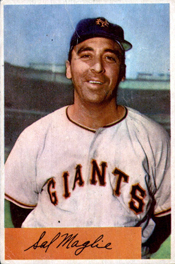
The first game, which began at 3:22 p.m., featured starting pitchers Sal Maglie of the Giants versus Joe Presko of the Cardinals. Maglie had the best record (9-2) in the league and a 1.94 ERA.

In the second inning, the Giants struck for five runs against Presko, snapping his streak of 18 consecutive scoreless innings.

After the Giants added six more runs in the third against Jack Crimian for an 11-0 lead, confident manager Leo Durocher began substituting, taking out left fielder Bob Elliott and catcher Wes Westrum.

The Giants’ lead “was as safe as money in the bank,” Bob Broeg wrote in the St. Louis Post-Dispatch.

Cardinals first-year manager Eddie Stanky, the former Giant, also considered lifting some starters, but “something inside told me not to make the changes,” Stanky told the Post-Dispatch.

Letting up

The Cardinals, shut out by Maglie for four innings, began their comeback in the fifth, totaling seven runs against him to make the score 11-7. The big hits were a three-run home run by Enos Slaughter, a solo shot by Tommy Glaviano and Stan Musial’s two-run single.

(Musial had a career .474 on-base percentage versus Maglie. In 171 games played at the Polo Grounds against the Giants and Mets, Musial batted .343 with 216 hits.)

“With the big lead, I relaxed,” Maglie told the New York Daily News. “Then they started hitting and, when I tried to bear down again, I just didn’t have it.”

Rookie knuckleball specialist Hoyt Wilhelm relieved, and in the seventh the Cardinals scored three times against him, cutting the deficit to one at 11-10.

Preparing to face George Spencer leading off the eighth, Solly Hemus asked Stanky whether he wanted him to try to draw a walk. Stanky instructed him to swing away. Hemus took a rip at Spencer’s first offering, driving it against the front of the upper deck in right for a home run, tying the score at 11-11.

Max Lanier, the former Cardinal who was traded to the Giants for Stanky, relieved. He retired Red Schoendienst and Musial, but Dick Sisler singled, Peanuts Lowrey drew a walk and Slaughter followed with a single, scoring Sisler and putting the Cardinals ahead 12-11.

Hemus hit another homer, a two-run blow in the ninth against Monty Kennedy, extending the lead to 14-11, and the Cardinals went on to a 14-12 triumph. 

Cardinals relievers Bill Werle, Eddie Yuhas and Willard Schmidt combined to limit the Giants to one run over the last seven innings. Boxscore

Things change

“Greatest rally I’ve ever seen,” Stanky told The Sporting News.

Cardinals coach Buzzy Wares, 66, said, “I’ve been in baseball since 1905 and I’ve never seen anything like that.”

According to the New York Daily News, no Giants team “ever suffered a more humiliating defeat.”

“How the Giants ever contrived to blow that horrendous opener is something that doubtless will remain to plague Durocher for all his days,” the New York Times declared.

When the second game began at 5:52 p.m., less than half of the crowd remained. Those who departed missed the performance of Giants starter Dave Koslo, who pitched a shutout in a game called after seven innings because of darkness. The win was his 11th in a row versus the Cardinals. Boxscore

(A left-hander, Koslo stretched his streak against them to 13 consecutive wins before the Cardinals beat him on Sept. 14, 1952. His career record against the Cardinals was 24-21.)

The day after the doubleheader, the Cardinals took a 7-4 lead into the bottom of the ninth, but Bobby Thomson again did something special, hitting a walkoff grand slam for an 8-7 Giants victory.

Read Full Post »

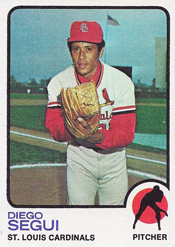
Diego Segui brought much-needed relief to the Cardinals.

On June 7, 1972, the Cardinals bought the contract of Segui from the Athletics.

A right-hander whose best pitch was a forkball, Segui gave the Cardinals a quality closer. Before acquiring him, the 1972 Cardinals totaled one save. The year before, their save leader had eight.

As the St. Louis Post-Dispatch noted, Segui “arrived to breathe life into a bullpen that had been horrible.”

From ranch to diamond

Segui was born and raised in southeastern Cuba near the seaport city of Santiago. His father was a ranch foreman who taught his son to rope horses and cattle. “I was pretty good with a lasso,” Segui told the Post-Dispatch.

The work strengthened his hands and helped Segui become a pitcher able to grip a variety of pitches.

He was 20 and pitching for the Tucson Cowboys of the Arizona-Mexico League when the Kansas City Athletics signed him on the recommendation of their scout, former big-league outfielder Al Zarilla. Segui entered their farm system in 1959 and reached the majors with the Athletics in 1962.

While with Kansas City, Segui met the woman he married, Emily. They were introduced by the mother of Athletics catcher Joe Azcue.

Segui developed a forkball, so named because the ball was held in the fork of the hand, between the forefinger and middle finger.

“A pitcher must have reasonably long and flexible fingers to throw the forkball, which is one reason it is not a common pitch,” the Kansas City Star noted. “The forkball is thrown with the same motion as a fastball, but the velocity is much slower and the ball breaks down as it reaches the plate.”

Segui pitched at a deliberate pace. As the Oakland Tribune observed, “He rubs up the ball between every pitch _ even during intentional walks _ straightens out the Virgin Mary medallion he wears around his neck, counts his fielders, steps off the mound to blow on his hand, and smooths the dirt in front of the rubber.”

Come and go

Segui pitched for Kansas City from 1962-65, got traded to the Senators, spent 1966 with them and was reacquired by the Athletics.

After two more seasons with the Athletics, Segui was selected by the Seattle Pilots in the American League expansion draft, pitched in their first regular-season game and finished the season with 12 wins and 12 saves. Boxscore

The Athletics, who had relocated to Oakland, reacquired him again, and Segui posted a 2.56 ERA, best in the American League, for them in 1970.

Rich with starting pitching (Catfish Hunter, Vida Blue, Ken Holtzman) and relievers (Rollie Fingers, Bob Locker, Darold Knowles) in 1972, their first of three consecutive World Series championship seasons, the Athletics didn’t have enough work for Segui, prompting the deal with the Cardinals.

When informed he’d be leaving the Athletics for the third time, Segui told the Oakland Tribune, “Maybe I’ll get a chance to pitch for St. Louis, but I would rather have stayed on this club and not pitched.”

Good impression

Segui’s perspective changed after he experienced immediate success with the Cardinals. In his National League debut, he pitched three scoreless innings against the Giants and got the win. Boxscore

“He has a hard slider that breaks at the last second,” Cardinals catcher Ted Simmons told the San Francisco Examiner. “His forkball is murder on a left-handed batter, dropping off the table.”

Two nights later, Segui got his first Cardinals save with 1.2 scoreless innings versus the Padres. Boxscore

“When a guy can throw strikes and has an out pitch like his forkball, you’re in business,” Simmons told the Post-Dispatch. “Segui has a fantastic forkball. It looks like a fastball to the batter, and before you know it, wham, the ball is by you.”

Orioles scout Jim Russo told columnist Bob Broeg, “In Segui, they’ve got one of their best pickups of late. He’s a nice guy, a good man on a club, and he knows how to pitch.”

Segui, who turned 35 two months after joining the Cardinals, finished the 1972 season as the team leader in saves (nine) and relief outings (33). He was 3-1 with a 3.07 ERA. Batters hit .184 against him with runners in scoring position. Video at 30-second mark

Say hey, Segui

Segui followed up with a strong season for St. Louis in 1973. He led the club in saves (17) and games pitched (65), posting a 7-6 record and 2.78 ERA. He struck out 93 in 100.1 innings and allowed a mere 78 hits.

“You wish you had 25 men like him,” Cardinals player personnel director Bob Kennedy told the Post-Dispatch. Kennedy was Segui’s manager with the 1968 Athletics.

“You couldn’t ask for a better guy,” Kennedy said. “He’s one of the finest men I’ve known in baseball.”

Segui had a couple of interesting matchups in 1973 with Willie Mays, 42, who was with the Mets in the final season of his Hall of Fame career.

On July 26 at St. Louis, with the Cardinals ahead, 2-1, in the ninth, the Mets had a runner on base, two outs, when Segui struck out Mays on a forkball to end the game. Boxscore

A week later, on Aug. 3 at New York, Mays, batting .207 for the season, faced Segui in the seventh, with two on, two outs and the Mets ahead, 4-3. Mays got a low inside fastball from Segui and hit it over the wall in center for a three-run home run. Boxscore

“I was just looking for something fast, and there it was,” Mays said to the Associated Press.

The home run was the 659th of Mays’ career. He hit his last, No. 660, two weeks later against Don Gullett of the Reds.

Family and fishing

After the season, the Cardinals swapped Segui, pitcher Reggie Cleveland and infielder Terry Hughes to the Red Sox for pitchers John Curtis, Mike Garman and Lynn McGlothen.

“Segui really did a job for us,” Cardinals manager Red Schoendienst told the Boston Globe, but he said Segui became expendable with the emergence of Al Hrabosky as a potential closer.

Segui pitched in a World Series with the Red Sox in 1975.

His final season in the majors was in 1977 with the expansion Seattle Mariners. Segui, who turned 40 that year, was their Opening Day starting pitcher. Naturally, he was called the “Ancient Mariner.” Boxscore

Segui is the only player to appear in games for both the Seattle Pilots and Seattle Mariners.

He continued to pitch professionally until 1984, when he turned 47 and earned 10 wins for Leon, a Mexican League team managed by ex-Cardinal Benny Valenzuela.

Diego and Emily Segui raised four children. One of them, David, played 15 seasons in the majors, just like his father did. Primarily a first baseman, David hit .291 for his career.

When David was a youngster, his father played baseball all year, including winters in the Caribbean. To fill the void, Emily would “play catch in the backyard and hit fungoes to David to help him work on his defensive skills,” the New York Times reported.

“All the credit must go to my wife,” Diego told the New York Daily News. “If my wife never takes him to play, and hitting ground balls, he would never be what he is.”

After seven years as a minor-league pitching coach for the Giants, Diego Segui retired in Kansas City and pursued his lifelong passion for fishing. He became an accomplished bass fisherman who excelled in local tournaments.

“In March, I won $2,200 for catching one fish,” Segui told the Kansas City Star in 1998. “When I broke into the big leagues, I made $6,000 a year. I made more in one cast than I would make in four months back in those days.”

Read Full Post »

« Newer Posts - Older Posts »