Feeds:
Posts
Comments

Archive for the ‘Games’ Category

When push came to shove during a game at Cincinnati, both the Cardinals and the plate umpire behaved badly.

On April 22, 1952, Cardinals manager Eddie Stanky confronted umpire Scotty Robb, who responded with a shove.
Two weeks later, Robb submitted his resignation to National League president Warren Giles, then accepted a surprise offer to continue umpiring in the American League.

Law and order

A Baltimore native, Douglas Walker Robb, known as Scotty, played semipro baseball until an arm injury prompted him to move into umpiring. He umpired college and minor-league games before serving two years (1944-45) in the Navy.

Robb was 38 when he became a National League umpire in August 1947. In his debut game, Cardinals versus Giants at the Polo Grounds in New York, he umpired at third base. Johnny Mize drove in four runs against his former club, powering the Giants to a 6-5 victory. Boxscore

Three years later, on July 2, 1950, Robb had a confrontation with Stanky in a game between the Braves and Giants at the Polo Grounds.

With the score tied at 2-2 in the seventh inning, the Giants had a runner on first, none out, when Stanky came to the plate with “visions of a game-winning rally,” the New York Daily News reported.

Nicknamed “The Brat,” Stanky got upset when Robb, working the plate, called Bob Chipman’s first pitch to him a strike. Stanky took an angry swing at the next delivery and missed badly. Strike two. After watching a pitch go outside, Stanky grounded into a rally-killing double play.

“Angrier than ever when he reached the bench, Stanky threw a couple of water buckets onto the grass,” the Daily News reported, and Robb ejected him.

Giants manager Leo Durocher came out of the dugout to argue and Robb tossed him, too.

As Stanky and Durocher made the long walk across the outfield to the clubhouse behind the bleachers in center, Giants outfielder Bobby Thomson threw a towel in the direction of Robb and he also was ejected.

In a flash, the Giants had lost their second baseman, center fielder and manager.

“It was a senseless rhubarb and strictly the Giants’ fault,” declared the Boston Globe.

Robb took “a wicked booing” from Giants fans the remainder of the game, the Globe noted, especially after the Braves struck for four runs in the ninth and won, 6-3. Boxscore

Boiling point

The Giants traded Stanky, 36, to the Cardinals in December 1951 and he became their player-manager, replacing Marty Marion.

After the Cardinals split their first six games in 1952, Stanky selected rookie pitcher Vinegar Bend Mizell, 21, to make his big-league debut in a start against the Reds at Crosley Field.

Mizell, who allowed the Reds two runs in the first and none for the rest of the game, showed more poise than Stanky and some of his veteran players.

In the third inning, Robb, the plate umpire, called out the Cardinals’ Solly Hemus on strikes for the second time in the game. Hemus barked at Robb before heaving his bat toward the grandstand on the first-base side near the visitors’ dugout.

Robb ejected Hemus, prompting Stanky to rush out of the dugout. Robb ordered Stanky to leave the field, but instead he got as close as he could to the umpire. Stanky stood toe to toe with Robb, gestured excitedly, waved his index finger in his face and berated him, the Cincinnati Enquirer reported.

“I wanted to know why Hemus was put out of the game,” Stanky told the St. Louis Globe-Democrat.

According to the Dayton Journal Herald, Stanky and Robb “were jostling each other in a startling fashion.”

During what the Globe-Democrat described as a “tornadic argument,” Robb thought Stanky touched or bumped him.

According to Bob Broeg of the St. Louis Post-Dispatch, “As far as press box observers could tell, it was a phantom touch, as light-fingered and as unobtrusive as a pickpocket.”

Stanky said to the Globe-Democrat, “I told Robb that I never touched him. If I did, it was not intentional, and probably was caused by the fact that his momentum as he was walking toward our dugout carried him into me.”

Enraged, Robb threw down his mask, put both hands on Stanky’s chest and vigorously shoved him back a few steps. “The umpire squared off and Stanky, obviously stunned, then started toward Robb,” the Post-Dispatch reported.

“It appeared as if the two might start swinging at each other,” the Globe-Democrat noted. 

Umpires joined Cardinals players and coaches in getting between the two and preventing further damage.

Stanky told the Post-Dispatch, “Getting shoved that way and not being able to strike back was the most embarrassing, the most humiliating thing that’s ever happened to me on a ball field.”

Robb ejected Stanky and the game continued. Gene Mauch replaced Hemus at shortstop.

Stan the Mad

More trouble happened in the seventh. With the Cardinals trailing, 2-1, Stan Musial batted with two outs and a runner on first. Musial hit a grounder sharply down the line at first. Umpire Lon Warneke, Musial’s former Cardinals teammate, ruled it a foul ball. “From the press box, the ball appeared to be foul by at least two feet,” the Cincinnati Enquirer noted.

Musial thought otherwise.

“Stan, who seldom protests a decision, kicked the dirt viciously several times,” the Globe-Democrat reported.

According to the Post-Dispatch, Musial was “drop-kicking dirt with the skill of a football field goal specialist.”

Perhaps to prevent Musial from getting ejected for the only time in his career, Cardinals reliever Al Brazle ran from the bullpen onto the field to argue on Musial’s behalf. Warneke ejected Brazle. Boxscore

Tough job

National League president Warren Giles was at the game and witnessed the shenanigans. The next day, Giles met for 45 minutes with Stanky, Hemus and the four umpires _ Robb, Warneke, Babe Pinelli and Dusty Boggess _ to get their versions of what happened.

As the meeting ended, Robb and Stanky shook hands. “It’s all over now,” Stanky told The Sporting News. “We’ll forget it and start anew.”

A few hours later, Giles, a former Cardinals minor-league executive, announced he was fining Hemus $25 and Stanky $50 for their roles in the incident. Giles publicly reprimanded Robb and said he fined the umpire an amount greater than the combined fines of Hemus and Stanky. Years later, The Sporting News reported Robb was fined $200.

Robb “seemed to feel he had been humiliated by Giles’ reprimand and fine,” The Sporting News reported.

The next game Robb worked was on April 26 when the Cardinals played the Cubs at St. Louis. In the seventh inning, Warneke ejected Stanky for arguing a call at third base. Boxscore

Unable to overcome the feeling that Giles hadn’t supported him, Robb resigned on May 5 and said he would operate a printing business in New Jersey.

Two days later, Robb was stunned when American League president Will Harrirdge offered him an umpiring job.

“When Mr. Harridge approached me with an offer, I was so choked up I couldn’t talk for a minute or two,” Robb told The Sporting News.

Harridge said, “I signed what I believed to be a good umpire and the kind of gentleman we would like to have on our staff.”

Robb umpired in the American League through June 1953, then retired from baseball at age 44.

“It’s a lonesome, difficult life,” Robb told The Sporting News. “An umpire must live like a hermit, avoiding casual acquaintances and not associating with players, managers or coaches. The travel is bad … and the pay wasn’t too good either.”

Read Full Post »

In the last regular-season game he played in the NFL, running back Jim Brown was ejected for fighting with a St. Louis Cardinals defensive lineman.

The incident occurred on Dec. 19, 1965, in the regular-season finale between the Cardinals and Cleveland Browns at Busch Stadium in St. Louis.

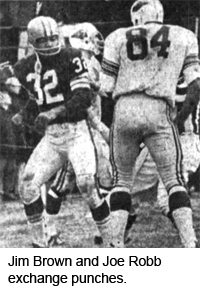
Just before halftime, Brown and Cardinals defensive end Joe Robb hit and kicked one another. The referee tossed both from the game. Brown still finished as the NFL rushing leader for the eighth time in nine seasons.

Despite a stellar performance by Cardinals safety Larry Wilson, who intercepted three passes and returned one 96 yards for a touchdown, the Browns won, 27-24, and advanced to the NFL championship game against the Green Bay Packers. Video

Brown, 29, played in the title game, won by the Packers, and then retired from football, launching an acting career with a role in the film “The Dirty Dozen.”

Tough guy

Joe Robb was born and raised in the east Texas town of Lufkin, near the Davy Crockett National Forest. His father was a professional wrestler.

Described by the Waco News-Tribune as “a carefree sort unused to a tight harness,” Robb played on the defensive line at Texas Christian University with future Pro Football Hall of Fame tackle Bob Lilly.

A rangy 6 feet 3 and 215 pounds, Robb was chosen by the Chicago Bears in the 14th round of the 1959 NFL draft. He was cut from the roster near the end of training camp and claimed by the Philadelphia Eagles.

A year later, Robb, who bulked up to about 240 pounds, was a starting defensive end for the Eagles when they won the 1960 NFL championship. In the title game against the Packers, Robb was matched against the future Hall of Fame offensive tackle, Forrest Gregg.

“Robb is a tough, hard-nosed kid,” Gregg told the Philadelphia Daily News. “He was charging the same on the last play as he was the first.”

When it came time to discuss a contract for the 1961 season, Robb said, “I went in and asked for $13,000. (General manager) Vince McNally said I was asking for a quarterback’s salary.”

The Eagles traded Robb to the Cardinals for defensive end Leo Sugar and linebacker John Tracey.

Trench battles

In joining the 1961 Cardinals, Robb and Jim Brown nearly became teammates. The Cardinals claimed they turned down a trade offer of Brown for running back John David Crow.

Wally Lemm became the Cardinals’ head coach in 1962 and Robb thrived in the system designed by defensive coordinator Chuck Drulis. Robb had 8.5 sacks in 14 games in 1963. “I really learned something about football at St. Louis,” Robb told the Fort Worth Star-Telegram. “Chuck Drulis taught me everything I know.”

The Eagles’ Bob Brown, the future Hall of Fame offensive tackle, said Deacon Jones of the Los Angeles Rams, the Packers’ Willie Davis and Robb were the toughest defensive linemen to block. Regarding Robb, Bob Brown told The Sporting News, “There’s bad blood between us. We just don’t like each other.”

Before the December 1965 game against the Cardinals, Cleveland’s Jim Brown had been ejected once since entering the NFL in 1957. It happened on Oct. 27, 1963, when he tried to block blitzing New York Giants linebacker Tom Scott on a play in the closing minute of the game. Brown and Scott traded punches and were ejected for fighting.

In an interview with author Alex Haley for Playboy magazine, Brown said he had been gouged in the eye “seven or eight times until I was half blinded” in an earlier game against the Giants.

“I made up my mind that if anybody ever again came deliberately close to my eyes, I would retaliate in spades,” Brown said. “So when I felt Scott’s fingers grabbing for me, I just swung on him and we had that little scuffle.”

Rough stuff

Jim Brown seemed headed toward a stellar performance against the Cardinals in the 1965 regular-season finale. He ran for a touchdown early in the second quarter and was averaging better than five yards per carry in the game.

Just before halftime, with Cleveland ahead, 17-7, Brown took a handoff from Frank Ryan and was hit by Robb.

“Robb hit me with a clothesline blow,” Brown told the Mansfield News-Journal.

The clothesline hit usually is defined as a strike to the head or neck with an extended stiff arm.

Robb told the Fort Worth Star-Telegram, “I tried to clothesline him. I missed.”

Brown said Robb hit him a second time _ in the back of the head with an elbow when Brown was returning to the huddle.

“He hit me twice,” Brown told Alex Haley. “I didn’t mind being hit _ that’s part of the game _ but he hit me for no reason, no reason at all, and that I did mind.”

Come and get it

On the next play, a deep pass, with Brown assigned to stay in the backfield to block, he motioned for the offensive linemen to let Robb advance unimpeded.

“When they came out of the huddle, he pointed his finger and said he was going to get me,” Robb told the Fort Worth Star-Telegram.

As Robb rushed into the backfield, Brown met him and raised his forearm. “It hit Joe like a machete,” the Fort Worth Star-Telegram reported.

Robb struck back and hit Brown.

“Brown swung again at Robb and landed,” the Fort Worth newspaper reported.

Robb said, “I grabbed his face mask with my left hand and busted his lip with the other.”

“He hit me on the jaw,” Brown told the Associated Press.

Brown knocked down Robb and kicked him. “I’ve got two cleat marks on the inside of my thigh,” Robb said to the Fort Worth newspaper.

“It was boom, boom, boom,” Brown said to the Mansfield News-Journal.

The two were kicking one another on the ground when the officials intervened and ejected them.

Robb said, “I told Brown, ‘Well, it’s over now, let’s shake hands.’ He didn’t want to, but he did.”

Brown said, “There’s no bad blood between us. We shook hands.”

Brown told the Mansfield newspaper he shouldn’t have let Robb anger him.

“I’m very disappointed when anything like this occurs,” Brown said. “An offensive man should not be looking for trouble. Every man is a cog in the team. I eliminated myself. It was a failure on my part. An offensive player should school himself to take such things.”

Career change

The Browns played the second half without Jim Brown and their top receiver, Gary Collins, who suffered a rib injury in the second quarter, but rallied to win after the Cardinals took a 24-17 lead.

Jim Brown finished the game with 12 carries for 74 yards, giving him 1,544 rushing yards for the season. The touchdown he scored was his career-high 21st of the season. Game stats

The Browns advanced to face the Packers in the NFL championship game on Jan. 2, 1966. Led by Paul Hornung, who had 105 yards rushing and a touchdown, the Packers won, 23-12. In what turned out to be his last game, Jim Brown had 50 yards rushing and 44 yards receiving but didn’t score.

The next summer, while acting in “The Dirty Dozen” in London with Lee Marvin, Brown announced his retirement from football. He followed “The Dirty Dozen” with another classic action film, “Dark of the Sun” with Rod Taylor.

Moving on

In June 1968, after he was traded to the Detroit Lions for linebacker Ernie Clark, Robb told the St. Louis Post-Dispatch, “I think there is a mutual lack of respect between players and management” on the Cardinals.

Asked about dissension that plagued the 1967 Cardinals under head coach Charley Winner, Robb said to the Fort Worth Star-Telegram, “It was just a bad situation. In fact, you could call it terrible. Most of the players were simply demoralized … A head coach’s job is to get his team psychologically prepared to play and Winner was incapable of that.”

Robb played for the Lions from 1968-71. He and former baseball Cardinals outfielder Carl Warwick went into the real estate business together in Texas.

In 1974, when he made a comeback at age 37 with the Houston Texans of the World Football League, Robb told the Philadelphia Daily News he had broken his nose 15 times while playing football and had undergone three knee operations. He was 50 when he died in 1987.

Read Full Post »

During a stretch in the 1960s, Jim Maloney was as overpowering as National League contemporaries Bob Gibson and Sandy Koufax, but by the early 1970s, when the Cardinals took a chance on him, Maloney’s pitching skill no longer was the same.

On Jan. 4, 1972, the Cardinals signed Maloney, hoping he could join a starting rotation with Gibson, Steve Carlton and Jerry Reuss.

Three months later, Maloney was gone, and so, too, were Carlton and Reuss.

Fresno fireballer

Maloney was born and raised in Fresno, Calif. For most of his youth, the Cardinals had a farm club in Fresno and Maloney attended the games. He got to see Cardinals pitching prospects such as Larry Jackson (28-4 for Fresno in 1952) and Tom Hughes (20-6 in 1955).

At Fresno High School, Maloney was the shortstop on a team that included a couple of other future big-leaguers: catcher Pat Corrales and pitcher Dick Ellsworth. (Tom Seaver, four years younger, went to Fresno High School after Maloney did.)

On the recommendation of Reds scout Bobby Mattick, Maloney converted from shortstop to pitcher at Fresno City College. The Reds signed him in April 1959 and he got to the majors with them the next year.

A right-hander, Maloney had exceptional velocity.

In his 1968 book “From Ghetto to Glory,” Gibson said, “I don’t throw as hard as Jim Maloney. Nobody throws as hard as Maloney. He’s the only guy who can simply overpower you. You know he’s going to throw the fastball, you set for it, but you still can’t catch up with it.”

Maloney had 15 wins or more for the Reds each season from 1963-68. He remains the Reds’ franchise leader in career strikeouts (1,592).

In 1963, when he turned 23, Maloney was 23-7 with a 2.77 ERA and 265 strikeouts. On May 21 against the Braves, Maloney struck out 16 batters, including eight in a row, in 8.1 innings. “He was faster than anyone else I’ve seen this season,” Hank Aaron told The Cincinnati Post. “Yes, he was faster than Sandy Koufax.” Boxscore

Three months later, after Maloney pitched a two-hit shutout against the Giants, their manager, Al Dark, called him a “right-handed Sandy Koufax,” according to the Dayton Daily News. Boxscore

In the book “We Played the Game,” Reds pitcher Jim O’Toole said, “Maloney had such a great fastball and curve that he was unhittable if he got them both over. He was as good as Koufax.”

In the 1963 season finale, Maloney gave up a pair of singles to Stan Musial, who was playing his last career game with the Cardinals. Afterward, Maloney went to the Cardinals clubhouse to congratulate Musial. When Musial saw him, he said aloud, “Here’s a real tough guy. He had me worried.” Said Maloney to reporters: “I was glad to see him go out hitting.” Boxscore

Hard to hit

In 1965, Maloney finished 20-9 with a 2.54 ERA and 244 strikeouts.

On June 14, he held the Mets hitless for 10 innings before a former Cardinal, Johnny Lewis, led off the 11th with a home run. Maloney struck out 18, but the Mets won, 1-0. Boxscore

Two months later, on Aug. 19 against the Cubs, Maloney got the first of his two no-hitters. He walked 10, hit a batter and struck out 12 in a 1-0 victory in 10 innings. The losing pitcher was Larry Jackson, the former Cardinal who Maloney used to watch pitch for minor-league Fresno. Boxscore and Video

“Basically, every time I went out I told myself I was going to throw a perfect game,” Maloney said to The Cincinnati Post.

Maloney pitched his second no-hitter in 1969 against the Astros, striking out 13. Boxscore (The next Reds pitcher to achieve a no-hitter was Tom Seaver, Maloney’s fellow Fresno High School alumnus, in 1978 against the Cardinals.)

Maloney also pitched five one-hitters in the majors.

Johnny Edwards, the Reds’ catcher before joining the Cardinals in 1968, told The Cincinnati Post, “Jim had what you’d call a light fastball, really easy to catch, because it was a rising fastball, but you’d look at your hand after the game and you’d have a bone bruise.”

Though the Cardinals won three National League pennants during Maloney’s prime years, he was 14-5 against them in his career. In 1968, Maloney was 3-0 with a 1.88 ERA versus the National League champions.

Rough time

An injury on April 16, 1970, sent Maloney’s career into a spiral. In trying to beat the throw of the Dodgers’ Maury Wills on a grounder to deep short, Maloney lunged toward first base and felt intense pain in his left foot. He’d ruptured the Achilles tendon that connects the muscles in the calf to the heel bone.

Fans at Crosley Field booed Maloney as he was carried off the field. “A sad night for Cincinnati baseball,” Bob Hertzel wrote in the Cincinnati Enquirer. Boxscore

Maloney didn’t pitch again for the Reds until September. In seven total appearances for them in 1970, he was 0-1 with an 11.34 ERA. He told The Sporting News, “When I started throwing again in September, I was within a fraction of being my old self. I’m sure I can be just as good as I was before.”

The Reds didn’t want to wait to find out. They offered Maloney to the Cardinals, who were interested “but didn’t feel they could afford what the Reds were after then _ a couple of young prospects,” the St. Louis Post-Dispatch reported.

In December 1970, the Reds traded Maloney to the Angels for pitcher Greg Garrett. Angels manager Lefty Phillips was a friend and mentor to Reds manager Sparky Anderson. “I told Lefty that Maloney is capable of winning the division for them,” Anderson informed the Cincinnati Enquirer.

Instead, the 1971 Angels finished 76-86. Maloney, sidelined by a groin pull, pitched in 13 games and was 0-3 with a 5.04 ERA. Lefty Phillips and general manager Dick Walsh were fired, and Maloney was released.

Tumultuous time

Maloney, 31, contacted the Cardinals and asked for a chance. Fred Koenig, hired by the Cardinals to manage in their farm system after being an Angels coach in 1971, vouched for Maloney. In his last four appearances for the Angels, covering a total of seven innings, Maloney allowed one run. “Koenig said Maloney threw as well as he ever threw,” Cardinals general manager Bing Devine said to The Sporting News.

Admitting it was “a kind of shaking the dice,” Devine signed Maloney and projected him to compete in spring training with Al Santorini, Santiago Guzman and Jim Bibby for the fifth spot in the Cardinals’ starting rotation. The Cardinals’ top four starting spots appeared set with Bob Gibson, Steve Carlton, Jerry Reuss and Reggie Cleveland.

“I have more velocity on my pitches than three-fourths of the pitchers in the majors leagues,” Maloney told The Sporting News.

He reported two weeks early to Cardinals camp and made an effort to be in top shape, walking two to five miles daily and jogging on the beach.

The spring of 1972 turned into a time of upheaval for the Cardinals. In February, Steve Carlton was traded to the Phillies for Rick Wise after club owner Gussie Busch became upset with Carlton’s salary demands. In April, Jerry Reuss was traded to the Astros for Scipio Spinks after Busch became upset with Reuss for growing a moustache.

In four spring training games totaling 13.2 innings, Maloney was 0-3 with a 7.07 ERA and was released by the Cardinals on April 9.

Maloney signed with the Giants, who sent him to their Phoenix farm club. He was 5-1 with a 2.61 ERA in seven appearances for Phoenix, but when no team showed interest in bringing him to the big leagues, he retired in June 1972, soon after turning 32.

After leaving baseball, Maloney said he started drinking too much. “I sort of had a hard time sliding back into society,” he told The Cincinnati Post.

The Giants hired him to manage their Fresno farm team in 1982, but the club finished 50-90 and Maloney was out of baseball again. In 1985, he underwent treatment for alcoholism. He completed the program and went on to become director of Fresno’s Alcoholism and Drug Abuse Council.

Read Full Post »

Cardinals manager Red Schoendienst had the self-confidence to make a bold decision when he thought it would give his team its best chance to win.

A prime example of how Schoendienst put team ahead of individual occurred on July 22, 1968, when the Cardinals trailed the Phillies by two runs in the bottom of the ninth inning.

With two on and none out, Orlando Cepeda was due to bat for the Cardinals. Cepeda was the cleanup hitter and the most recent winner of the National League Most Valuable Player Award, but he hadn’t been producing lately with runners in scoring position.

Schoendienst chose to let Lou Brock bat for Cepeda. The move stunned Cepeda, who never had been removed for a pinch-hitter, but the decision to let one future Hall of Famer bat for another turned out well.

Setting the table

Sparked by a three-run home run from Don Lock against Steve Carlton, the Phillies led the Cardinals, 4-2, entering the last of the ninth at Busch Memorial Stadium in St. Louis.

The Cardinals’ first batter was Julian Javier. Using a bat borrowed from Curt Flood, he fought off an inside fastball from Phillies left-hander Woodie Fryman and blooped a single into shallow right, breaking the bat.

“It was my sweet stroker,” Flood told the St. Louis Post-Dispatch when asked about the bat. “I had used it a couple of weeks.”

John Boozer, a right-hander with a 1-0 record and five saves, relieved Fryman. The first batter he faced, Flood, noticed that third baseman Tony Taylor was playing back on the infield and guarding the line against an extra-base hit. Flood made the decision to try for a bunt single.

“Flood laid down a gorgeous drag bunt,” the Philadelphia Daily News reported.

Taylor charged in, grabbed the ball and threw high to first. Flood easily beat the throw for a single, and Javier advanced to second.

Phillies manager Bob Skinner, a former Cardinals teammate of Flood, said, “Give the guy credit for making the play. It’s a do or die play.”

Rare opportunity

With runners on first and second, none out, the situation seemed ideal for Cepeda, who had 111 RBI for the Cardinals the previous year, but Schoendienst had other ideas.

Cepeda had produced a mere two RBI for the month and none since July 13. (He ended up with five RBI for July.) Cardinals fans booed him the day before when he was 0-for-4 with three strikeouts versus Mets left-hander Jerry Koosman.

Though Cepeda hit well against Boozer in his career (.375 with two home runs), it was a different story in 1968. Cepeda would go hitless in four at-bats versus Boozer for the year.

Schoendienst liked the notion of having Brock, a left-handed batter, face Boozer. (Brock would hit .391 versus Boozer in his career and go 3-for-5 against him in 1968. Also, left-handed batters would hit .352 versus Boozer for the season.) Plus, Schoendienst figured Brock was less likely to hit into a double play. (Cepeda grounded into a team-high 13 double plays in 1968 compared with four by Brock.)

With the Phillies starting a left-hander (Fryman), Schoendienst had intended to give Brock, who complained of leg muscle soreness, a day off, but with the game on the line and Boozer on the mound, the manager couldn’t resist making a move.

“You don’t always have a Brock sitting on your bench in such a situation,” Schoendienst said to the Post-Dispatch. “If there was no Brock, I wouldn’t have used anyone to pinch-hit.”

Right stuff

Cepeda told the Post-Dispatch he never had been lifted for a pinch-hitter at any level of amateur or professional baseball. When Schoendienst sent Brock to bat for him, Cepeda flung his helmet and stormed into the clubhouse.

“Anyone who knows this proud Puerto Rican must realize what a severe blow it was to his pride,” The Sporting News noted.

Brock was seeking his first hit versus the Phillies in 1968. He had gone hitless in 17 at-bats against them.

Using a bat borrowed from Javier, Brock grounded a 2-and-1 pitch from Boozer into right field for a single, scoring Javier and narrowing the Phillies’ lead to 4-3. Flood advanced to third on the play.

It was Brock’s only hit in three appearances as a pinch-batter in 1968. (For his career, Brock batted .258 with 33 hits as a pinch-batter.)

Mike Shannon followed and belted a 2-and-0 pitch from Boozer over Lock’s head in right. The ball bounced into the seats for a ground-rule double. The hit drove in Flood, tying the score at 4-4, and moved Brock to third.

Left-hander Grant Jackson replaced Boozer. Tim McCarver, a left-handed batter, smacked Jackson’s first pitch to deep center, a sacrifice fly that scored Brock with the winning run. Boxscore

Learning experience

Soon afterward, Schoendienst went to the clubhouse and met with Cepeda.

“Cepeda was mad, and it’s good that he was mad because it shows he wants to play,” Schoendienst told the Post-Dispatch.

Cepeda said, “This is a new experience for me. I wanted to bat. I was mad at first, but you never stop learning in this game. The manager made the right move. I haven’t been hitting. You know Brock is not going to hit into many double plays. He’s been hitting well.”

The next night, Cepeda had two hits and scored three runs in a Cardinals rout of the Phillies.

After hitting .325 with 25 home runs and 111 RBI in 1967, Cepeda finished at .248 with 16 homers and 73 RBI in 1968. For the season, he hit .217 with runners in scoring position, but the Cardinals still won their second consecutive National League pennant.

In March 1969, the Cardinals traded Cepeda to the Braves for Joe Torre.

Read Full Post »

When the Cardinals got Tom Lampkin, it was not with the expectation he would be their Opening Day catcher in each of the next two seasons.

On Dec. 19, 1996, the Cardinals acquired Lampkin from the Giants for a player to be named. Two months later, the Giants chose pitcher Rene Arocha from a list of four players offered by the Cardinals, completing the deal.

Lampkin was projected to be a backup, but when starter Tom Pagnozzi got injured in 1997 and 1998, Lampkin was in the Cardinals’ Opening Day lineup both years.

Supporting role

After graduating from the University of Portland with a degree in marketing and management, Lampkin reached the major leagues in September 1988 with the Cleveland Indians. The next year, he was traded to the Padres.

In 1991, Lampkin began a season on a major-league roster for the first time, serving as backup to Padres catcher Benito Santiago. The Padres traded Lampkin to the Brewers in 1993. The Giants signed him after the season when he became a free agent.

Lampkin spent a full season in the majors for the first time in 1995 when he was backup to Kirt Manwaring. After the Giants traded Manwaring to the Astros in July 1996, Lampkin became the starter.

“He’s done a good job with the young (pitchers), especially Shawn Estes and William VanLandingham,” Giants manager Dusty Baker told the San Francisco Examiner.

Lampkin nailed 17 of 33 runners attempting to steal (51.5 percent, best in the National League) in 1996 and didn’t allow a passed ball, but he became expendable when the Giants deemed Rick Wilkins and Marcus Jensen to be their catchers in 1997.

Good fit

The Cardinals had a three-time Gold Glove Award winner, Tom Pagnozzi, as their catcher, with Danny Sheaffer as the backup, but both were right-handed batters. Lampkin appealed to the Cardinals because he batted from the left side.

“This creates a little competition,” Cardinals general manager Walt Jocketty told the St. Louis Post-Dispatch after he acquired Lampkin.

Manager Tony La Russa said Lampkin “comes with really good endorsements from pitchers whom he’s caught and managers he’s played for. He’s a good thrower, has good hands and he’s a left-handed hitter who’s a dangerous out. I think this really adds balance to our catching corps.”

With the Giants in 1996, Lampkin had batted .264 versus right-handers and had one of his best games in May when he produced three hits and a walk and scored four times against the Cardinals. Boxscore

After joining St. Louis, Lampkin told the Post-Dispatch, “I don’t intend to be named the starting catcher, but I’m not going to lay down … I know La Russa. He’s the kind of manager who likes to keep all his players ready. Hopefully I’ll get to see some playing time.”

Stepping in

Lampkin’s value increased late in spring training of 1997 when Pagnozzi, 34, went on the disabled list because of a strained calf muscle.

The Cardinals began the regular season with Lampkin, 33, and Sheaffer, 35, as the catchers. Lampkin was the Opening Day starter against the Expos at Montreal Boxscore and in the Cardinals’ home opener. Boxscore

Pagnozzi missed the first 19 games of the season, returned and soon suffered a torn hip flexor, sidelining him until August.

The Cardinals called up Mike Difelice, 27, from Class AA and demoted Sheaffer. A defensive specialist, Difelice platooned with Lampkin.

Lampkin hit seven home runs, including a game-winner versus LaTroy Hawkins of the Twins on July 1. Boxscore

He batted .245 in 108 games for the 1997 Cardinals, but a mere .209 with runners in scoring position. He also disappointed as a pinch-hitter (.171).

Lampkin wasn’t as good on defense for the 1997 Cardinals as he was the year before with the Giants. He threw out 22 of 77 runners attempting to steal against him (29 percent) and was charged with six passed balls.

The Cardinals had five catchers make starts for them in 1997: Difelice (81), Lampkin (56), Eli Marrero (13), Pagnozzi (11) and Sheaffer (one). A right-handed batter, Marrero hit .273 with 20 home runs in the minors in 1997 and was considered the heir apparent to Pagnozzi

Helping hand

After the 1997 season, Difelice was selected by the Tampa Bay Rays in the expansion draft, leaving the Cardinals with a catching corps of Pagnozzi, Lampkin and Marrero.

What seemed a team strength turned into a weakness during 1998 spring training. Marrero, 24, had a cancerous thyroid gland removed in March. Pagnozzi became sidelined because of a shoulder problem.

When the Cardinals opened the 1998 regular season, Lampkin was their starting catcher. Boxscore  “I prepared myself every spring to play every day,” Lampkin told the Post-Dispatch. “Now it’s paid off because it’s actually happening.”

Lampkin eventually split time with Marrero and Pagnozzi when they got healthy enough to return.

Noting Lampkin’s intensity, La Russa said, “He’s too gung-ho, too Marine-like to play every day. He’s a good player and there’s no question he’d do anything to try to win for this team.”

Lampkin hit .231 in 93 games for the 1998 Cardinals. He hit .246 with runners in scoring position and .304 as a pinch-hitter.

Lampkin also caught 13 of 43 runners attempting to steal against him (30 percent) and allowed four passed balls.

Marrero made 67 starts at catcher for the 1998 Cardinals. Lampkin had 54 starts and Pagnozzi made the rest.

Lampkin became a free agent after the 1998 season and was considered “most likely to return” to the Cardinals, the Post-Dispatch reported, but he opted to sign with the Mariners.

He spent three seasons with the Mariners as backup to Dan Wilson before finishing his playing career as the primary catcher for the 2002 Padres.

In his last eight seasons (1995-2002), Lampkin played for four managers who were among the game’s most successful: Dusty Baker, Tony La Russa, Lou Piniella and Bruce Bochy.

Read Full Post »

In building a bullpen for the 1982 season, the Cardinals took a look at a pitcher described as the Cy Young of Mexico.

On Dec. 9, 1981, the Cardinals signed Vicente Romo and invited him to their major-league spring training camp.

Romo hadn’t pitched in the big leagues since 1974 and was nearly 39 years old, but he was a consistent winner in the Mexican League and the Cardinals considered him a talent worth exploring.

Reaching the top

Romo was born in Santa Rosalia, a port city on Mexico’s Baja peninsula. The family moved to the fishing hub of Guaymas, on the other side of the Gulf of California in the state of Sonoma, when Romo was a youth.

Romo was 19 when he became a professional ballplayer in the Mexican League in 1962. The Cleveland Indians purchased his contract in October 1964 and he was sent into their farm system.

In 1967, Romo almost made the Indians’ Opening Day roster, but was sent back to the minors at the 11th hour. The Dodgers selected him in the November 1967 Rule 5 draft.

A right-hander, Romo began the 1968 season with the Dodgers and pitched in one game for them. When the Dodgers called up Don Sutton from the minors in April, they tried to assign Romo to a farm club, but the Indians reclaimed him.

Indians pitching coach Jack Sanford became Romo’s tutor and helped him develop into a reliable reliever. Mixing a sidearm fastball with an assortments of curves, Romo was 5-3 with 12 saves and a 1.62 ERA for the 1968 Indians.

In April 1969, the Indians traded Romo to the Red Sox. He was 6-0 with six saves and a 2.43 ERA for them as a reliever in 1970; 1-3 with a 6.10 ERA in 10 starts.

On May 30, 1970, at Boston’s Fenway Park, Romo pitched four scoreless innings of relief against the White Sox and hit a game-winning home run over the 37-foot wall in left. Boxscore

Romo also pitched for the White Sox (1971-72) and Padres (1973-74) before going back to the Mexican League.

Better with age

In Mexico, Romo thrived as a starting pitcher. According to the Society for American Baseball Research, “He is viewed as his nation’s Cy Young.” For seven consecutive seasons (1975-81), he never had an ERA higher than 2.63. In 1981, he was 16-6 with a 1.40 ERA for Coatzacoalcos.

The Cardinals were seeking depth for a bullpen projected to include Bruce Sutter, Doug Bair, Jim Kaat and Mark Littell in 1982. Scouting reports on Romo indicated he could help.

At spring training camp in St. Petersburg, Fla., in 1982, Kaat was 43 and Romo was a month away from turning 39, though speculation was he might be older. Fourteen years earlier, in 1968, they first pitched against one another when Kaat was with the Twins and Romo was with the Indians. Boxscore

Romo made a strong bid to make the Cardinals’ Opening Day roster, posting a 1.80 ERA in 15 innings in spring training games. “I thought I pitched very well,” he told the St. Louis Post-Dispatch.

The final bullpen spot on the roster apparently came down to a choice between Kaat and Romo. The Cardinals kept Kaat, a much-needed left-hander, but as the Post-Dispatch noted, “The way the gag goes, they decided to keep 43-year-old Kaat over 39-year-old Romo because Kaat was younger.”

Back where he began

The Cardinals wanted Romo to go to their Class AAA Louisville farm club, but he opted to return to the Mexican League.

Pitching for Coatzacoalcos, Romo was 7-0 with a 1.54 ERA in eight starts when the Dodgers purchased his contract on May 24, 1982.

The Dodgers’ move surprised Cardinals manager Whitey Herzog, who indicated he’d hoped Romo could come back to the Cardinals. “Herzog said his scout in Mexico, Willie Calvino, had not kept him apprised that Romo was doing so well,” the Post-Dispatch reported.

Pitching in the big leagues for the first time in eight years, Romo thrived as a Dodgers reliever. On June 18, he got a save against the Reds. Boxscore It was his first big-league save since July 9, 1974.

After posting a 1.29 ERA in nine relief appearances, Romo was moved into the Dodgers’ starting rotation. On July 19, he pitched seven scoreless innings versus the Expos and got the win, his first in the majors as a starter since April 1970. Boxscore

“He used all his pitches, and that means about seven or eight of them,” said Dodgers catcher Mike Scioscia. 

Expos manager Jim Fanning said, “He fooled us all night.”

In late July, Romo injured his left knee and was done for the season. His record for the 1982 Dodgers: 1-2 with a 3.03 ERA.

Romo returned to the Mexican League in 1983. He went to spring training with the California Angels in 1984, but was included in the first roster cut and spent the season, his last, in the Mexican League.

In eight years in the majors, Romo was 32-33 with 52 saves and a 3.36 ERA. In nine games versus the Cardinals, he was 0-1 with three saves and a 2.45 ERA.

A younger brother, Enrique Romo, pitched six years in the majors, including 1979, when he was 10-5 with five saves for the World Series champion Pirates. Against the Cardinals in his career, Enrique Romo was 6-1 with three saves.

Read Full Post »

« Newer Posts - Older Posts »