Feeds:
Posts
Comments

Archive for the ‘Games’ Category

(Updated Feb. 21, 2023)

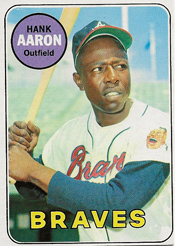
Hank Aaron was the recipient of a special delivery from Bob Gibson.

On July 28, 1970, Gibson threw a knuckleball in a game for the first time. The batter he threw it to was Aaron.

The unlikely pitch from a premier fastball pitcher to a premier fastball hitter occurred in a game between the Cardinals and Braves at Atlanta.

Mighty matchups

Aaron, 36, and Gibson, 34, still were at the top of their games in 1970. Aaron would finish the season with 38 home runs and 118 RBI. Gibson would finish at 23-7 and win his second National League Cy Young Award.

The two future Hall of Famers faced each other often. Aaron completed his career with 163 at-bats against Gibson. Only Billy Williams (174) batted more times versus Gibson.

Aaron batted .215 versus Gibson for his career. He had 35 hits, including eight home runs, and struck out 32 times. “Gibson was every bit as mean as (Don) Drysdale, and he threw harder,” Aaron said in his autobiography “I Had a Hammer.”

In his book, “Sixty Feet, Six Inches,” Gibson said, “There are very few guys who can consistently hit that 95 mph fastball that’s up above the belt. Hank Aaron could. Aaron swung down on the ball. He’d get backspin on it and hit line drives that would start off close to the ground and just keep going unless the fence got in the way.”

“I’d avoid throwing Hank Aaron a fastball over the plate if there was any possible way I could get around it,” Gibson said. “That man did not miss a fastball.”

In Gibson’s first two starts against the 1970 Braves, Aaron tagged him for five hits in eight at-bats.

Entering their third and final matchup of the season on a hot, humid night in Georgia, Gibson had a surprise for Hammerin’ Hank.

Ready or not

Before the game, Gibson told catcher Joe Torre he wanted to throw a knuckleball.

“I’ve been fooling around with that pitch on the sidelines for what, three, four years?” Gibson said to the St. Louis Post-Dispatch. “I figured I finally had enough guts to throw it in a game. I just wanted to see what would happen.”

In the first inning, the Braves had a runner on second, one out, and Aaron at the plate. When the count got to 2-and-2, Gibson decided to unveil the knuckleball.

“I got it over and it went down pretty good,” Gibson said.

Aaron swung at it and popped out to second baseman Julian Javier.

In his book, Gibson recalled, “As he ran back to the dugout, he yelled to me, ‘What the hell was that?’ I laughed and told him, all proud, ‘That was my knuckleball.’ ”

Gibson knew Aaron sometimes could be coaxed into chasing tantalizingly slow pitches. Five years earlier, in 1965, the Cardinals’ Curt Simmons threw a high, floating changeup to Aaron, who hit the ball over the wall but was called out by the umpire for stepping out of the batter’s box.

Gibson said he tried a knuckleball as a substitute for a changeup.

“Knuckleballs, incidentally, aren’t thrown with your knuckles,” Gibson said in his book. “They’re thrown with your fingernails. The reason they call it a knuckleball is because that’s what the hitter sees when you dig your fingernails into the seam.”

Encore in ninth

Gibson retired 12 of the first 13 Braves batters, and the Cardinals built a 6-0 lead against Jim Nash and Bob Priddy.

According to the Atlanta Constitution, Braves manager Lum Harris said Gibson “was bringing it up there in a hurry. I wondered if we’d get any runs off him.”

In the sixth, Aaron drove in a run with a single and the Braves scored three times in the inning. “I pitched dumb,” Gibson said of his sixth-inning effort. “I just tried to get by on nothing but fastballs, and I was getting tired.”

The Braves added another run in the seventh, getting within two at 6-4.

In the ninth, the Braves brought in the master knuckleball specialist, 48-year-old Hoyt Wilhelm, to pitch, and he retired the Cardinals in order. “Old Hoyt was something,” Harris marveled.

After retiring Felix Millan in the bottom half of the inning, Gibson again faced Aaron, who popped out to second base for the third time in the game.

“I got Aaron on that pop-up in the ninth on a knuckler,” Gibson told the Atlanta Constitution.

Torre said to the Post-Dispatch, “In the ninth, when Henry popped up, it looked as if he had a good ball to hit, but just when Henry got the bat around to where the pitch was, the ball sailed out. Henry never had a chance. All Henry said was, ‘Son of a bitch.’ ”

Gibson struck out the next batter, Rico Carty, to complete the game and earn the win, boosting his record to 13-5. His totals for the game: 9 innings, 12 hits, 4 runs, 1 walk, 7 strikeouts. Boxscore

“Twelve hits are a lot to give up and still win, but I’m not complaining,” said Gibson.

In his book, Gibson said he rarely threw another knuckleball.

“Every time I threw a changeup, somebody would whack it over some fence, or in between the outfielders,” Gibson said. “Unfortunately, my knuckleball wasn’t much better.”

Read Full Post »

In a preview of what was to come during a Hall of Fame career with the Cardinals, a confident Dizzy Dean dazzled in his debut game in the major leagues.

On Sept. 28, 1930, the last day of the regular season, Dean pitched a three-hitter in a 3-1 Cardinals triumph against the Pirates before an estimated 22,000 spectators at Sportsman’s Park in St. Louis. The game was completed in one hour, 22 minutes.

Dean’s dominant performance capped a glorious season for the Cardinals, who clinched the National League pennant two days earlier and were headed to the World Series to face the Athletics.

Red Smith of the St. Louis Star-Times noted, “Dean wrote a brilliant first chapter in the story of his major-league career … If a single performance in a single, meaningless game can be taken as a criterion, Dean is destined for stardom.”

Fast rise

A right-hander who was pitching semipro baseball in San Antonio, Dean, 20, signed with the Cardinals before the start of the 1930 season and was assigned to the minors. He was an immediate success, earning 25 wins. Dean was 17-8 for St. Joseph (Mo.) of the Western League and 8-2 for Houston of the Texas League.

The Cardinals called up Dean on Sept. 7, 1930, and he joined them for their final road trip of the season to New York, Boston, Brooklyn and Philadelphia.

Dean watched from the bench as the Cardinals won 12 of 15 games on the trip and took command of the pennant race.

Returning to St. Louis to complete the season with a series versus the Pirates, the Cardinals clinched the pennant with a win on Sept. 26, giving them a three-game lead over the second-place Cubs with two to play.

On the last day of the regular season, Sunday, Sept. 28, Cardinals manager Gabby Street gave the start to Dean, who’d been pestering him for a chance to pitch since joining the club three weeks earlier.

Speed and poise

For his debut, Dean wore cleats borrowed from pitcher Burleigh Grimes because he’d misplaced his own, according to the biography “Diz” by author Robert Gregory.

Dean was matched against Pirates starter Larry French, who’d defeated the Cardinals three times in 1930. The Pirates’ lineup featured two future Hall of Famers, Pie Traynor and Paul Waner.

In the first inning, two of the first three batters, Gus Dugas and George Grantham, reached on walks and Traynor drove in Dugas with a single.

Dean settled down and the Cardinals came back with two runs in the third. Dean contributed to the rally with a single and scored from third on a forceout.

Traynor got a leadoff single in the fourth but the Pirates didn’t get another hit, their last, until Ben Sankey singled in the seventh.

“All the time he was beating the Pirates’ ears, he was complaining his fastball wasn’t working,” Cardinals pitcher Bill Hallahan told the Star-Times.

Said Burleigh Grimes: “He was as unconcerned as if he was tossing rocks at a mud turtle on a log in the Meramec River.”

In the eighth inning, Grimes said, Dean “turned to me and said, ‘The Cardinals’ business office thinks I’m a dumb guy. My salary stops today and (traveling secretary) Clarence Lloyd had the nerve to ask me if I wanted to make the trip to Philadelphia for the World Series. He said the club would pay my expenses. I asked him would I draw dough for going and he said no. He thought he could put that over on me. I may be dumb, but I’m not that dumb.”

Star quality

Throughout the game, Dean had the crowd “showering him with applause as he gyrated deceptively, flaunting a triple windup,” the St. Louis Globe-Democrat reported. “Besides poise, he had tremendous speed, a fast curve and, lo and behold for a youngster, a change of pace which he employed smartly.”

In the Star-Times, Red Smith wrote, Dean “showed burning speed, a wide, sweeping curve, a clever change of pace and, best of all, unusual control for a rookie.”

Describing Dean as a “tall, gangling youth with large hands that dangle from grotesquely long arms,” Smith observed, “He wheels his right arm around his head like the lash of a whip, then throws with a sweeping sidearm motion, baffling to the batter and amusing to the crowd.”

“That delivery may earn him the name of Dizzy,” Smith concluded, “but it seems likely, too, to earn him the title of star.”

The Cardinals extended their lead to 3-1 with a run in the sixth and Dean did the rest, shutting down the Pirates. Boxscore

According to Red Smith, manager Gabby Street called Dean “the nearest thing to Walter Johnson I ever saw.”

Burleigh Grimes, like Walter Johnson, a future Hall of Famer, said of Dean, “I’ll predict that two years from now that kid will be the sensation of the National League.”

Rather than accept the Cardinals’ invitation to travel with them to Philadelphia for the start of the World Series, Dean headed home to San Antonio. On the way there, he stopped at St. Joseph, Mo., and told friends, “I was fed up on baseball, so I didn’t go to the World Series. I just told (club executive) Branch Rickey I’d wait until next year and then win three games in the first Series I ever attended.”

After spending the 1931 season in the minors at Houston, winning 26 games, Dean stuck with the Cardinals in 1932. As Grimes predicted, two years after Dean made his Cardinals debut, he was a sensation in 1932, leading National League pitchers in strikeouts.

Dean proved to be a good predictor, too. In his first World Series, in 1934, he didn’t win three games, but he did win two, including a shutout in the decisive Game 7, against the Tigers.

Read Full Post »

In his last appearance of the 1970 season, Steve Carlton survived a beanball battle and avoided becoming the first Cardinals pitcher in 50 years to lose 20 games.

On Sept. 26, 1970, Carlton pitched a three-hitter and got the win in a 7-2 Cardinals triumph versus the Expos at Montreal. A left-hander and future Hall of Famer, Carlton finished 10-19 in 1970.

The last Cardinals pitcher with 20 losses in a season was another future Hall of Famer, Jesse Haines, who was 13-20 in 1920.

No Cardinals left-hander has had a 20-loss season.

The most losses by a Cardinals pitcher in one season is 25. Stoney McGlynn was 14-25 for the 1907 Cardinals and Bugs Raymond was 15-25 for the 1908 Cardinals.

Head games

Carlton reported late to spring training in 1970 because of a contract dispute and struggled throughout most of the regular season. He was 1-2 in April and 1-4 May. Carlton didn’t have a winning record in any of the first five months of the season and entered September at 7-18.

After winning two of three decisions in September, Carlton went into his last start looking to end on a positive note against the Expos, who had beaten him twice during the season.

He was matched against Expos starter Bill Stoneman, who had angered the Cardinals by throwing at them.

On Aug. 9, Stoneman threw a pitch close to the head of the Cardinals’ Richie Allen. Cardinals pitcher Jerry Reuss retaliated by plunking Stoneman with a pitch on the peak of his batting helmet. Boxscore

A month later, on Sept. 5, Stoneman hit the Cardinals’ Joe Torre with a pitch. Boxscore

Stoneman hit 14 batters with pitches, the most in the major leagues in 1970. Expos manager Gene Mauch claimed the reason Stoneman hit so many was because the batters leaned in toward the plate in anticipation of his breaking pitches, The Sporting News reported.

Law and order

Trouble started early in the late September showdown between Carlton and Stoneman.

In the second inning, Stoneman hit Jose Cruz with a pitch.

Carlton retaliated by brushing back Stoneman with a pitch in the third. “You can’t let a pitcher go after your hitters,” Carlton told The Sporting News. “I’ve got to protect my guys.”

Hoping to defuse the tension, umpires issued an warning to both teams. Mauch stormed onto the field, objecting to the warning, and was ejected.

In the fourth, a defiant Stoneman hit Torre with a pitch and was ejected.

“That guy throws at six or seven guys every game,” Cardinals manager Red Schoendienst told the Montreal Gazette. “That’s his best pitch.”

Expos catcher John Bateman, miffed about the ejections of Mauch and Stoneman, expressed his frustrations to the umpires in the fifth inning and was tossed, too.

Win some, lose some

The Cardinals broke a 1-1 tie with three runs in the eighth. Torre hit a two-run triple against Dan McGinn and Ted Simmons drove in Torre with a single versus Claude Raymond.

In the ninth, Carlton was hit in the rump by a pitch from Mike Wegener. “I don’t understand him hitting me,” Carlton said. “I thought everything was settled by that time.”

Players from both teams swarmed onto the field, but “nobody swung. They just jabbered and looked tough,” the Montreal Gazette reported.

After the Cardinals scored three times in the top of the ninth, the Expos added a run in the bottom half of the inning on a leadoff home run by Gary Sutherland before Carlton retired the next three batters, completing the win. Boxscore

Though he avoided a 20-loss season for the Cardinals, Carlton wasn’t so fortunate three years later with the Phillies. In 1973, Carlton lost six of his last eight decisions and finished with a record of 13-20. The 20th loss came against the Cardinals at St. Louis. Boxscore

Read Full Post »

(Updated Feb. 6, 2025)

Even when the St. Louis football Cardinals didn’t play well, Larry Wilson could make them winners.

A prime example occurred on Oct. 31, 1966, when the Cardinals played the Chicago Bears at Busch Memorial Stadium in St. Louis.

Cardinals quarterback Charley Johnson completed a mere four passes in the game, Bears running back Gale Sayers threw for nearly as many yards (39) as Johnson did (47) and the Bears totaled 282 yards compared with 166 for the Cardinals, but St. Louis won, 24-17.

The difference was Wilson, the Cardinals’ wiry safety. He intercepted three passes, returning one for a touchdown, setting up another score and preventing the Bears from mounting a late rally.

“If there’s a finer defensive back in pro football, I’d like to see him,” a grateful Charley Johnson told the St. Louis Post-Dispatch. “Larry plays 100 percent all the time and doesn’t know there’s any other way.”

Super safety

Wilson was born and raised in Rigby, Idaho, a small town about 95 miles from Yellowstone National Park. His mother died when he was a boy and his father, a truck driver, continued to care for him.

An accomplished prep athlete, Wilson wanted to play football at Idaho State, but his father convinced him to take a chance at a larger school, Utah, according to the Post-Dispatch.

Wilson played offense and defense at Utah, excelling as a running back and cornerback. At nights, he worked as a watchman at the Salt Lake City zoo.

The Cardinals selected Wilson in the seventh round of the 1960 NFL draft, but he also got an offer from the Buffalo Bills of the fledgling AFL. Wilson was close to signing with the Bills for $10,000, the Post-Dispatch reported, but when they refused his request for an additional $500 bonus, he chose the Cardinals.

Cornerback was Wilson’s initial position with the Cardinals, but he flopped and shifted to safety.

His big break came in 1961 when assistant coach Chuck Drulis designed a defense featuring a safety blitz. Wilson was as adept at pressuring and sacking the quarterback as he was at picking off passes.

After the debut of the safety blitz in the 1961 season opener against the New York Giants, Cardinals defensive back Jimmy Hill told Wilson, “You played a whale of a game. We’re going to call you Wildcat Wilson,” the Post Dispatch reported.

The name stuck. The safety blitz became known as wildcat in the Cardinals’ playbook and Wildcat Wilson was the player who did it best.

According to Bob Broeg of the Post-Dispatch, Wilson said the safety blitz required a player with “the soul of a linebacker” and “the mentality of a mule.”

In his book “Instant Replay,” Green Bay Packers guard Jerry Kramer said, “I honestly think their safety, Larry Wilson, is the finest football player in the NFL, and he fired up their whole team. He blitzed. He shot. He red-dogged. He hurled himself through the air to make tackles. His enthusiasm was infectious.”

Bring on the Bears

In 1966, Wilson was in his prime. A year earlier, he secured his place in NFL lore when he intercepted a pass while both of his fractured hands were in casts.

Wilson had five interceptions in the first seven games of 1966 heading into the Week 8 Monday night matchup against the Bears.

The Bears’ quarterback was Rudy Bukich, who was born and raised in St. Louis.

After the Cardinals went ahead, 7-0, on a three-yard rushing touchdown by rookie Johnny Roland, Wilson intercepted a Bukich sideline lob to Sayers and returned the ball to the Bears’ 18-yard line. Soon after, Roland scored again on another three-yard carry and the Cardinals led, 14-0.

The Cardinals harassed Bukich with a stunting, blitzing defense and he was sacked four times in the first half. He played most of the game with his throwing hand taped after he jammed it in the first quarter, “but refused to use the injury as an alibi” for the passes intercepted by Wilson, the Chicago Tribune reported.

After Wilson’s first interception, Bears assistant coach Luke Johnsos led Bukich to a remote corner of the bench and talked quietly with him. He told Bukich to call audibles when he noticed the Cardinals’ defense shifting, the Tribune reported.

“We knew they’d do a lot stunting with their linemen and blitzing with the linebackers,” Johnsos said.

A one-yard plunge into the end zone by Bukich in the second quarter made the score 14-7 and the Bears got within three, 14-10, with a field goal in the third.

Difference maker

The Cardinals had planned to throw often against the Bears, the Post-Dispatch reported, but changed course because Johnson was misfiring. He said, “I’ve had bad games, but none as bad, so far as mechanically throwing the ball … I just didn’t have control of the ball.”

Early in the fourth quarter, Johnson did get a pass to tight end Jackie Smith, who would have scored, but Smith dropped the ball. The Cardinals settled for a field goal and a 17-10 lead.

The Bears responded with an 80-yard completion from Bukich to Dick Gordon for an apparent touchdown to tie, but the play was nullified by a holding penalty.

Said Bears head coach George Halas, whose club was penalized nine times: “The Cardinals should award the game ball to one of the officials … I am amazed at the bad officiating.”

On the Bears’ next possession, Bukich again looked to Gordon, who ran a down-and-out pattern, but Wilson cut in front of the receiver, intercepted the ball and returned it 29 yards for a touchdown and a 24-10 lead.

Wilson’s scoring play provided the margin of victory. The Bears got within seven, 24-17, when Sayers snared a pass from Bukich and went 80 yards for a touchdown.

According to the Tribune, after making the catch, “Sayers, covered by linebacker Bill Koman in the flat, spun out of Koman’s arms and outdistanced a flock of Cardinals in a 60-yard race for the goal.”

After stopping the Cardinals, the Bears looked to drive for another score, but Wilson ended their hopes with his third interception.

“He’s unreal,” Cardinals kicker Jim Bakken said. “Nobody could hang in the air as he did for that third interception.” Game stats and Video

Wilson finished with a career-high 10 interceptions in 14 games in 1966, helping ensure his eventual election to the Pro Football Hall of Fame.

Read Full Post »

Flint Rhem was a Cardinals pitcher with an addiction to alcohol and a fiction writer’s imagination.

During the National League pennant race in September 1930, Rhem went missing for about 24 hours before his scheduled start for the Cardinals against the Dodgers at Brooklyn.

When he eventually showed up at the team hotel in Manhattan, Rhem told Cardinals manager Gabby Street he’d been kidnapped by two men who didn’t want him to face the Dodgers, held at gunpoint and forced to drink to excess.

Rhem had gone on a binge, all right, but neither the Cardinals nor the newspapers bought his tall tale of a kidnap.

Though he did miss his start against the Dodgers, Rhem recovered to win his next two starts and help the Cardinals clinch the pennant.

Back in business

After splitting a doubleheader with the Braves at Boston on Sept. 14, the 1930 Cardinals were in second place in the National League heading into a three-game series with the first-place Dodgers at Brooklyn.

Rhem was the Cardinals’ choice to start Game 2 of the series. A right-hander, Rhem, 29, had won his last six decisions and was 10-8 for the season.

Rhem’s status as a valued starter represented quite a comeback. A year earlier, Rhem’s career was headed in the wrong direction. Though he was a 20-game winner for the 1926 World Series champion Cardinals and an 11-game winner when the club won another pennant in 1928, Rhem got in trouble with management because of his drinking, the St. Louis Star-Times reported, and was banished to the minors in 1929.

When Gabby Street replaced Bill McKechnie as manager for 1930, Rhem pledged to stay sober and was given a chance for redemption. He appeared to be succeeding until the setback in September.

Flush with cash

Before the Cardinals left Boston and headed to Brooklyn, Rhem won $200 on a horse race, Cardinals players told the Brooklyn Daily Eagle. The windfall might have had something to do with what happened next.

The Cardinals had a day off in New York on Monday, Sept. 15, before opening the series against the Dodgers on Tuesday, Sept. 16.

Rhem failed to show in the Cardinals’ clubhouse at Ebbets Field for the Sept. 16 game, the Star-Times reported. When his room at the Alamac Hotel on Broadway and 71st Street in Manhattan was checked, it was discovered it hadn’t been occupied. No one knew where he went.

The Cardinals won the series opener, 1-0 in 10 innings, behind the shutout pitching of Bill Hallahan and moved into a first-place tie with the Dodgers. Boxscore

That night, Rhem, who was supposed to start the next day, arrived at the hotel “in a condition unbecoming a major-league player,” the St. Louis Post-Dispatch reported.

“He came wandering back, babbling a weird tale of how he had been kidnapped,” the Star-Times reported.

Spinning a yarn

Rhem said he was standing outside the hotel on Sept. 15 when two men approached, thrust revolvers into his ribs and motioned for him to get into a waiting taxi, the Daily Eagle reported.

Rhem said the men told him, “Get in there. We are going to get you drunk so you won’t be able to pitch against our (Dodgers).”

According to the Daily Eagle, Rhem said he was driven to a “log cabin” in the Bronx. The version Rhem told the St. Louis Globe-Democrat was he was taken to a roadhouse.

Rhem said the men forced him to drink straight alcohol all night on Sept. 15 and all day on Sept. 16, the Post-Dispatch reported.

Rhem said the men drove him back to within a few blocks of the hotel when they were satisfied he was too inebriated to pitch the next day.

Asked by the Daily Eagle for his reaction to Rhem’s story, Cardinals executive Branch Rickey replied, “Bunk.”

Forgive us our trespasses

According to the Globe-Democrat, Rhem told manager Gabby Street, “What could I do? They just made me go along with them.”

According to the Star-Times, Street responded, “It isn’t so much that you let me down and let the St. Louis ballclub down, but you let 24 of your pals down. That’s what’s rotten … For heaven’s sake, Flint, straighten up and be a man.”

Admonished, Rhem was sent to bed and the Cardinals instructed the hotel to prohibit telephone calls to and from his room, the Post-Dispatch reported.

Street decided no disciplinary action would be taken because Rhem had stayed out of trouble since Street became manager. “He has been hewing to the line all summer,” Street told the Globe-Democrat.

Red Smith of the Star-Times was less forgiving. He described Rhem as being “coddled and pampered” and concluded, “Rhem, who apparently cares more for the bright lights than he does for the Cardinals’ chances of entering the World Series, will, for the time being, go unpunished for quitting cold on his manager and comrades just when they needed him most.”

Rhem’s antics brought to mind his former Cardinals teammate, Grover Cleveland Alexander, another pitcher whose drinking got him into trouble.

Making amends

With Rhem unavailable, Syl Johnson got the start in the second game of the series on Sept. 17, limited the Dodgers to three runs in seven innings, and enabled the Cardinals to come back for a 5-3 victory. Boxscore

According to the Daily Eagle, Rhem sat glumly in the corner of the locker room and “kept his head down while he dressed.”

The next day, Sept. 18, Rhem pitched batting practice before the series finale, the New York Daily News reported. Behind the pitching of Burleigh Grimes, the Cardinals completed a series sweep with a 4-3 victory and moved two games ahead of the Dodgers with nine to play.

Rhem delivered in the stretch, making two starts against the Phillies and winning both. The wins gave him eight in a row and a record of 12-8.

The Cardinals won seven of their last nine and clinched the pennant. In the World Series against the Athletics, Rhem started Game 2 versus the Athletics and lost.

Rhem pitched in 10 seasons for the Cardinals and was 81-63.

Read Full Post »

After playing a twi-night doubleheader in St. Louis, the Dodgers were grateful to arrive alive for their afternoon game in Chicago the next day.

leo_durocher3On Sept. 15, 1945, a passenger train carrying members of the Dodgers from St. Louis to Chicago collided with a gasoline tanker truck at a road crossing in Manhattan, Ill.

The locomotive engineer was killed in the crash. The train’s fireman was burned, but survived with assistance from the Dodgers’ trainer.

None of the Dodgers were badly injured.

Scheduling conflicts

After playing a doubleheader at Cincinnati on Tuesday, Sept. 11, the Dodgers arrived by train in St. Louis the morning of Wednesday, Sept. 12, and were scheduled to play a doubleheader that evening versus the Cardinals.

The Cardinals won the opener but the second game was called off because of rain. Another doubleheader was scheduled for Thursday, Sept. 13, but rain wiped out both games. The games were rescheduled for Friday, Sept. 14, which was supposed to be a travel day for the Dodgers.

Dodgers manager Leo Durocher requested day games for the Sept. 14 doubleheader so that his club would have time to rest after traveling to Chicago for their day game on Saturday, Sept. 15, against the Cubs, but Cardinals owner Sam Breadon scheduled the Sept. 14 doubleheader to start at 5 p.m.

The Dodgers sent Les Webber, their starting pitcher for the Sept. 15 day game, to Chicago ahead of time.

The weather in St. Louis was chilly and damp on Sept. 14 and the doubleheader attracted a mere 2,103 paid customers, but both games were played. The Dodgers swept. Boxscore and Boxscore

The setbacks dropped the Cardinals 3.5 games behind the league-leading Cubs.

All aboard

After the Sept. 14 doubleheader, the eight starting position players for the Dodgers departed for Chicago on one train and the remainder of the club left on the midnight train, the Wabash Limited.

The same eight position players had started both games of the Sept. 14 doubleheader. They were Eddie Stanky, Goody Rosen, Augie Galan, Dixie Walker, Ed Stevens, Frenchy Bordagaray, Tommy Brown and Mike Sandlock.

Boarding the midnight train were manager Leo Durocher, coaches Chuck Dressen and Red Corriden, traveling secretary Harold Parrott, trainer Harold Wendler, and players Hal Gregg, Cy Buker, Vic Lombardi, Babe Herman, Ralph Branca, Tom Seats, Johnny Peacock, John Dantonio, Clyde King, Eddie Basinski, Art Herring, Curt Davis and Luis Olmo.

The Wabash Limited was a train operated by the Wabash Railroad, a Midwestern rail line popularized by the song, “The Wabash Cannonball.” The train of seven cars and three baggage coaches was listed as passenger train No. 18 on its run from St. Louis to Chicago.

The Dodgers were riding in the rear passenger car. Because of wartime restrictions, sleeper berths were limited, so the Dodgers settled for a day coach. Some of the team members were asleep on the floor of the passenger car when the train approached a diagonal crossing at Route 52, the main business street in the village of Manhattan, about 45 miles southwest of Chicago, at 6:30 a.m. on Sept. 15.

Death on the tracks

A truck, pulling two full gasoline tankers, tried to get through the crossing, but the train hit the rear tanker, causing an explosion, the Decatur (Ill.) Daily Review reported. The locomotive engine became enveloped in fire. Most of the windows on the train were shattered, sending glass flying inside the passenger cars, and flames lapped the open frames.

The train pushed the truck along the track before stopping and the inferno set fire to the office of the nearby Alexander Lumber Company, the Decatur newspaper reported. Two of the lumber company’s warehouses also were destroyed by the blaze, according to the Chicago Tribune.

“Townspeople who saw the collision declared the train was a flaming torch … and the Manhattan fire department had its work cut out for it to keep the flames from destroying the whole of the little town,” The Sporting News reported.

The driver of the train, engineer Charles Tegtmeyer, 69, died instantly of burns while in the cab of the locomotive. Tegtmeyer went to work for the Wabash Railroad as a fireman in 1901 and was promoted to engineer in 1910, the Decatur newspaper reported.

George Ebert, the train’s fireman, who was responsible for maintaining the correct steam pressure in the engine’s boiler, jumped from the locomotive.

Dodgers trainer Harold Wendler “saw the fireman lying outside on the embankment, his blue overalls smoldering,” The Sporting News reported.

According to the Decatur newspaper, Dodgers team members helped Ebert out of his burning clothes.

Wendler administered first aid to Ebert until an ambulance arrived and took him to a hospital about 10 miles away in Joliet, Ill.

The truck driver, Herman Cherry, was picked up along the road and taken to a Joliet hospital by a passing motorist, the Decatur newspaper reported.

Show must go on

According to The Sporting News, Leo Durocher kept the Dodgers calm in the moments immediately following the collision. “Don’t run, fellows,” Durocher said. “Take it easy and go out by the rear door.”

Six passengers on the train were injured slightly by broken glass, the Decatur newspaper reported. According to The Sporting News, Dodgers player Luis Olmo was cut on his right arm by flying glass. Coach Chuck Dressen injured a knee.

The train never left the track, the Decatur newspaper reported. After the fire was extinguished, the entire train was taken to Chicago.

The Dodgers played their game that afternoon and were defeated, 7-6, by the Cubs. Boxscore

Five players who were on the damaged train played in the game: pinch-hitters Babe Herman and Johnny Peacock, and relief pitchers Tom Seats, Clyde King and Cy Buker.

Read Full Post »

« Newer Posts - Older Posts »