Feeds:
Posts
Comments

Archive for the ‘Games’ Category

(Updated Sept. 7, 2024)

Red Schoendienst made a brave comeback from a serious illness.

On Sept. 2, 1959, Schoendienst appeared in a major-league game for the first time since being sidelined because of tuberculosis.
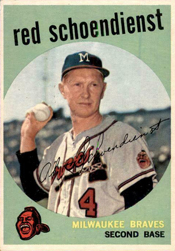
Schoendienst was diagnosed with tuberculosis in November 1958, shortly after he played in the World Series for the Braves, and it was expected he would sit out the entire 1959 season or perhaps never play again.

Schoendienst, who was confined to a sanitarium in St. Louis for several months and also underwent lung surgery, made a full recovery.

He returned to the Braves’ active roster sooner than expected, on Sept. 1, 1959, and was used as a defensive replacement and pinch-hitter in the last month of the season.

Feeling drained

Schoendienst had experience overcoming adversity. When he was 16, he was struck in the left eye by a staple while building a fence. Doctors wanted to remove the damaged eye, but Schoendienst wouldn’t let them, and his sight recovered.

A nine-time National League all-star as a second baseman for the Cardinals, Schoendienst was traded to the Giants on June 14, 1956. A year later, June 15, 1957, the Giants dealt him to the Braves. Schoendienst helped the Braves win National League pennants in 1957 and 1958. They were World Series champions in 1957.

In his book, “Eddie Mathews and the National Pastime,” Braves third baseman Eddie Mathews said of Schoendienst, “It would be hard to overstate how important he was in our winning the pennant in 1957. Leadership is hard to define. It involves clutch hitting, turning the key double play, a whole lot of things. Red did them all.”

Hank Aaron, in his autobiography, “I Had a Hammer,” said Schoendienst “was a master second baseman” who “made our team complete.”

Toward the end of the 1958 season, Schoendienst, 35, felt unusually tired. In his book, “Red: A Baseball Life,” Schoendienst said he told people he had a bad cold, “but in my own mind, I was scared.”

Schoendienst started at second base in all seven games of the 1958 World Series, batted .300, produced nine hits, including three doubles and a triple, and made one error in 63 innings, but he felt terrible.

In the 1964 book “The Quality of Courage,” Mickey Mantle, who played against Schoendienst in the 1958 World Series, recalled, “Seriously ill, he played up to the hilt for seven games. He never quit. More than that, he never stopped producing. He batted .300, fielded beautifully and literally ran his lungs out to stretch a hit into a triple.”

In an article she wrote for Parade magazine, Red’s wife, Mary Schoendienst, said her husband was so weak during the 1958 World Series “he spent nearly every hour away from the ballpark in bed.”

Said Red: “During the World Series when I was in the field, I couldn’t move. When I walked up to bat, I could hardly swing the bat. I saw the ball well, but I couldn’t react to it. There was no question I was sick.”

When he returned home to St. Louis, Schoendienst, coughing and having trouble breathing, was examined by his personal physician, who sent him to a hospital. Tests revealed Schoendienst had tuberculosis. Schoendienst’s condition was made public in November 1958. Dr. Ray Martin of St. Louis said Schoendienst would be confined to Mount St. Rose Sanitarium in St. Louis “for four to six months,” The Sporting News reported.

“Sometimes it takes as long as a year for a tubercular patient to return to even an ordinary job,” Dr. Martin said.

The Sporting News concluded, “The disclosure made it all but certain Schoendienst would be lost to the Braves for the entire 1959 season. Under the circumstances, there is grave doubt (he) will ever play again.”

Doctor’s orders

Schoendienst said he decided, “I was going to fight this disease as hard as I had played any game in my life. I had too much to live for to surrender without waging all-out war. I pledged to do whatever the doctor said, to become a model patient and listen to him as closely as I ever listened to any manager and coach.”

In February 1959, when doctors recommended surgery to remove part of an infected lung, Schoendienst replied, “Let’s do it.”

While he was in the sanitarium, Schoendienst was visited by Braves executives, who offered him a contract for 1959.

“The Braves’ owner, Lou Perini, knew I might not play a game in 1959, but he still wanted me to have that salary and I certainly appreciated it,” said Schoendienst. “Had the team not been willing to do that, I am certain it would have added a lot of mental stress to wonder how I would take care of my family. Giving me that contract allowed me to concentrate entirely on getting well.”

On March 24, 1959, Schoendienst was sent home, four months after he had entered the sanitarium. By July, he began preparing to return to baseball.

“I did bending exercises to get my legs in shape and arm exercises to strengthen my shoulders,” he said. “I started playing catch with some of the kids in the neighborhood and also my father-in-law. The doctors told me the only thing they didn’t want me doing was running.”

Schoendienst discreetly went with his brother Joe to local parks and began hitting baseballs again.

When the Braves came to St. Louis to play the Cardinals in mid-summer, Schoendienst went to the ballpark one morning and took batting practice. He also went to second base and fielded grounders and pop flies.

After the Braves left town, Schoendienst said the Cardinals allowed him to come to Busch Stadium each day and work out.

Doctors gave Schoendienst, 36, approval to resume playing before the season ended if he and the Braves “were willing to be cautious and not overdo things.”

United Press International reported, “Regular play could overtire him and that is still forbidden, according to doctors’ orders.”

Big moment

The Braves were home in Milwaukee for two games against the Phillies Sept. 1-2. Schoendienst was back in uniform for the first game but didn’t play. The next night, the Braves had a runner on second, two outs, in the seventh inning when manager Fred Haney told Schoendienst to bat for pitcher Juan Pizarro. The crowd of 18,047 at County Stadium roared and gave a standing ovation when Schoendienst emerged from the dugout.

“I had more butterflies than I ever had,” Schoendienst said to the Associated Press. “It was truly a big moment.”

In his book, Schoendienst said, “The cheers sent goosebumps down my back and I stepped out of the box a couple of extra moments to compose myself.”

Schoendienst hit a groundball to pitcher Robin Roberts, who fielded it and threw to first for the out. Boxscore

Schoendienst appeared in five games, mostly as a defensive replacement, for the 1959 Braves and was hitless in three at-bats, but he was healthy and ready to keep playing.

Schoendienst was the Opening Day second baseman for the 1960 Braves, but eventually was benched by manager Chuck Dressen. The Braves released him after the season and Schoendienst returned to the Cardinals after rejecting an offer from the Angels. He batted .300 in a utility role for the 1961 Cardinals and was a player-coach for them in 1962 and 1963.

After serving fulltime as a coach in 1964, Schoendienst became Cardinals manager for 1965, embarking on a successful second career.
Read Full Post »

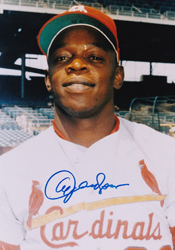
After losing 10 of 11 decisions against the Dodgers, Al Jackson persevered and outdueled Sandy Koufax.

A left-handed pitcher who relied on a sinker for groundball outs, Jackson made his major-league debut in 1959 with the Pirates, spent most of his career with the Mets and had two strong seasons with the Cardinals.
During his first stint with the Mets from 1962-65, Jackson was 1-9 versus the Dodgers. He lost eight consecutive decisions against them before spinning a three-hitter and outdueling Claude Osteen in a 1-0 Mets victory on June 21, 1965, at Dodger Stadium. Boxscore

Two months later, on Aug. 10, 1965, Koufax got his 20th win of the season, striking out 14 Mets and beating Jackson in a 4-3 Dodgers victory at Los Angeles. Boxscore

The Mets traded Jackson and third baseman Charlie Smith to the Cardinals for third baseman Ken Boyer after the 1965 season.

Tough luck

After opening the 1966 season as a reliever, Jackson was moved into the Cardinals’ starting rotation in May, replacing Ray Sadecki, who got traded to the Giants.

The first time Jackson faced the Dodgers as a Cardinal was June 1, 1966, at St. Louis. Although he pitched well, he again took the loss. Jackson held the Dodgers to three hits in seven innings, but Koufax pitched a shutout in a 1-0 Dodgers victory.

Jackson “deserved a better fate, but he was pitted against a master,” the Los Angeles Times observed.

The Dodgers scored an unearned run in the seventh. With one out and none on, Jackson “got a slider too high and too close” to Willie Davis, who hit the pitch into the right-field corner for a triple, the St. Louis Post-Dispatch reported. When right fielder Bobby Tolan’s throw eluded relay man Julian Javier, Davis raced to the plate on the error.

“I’m sure Jackson would like to have that pitch back,” Davis said. Boxscore

The loss dropped Jackson’s career record versus the Dodgers to 1-10.

Beating the best

One month later, on July 1, 1966, at Dodger Stadium, Jackson and Koufax again were matched against one another.

Koufax had a five-game winning streak versus the Cardinals. His season record was 14-2. Jackson had been given an extra day of rest since making his last start five days earlier against the Astros.

The two left-handers held their opponents scoreless through the first six innings. With one out in the seventh, Orlando Cepeda singled and Mike Shannon slugged a home run, giving the Cardinals a 2-0 lead.

Jackson did the rest, pitching a six-hit shutout. Only one Dodgers baserunner, Wes Parker in the first inning, reached second base. Jackson got the Dodgers to ground into three double plays and walked none.

“When I have a good day, I work my infielders pretty hard,” Jackson said.

The game was completed in 1 hour, 53 minutes.

Jackson said “my breaking ball wasn’t working so good” and his fastball initially was “too straight.” A word of advice from pitching coach Joe Becker helped.

Becker “told me to become a pitcher again, instead of a thrower, and I started keeping the ball down,” Jackson said.

In the ultimate compliment, Koufax said, “I had the best stuff I’ve had all year, but Al just pitched better.” Boxscore

Action Jackson

Jackson’s gem changed his luck against the Dodgers. Six of his last eight career decisions versus the Dodgers were wins. Jackson was 2-2 with an 0.92 ERA versus the Dodgers for the 1966 Cardinals and 3-0 against them for the 1967 Cardinals.

Jackson, who was traded back to the Mets after the Cardinals won the 1967 World Series title, finished with a career mark of 7-12 and a 3.41 ERA versus the Dodgers. He was 5-2 against them as a Cardinal; 2-10 as a Met.

Here is the breakdown of Jackson’s Dodgers decisions: 3-0 vs. Don Sutton, 1-0 vs. Claude Osteen, 1-0 vs. Jim Brewer, 1-2 vs. Don Drysdale, 1-5 vs. Koufax, 0-2 vs. Joe Moeller, 0-2 vs. Pete Richert and 0-1 vs. Bill Singer.

Jackson had an overall major-league record of 67-99 with a 3.98 ERA. In two seasons with St. Louis, he was 22-19 with a 2.97 ERA.

In 1966, when he was 13-15 with a 2.51 ERA, Jackson was second on the Cardinals in wins, games started (30), complete games (11) and innings pitched (232.2). He was 12-14 with a 2.61 ERA as a starter; 1-1 with an 0.73 ERA in six relief appearances.

Jackson was 9-4 with a 3.95 ERA in 39 appearances for the 1967 Cardinals. He was 5-3 with a 4.88 ERA in 11 starts; 4-1 with a 2.81 ERA as a reliever.

Read Full Post »

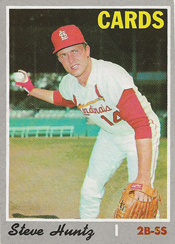
Steve Huntz had impressive timing for a player with unimpressive numbers.

On Aug. 28, 1969, Huntz hit his first major-league home run, giving the Cardinals a 2-1 walkoff victory over the Astros at St. Louis.
Huntz was an unlikely candidate for such a feat. The rookie infielder entered the game with a season batting average of .186.

Prospect with pop

Huntz began his professional career when he signed with the Orioles as an amateur free agent after three successful varsity seasons at St. Ignatius High School in Cleveland.

In 1964, his first professional season, Huntz had 74 RBI for the Class A Midwest League Fox Cities Foxes. Of his 98 hits, 34 were for extra bases.

Cardinals scouts Jim Belz and Joe Mathes liked what they saw from Huntz. Based on their recommendations, the Cardinals paid $8,000 for the right to select Huntz in the November 1964 minor-league draft.

Huntz broke his leg in 1965 and sat out the season. He came back in 1966, played for Class AA Arkansas and committed 44 errors at shortstop.

After spending the 1967 season with Class AAA Tulsa, Huntz was called up to the big leagues when rosters expanded in September and appeared in three games for the Cardinals.

Huntz, a switch-hitter, was considered a prime candidate to earn a spot with the 1968 Cardinals as a utility player, but he batted .167 in spring training and “displayed limited range at the most critical position as backup man to Dal Maxvill at shortstop,” The Sporting News reported.

The Cardinals kept veteran Dick Schofield as their reserve shortstop and sent Huntz to Tulsa for the 1968 season.

Playing for manager Warren Spahn, Huntz hit .284 with 35 doubles and 74 RBI, helping Tulsa win the 1968 Pacific Coast League championship. Though Huntz committed 41 errors at shortstop, the Cardinals were intrigued by his power.

“He’s an infielder with sting at the plate and there aren’t many prospects like that around,” said Cardinals assistant farm director Fred McAlister.

As for fielding, McAlister said, “Huntz does a good job of moving to his right, bracing himself and gunning the ball. He can’t move to his left the way Dal Maxvill can, but how many men can a shortstop throw out when he fields the ball deep to his left? It’s making the routine plays that’s most important with a shortstop.”

Ups and downs

After the 1968 season, Schofield was traded to the Red Sox for pitcher Gary Waslewski, opening a path for Huntz to be a reserve infielder for the 1969 Cardinals. A headline in The Sporting News declared, “Cards Tap Huntz As New Super Sub.”

Huntz, 23, spent the entire 1969 season with the Cardinals, but struggled from the start. A breakthrough came on July 1, 1969, in a doubleheader against the Mets at St. Louis. Huntz, who had one RBI for the season, started at second base in the opener and drove in a run. Boxscore In the second game, he started at shortstop and drove in three runs with a bases-loaded double against Don Cardwell. Boxscore

Nearly two months later, Huntz got his first big-league home run. He entered the game against the Astros at Busch Stadium in the ninth inning as a replacement for Maxvill, who was lifted in the bottom half of the eighth for pinch-hitter Vic Davalillo.

The Astros led, 1-0, until the Cardinals tied the score in the bottom of the ninth against starter Don Wilson. Vada Pinson led off with a single. Joe Torre followed with a potential double-play grounder, but the ball took a bad hop, caromed off shortstop Denis Menke’s shoulder and went into center field for a single, advancing Pinson to third. A Dave Ricketts sacrifice fly scored Pinson.

Huntz led off the bottom of the 10th and hit a 2-and-1 pitch from Wilson over the right-field wall for the walkoff home run. Boxscore

Cardinals manager Red Schoendienst told the St. Louis Post-Dispatch, “When Steve went up to hit in the 10th, I said, ‘Hit one out of here so we can get going,’ and damned if he didn’t.”

Huntz had one more Cardinals highlight. On Sept. 26, Huntz became the only 1969 Cardinals batter to hit two home runs in a game. Facing the Expos at Jarry Park in Montreal, Huntz hit a two-run home run against Don Shaw and a solo home run versus ex-Cardinal Larry Jaster. Boxscore

“I haven’t exactly been mashing the ball, you know,” Huntz said. “I’ve tried to do the job, but I haven’t performed as well as I thought I would.”

Huntz completed the 1969 Cardinals season with a .194 batting average in 71 games. He had more strikeouts (34) than hits (27) and committed nine errors in 52 games at shortstop.

Moving on

At spring training in 1970, Huntz hit .345, but the Cardinals deemed him overweight and opted to send him to Tulsa. After Huntz told teammates he wouldn’t report to the minors, the Cardinals traded him to the Padres for pitcher Billy McCool on April 2, 1970.

The Padres assigned Huntz to their Class AAA farm club at Salt Lake City. He threatened to quit, but reconsidered after a talk with Padres manager Preston Gomez. “I told him to get in shape and he could be up with us before too long,” Gomez said.

Huntz hit .308 in seven games for Salt Lake City and got called up to the Padres.

On April 28, 1970, in his first Padres at-bat, Huntz hit a home run against the Expos at San Diego. It came against Waslewski, his former Cardinals teammate. Boxscore

Huntz hit 11 home runs for the 1970 Padres. Three of those homers came against future Hall of Famers _ Tom Seaver, Gaylord Perry and Phil Niekro.

Huntz also played for the White Sox in 1971 and again for the Padres in 1975.

Read Full Post »

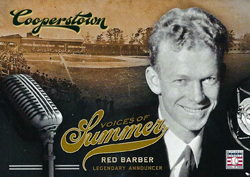
Dodgers president Larry MacPhail, accustomed to rocking the status quo, was the first executive in the major leagues to go to bat for television.

On Aug. 26, 1939, a big-league baseball game was televised for the first time when NBC aired the opener of a doubleheader between the Reds and Dodgers at Ebbets Field in Brooklyn.

MacPhail, an innovator who introduced night games and yellow baseballs to the big leagues, approved the experiment to televise a Dodgers game when the opportunity was presented to him by team broadcaster Red Barber.

Today, television is as much a part of baseball as bats and gloves, but in 1939 the medium barely was part of American culture.

Greatest showman

MacPhail, a lawyer and colleague of Cardinals executive Branch Rickey, worked in the Cardinals’ system as president of their Columbus, Ohio, farm club before getting to the big leagues as general manager of the Reds in 1934. MacPhail installed lights at Cincinnati’s Crosley Field and introduced night baseball to the big leagues on May 24, 1935, when the Phillies played the Reds.

In 1938, MacPhail became general manager of the Dodgers and was promoted to team president a year later. MacPhail chose Leo Durocher, the fiery former Gashouse Gang Cardinals shortstop, to manage the Dodgers and brought Barber to Brooklyn from Cincinnati, where they had worked together with the Reds.

Barber’s folksy Southern charm and catchy phrasing on his Dodgers radio broadcasts entertained and attracted listeners. According to The Sporting News, Barber in 1939 helped “to establish a record attendance at Ebbets Field by the interest he aroused in the team.”

Modern technology

Television sets were demonstrated to the American public at the New York World’s Fair in 1939. A television set cost about $600, the same price as a new car.

The U.S. had fewer than 500 television sets in 1939 and most were in New York City, but advancements rapidly were occurring. In April 1939, Franklin D. Roosevelt became the first U.S. president to have a speech televised. A month later, in May 1939, a college baseball game featuring Princeton and Columbia was televised. A heavyweight bout between Lou Nova and Max Baer was televised in June 1939.

Alfred Morton, a NBC vice president in charge of their fledgling television division, was looking for more opportunities to test the technology. He called his friend, Barber, and asked whether he thought MacPhail would allow NBC to televise a major-league game from Ebbets Field. Barber agreed to find out.

In his 1968 book, “Rhubarb in the Catbird Seat,” Barber said he went to MacPhail’s office and said, “Larry, would you like to be the first man ever to put on a television broadcast of a major-league baseball game?”

MacPhail replied simply, “Yes.”

Barber said MacPhail didn’t charge NBC any rights fees. He only asked for the network to install a television set in the Ebbets Field press room so club officials and media could watch the telecast.

New world

In August 1939, NBC”s New York station, W2XBS, was on the air for four hours a day (2:30 p.m. to 4:30 p.m. and 8:30 p.m. to 10:30 p.m.) and five days a week (Wednesday through Sunday).

“Television then was on about the same level of speculation as a trip to the moon is now,” Barber said. “It was feasible, within reach, about to happen, actually happening, but, even so, it was still away out in the future.”

Barber was chosen to be the broadcaster for the Saturday afternoon telecast from Ebbets Field. Only the first game of the doubleheader was televised.

NBC set up two cameras. One was near the visitors’ dugout on the third-base side and the other was on the second deck behind home plate.

Barber did his announcing from a seat among the fans in the upper deck behind third base because the radio broadcast was being done from the press box booth.

“I had to guess which way the camera was pointing, and I never knew for sure what was on the picture,” Barber said. “Burke Crotty was the director and every once in a while he would holler at me through the earphones that the camera was on second base now, or it was on the pitcher.”

Barber ad-libbed commercials for the three telecast sponsors _ Wheaties, Mobil Oil and Ivory Soap.

“They put the camera on me and I held up a box of Wheaties and poured them in a bowl,” Barber said. “I took a banana and a knife and I sliced the banana onto the Wheaties. Then I poured in some milk and said, ‘That’s the breakfast of champions.’

“I put on a Mobil service station cap and held up a can of oil. For Ivory Soap, I held up a bar of soap.”

After the Reds won the game, 5-2, before 33,535 spectators, Barber did television’s first postgame show on the field, interviewing Durocher, Reds manager Bill McKechnie, Dodgers first baseman Dolph Camilli and Reds pitcher Bucky Walters. Boxscore

“I got Camilli to show his hands on camera,” Barber recalled. “I had always been much impressed with the size, the agility, the dexterity, the grace, the beauty, the strength of Camilli’s hands.”

That’s entertainment

Public response to the telecast was “instantaneous and amazing,” according to The Sporting News.

The Television Building at the World Fair, which showed the telecast, had to shut its doors because the crowd wanting to get in was so great. A Broadway theater which showed the game on its television set “was swamped” with curious viewers, The Sporting News noted.

International News Service marveled at how the game could be seen by television viewers “as far as 50 miles away” from Brooklyn.

As for the quality of the telecast, International News Service reported, “At times, despite the great speed of play, the baseball was visible in the television image, particularly when pitchers Luke Hamlin and Bucky Walters resorted to slower delivery, or when the batter drove out a hit directly away from the iconoscope camera.”

According to The Sporting News, “The players were clearly distinguishable, but it was not possible to pick out the ball.”

On Sept. 30, 1939, a college football game between Waynesburg and Fordham was televised. A NFL game featuring Philadelphia and Brooklyn was televised a month later.

About 2,000 television sets were in use in the U.S. by 1940, but World War II slowed development because people and resources were needed for the military effort. At the close of World War II in 1945, there were 7,000 television sets in the U.S. and nine stations on the air. By 1960, the number of TV sets nationwide was 52 million.

Read Full Post »

Johnny Mize barely missed out on being part of the Cardinals’ championship run of the early 1940s, but his timing was right with the Yankees.

On Aug. 22, 1949, the Giants sold Mize’s contract to the Yankees for $40,000.

The slugging first baseman played for the Yankees for five seasons, 1949-53, and they were World Series champions in each of those years.

Mize, one of the National League’s most feared sluggers when he played for the Cardinals and Giants, became a valued role player with the Yankees, platooning at first base and excelling as a pinch-hitter.

Cardinals clouter

In 1936, two years after the Gashouse Gang Cardinals won a World Series title against the Tigers, Mize made his major-league debut and replaced Rip Collins as the first baseman.

A left-handed batter nicknamed “The Big Cat,” Mize hit with consistent power. He was the first Cardinals player to hit three home runs in a game four times.

Mize had 100 or more RBI in five of his six St. Louis seasons. He established the Cardinals’ single-season home run record with 43 in 1940. The mark held until Mark McGwire, using performance-enhancing drugs, hit 70 in 1998.

Mize batted .336 with 1,048 hits in 854 games as a Cardinal, but the club never won a pennant in any of his seasons with them.

On Dec. 11, 1941, the Cardinals traded Mize, 28, to the Giants for pitcher Bill Lohrman, first baseman Johnny McCarthy, catcher Ken O’Dea and $50,000.

The Cardinals went to the World Series in each of the next three years, winning championships in 1942 and 1944.

Differences with Durocher

After one season with the Giants, Mize joined the Navy and served for three years (1943-45) during World War II. He returned to the Giants in 1946 and twice led the league in home runs, hitting 51 in 1947 and 40 in 1948.

Leo Durocher became Giants manager in July 1948 and he was tough on his former Cardinals teammate. Mize’s “slowness afoot displeased Durocher,” the Associated Press reported, and, according to The Sporting News, Durocher tried to get Mize “to change his stance in order to pull outside pitches instead of poking them into left field.”

Mize “rebelled quietly at the harshness” of Durocher, the New York Daily News reported.

During spring training in 1949, the Dodgers inquired about Mize but lost interest when the Giants asked for $200,000 in return, the Associated Press reported.

The Tigers made a bid for Mize in July 1949, but it didn’t work out. According to the New York Daily News, the Tigers determined Mize, 36, was “too old and slow.”

Good move

In August 1949, the Giants placed Mize on waivers and none of the other seven National League teams put in a claim for him.

The Cardinals had first basemen Nippy Jones and Rocky Nelson, and club owner Fred Saigh said, “We’re in good shape at first base and didn’t need any more help.”

Said Phillies owner Bob Carpenter: “The fact all the clubs waived on him speaks for itself.”

Though past his prime, Mize still was an effective run producer, with 18 home runs and 62 RBI for the 1949 Giants.

By clearing waivers, Mize could be dealt to an American League team.

The first-place Yankees thought their closest pursuers, the Red Sox, “would take Mize if they didn’t,” the New York Daily News reported, and offered the most money for him. Acquiring Mize also enabled the Yankees to return Tommy Henrich, who was playing first base, to the outfield, his most natural position.

In five seasons with the Giants, Mize hit .299 with a .389 on-base percentage, but, like with the Cardinals, never played in a World Series for them.

Puffing on a cigar, Mize told United Press, “I wouldn’t say I’m glad to get away from the Giants. I got along all right with Leo Durocher, although I didn’t always agree with him.”

The Yankees were credited with making a shrewd move.

“Mize may turn out to be the longball-hitting first sacker the Yankees have been seeking ever since the immortal Lou Gehrig retired,” the Associated Press declared.

Sid Keener of the St. Louis Star-Times wrote, “The Yankees are playing table stakes with blue chips in their effort to bring the 1949 pennant to New York.”

Mize’s mother, Emma, immediately recognized the potential benefits for her son, telling United Press, “All my life I’ve wanted to see him in the World Series. Maybe he’ll make it at last.”

A lot left

In his second game for the Yankees, Mize hit a two-run home run against Bob Feller, sparking them to a victory. Boxscore

The 1949 Yankees went on to win the pennant and Mize got to play against the Dodgers in his first World Series.

In 1950, Mize produced 25 home runs and 72 RBI in just 90 regular-season games for the Yankees.

He was a standout of the 1952 World Series when he batted .400 and slugged three home runs against the Dodgers. He would have had a fourth home run, but Dodgers outfielder Carl Furillo “leaped high, leaned back and robbed” Mize, catching a drive headed for the bleacher seats, The Sporting News reported.

Mize appeared in 18 World Series games for the Yankees and hit .286 with nine RBI.

In 1953, his final season, Mize, 40, was at his best as a pinch-hitter, batting .311 (19-for-61) in the role.

When Mize completed his career in the majors, his 359 home runs ranked sixth all-time. He finished with 2,011 hits, 1,337 RBI and a career batting average of .312.

Mize hit 20 or more home runs nine times and never struck out more than 57 times in any of those seasons. When he hit his career-high 51 home runs for the 1947 Giants, he struck out only 42 times.

Read Full Post »

(Updated Dec. 1, 2024)

Grover Cleveland Alexander lost his spot on the Cardinals when manager Bill McKechnie lost confidence in the pitcher’s ability to come to games ready to play.

On Aug. 19, 1929, McKechnie determined Alexander’s alcoholism made him unreliable and sent him back to St. Louis during a road trip.

Cardinals owner Sam Breadon, who liked Alexander and was sympathetic to him, told him to go home to Nebraska, sit out the rest of the 1929 season and try to get sober.

Alexander never pitched for the Cardinals again.

Shell shocked

After posting a 190-88 record in seven seasons with the Phillies, Alexander was dealt to the Cubs in December 1917. He entered the Army in the spring of 1918 and experienced extensive combat in Europe during World War I.

Exposed to heavy artillery shelling, Alexander lost hearing in his left ear, suffered damage to his right ear, developed epilepsy and became an alcoholic.

In the book “Baseball As I Have Known It,” Alexander said to author Fred Lieb, “I don’t feel sorry for myself, or excuse my drinking. I guess I just had two strikes on me when I came into this world. My father was a hard drinker before me, and so was my grandfather before him. I tried to stop. I just couldn’t.”

Alexander returned to the Cubs in May 1919 and pitched effectively for several seasons, but his drinking eventually got him in trouble with rookie manager Joe McCarthy, who took over in 1926 and wanted him off the team.

Years later, Alexander’s wife, Aimee Alexander, told Sport magazine, “Alex always thought he could pitch better with a hangover, and maybe he could, at that.”

In June 1926, the Cubs granted McCarthy’s request, placed Alexander on waivers and he got claimed by the Cardinals.

Under control

In his book “Redbirds: A Century of Cardinals Baseball,” author Bob Broeg described Alexander, 39, as “freckled and turkey-wattled from a long, hard athletic life, knock-kneed, wearing his cap perched on top of his head like a peanut.”

Alexander may not have had control of his personal demons, but he still had command of his pitches. According to Broeg, Alexander was called “Old Low and Away” by teammate Jesse Haines for his ability “to pinpoint pitches down across the lower, outer edge of the plate.”

Alexander was 9-7 for the Cardinals the remainder of the 1926 season, helping them win their first National League pennant. In the 1926 World Series against the Yankees, Alexander made two starts, won both, and earned the save in Game 7 with 2.1 innings of hitless relief, including an iconic strikeout of Tony Lazzeri with two outs and the bases loaded in the seventh.

Alexander was 21-10 for the Cardinals in 1927 and 16-9 in 1928 when they won their second National League championship.

At 42, Alexander still was a starter for the Cardinals in 1929, but he delivered one of his best performances in a relief stint.

On Aug. 10, 1929, in the second game of a Saturday doubleheader against the Phillies at Philadelphia, McKechnie brought Alexander into the game in the eighth inning with the Cardinals trailing, 9-8. According to Broeg, McKechnie said to Alexander, “Hold ’em, and we’ll win it for you.”

The Cardinals got a run in the ninth to tie the score at 9-9 and two in the 11th for an 11-9 lead. Alexander did his part, pitching four scoreless innings and earning the win, the 373rd and last of his major-league career. According to the St. Louis Post-Dispatch, Cardinals catcher Jimmie Wilson said Alexander had such control of his pitches against the Phillies “he could have hit a gnat in the eyebrow.” Boxscore

Basic training

Philadelphia prohibited Sunday baseball, so with a day off on Aug. 11, 1929, Alexander informed McKechnie he planned to go to Atlantic City to visit friends.

According to Broeg, Alexander told McKechnie, “I won’t take a drink.”

McKechnie replied, “I don’t care if you take a drink. Just return Monday, fit and ready to work.”

(In “Baseball As I Have Known It,” McKechnie said he told Alexander, “I know you have many friends here and that you like to be with them. I am going to trust you. You can have a few beers, but no gin.”)

Alexander returned to the club on Monday looking “unsightly and shaky,” according to Broeg.

McKechnie told Fred Lieb, “He was a sight. His eyes were watery and bloodshot … His clothes looked as though someone had rolled him in the gutter. Two minutes after he arrived, the room reeked of bad gin. When Alexander was on a real bender, he not only drank quantities of gin, but rubbed it into his skin.”

McKechnie warned Alexander not to let it happen again.

On Aug. 17, 1929, Alexander got the start against the Giants in Game 2 of a Saturday doubleheader in New York and took the loss, yielding five runs in three innings and dropping his record to 9-8.

Alexander went on a drinking binge again. Two days later, on Aug. 19, 1929, during a day off in Brooklyn, McKechnie “ordered Alexander to leave the team for breaking training” rules, the St. Louis Globe-Democrat reported.

McKechnie had given Alexander “repeated warnings” and said he decided “to use stern measures” because “leniency had failed to gain results,” the Associated Press reported.

In the Post-Dispatch, J. Roy Stockton wrote, “Everybody knows what caused Alexander’s final break with Bill McKechnie. His waywardness has been disguised by a kindly newspaper world as mumps, measles, lumbago, indigestion and ptomaine poisoning, but it is doubtful if anybody is fooled.”

Fond farewell

When he got back to St. Louis, Alexander told the St. Louis Star-Times, “I’ve been a bad boy of baseball and I’m paying for it. There’s no one to blame but myself. I hold no hard feelings toward anyone. Everyone knows I never was an angel.”

Alexander met with Sam Breadon the next day, Aug. 21, 1929. Breadon thought it best for Alexander to take a break from baseball, but said he would continue to pay him during his leave of absence.

“Mr. Breadon told me to go home and straighten up with a long rest and all would be all right,” Alexander said to the Post-Dispatch. “I am going home to St. Paul, Nebraska, and go fishing for bullheads. I expect to regain my best condition and to pitch for the club next year.”

According to the Globe-Democrat, Breadon said McKechnie “did right to order (Alexander) away from the team and I support McKechnie in his moves.”

Breadon added, “I have always been very fond of Alexander and I could not deal harshly with him. It has been said I have disciplined my managers for not holding Alexander closer to the mark, but the actual truth is I have been even more lenient with Alexander than the managers.”

Four months later, on Dec. 11, 1929, the Cardinals traded Alexander and catcher Harry McCurdy to the Phillies for pitcher Bob McGraw and outfielder Homer Peel.

Alexander was 0-3 with a 9.14 ERA in nine appearances for the 1930 Phillies, got sent to the minors and didn’t play in the big leagues again.

He and Christy Mathewson are tied for third among major leaguers in career wins at 373. Only Cy Young (511) and Walter Johnson (417) have more.

Alexander struggled with personal and financial problems during the Great Depression. According to Broeg, Breadon, for the rest of his life, paid Alexander $100 a month, sending the check through the National League office. After Breadon died in 1949, Fred Saigh, part of the Cardinals’ new ownership, kept up the payments to Alexander and paid for the funeral when Alexander died in 1950.

Read Full Post »

« Newer Posts - Older Posts »