Feeds:
Posts
Comments

Archive for the ‘Games’ Category

Before Al Hrabosky became prominent, another pitcher with a double-consonant start to his name, Joe Grzenda, was the Cardinals’ top left-handed reliever.
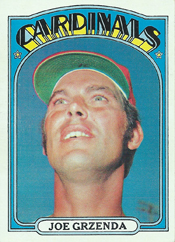
Grzenda pitched eight seasons in the major leagues for the Tigers (1961), Athletics (1964 and 1966), Mets (1967), Twins (1969), Senators (1970-71) and Cardinals (1972).

The Cardinals, seeking a reliever who could get out left-handed batters, acquired Grzenda from the Senators for infielder Ted Kubiak on Nov. 3, 1971, but it didn’t work out the way they’d hoped.

Nervous energy

Grzenda was born in Scranton, Pa. His father was a coal miner. Grzenda signed with the Tigers when he was 18 in 1955. He injured his arm in the minor leagues and developed a sidearm delivery, relying on a sinker.

After making his major-league debut with the Tigers in 1961, Grzenda was released in 1963 and joined the Athletics. According to Hardball Times, when Grzenda was in the Athletics’ farm system in 1964, his teammates “quickly took note of his habit of drinking two pots of coffee each day. They also noticed his chain-smoking, as he plowed through three packs of Lucky Strikes in a typical day. Sometimes Grzenda would light a cigarette and start smoking, leave it on the bench, and then work so quickly on the mound that he could return to the dugout and finish off the cigarette. A bundle of nervous energy fueled by cigarettes and coffee, he was in constant motion.”

In 1967, with Dave Duncan as his primary catcher, Grzenda was 6-0 with a 1.20 ERA in 52 appearances for the Birmingham club in the Athletics’ farm system. Mets president Bing Devine was impressed and purchased Grzenda’s contract on Aug. 14, 1967. Grzenda made 11 appearances with the 1967 Mets and had a 2.16 ERA.

Grzenda had his biggest successes in the major leagues with the 1969 Twins and 1971 Senators.

Playing for manager Billy Martin, Grzenda was 4-1 with three saves for the Twins, who won the 1969 American League West title.

In March 1970, the Twins traded Grzenda to the Senators, who were managed by Ted Williams.

In the book “Kiss It Goodbye,” Senators radio voice and author Shelby Whitfield noted, “Williams was the only one who saw potential in Grzenda.”

Getting a grip

During the 1970 season, Senators catchers told Grzenda “he was throwing the slider with more velocity than his fastball,” The Sporting News reported.

Seeking a remedy, Grzenda went to Senators pitching coach Sid Hudson, who suggested a grip change. Grzenda tried it and his fastball developed the action of a slip pitch. Bob Broeg of the St. Louis Post-Dispatch described the slip pitch as “a delivery that fades and falls like a screwball.”

“It serves not only as a changeup,” Broeg wrote, “but also as a good double-play pitch for right-handed hitters who try to pull it.”

Many pitchers can’t control a slip pitch, but for Grzenda it “was love at first sight,” according to Broeg.

Hudson said, “Now he has more confidence in what he is doing because he has more velocity and is throwing pitches with different speeds.”

Grzenda was 5-2 with five saves and a 1.92 ERA in 46 relief appearances for the 1971 Senators. He limited batters to 17 walks in 70.1 innings. Left-handed batters hit .226 against him.

Filling a need

Cardinals scout Joe Monahan was impressed and said Grzenda has “a good curve, his fastball is alive and he has excellent control. His fastball sinks and has the effect of a screwball against right-handed batters.”

After the 1971 season, the Senators moved from Washington, D.C., to Texas and were renamed the Rangers. The club was seeking a second baseman and Williams viewed Kubiak, a Cardinals utility infielder, as an ideal candidate.

“Ted Williams has been interested in Kubiak for a couple of years,” Rangers owner Bob Short told The Sporting News.

Williams contacted the Cardinals to inquire about Kubiak’s availability. Monahan “highly recommended” the Cardinals ask for Grzenda in exchange. Devine, who had left the Mets and was in his second stint as Cardinals general manager, was willing to acquire Grzenda a second time.

“We needed an experienced left-handed reliever so badly,” Devine said.

Devine figured Grzenda and Don Shaw would give the 1972 Cardinals a pair of quality left-handers in the bullpen. Shaw was 7-2 with a 2.65 ERA for the Cardinals in 1971 and left-handed batters hit .171 against him.

Slippery slope

The plan unraveled early in the 1972 season.

Shaw developed a shoulder ailment, made eight appearances for the Cardinals and was traded to the Athletics in May.

Grzenda’s slip pitch no longer was effective. He had a 6.75 ERA in April and an 8.59 ERA in May.

Grzenda and his road roommate, Moe Drabowsky, made unwanted headlines during a series in Houston in May when it was discovered their hotel room was extensively damaged. Devine described the damage as “pretty bad.” According to the Post-Dispatch, light bulbs and drinking glasses were smashed and a bed headboard was “sighted sailing down a corridor” of the hotel.

In June, when he turned 35, Grzenda had a turnaround. He didn’t allow an earned run in 6.1 innings over five appearances for the month. He also got a win with 1.1 innings of scoreless relief against the Giants on June 17. Boxscore

After that, the highlights were few. Grzenda had a 6.75 ERA in August and a 12.46 ERA in September.

The Cardinals, out of contention and headed for a 75-81 finish, used the last few weeks of the season to look at some prospects, including Hrabosky.

Grzenda made the most appearances (30) of any left-hander on the 1972 Cardinals and was 1-0 with a 5.66 ERA. He gave up 46 hits in 35 innings and walked more batters (17) than he struck out (15). Left-handed batters hit .436 against him.

The 1972 season was Grzenda’s last in the big leagues. His career mark in the majors: 14-13 with 14 saves and a 4.00 ERA.

Hrabosky, who had brief stints with the Cardinals from 1970-72, pitched in 44 games for them in 1973 and went on to become their top left-handed reliever from 1974-77 while developing a persona as the self-psyching “Mad Hungarian.”
Read Full Post »

(Updated Dec. 23, 2019)

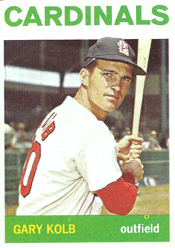
Gary Kolb impressed Branch Rickey, stepped in for Stan Musial and got traded for Bob Uecker.

Kolb played seven major-league seasons with the Cardinals (1960, 1962-63), Braves (1964-65), Mets (1965) and Pirates (1968-69).

A left-handed batter with speed, Kolb primarily was an outfielder who also experimented with catching and playing infield in the hope his versatility would enhance his value to the Cardinals.

Rickey, the former general manager who came back to the club as a consultant, liked Kolb, and so did Musial, who tabbed Kolb and Mike Shannon as potential outfield successors.

Top prospect

Kolb was a standout in baseball, basketball, football and track at Rock Falls High School in Illinois. He enrolled at the University of Illinois and played on the freshman football, basketball and baseball teams.

As a college sophomore, Kolb, 6 feet and 190 pounds, gave up basketball, but played varsity football and baseball. He signed a professional contract with the Cardinals in the spring of 1960 after completing his sophomore baseball season.

“I thought I’d better get out of football before I got hurt,” Kolb said to the St. Louis Post-Dispatch.

Kolb, 20, played for two Cardinals farm clubs in the summer of 1960, produced 15 triples and was called up to the big-league club in September. He made his Cardinals debut on Sept. 7, 1960, as a pinch-runner. Kolb appeared in nine games, eight as a pinch-runner, for the 1960 Cardinals.

Kolb spent the next two seasons in the minors before getting another September call-up to the Cardinals in 1962. He hit .357 for them in 14 at-bats.

A month later, in October 1962, the Cardinals hired Rickey, 80, as a consultant and one of his first assignments was to assess their players in the winter Florida Instructional League. Kolb was there, playing shortstop, and he caught the attention of Rickey.

Rickey “indicated he considered Kolb one of the best prospects in the camp,” the Post-Dispatch reported.

Batter up

In February 1963, shortly before the Cardinals opened spring training at St. Petersburg, Fla., they arranged for six prospects, including Kolb, to attend a special five-day hitting session. Joining Kolb were Jerry Buchek, Duke Carmel, Doug Clemens, Phil Gagliano and Dal Maxvill.

Rickey proposed the extra workouts after he observed the players at the Florida Instructional League.

“All are good athletes with good reflexes and baseball instinct,” the Post-Dispatch reported, “but all have been disappointing at swinging a bat against major-league pitching.”

Cardinals manager Johnny Keane, coach Vern Benson and Rickey were the instructors for the sessions.

Rickey “had a special batting cage built in the center field corner of the Redbirds’ spring training park,” the Post-Dispatch observed. “Behind the batting cage is a platform about five feet above the ground from which Rickey watches the batters hit against a pitching machine.”

Rickey told the assembled prospects, “You’ll hit until you are weary. You’ll get blisters on your hands before we’re through, unless you wear the golf gloves we have here for you, gloves for both hands. You’ll swing as hard as you can and you’ll bunt. You’ll bunt for the sacrifice and you’ll bunt for base hits.”

On the rise

The extra work apparently helped Kolb because he had a good spring training camp with the 1963 Cardinals. Eddie Stanky, the Cardinals’ director of player development, said Kolb is “a bulldog and a versatile athlete whose ability to play both infield and outfield will help him make the big-league club.”

Near the end of spring training, Kolb, at Rickey’s urging, “strapped on the pads” and worked out as a catcher “to lend value to his versatile efforts,” the Post-Dispatch reported.

When the Cardinals sold the contract of outfielder Minnie Minoso to the Senators, it opened a spot for Kolb on the Opening Day roster as a reserve outfielder.

The Cardinals returned Kolb to the minors in May 1963, but he hit .318 for Tulsa and was brought back to the big-league club in July.

Keane gave Kolb a start in right field against the Braves on July 12, 1963, and he produced two hits, including his first major-league home run, against Tony Cloninger. The two-run homer carried onto the pavilion roof at Busch Stadium. Boxscore

Kolb was back in the starting lineup again the next day, July 13, 1963, and went 3-for-4 with two singles and another home run against the Braves’ Hank Fischer. Boxscore

Kolb made 19 starts in right field, mostly in July, for the 1963 Cardinals. He batted .327 with 18 hits and 12 walks in 19 July games.

Kind words

In September 1963, with the Cardinals challenging the Dodgers for the pennant, Kolb was used primarily as a pinch-runner, most often for Musial, who was 42 and in his last season. Kolb appeared nine times as a pinch-runner for Musial in 1963.

On Sept. 29, 1963, Musial was in the Busch Stadium clubhouse, preparing to play his final game, when Kolb and Shannon walked by his locker.

“Wait a minute,” Musial said, putting an arm around each of them.

As photographers and reporters closed in, Musial said, “These are my proteges. They’re going to take over for me, aren’t you?”

Kolb and Shannon blushed, according to the Post-Dispatch.

After Musial stroked a RBI-single in the sixth, Keane sent in Kolb to run. Kolb told his hometown news organization, Saukvalley.com of Sterling, Ill., that as Musial departed first base for the final time to a thunderous ovation, he turned to him and said, “They love you, kid.” Boxscore

Moving on

Kolb batted .271 in 119 plate appearances for the 1963 Cardinals. He generated 26 hits, including five triples, and 22 walks for a .403 on-base percentage.

Kolb hit .328 for the Cardinals versus right-handers in 1963 and overall he batted .500 (9-for-18) against the Braves.

After trading George Altman to the Mets, Cardinals general manager Bing Devine said in November 1963 he viewed Kolb, Shannon, Clemens and Johnny Lewis as candidates to start in right field in 1964.

The scenario changed in February 1964 when the Cardinals acquired outfielder Carl Warwick from the Houston Colt .45s. Warwick and Lewis performed best in spring training and Kolb became expendable.

On April 9, 1964, the Cardinals traded Kolb and catcher Jimmie Coker to the Braves for Uecker, who was viewed as a defensive upgrade as a backup to starting catcher Tim McCarver.

Rickey opposed the deal made by Devine. According to the book, “October 1964,” when Uecker introduced himself to Rickey in the Cardinals’ clubhouse, Rickey replied, “I didn’t want you. I wouldn’t trade a hundred Bob Ueckers for one Gary Kolb.”

Kolb spent his final three seasons (1971-73) with the Pirates’ Class AAA farm club in Charleston, W.Va., and settled there after his playing career. His cousin, Dan Kolb, was a big-league relief pitcher from 1999-2007.

Read Full Post »

Eight months after striking out in their efforts to acquire Matt Holliday from the Rockies, the Cardinals got him from the Athletics, completing a series of transactions designed to boost their offense and bolster their chances of returning to the postseason after a two-year absence.

On July 24, 2009, the Athletics dealt Holliday to the Cardinals for three prospects: corner infielder Brett Wallace, pitcher Clayton Mortensen and outfielder Shane Peterson.
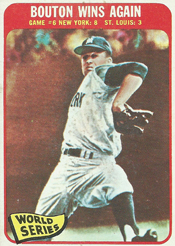
Cardinals manager Tony La Russa put Holliday in left field and batted him in the cleanup spot between Albert Pujols and Ryan Ludwick.

Holliday was the third prominent position player acquired by the Cardinals in a span of one month. On June 27, 2009, they got third baseman Mark DeRosa from the Indians for pitchers Chris Perez and Jess Todd, and on July 22, 2009, they acquired infielder Julio Lugo from the Red Sox for outfielder Chris Duncan.

“Tony pushes these guys to be successful,” Cardinals general manager John Mozeliak said to the St. Louis Post-Dispatch. “My job is to make sure he has the right players to do so.”

Aggressive suitor

The Cardinals’ pursuit of Holliday intensified in November 2008 at the general managers meetings at Dana Point, Calif.

Holliday won a National League batting title in 2007, hitting .340, and led the league in hits (216), doubles (50), RBI (137) and total bases (386) for the pennant-winning Rockies. He became expendable after the 2008 season because the Rockies couldn’t get him to commit to a long-term contract and he was eligible to become a free agent a year later.

“The Rockies arrived at the meetings intent on building momentum for a deal involving Holliday,” the Post-Dispatch reported, and the Cardinals were an “aggressive suitor.”

Mozeliak, who worked for the Rockies before joining the Cardinals after the 1995 season, acknowledged the pursuit of Holliday. “For me to say there were not serious discussions would be inaccurate,” he said to the Post-Dispatch.

The Cardinals offered Ludwick for Holliday, the Post-Dispatch reported, but the Rockies also wanted utility player Skip Schumaker and pitcher Mitchell Boggs included in the deal.

According to the Post-Dispatch, “misgivings existed within some quarters of the organization about committing multiple players for Holliday” because he could depart as a free agent after the 2009 season.

Unable to come to terms with the Cardinals, the Rockies traded Holliday to the Athletics on Nov. 10, 2008, for outfielder Carlos Gonzalez and pitchers Huston Street and Greg Smith.

Big deal

The Athletics posted losing records in each of the first three months of the 2009 season and entered July in last place in the American League West. Out of contention and facing the likelihood Holliday could walk away after the season, the Athletics shopped him and the Cardinals made the best offer.

Wallace, the Cardinals’ 2008 first-round draft pick, was the “keystone of the deal” for the Athletics, Mozeliak told the Post-Dispatch.

“Wallace is not the type of hitter you’re going to replace easily,” Mozeliak said.

Wallace hit a combined .337 for two Cardinals farm clubs in 2008 and .293 for Class AAA Memphis in 2009.

The Cardinals, who were 52-46 and in first place in the National League Central, 1.5 games ahead of both the Astros and Cubs, were willing to give up prospects for the opportunity to qualify for the postseason for the first time since 2006.

Asked whether he was concerned Holiday would depart as a free agent, Mozeliak responded, “Let him get a taste of St. Louis.”

How big a deal was it for the Cardinals to get Holliday? “It’s as big as his biceps,” pitcher Adam Wainwright told the Post-Dispatch.

Loaded lineup

Holliday was informed of the trade the morning of July 24, 2009, by text at a hotel in New York, where the Athletics were staying for a series with the Yankees.

Accompanied by his wife and two sons, Holliday took a train from Manhattan to Philadelphia and joined the Cardinals in time for their night game against the Phillies.

La Russa posted a revamped batting order of Lugo at second base, DeRosa at third, Pujols at first, Holliday in left, Ludwick in right, Yadier Molina at catcher, Rick Ankiel in center, Brendan Ryan at short and pitcher Joel Pineiro.

At the time of the trade, Pujols had received 34 intentional walks on the season, or 21 more than any other major-league batter, according to Post-Dispatch columnist Bernie Miklasz.

“By getting Holliday to follow Albert Pujols in the lineup, the Cardinals clearly raised their profile as a National League contender,” the Philadelphia Inquirer observed.

Pujols called Holliday “a professional hitter” and said, “He’d make any lineup better.”

Holliday went 4-for-5 in his Cardinals debut, producing three singles and a double, with one RBI and a run scored in an 8-1 triumph over the Phillies. Boxscore

“I can’t imagine being a pitcher and having to pitch to Pujols and looking on deck and seeing Holliday,” Athletics infielder Mark Ellis said to the New York Daily News. “That’s incredible.”

Dodgers manager Joe Torre, taking a good-natured jab at La Russa, said to the Post-Dispatch, “That lineup is pretty deep now. Tony won’t have to bat the pitcher eighth anymore.”

Happy Holliday

After batting .286 with 54 RBI in 93 games for the 2009 Athletics, Holliday hit .353 with 55 RBI in 63 games for the 2009 Cardinals.

With Holliday, the Cardinals were 39-25 and won the 2009 division title with an overall mark of 91-71, finishing 7.5 games ahead of the second-place Cubs.

Holliday, 29, became a free agent after the season, but returned to the Cardinals. In 2010, he hit .312 with 45 doubles, 28 home runs and 103 RBI.

He played in the postseason in six of his eight years with the Cardinals, missing only in 2010 and 2016, and helped them to two National League pennants and a World Series title.

Holliday’s numbers as a Cardinal: .293 batting average, 1,048 hits, .380 on-base percentage.

Read Full Post »

Before he became a celebrated author with “Ball Four,” Jim Bouton was a power pitcher whose cap flew off with nearly every delivery.

In 1964, Bouton made two starts for the Yankees against the Cardinals in the World Series and won both.

The Cardinals won the championship, but Bouton impressed with his ability to produce on the big stage. He was the first pitcher to earn two wins in a World Series versus the Cardinals since the Yankees’ Spud Chandler in 1943.

Stubbornly effective

Bouton, 25, was 18-13 with a 3.02 ERA for the 1964 Yankees. The right-hander led the team in wins, starts (37) and innings pitched (271.1).

For the first two World Series games in St. Louis, Yankees manager Yogi Berra started ailing ace Whitey Ford, who lost, and rookie Mel Stottlemyre, who won. Bouton was the starter for Game 3 at Yankee Stadium and was matched against Curt Simmons.

In his book “October 1964,” author David Halberstam called Game 3 “probably the best played and best pitched game of the series.”

Played on Saturday afternoon, Oct. 10, 1964, before 67,101 spectators, the game became a duel between Bouton and Simmons.

Bouton threw “virtually straight overhanded with his delivery and his forearm brushed the back of his cap, sending it sailing,” the Sporting News noted.

Said Berra: “We’ve tried a dozen different caps on him, and he wears a small, tight one now, but it doesn’t do any good.”

The Yankees got a run in the second on Clete Boyer’s RBI-double and the Cardinals tied the score, 1-1, on a RBI-single by Simmons in the fifth.

After retiring the Cardinals in order in three of the first four innings, Bouton worked out of multiple jams. The Cardinals loaded the bases in the sixth with two outs, but Mike Shannon grounded into a forceout. In the seventh, Dal Maxvill led off with a double and moved to third on Simmons’ sacrifice, but Curt Flood and Lou Brock stranded him.

“Bouton was keeping the ball away from me good,” Flood said to the St. Louis Post-Dispatch.

Said Brock: “I was out in front of this guy all day. I never do this … I hit the ball off the end of the bat all four times.”

In the ninth, Tim McCarver led off and reached on an error by shortstop Phil Linz. Shannon’s sacrifice bunt moved McCarver to second. Carl Warwick, batting for Maxvill, walked, but Bouton retired Bob Skinner and Flood.

Barney Schultz relieved Simmons in the bottom of the ninth and Mickey Mantle walloped his first pitch, a knuckleball, into the upper deck in right for a walkoff home run and a 2-1 Yankees victory. Boxscore

Bouton threw 123 pitches in what the New York Daily News described as a “stubborn pitching performance.” Video highlights at 1:30 mark

Under pressure

The Cardinals won Games 4 and 5 at Yankee Stadium. Back in St. Louis with a chance to clinch the title in Game 6 on Wednesday afternoon, Oct. 14, 1964, the Cardinals started Simmons in a rematch with Bouton, who welcomed the challenge.

“Far more than most baseball players, he was an adrenaline player, and he liked pitching under this kind of pressure,” said Halberstam. “He loved being the center of attention and being given the ball in a game this big.”

When Flood and Brock opened the bottom of the first with singles, it was a wakeup call for Bouton, who said, “I had to stop and boot myself in the fanny. Those hits kind of shook me up.”

Bouton got the next batter, Bill White, to ground into a double play. Flood scored from third, but Bouton settled down.

In the fifth, Bouton lined a single over the head of shortstop Dick Groat, driving in Tom Tresh from third and tying the score at 1-1.

The game turned in the sixth when Roger Maris and Mantle hit back-to-back home runs against Simmons, giving the Yankees a 3-1 lead.

In the seventh, Bouton told Berra to get a reliever ready because his right shoulder was getting tight. The Yankees extended their lead in the eighth, scoring five times. The big hit was a grand slam by Joe Pepitone against Gordon Richardson.

Bouton yielded a run in the eighth and another in the ninth. He went 8.1 innings before being relieved by Steve Hamilton, and the Yankees won, 8-3. Boxscore  and Video highlights at 1:45 mark

Cardinals slugger Ken Boyer said Bouton “kept the ball low and away all afternoon, and, if he missed the plate, he barely missed it.”

Jim and Joe

Bouton’s career took a downturn the next year. He developed a sore arm, posted records of 4-15 in 1965 and 3-8 in 1966, and was dropped from the starting rotation.

The Yankees sold Bouton’s contract to the Seattle Pilots, who joined the American League as an expansion team in 1969. The Pilots’ manager was Joe Schultz, who was a Cardinals coach from 1963-68 after managing in their farm system.

Schultz, a round, balding, good-natured baseball lifer, became a central character in “Ball Four.” Two samples of Bouton’s musings:

_ “Joe Schultz stopped by again today to say a kind word. I noticed he was making it his business to say something each day to most of the guys. He may look like Nikita Khrushchev, but it means a lot anyway. I’m sure most of us here feel like leftovers and outcasts and marginal players and it doesn’t hurt when the manager massages your ego a bit.”

_ “After the game, Joe Schultz said, ‘Attaway to stomp on ’em, men. Pound that Budweiser into you and go get ’em tomorrow.’ Then he spotted John Gelnar sucking out of a pop bottle. ‘For crissakes, Gelnar,’ Joe said, ‘You’ll never get them out drinking Dr. Pepper.’ ”

Fitting in

Bouton was 2-1 with a save and a 3.91 ERA in 57 appearances for the Pilots. On Aug. 24, 1969, they traded him to the Astros for pitchers Dooley Womack and Roric Harrison.

Two nights later, on Aug. 26, 1969, Bouton made his National League debut, relieving Larry Dierker and pitching a scoreless eighth against the Cardinals at St. Louis. Bouton retired Shannon on a groundout and Julian Javier on a pop-up before striking out Maxvill on a 3-and-2 knuckleball.

“The knuckleball was a doll,” Bouton said.

When Bouton got to the dugout, Astros pitching coach Jim Owens asked him why he threw a knuckleball with the count full.

“I told him that first time around I want to earn a little respect,” Bouton said. “I want everyone to know that I’m liable to throw that pitch in any situation … I want them to know that they can’t count on getting the fastball.” Boxscore

Read Full Post »

Lou Brock and Carl Yastrzemski, catalysts for their teams in the 1967 World Series, were linked again 12 years later as all-stars.

On July 17, 1979, Brock, 40, played in an All-Star Game for the last time. He and Yastrzemski, who turned 40 a month later, were the oldest position players among the 1979 all-stars.
In his one at-bat in the game, Brock’s hard groundball against Nolan Ryan of the Angels bounced high on the artificial surface of Seattle’s Kingdome and over the head of Yastrzemski, the American League first baseman, for a single.

Yastrzemski was accustomed to seeing Brock reach base. In the 1967 World Series, won by the Cardinals against the Red Sox in seven games, Brock and Yastrzemski were the left fielders and excelled at the plate. Brock batted .414 with 12 hits, eight runs scored and seven stolen bases for the Cardinals. Yastrzemski batted .400 with 10 hits, including three home runs, and four walks.

Force at 40

After batting .221 for the Cardinals in 1978, Brock said the 1979 season would be his last as a player. Based on his 1978 performance, Brock wasn’t on the ballot for fan voting to select the 1979 National League all-stars.

“The pallbearers stepped out last year,” Brock said to the Fort Lauderdale News. “They had the coffin and the nails in, too.”

Brock returned to form in 1979, hitting .314 in April and .433 in May, and got the most write-in votes of any National League all-star candidate. At the all-star break, Brock was batting .322 and was within 27 hits of reaching 3,000.

National League manager Tommy Lasorda of the Dodgers selected Brock as a reserve outfielder.

“Lou Brock has been an inspiration to everyone in baseball,” Lasorda said to Fort Lauderdale News columnist Bernie Lincicome. “This is our way of saying thanks for all the years you’ve given baseball.”

Yastrzemski and Red Sox teammates Fred Lynn and Jim Rice were voted by the fans to be the starting outfielders for the American League, but Yastrzemski had a strained right Achilles tendon, so manager Bob Lemon moved him to first base, replacing injured starter Rod Carew of the Angels, and put the Angels’ Don Baylor in the outfield with Lynn and Rice.

Mets first baseman Ed Kranepool told the Los Angeles Times he admired Brock and Yastrzemski for working to stay in playing shape.

“The body is obviously the key to longevity,” said Kranepool, “but mental outlook is the key to conditioning.”

At an all-star banquet the night before the game, Brock said, “We’re not here to live history, but to make history,” the Chicago Sun-Times reported.

Signs of respect

Lasorda gave Brock the honor of presenting the National League lineup card to the umpires at home plate before the game.

After the National League scored twice in the first on a RBI-triple by the Phillies’ Mike Schmidt and a RBI-double by the Reds’ George Foster against Ryan, the American League countered with three in the bottom half of the inning on Baylor’s RBI-double and Lynn’s two-run home run against the Phillies’ Steve Carlton.

In the second, with one out and Bob Boone of the Phillies on first, Carlton was due to bat. Lasorda again honored Brock by selecting him to be the first pinch-hitter of the game. Stepping to the plate for Carlton, his former Cardinals teammate, Brock came through with the single.

(In regular-season games versus Ryan in his career, Brock produced a .516 on-base percentage, with five hits, 11 walks and a sacrifice fly in 31 plate appearances, according to baseball-reference.com.)

Boone stopped at second rather than advance to third on Brock’s hit to right. NBC broadcaster and three-time all-star Tony Kubek credited shortstop Roy Smalley of the Twins and second baseman Frank White of the Royals with “decoying Boone into thinking the ball was coming back to the infield quickly,” the Associated Press reported.

After an infield hit by the Dodgers’ Davey Lopes loaded the bases, Boone scored from third on a sacrifice fly by the Pirates’ Dave Parker. Steve Garvey of the Dodgers popped out to Yastrzemski, ending the inning and finishing Brock’s stint. Video of Brock at 1:00.15 mark

The hit gave Brock, a six-time all-star, a career .375 batting average in the five All-Star Games he played.

Bygone era

Another National League reserve outfielder, the Mets’ Lee Mazzilli, led off the eighth with a home run against the Rangers’ Jim Kern, tying the score at 6-6. In the bottom half, the Angels’ Brian Downing tried to score from second on a single to right by Graig Nettles of the Yankees, but was nailed at the plate by a rocket throw from Parker to Expos catcher Gary Carter.

In the ninth, the Yankees’ Ron Guidry walked Mazzilli with the bases loaded, and the National League got its eighth consecutive all-star victory, winning 7-6. Boxscore

“I’m glad I was a part of it,” Brock said to United Press International. “It’s going to be a little hard to watch all this on television next July.”

As he packed his uniform, Brock told the Fort Lauderdale News, “Just as one knows when to start something, one should know when to end it. I recognize the time has come for me.

“I’m probably the last link to an era, an era that relates to tradition,” said Brock. “Pete Rose, Carl Yastrzemski, we go way back, back to an attitude that is not present today. We’re the last products of ‘you get what you paid for,’ and not ‘you get paid for what you might do.’ “

Read Full Post »

Baseball experienced Saturday night fever on a Thursday in Chicago and it resulted in a disco inferno.

On July 12, 1979, the White Sox staged a Disco Demolition Night promotion for a doubleheader with the Tigers at Comiskey Park.

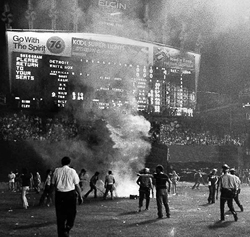
The stunt called for disco record albums to be blown up between games, but the situation got out of control when thousands of people poured out of the stands and damaged the field.

Umpire crew chief Dave Phillips called off the second game, ruling the field unplayable, and the next day the American League granted a forfeit win to the Tigers.

Rock n’ roll will never die

Disco dance music became popular in the 1970s and was highlighted by performers such as Donna Summer, Village People, and KC and the Sunshine Band. The soundtrack to the movie, “Saturday Night Fever,” featured disco songs such as “Stayin’ Alive” by the Bee Gees and “Disco Inferno” by The Trammps.

In an attempt to capitalize on the trend, Chicago radio station WDAI changed its format from rock music to disco. The switch caused the departure of disc jockey Steve Dahl, who resented the rise of disco.

Dahl ended up at WLUP, a Chicago FM radio station focused on rock music. Dahl, 24, developed a following by bashing disco.

The White Sox, looking to build an audience for a weekday doubleheader between two teams with losing records, arranged with Dahl and WLUP for the Disco Demolition Night. Anyone bringing a disco album would be admitted to the doubleheader for 98 cents. The price was chosen because WLUP’s location on the FM dial was 97.9.

“When baseball has to rely on that kind of bush promotion to get people in the park, we’re all in trouble,” Tigers general manager Jim Campbell said to the Detroit Free Press.

The scheme called for the disco albums to be burned and exploded under fire department supervision in center field between games.

White Sox owner Bill Veeck, whose 1979 antics included a Greek Night featuring what The Sporting News described as belly dancers “of all shapes, sizes and ages,” was surprised when the anti-disco promotion attracted far more spectators than he expected. Attendance was 47,795 in a ballpark with a seating capacity of 44,492 and many more reportedly were turned away at the gates.

“We had more security than we ever had before, but we had as many people in here as we ever had,” Veeck said to the Chicago Tribune.

The first game was played “under a constant bombardment of records and firecrackers,” according to the Tribune, and play was halted several times. Spectators flung the record albums onto the field like Frisbees.

“How’d you like to get hit in the eye with one of those?” said White Sox designated hitter Wayne Nordhagen. “These people don’t realize it only takes one to ruin a guy’s career.”

Tigers center fielder Ron LeFlore said a golf ball thrown from the stands bounced between his legs while he was catching a fly ball.

“These were not baseball fans tonight,” Veeck said.

After the Tigers won the game, 4-1, it was time for the disco demolition to begin. Boxscore

Wild bunch

Dahl blew up a crate of disco records and the fiery explosion sent spectators into a frenzy. An estimated 7,000 spectators stormed the field, the Free Press reported. Video

“I was scared,” said White Sox pitcher Ken Kravec, who was in the bullpen to warm up for Game 2.

Veeck and White Sox broadcaster Harry Caray each used the public address system to urge people to leave the field, but their pleas mostly were ignored.

“Beer and baseball go together,” Tigers manager Sparky Anderson told the Tribune. “I think those kids were doing things other than beer.”

With little to do other than run around the field, the interlopers eventually began leaving. When helmeted police arrived, fewer than 1,000 people remained on the field and officers cleared it in five minutes, The Sporting News reported.

According to the Tribune, 39 people were arrested and six were injured.

One hour and 16 minutes after its scheduled start, Phillips called off Game 2.

“Ten years after Woodstock, there was Veeckstock,” wrote Tribune columnist David Israel, who called it baseball’s “first rock riot.”

Paying the consequences

On July 13, 1979, American League president Lee MacPhail ruled the canceled game a forfeited win for the Tigers and a loss for the White Sox “because of inadequate crowd control and damage to the playing field, both of which are the responsibility of the home team.”

“We have found a lot of ways to lose games this year,” said White Sox manager Don Kessinger, “but I guess we’ve added a new wrinkle. It’s tough to lose two games when you played only one.”

For Anderson, who joined the Tigers a month earlier after managing the Reds in the National League, Disco Demolition Night was his first time at Comiskey Park.

“If I could get every team in the league to put on a promotion like that, I might win a few games,” Anderson said.

Veeck disagreed with MacPhail’s decision, saying, “I think the grounds for forfeiting are specious at best. It’s true there was some sod missing. Otherwise, nothing was wrong.”

On its editorial page, the Tribune called Veeck’s antics “an outrageous example of irresponsible hucksterism that disgraced the sport of baseball, endangered the White Sox and Tigers, and cheated and insulted the genuine fans who came to Comiskey Park.”

In The Sporting News, columnist Dick Young suggested, “Let them hold it in the studio and burn down the radio station.”

Dahl said to the Free Press, “Everybody over 40 is freaked out.”

Veeck called Disco Demolition Night “a regrettable incident” and an “ill-advised promotion,” apologized to White Sox fans and players, and said, “All I know is we’ll make certain we don’t try anything like this again.”

WLUP producer Russ James shot back, “Tonight was like the Toyota commercial: You asked for it, you got it. What did Veeck expect? He sanctioned this.”

Said White Sox pitcher Rich Wortham: “This wouldn’t have happened if they had country-and-western night.”

Read Full Post »

« Newer Posts - Older Posts »