Feeds:
Posts
Comments

Archive for the ‘Games’ Category

A friendship with general manager Bing Devine enabled first baseman Bill White to finish his playing career with the Cardinals.
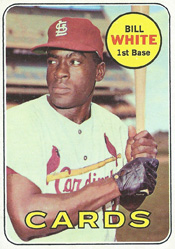
On April 2, 1969, the Cardinals reacquired White from the Phillies for infielder Jerry Buchek and utility player Jim Hutto.

The trade gave White, 35, the opportunity to return to the team for whom he’d achieved the most success.

White no longer was an everyday player and he was preparing to transition into a television career in Philadelphia, but Devine wanted him to fill a bench role and White was willing to do so as a favor to his friend and to bring closure to his playing days.

Ties that bind

In White’s first stint with the Cardinals, from 1959-65, he topped 100 RBI three times, hit 20 or more home runs five years in a row and won the Gold Glove Award six times as a first baseman. He also was a National League all-star in five of his seasons with the Cardinals and helped them become 1964 World Series champions.

In October 1965, Cardinals general manager Bob Howsam traded White to the Phillies. He had 22 home runs and 103 RBI for them in 1966, but he injured an Achilles tendon in 1967 and his production declined considerably.

According to the Philadelphia Inquirer, White decided in August 1968 he would retire after the season, but Phillies general manager John Quinn convinced him to play another year.

At spring training in 1969, when the Phillies shifted Richie Allen from third base to first base, White asked Quinn what the club planned to do with him. Quinn said the Phillies wouldn’t cut White from the roster but might trade him to the Cardinals.

“Bing Devine has expressed an interest in you,” Quinn told White.

Devine was Cardinals general manager in March 1959 when the club acquired White from the Giants. Devine and White developed a mutual respect and their bond remained strong, even after Devine was fired by Cardinals owner Gussie Busch in August 1964.

In 1967, when White was with the Phillies and Devine was with the Mets, Devine visited White at his home to offer support and encouragement while White was attempting to recover from the Achilles tendon injury. “I think a lot of him,” White said to the Inquirer.

Welcome back

In his 2011 autobiography, “Uppity,” White said, “At first I said no to the proposed trade, but Bing was persuasive.”

White told Quinn he agreed to the trade because of Devine, who returned to the Cardinals after the 1967 season. “I wouldn’t have gone to any other team,” White said to the Inquirer. “I wouldn’t even have gone to St. Louis if it were not for Bing Devine.”

The Philadelphia Daily News described the two-time defending National League champion Cardinals as “a dynasty.” Joe Torre, acquired from the Braves for Orlando Cepeda, was the first baseman for the 1969 Cardinals and Devine saw White as being an ideal backup as well as a left-handed pinch-hitter.

“Bill fits the bill,” Devine said to the St. Louis Post-Dispatch.

In a 2011 interview, White told me another reason Devine wanted him back with the Cardinals is he hoped to groom him to become a manager when White was done playing, but White wasn’t interested.

“Bing brought me back because he wanted me to manage at (Class AAA) Tulsa and eventually manage the Cardinals,” White said. “I didn’t want to manage. I didn’t want to try to tell 25 other guys how to play the game. I’d rather do something where the success depends on me, not on other people.”

Open and shut

White wore No. 12 for most of his first seven seasons with St. Louis, but backup outfielder Joe Hague had that number with the 1969 Cardinals. White asked for and received No. 7 because he liked low numbers, he said to the Post-Dispatch.

“I’m ready to do anything they want me to _ even pitch batting practice,” White said to the Post-Dispatch.

“This isn’t a knock at the Phillies’ organization _ they’ve been good to me _ but the difference between playing in St. Louis and Philadelphia is night and day,” White said to the Inquirer. “It’s depressing playing in that Philadelphia ballpark. Heck, my locker was over a sewer … And it’s depressing to hear your teammates booed.”

On April 8, 1969, the Cardinals opened the season against the Pirates at St. Louis. In the 12th inning, with the score tied at 2-2, two outs and Mike Shannon on first base, Cardinals manager Red Schoendienst sent White to bat for second baseman Julian Javier.

White was “cheered loudly” as he stepped to the plate, the Post-Dispatch reported.

Facing right-hander Ron Kline, White lined a pitch to left-center.

“What appeared to be a sure double turned out to be a mere out because the ball hooked toward” left fielder Willie Stargell, who made a one-handed catch while on the run, according to the Post-Dispatch.

If the ball had eluded Stargell, Shannon likely would have circled the bases and scored the game-winning run.

“That could have been a great way to open up,” hitting coach Dick Sisler said to White.

White replied, “Yeah, that would have carried me all year.”

Instead, the Pirates scored four runs in the 14th against Mel Nelson and won, 6-2. Boxscore

The 1969 season turned out to be disappointing for the Cardinals, who finished in fourth place in a six-team division, and for White. He suffered sore ribs and cuts to his left elbow in a car accident in St. Louis on May 3. For the season, White hit .211 with no home runs and four RBI in 57 at-bats. As a pinch-hitter, he batted .167 (5-for-30).

White retired as a player after the 1969 season and launched a broadcasting career before becoming president of the National League.
Read Full Post »

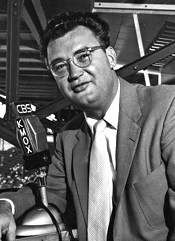
Five months after he suffered multiple injuries when struck by a car, Harry Caray returned with a flourish to broadcast the season opener for the Cardinals.

On April 8, 1969, when the two-time defending National League champion Cardinals opened the season against the Pirates at St. Louis, Caray called the game from the Busch Memorial Stadium broadcast booth.
Caray’s appearance was a testament to his determination to recover from compound fractures of both legs, a broken right shoulder, a broken nose and facial cuts and he made certain his comeback was noticed. Given center stage as emcee for pre-game ceremonies on the field, he put on a performance for the audience.

Road to recovery

At about 1:15 a.m. on Nov. 3, 1968, Caray, 51, was hit by a car while he attempted to the cross the street outside the Chase Park Plaza Hotel in St. Louis.

Caray’s injuries were disabling and he spent several weeks in a St. Louis hospital. After his release just before Christmas in 1968, Caray went to Florida and continued his recuperation near St. Petersburg at the beach house of Cardinals owner Gussie Busch.

In his 1989 book “Holy Cow!,” Caray said he was under the care of a male nurse at Busch’s residence and dutifully did isometric exercises daily. According to The Sporting News, he also did a daily radio show from the beach house for St. Louis station KMOX.

Though both legs were in casts, Caray said in his book, “I managed to keep myself entertained. I had a lot of friends there and they were always coming by the house or taking me out to restaurants. I could get around in a collapsible wheelchair.”

In early February 1969, Caray went to St. Louis to be evaluated by his doctors. He convinced them to remove the casts from his legs and returned to Florida as the Cardinals were arriving in St. Petersburg for spring training.

“I was determined to get myself in shape right along with the players,” Caray said.

Caray reported daily to Cardinals trainer Bob Bauman at the club’s spring training facility. “Caray has spent more time in the rubbing room than the adhesive tape,” The Sporting News noted.

Said Caray: “I worked hard, kept on the leg exercises and by the end of spring training I had advanced from crutches to canes to the point where I didn’t really need anything to help me walk.”

Ribbed at roast

On April 7, 1969, on the eve of the Cardinals’ opener, Caray was the guest of honor at the annual Knights of the Cauliflower Ear banquet at the Stouffer’s Inn in downtown St. Louis. The event was similar to the famous Friars Club roasts where the guest of honor was expected to be skewered, or “roasted,” by colleagues.

According to the St. Louis Post-Dispatch, Caray used a cane to maneuver his way around the banquet hall.

Jack Buck, Caray’s Cardinals broadcast partner, was master of ceremonies for the event and delivered several zingers at the guest of honor.

“What nice things can I say about Harry that you haven’t heard from the man himself?” Buck said in his opening remarks.

Referring to Caray getting hit by a car, Buck said to the audience, “What can I say to make you believe I didn’t do it?”

As the event ended, Buck told the crowd, “Please drive carefully. Harry’s walking again.”

St. Louis showman

The Cardinals opened the 1969 season on a Tuesday night.

When Caray emerged from the dugout to begin the pre-game ceremonies at home plate, he used two canes to walk onto the field. He received polite applause while “hobbling along rather pathetically,” he said in his book.

As Caray approached the first-base line, “I whirled one cane over my head and flung it as far as I could,” he said.

With the crowd cheering and urging him on, Caray started toward home plate with the help of the remaining cane. Just before he got to his spot, Caray stopped and tossed the cane into the air as spectators roared in approval.

After the ceremony, Caray made his way to the dugout and was approached by pitcher Bob Gibson. According to Caray, they had the following exchange:

Gibson: “Harry, what the hell was that all about?”

Caray: “Hey, Gibby, it’s like I’ve always told you, pal. This isn’t just baseball. It’s show biz.”

During the broadcast of the game, won by the Pirates in 14 innings, Caray interviewed baseball commissioner Bowie Kuhn and let him do some play-by-play. Boxscore

The 1969 season turned out to be Caray’s last with the club. On Oct. 9, 1969, he was fired after serving as the voice of the Cardinals for 25 years.

Read Full Post »

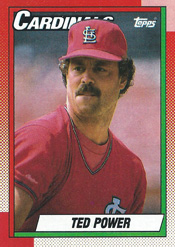
After a rough beginning to his season with the Cardinals, Ted Power recovered and developed into a reliable starting pitcher for them.

On March 28, 1989, the Cardinals signed Power, 34, to a minor-league contract following his release by the Tigers.
Five months later, Cardinals manager Whitey Herzog was referring to Power as the “savior” of the pitching staff.

Versatile pitcher

In 1981, Power debuted in the major leagues with the Dodgers, spent parts of two seasons with them and was traded to the Reds. A right-handed reliever, his breakout season came in 1985 when he produced eight wins, 27 saves and a 2.70 ERA for Cincinnati.

Reds manager Pete Rose put Power into the rotation in August 1986 and he was 6-1 with a 2.59 ERA in 10 starts. The next year, Power led the 1987 Reds in starts (34), innings pitched (204) and strikeouts (133).

The Reds traded Power to the Royals for pitcher Danny Jackson after the 1987 season. According to the St. Louis Post-Dispatch, Royals reliever Steve Farr displayed two baseball cards _ one of Dan Quisenberry and the other of Power _ atop his locker. “One of them is my idol on the field (Quisenberry) and the other my idol off the field,” Farr said.

The Royals sent Power to the Tigers in August 1988 and after the season he had surgery to remove calcium deposits near his right elbow. When spring training began in 1989, Power was ready to pitch for the Tigers.

Comeback bid

In March 1989, the Cardinals were in the market for pitching depth after starters Danny Cox and Greg Mathews went on the disabled list because of elbow ailments. General manager Dal Maxvill sent scout Rube Walker to Tigers camp to assess Power, and Herzog spoke with Detroit manager Sparky Anderson about the pitcher.

On March 25, 1989, the Tigers released Power and three days later he signed with the Cardinals, who assigned him to their Louisville farm club. Under terms of the contract, if Power received an offer from another big-league team while with Louisville, the Cardinals would have 48 hours to decide whether to promote him to St. Louis or let him depart.

“I look at those major-league box scores every day and see middle relievers and starters who aren’t doing the job,” Power said to the Louisville Courier-Journal. “I have all the confidence in the world that I’m going to get back. When I do, I won’t take anything for granted. You can get too comfortable up there. I won’t ever do that again.”

Louisville manager Mike Jorgensen placed Power in the rotation and he produced a 3-1 record and 2.73 ERA in five starts, prompting the Phillies to make him an offer. Unwilling to let Power go, the Cardinals promoted him to St. Louis on May 4, 1989.

“We were kind of forced to bring him up,” Herzog said to The Sporting News. “We didn’t want to bring him up that early.”

On the brink

After appearing in two games for the Cardinals, Power pulled a ribcage muscle while taking batting practice on May 17 and didn’t pitch again for them until June 20.

Herzog put Power in a rotation with Jose DeLeon, Joe Magrane, Ken Hill and Scott Terry, but he wasn’t effective. He reached a nadir on July 17, 1989, when he gave up seven runs to the Giants before being lifted with one out in the second inning. Boxscore

Power said he was overthrowing, causing his breaking pitches to “flatten out.” Said Herzog: “A lot of high sliders.”

Though he was 1-4 with a 7.43 ERA, Power made his next scheduled start against the Padres on July 22, 1989, held them to a run in 6.2 innings and got the win. Boxscore

“I feel like I belong in the big leagues, but this makes me feel like I belong on this team,” Power said.

Over his next three starts, Power shut out the Expos for seven innings, limited the Mets to a run in 6.2 innings and held the Pirates scoreless for eight innings.

“He’s kind of been a savior to us,” Herzog said.

Said Cardinals shortstop Ozzie Smith: “He’s throwing the ball as well as I’ve ever seen him throw it. It’s nice to see a guy like that come back. He was really on his way out.”

Getting it done

On Aug. 22, 1989, Power, matched against Derek Lilliquist, took a no-hitter and a 10-0 lead into the eighth against the Braves before he tired and gave up home runs to Tommy Gregg and Dale Murphy. Boxscore

In six August starts, Power produced a 2.61 ERA.

“He has more idea of what he wants to do,” said Cardinals catcher Tony Pena. “Before, he had no idea where he was throwing the fastball.”

Said Maxvill: “I look at 25 other clubs and how many have better fifth starters than Ted Power?”

On Sept, 2, 1989, Power beat the Astros in Bob Forsch’s last big-league start and last appearance against his former Cardinals teammates. Boxscore

Five days later, in a start against the Mets, Power suffered a hamstring injury. He was sidelined for two weeks and when he returned he made six appearances in relief.

Power finished with a 7-7 record and 3.71 ERA for the Cardinals in 1989. He became a free agent after the season and got a one-year offer from the Cardinals, but signed with the Pirates, who gave him a contract for 1990 with an option for 1991.

“I would really love to go back to St. Louis … but I’ve got to think of myself and my family,” Power said to the Post-Dispatch. “It looks like a deal that could be solid for a couple of years.”

Power went on to pitch the next four seasons for the Pirates (1990), Reds (1991), Indians (1992-93) and Mariners (1993). He completed 13 seasons in the big leagues with a 68-69 record, 70 saves and a 4.00 ERA.

Read Full Post »

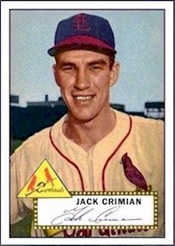
Surviving a scare from the last batter he faced in the game, Jack Crimian earned his first major-league win for the Cardinals in his hometown of Philadelphia.

Crimian reached the big leagues with the Cardinals in 1951, pitched in two seasons for them and also played for the Athletics and Tigers.

A right-hander, Crimian was a relief specialist with the Cardinals, but had his most successful season as a starter in the minor leagues.

Willing to work

After graduating high school in Philadelphia, Crimian was signed by the hometown Phillies. In 1944, his first season in the Phillies’ minor-league organization, Crimian earned 18 wins. He joined the Army in 1945 and served as a paratrooper. A year later, he returned to the Phillies’ farm system and was chosen by the Cardinals in the November 1946 minor-league draft.

In 1951, Crimian’s fifth season as a Cardinals minor leaguer, he thrived as a reliever for Columbus manager Harry Walker.

Crimian worked in 30 of Columbus’ first 50 games, developing a reputation as a “rubber-armed pitcher,” according to The Sporting News.

“Crimian is a big-league relief pitcher,” said Charlie Grimm, manager of the Braves’ Milwaukee farm team. “I’ll not miss him when the St. Louis Cardinals call him up.”

On Walker’s recommendation, the Cardinals promoted Crimian on July 1, 1951, as they were about to embark on a three-week road trip. “Harry told me Jack was one of those guys you can use every day for a couple of innings and have him go at top speed,” said Cardinals manager Marty Marion. “That’s what we need.”

Frustrating the Phillies

Crimian, 25, made his major-league debut for the Cardinals on July 3, 1951, against the Reds at Cincinnati. Relieving Harry Brecheen in the sixth inning, Crimian faced two batters, yielding a walk to Dixie Howell and a three-run double to Barney McCosky. Boxscore

The highlight of Crimian’s stint with the Cardinals came two weeks later, on July 15, 1951, in the first game of a doubleheader against the Phillies at Shibe Park in Philadelphia.

With the score tied at 3-3, Crimian relieved Brecheen and held the Phillies scoreless in the sixth, seventh and eighth innings, working around a leadoff triple by Granny Hamner in the seventh. The Cardinals scored twice in the seventh and twice in the eighth, taking a 7-3 lead into the bottom of the ninth.

With one out, Del Ennis hit a home run against Crimian, cutting the Cardinals’ lead to 7-4. After Hamner grounded out, Jimmy Bloodworth walked and Del Wilber doubled, putting runners on second and third and bringing the potential tying run to the plate.

Dick Sisler, a former Cardinal, was the batter. After working the count to 2-and-1, he hit a pitch from Crimian over the right-field wall. If the ball landed fair, it would have been a three-run home run, tying the score, but it curved into foul territory.

Unwilling to let Crimian throw another pitch to Sisler, Marion brought in Al Brazle to finish the job. Brazle’s first pitch was a curveball and Sisler watched it bend across the plate for strike three, preserving the win for Crimian. Boxscore

A week later, on July 24, 1951, Crimian made his first appearance at Sportsman’s Park in St. Louis and Sisler again played a central role. With the Cardinals leading the Phillies, 8-5, Crimian relieved Brecheen with two on and two outs in the eighth and struck out Sisler. The Cardinals scored a run in the bottom of the eighth and Crimian retired the Phillies in order in the ninth, earning a save. Boxscore

On the move

Crimian made 11 appearances, all in July, for the 1951 Cardinals and was 1-0 with a 9.00 ERA before he was returned to the minors.

In 1952, Crimian was called up to the Cardinals in June, pitched in five games, posted a 9.72 ERA and was demoted.

Playing for Walker at Rochester in 1953, Crimian was 13-5 with a 2.86 ERA, but the Cardinals didn’t call. On Dec. 2, 1953, the Cardinals sent Crimian and $100,000 to the Reds for shortstop Alex Grammas.

According to the Dayton Daily News, Walker spoke to Reds manager Birdie Tebbetts about Crimian and said there’s “no reason why he can’t relieve successfully in the majors.”

The Reds, though, never gave Crimian a chance. On April 8, 1954, the Reds sold Crimian’s contract to the Toronto Maple Leafs, an unaffiliated minor-league club owned by Jack Kent Cooke. The Maple Leafs manager was Luke Sewell, who managed the St. Louis Browns to the 1944 American League pennant and a berth in the World Series against the Cardinals.

Back in the bigs

Crimian earned 30 saves for the Maple Leafs in 1954. During the summer, the Yankees expressed interest in acquiring him, “but Cooke wouldn’t part with Crimian in midseason,” The Sporting News reported.

In 1955, Sewell put Crimian in the starting rotation because he “wasn’t getting enough work to stay sharp” as a reliever.

“I have trouble keeping a fine touch if I don’t get enough work,” Crimian said.

Crimian posted a 19-6 record and 2.10 ERA, earning International League pitcher of the year honors.

The pitching-poor Athletics of the American League took notice. On Oct. 12, 1955, the Athletics acquired Crimian from the Maple Leafs for pitcher Marion Fricano and $60,000.

“If they give this fellow a chance to learn the hitters, he can’t miss,” Sewell said. “He’s got the best control I’ve seen in any pitcher.”

Crimian spent the 1956 season with the Athletics and was 4-8 with a 5.51 ERA in 54 appearances. His highlight came on Sept. 4, 1956, when he won a start against the Indians and outdueled Herb Score, a 20-game winner. Boxscore

In December 1956, the Athletics traded Crimian to the Tigers. He pitched in four games for them in 1957, including on April 18 when Indians rookie Roger Maris hit his first major-league home run, a grand slam, against Crimian in the 11th inning at Detroit. Boxscore

Read Full Post »

(Updated June 15, 2023)

Joe Gibbon grew up as a Cardinals fan in Mississippi, passed up a career in basketball for baseball and pitched in the major leagues for 13 seasons.

Gibbon spent his big-league career in the National League with the Pirates (1960-65 and 1969-70), Giants (1966-69), Reds (1971-72) and Astros (1972).

A left-hander who threw sidearm and possessed a sinking fastball, Gibbon was used as a starter and reliever. He had a record of 61-65 with 32 saves and a 3.52 ERA in the majors. Gibbon was 38-46 with a 3.98 ERA as a starter and 23-19 with a 2.73 ERA as a reliever.

Against the Cardinals, Gibbon was 3-9 with three saves and a 5.05 ERA, giving up 155 hits in 117.2 innings. Curt Flood batted .531 in 49 at-bats versus Gibbon, but Lou Brock hit .159 in 44 at-bats.

In the book “We Played the Game,” Cardinals catcher Tim McCarver, comparing the pitching motions of National League left-handers, said, “Sandy Koufax came over the top, so he wasn’t as frightening as left-handers like Joe Gibbon and (Pirates teammate) Fred Green.”

In his book, “Baseball for Brain Surgeons and Other Fans,” McCarver explained why he thought Gibbon was intimidating for a left-handed batter to face: “On his delivery, he’d drop his arm to first and our rear ends would follow. It was impossible to stay in against him. I said, ‘I’m going to stand away from the plate and I’ll take anything inside,’ but when I moved off the plate, he’d cleverly follow me with his sinker. I still couldn’t extend my arms. I’d lose all sense of where I was in the box.”

Hoops talent

Gibbon was born and raised in Hickory, Mississippi, a town named after President Andrew Jackson, who earned the nickname “Old Hickory” because of his toughness as an Army general.

Gibbon followed the Cardinals as a youth and his favorite player was Stan Musial, according to the Society for American Baseball Research. Gibbon listened on radio to the broadcast of Game 7 of the 1946 World Series when Harry Walker of the Cardinals drove in Enos Slaughter with the winning run against the Red Sox. Walker would become one of Gibbon’s managers in the big leagues.

At 6 feet 4, Gibbon was talented in baseball and basketball, excelling in both sports at the University of Mississippi. In the 1956-57 NCAA Division I basketball season, Gibbon was second in the nation in scoring, averaging 30 points and 14.1 rebounds a game. Grady Wallace of South Carolina averaged 31.2 points and he and Gibbon finished ahead of Seattle’s Elgin Baylor (29.7) and Kansas’ Wilt Chamberlain (29.6).

Gibbon was drafted by the NBA Boston Celtics but signed with the baseball Pirates in 1957. In 1959, his third season in the Pirates’ farm system, Gibbon was 16-9 with a 2.60 ERA for Class AAA Columbus, Ohio, gaining him a spot in the majors with the 1960 Pirates.

Rookie success

After earning two wins in relief in April 1960 for the Pirates, Gibbon’s first win as a big-league starter came against the Cardinals on May 19 at Pittsburgh.

Matched against 19-year-old Ray Sadecki, who was making his major-league debut for the Cardinals, Gibbon pitched six scoreless innings before yielding a run in the seventh and another in the eighth. The second run was scored by Musial, who walked in a pinch-hit appearance the first time he faced Gibbon.

Gibbon pitched 7.1 innings, allowing two runs, striking out seven and getting the win in an 8-3 Pirates triumph over the Cardinals. Boxscore

The Pirates won the 1960 National League pennant and Gibbon contributed with a 4-2 record. In the 1960 World Series against the Yankees, Gibbon made two relief appearances, surrendering a three-run home run to Mickey Mantle in Game 2 Boxscore and pitching a scoreless inning in Game 3. The Pirates won the championship in Game 7.

Birthday blast

In 1961, Gibbon earned 13 wins for the Pirates, but against the Cardinals he was 0-3 with a 7.71 ERA.

On Aug. 9, 1961, the Cardinals’ Julian Javier broke up a scoreless game with a grand slam against Gibbon in the eighth inning at Pittsburgh. Javier, a former Pirates prospect playing on his 25th birthday, hit an outside fastball down the right-field line and over the wall at Forbes Field. Boxscore

Six years later, on June 29, 1967, Gibbon started for the Giants against the Cardinals at St. Louis. The Giants scored 11 runs in the top of the first against Bob Gibson and Nelson Briles, but Gibbon couldn’t take advantage of the gift. He gave up two runs in the bottom half of the inning without getting an out and was lifted for a reliever. Boxscore

Read Full Post »

(Updated April 13, 2020)

Don Newcombe was as tough on the Cardinals with a bat as he was with pitches.

Newcombe was a hard-throwing, hard-hitting pitcher who spent his prime years with the Dodgers.

At 6-4, 220 pounds, Newcombe was an imposing figure on the mound, where he threw right-handed, and at the plate, where he hit left-handed.
In 10 years in the major leagues, Newcombe had a 149-90 record and hit .271 with 15 home runs. Against the Cardinals, Newcombe was 23-11 and hit .299 with six home runs.

In 1955, when he was 20-5 for the champion Dodgers, Newcombe “toyed with the Cardinals as though they were a sandlot team,” the St. Louis Post-Dispatch reported. Newcombe was 4-0 with a 1.75 ERA and batted .524 with seven RBI versus the 1955 Cardinals.

Newcombe “is downright unbelievable these days,” marveled the Post-Dispatch. “The way he’s going, the only question is whether he can throw as hard as he can hit, or hit as hard as he can throw.”

Rookie vs. Redbirds

Newcombe, 22, made his major-league debut for the Dodgers against the Cardinals on May 20, 1949, at St. Louis and it was a hard-luck initiation.

With the Cardinals ahead, 3-2, Newcombe relieved Rex Barney to open the bottom of the seventh inning. The St. Louis Star-Times, getting its first glimpse of the rookie, described him as “bull-shouldered” and a “massive mountain man.”

Newcombe struck out the first batter, Chuck Diering, on three pitches _ two fastballs and a curve _ and Red Schoendienst followed with a lined single to right.

Next up was Stan Musial. Newcombe fooled him with a low, outside pitch, causing Musial to check his swing, but the ball met his bat and was blooped into shallow left for a single, moving Schoendienst to second.

Newcombe overpowered the next batter, Eddie Kazak, who topped the ball to short so weakly Pee Wee Reese had no play.

The infield single loaded the bases for Enos Slaughter, who drove Newcombe’s first pitch deep down the left-field line for a bases-clearing double. Newcombe was relieved by Erv Palica and the Cardinals won, 6-2. Boxscore

“I had good stuff,” Newcombe said to The Brooklyn Daily Eagle. “My arm felt good and loose, too.”

According to a Saturday Evening Post article reported on in The Sporting News, when Newcombe struck out Diering, “the Negro fans in the right field stands at Sportsman’s Park went wild. White fans resented this _ cheers for the visiting Negro player and hoots for the hometown Cardinals. So when the Cardinals began pounding away at Newcombe, the white fans gave him the business.”

Three months later, on Aug. 24, 1949, in what The Brooklyn Daily Eagle called “quite possibly the most important single game the Dodgers will have this season,” Newcombe pitched a shutout and drove in three runs in a 6-0 victory over the Cardinals at Brooklyn. The win moved the Dodgers within a game of the first-place Cardinals. Boxscore

Newcombe is “the closest thing to a real blow-’em-down pitcher the National League has seen since Mort Cooper was at his best,” declared the Post-Dispatch.

Solved by Stan

The Dodgers won the 1949 pennant, finishing a game ahead of the Cardinals. Newcombe posted a 17-8 record, pitched 244.1 innings and won the National League Rookie of the Year Award.

In the 1994 book “We Played the Game,” Newcombe said as a rookie, “I had the talent and desire _ and I was cocky. I knew I was good, as good or better than the white guys who were trying to keep me from being there.”

Newcombe led the National League in winning percentage in 1955 (20-5, .800) and 1956 (27-7, .794), and was 4-0 versus the Cardinals in each season.

The Cardinal who hit Newcombe the hardest was Musial. Newcombe gave up more home runs (11) to Musial than to any other batter. Musial hit .349 against him.

In “We Played the Game,” Newcombe said, “I pitched toward batters’ weaknesses. Except for Stan Musial and Hank Aaron, they all had weaknesses, even Willie Mays.”

On June 21, 1956, during a season when Newcombe won both the Cy Young Award and the National League Most Valuable Player trophy, Musial hit a pair of two-run home runs and a single against him, but the Dodgers won, 9-8, with a four-run rally in the bottom of the ninth. Boxscore

Newcombe and Carl Erskine were the pitchers when Musial hit for the cycle against the Dodgers on July 24, 1949, at Brooklyn. Musial tripled against Newcombe and had a single, double and home run off Erskine. Boxscore

In his 1964 autobiography, “Stan Musial: The Man’s Own Story,” Musial said, “Newk had as great control for a hard thrower as any pitcher I ever faced. I hit him good, but he had a good fastball and curve.”

Read Full Post »

« Newer Posts - Older Posts »