Feeds:
Posts
Comments

Archive for the ‘Games’ Category

As a big-league shortstop, Khalil Greene had special physical skills, but a mental health condition rendered him unable to continue his playing career.
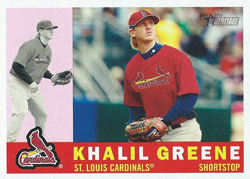
On Dec. 4, 2008, the Cardinals acquired Greene from the Padres for pitchers Mark Worrell and Luke Gregerson unaware Greene suffered from social anxiety disorder.

The Cardinals were seeking a replacement at shortstop for Cesar Izturis, who became a free agent, and Greene appealed because he hit for power and, according to the St. Louis Post-Dispatch, was “an above-average defender.”

Greene also was shy, or introverted, but those personality traits, the Cardinals found out, carried deeper meaning.

Early success

Khalil Thabit Greene was born in Butler, Pa., and went to high school in Key West, Fla. His father was a jeweler and his mother was a teacher.

Greene was brought up in the Baha’i Faith, whose followers “believe the crucial need facing humanity is to find a unifying vision of the future of society and of the nature and purpose of life,” the organization’s website explains.

According to the Post-Dispatch, Khalil translates to “friend of God” and Thabit means “steadfast.”

Greene enrolled at Clemson University and earned a degree in sociology. He also excelled at baseball, completing a four-year career as Clemson’s all-time leader in hits, doubles, RBI, extra-base hits and total bases.

The Padres chose Greene in the first round of the 2002 amateur draft and he made his big-league debut with them on Sept. 3, 2003.

From 2004 through 2007, Greene averaged 18 home runs and 72 RBI per year and had his best season in 2007 when he produced 27 home runs and 97 RBI.

Greene was limited to 105 games in 2008 because of a season-ending injury on July 30 when he fractured his left hand after punching a storage chest in frustration. “I would say that was very out of character,” Greene told Derrick Goold of the Post-Dispatch.

Though Greene batted .213 in 2008, Cardinals general manager John Mozeliak was unhesitant in dealing for him. “It’s our strong belief that last year (2008) was an aberration,” Mozeliak said.

Seventy percent of respondents to a stltoday.com poll gave the trade a thumbs up.

Under pressure

At spring training with the Cardinals in 2009, Greene, 29, impressed, hitting .408 with 17 RBI in exhibition games.

Regarding his quiet demeanor, Greene told the Post-Dispatch, “I internalize more and that leads people to assume different things about me.”

The Cardinals’ high expectations for Greene were evident in the season opener on April 6, 2009, when manager Tony La Russa batted him in the cleanup spot between Albert Pujols and Ryan Ludwick. Boxscore

Greene struggled, batting .219 in April and .171 in May. Teammates noticed Greene punishing himself during the season’s first road trip, the Post-Dispatch reported.

On May 29, 2009, the Cardinals placed Greene on the disabled list because of social anxiety disorder.

“We’re trying to take some things off him for a while,” La Russa said.

Greene’s condition “is brought on by fatigue caused by incessant stress,” Joe Strauss of the Post-Dispatch reported. “Any failure, such as a strikeout or an error, reinforces a sense of frustration that finds release only through verbal or physical outbursts, followed by embarrassment and regret.”

Said Greene: “It’s about trying to find balance, about not being too hard on myself and being able to let it go sometimes.”

Tough tests

The Cardinals reinstated Greene on June 18, 2009, and he hit home runs against the Royals in each of his first three games back. After that, he went into a slump, the anxiety resurfaced and the Cardinals returned him to the disabled list on June 29, 2009.

“When he had success in Kansas City, that wasn’t really the test,” La Russa said to the Associated Press. “The test is when you struggle and how you handle it.”

Greene went home to South Carolina to spend time with his wife and parents and receive treatment.

Brendan Ryan had taken over as Cardinals shortstop and was playing well, so when Greene returned to the club for the last two months of the season he primarily was used as a pinch-hitter and reserve infielder.

“I need to get a sense of gratification when things are going well while being able to see any shortcomings in a way that’s not such a debilitating thing,” Greene said.

On Aug. 28, 2009, Greene hit the first pinch-hit home run of his big-league career, tying the score at 2-2 in the eighth inning against the Nationals. The Busch Stadium crowd gave him a standing ovation and his teammates pushed him toward the top step of the dugout to make a curtain call and tip his cap, telling him, “Get out there. You earned it.” Boxscore

Greene finished the 2009 season with a .200 batting average, six home runs and 24 RBI in 77 games. He did hit .353 (12-for-34) with runners in scoring position.

In November 2009, Greene entered free agency and two months later signed a $750,000, one-year deal with the Rangers, who projected him for a utility role.

“This is a situation that will be good for me in a lot of ways,” Greene said. “It’s an exciting team to play for and it looks like a neat place to play.”

On Feb. 25, 2010, the Rangers voided the contract, saying a private matter would keep Greene from reporting to spring training. At age 30, he was finished as a professional ballplayer.
Read Full Post »

(Updated Dec. 16, 2024)

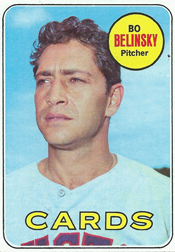
Bo Belinsky, a left-handed pitcher with a playmate wife and a penchant for publicity, appealed to the Cardinals as a possible answer to a bullpen need.

On Dec. 2, 1968, the Cardinals selected Belinsky in the Rule 5 draft of unprotected players.
Because of the departures of Wayne Granger to the Reds and Larry Jaster to the Expos, the reigning National League champion Cardinals sought another left-hander to join Joe Hoerner in the bullpen.

Belinsky was a surprising choice. He’d spent the 1968 season in the minors after a subpar year with the 1967 Astros and he maintained a legendary reputation for off-field carousing and feuds with baseball management.

As Bob Broeg noted in a column for the St. Louis Post-Dispatch, Belinsky let “a loose tongue and 10-cent brain offset the potential brilliance in a million-dollar arm.”

Going Hollywood

Belinsky spent his youth in Trenton, N.J. “I was a wild kid,” he told Arnold Hano of Sport magazine. “I ran with an older crowd. We played in the streets. They chased us out of playgrounds and parks. All I wanted was to grow up fast and get the hell out of Trenton.”

He got a factory job and supplemented his income with pool hustling and poker. That’s how he got scars near both eyes. “Broken beer bottles,” from bar brawls he told Sport magazine.

The Pirates saw him pitch in a Trenton recreation league and signed him. It didn’t work out. Then he hooked on with the Orioles. Belinsky spent six seasons in the minors before getting a chance in the big leagues with the 1962 Angels.

On May 5, 1962, Belinsky pitched a no-hitter for the Angels against the Orioles, boosting his record to 4-0 and rocketing him to the top among sports celebrities in image-conscious Los Angeles. Boxscore

Craving fame and fun, Belinsky was drawn to the Hollywood nightlife and became a fixture on Sunset Strip.

“He wears cashmere sport jackets and overcoats (and) custom-made suits, the wool imported from British mills and sewed by Venezuelan tailors,” Sport magazine reported.

To get the deepest tan, “He soaks his face with a mixture of tincture of iodine and baby oil and lets the sun burn the iodine into his skin,” Arnold Hano wrote. “He digs the sun; he digs the beaches; he digs the dolls spilled like lazy hourglasses on the sands of Malibu.”

According to Bob Broeg, Belinsky “tooled around town in a candy-apple Cadillac convertible burning more midnight oil than he drank, squiring some of the long-stemmed beauties of Hollywood.”

Belinsky dated actresses Ann-Margret, Tina Louise, Connie Stevens and Juliet Prowse and was engaged for a few months to Mamie Van Doren, who told the New York Times, “Our life was a circus.”

While Belinsky’s partying peaked, his pitching plummeted. In three seasons with the Angels, his record was 21-28. They traded him to the Phillies on Dec. 3, 1964.

Happy in Hawaii

Belinsky floundered with the Phillies. He was 4-9 with a 4.84 ERA in 1965 and 0-2 in 1966, but he was effective against the Cardinals. In five starts versus St. Louis in 1965, Belinsky was 2-2 with a 2.72 ERA.

On May 17, 1965, Belinsky pitched a five-hitter in a 2-1 Phillies victory at St. Louis (Boxscore). A month later at Philadelphia, he pitched a six-hitter in a 7-1 triumph over the Cardinals (Boxscore).

The Astros claimed Belinsky in the Rule 5 draft in November 1966 and he was 3-9 with a 4.68 ERA for them in 1967. When Belinsky went to spring training with the Astros at Cocoa, Fla., in 1968, he was visited by Jo Collins, a Playboy magazine playmate of the year. Belinsky asked the club for permission to stay out with Collins after the midnight curfew, but the Astros refused his request and Belinsky left camp, The Sporting News reported.

By mutual request, the Astros sent Belinsky to the Hawaii Islanders of the Pacific Coast League for the 1968 season. Belinsky, who developed a screwball to go with a formidable fastball, pitched better for Hawaii than his 9-14 record indicated. He threw three shutouts, including a no-hitter, struck out 181 batters in 176 innings and posted an ERA of 2.97.

Taking a chance

Cardinals scout Bill Sayles was impressed by Belinsky’s pitching and said in his report to the club, “This guy is a big-league pitcher. He has the best arm I’ve seen all year and he has the stuff to go with it.”

Warren Spahn, the former big-league ace who was manager of the Cardinals’ Tulsa farm club, supported Sayles’ assertions and St. Louis scouting supervisor Harrison Wickel also watched Belinsky and liked what he saw.

After the 1968 season, the Hawaii club returned Belinsky to the Astros and they assigned him to their Oklahoma City affiliate, making him eligible for the Rule 5 draft. Cardinals general manager Bing Devine and manager Red Schoendienst agreed they’d select Belinsky at the cost of $25,000.

“We felt we might as well take a chance on someone who has a good arm,” Schoendienst said to the Post-Dispatch.

Asked about Belinsky’s reputation, Devine told The Sporting News, “His off-field activities don’t bother me … Sure, he’s a character and he likes girls, but he’s single and I’d say that’s a reasonably normal situation.”

Actually, Belinsky and Collins quietly had married in Hawaii three months earlier in September 1968, the Post-Dispatch and The Sporting News later reported, and she was pregnant. Belinsky and Collins were together in Venezuela, where Bo was pitching winter baseball, when the Cardinals called to tell him they’d drafted him.

Belinsky’s stay in Venezuela ended in a dispute when he refused to pitch in a game, saying his arm was sore. The club suspended him and Belinsky returned to the United States with Collins, saying he would sue to recover withheld pay.

Bo and Jo

At Cardinals spring training camp in St. Petersburg, Fla., Belinsky told Broeg, “I’m broke and if I don’t make it with the Cardinals, a good ballclub, I’ll be hurting.”

Reflecting on his life, Belinsky said, “I had a hell of a good time, but I burned the candle at both ends,” then added, “Though I don’t believe I’ve ever quite fit the portrayal of a finger-snapping, gum-cracking, girdle-snapping cool cat.”

“I think I’d have been better off in baseball in the Babe Ruth era when this wasn’t such a fragile game,” Belinsky said. “I like baseball, but maybe I haven’t had the temperament to be a truly dedicated player.”

Belinsky, 32, and his wife Jo, 23, arrived in Florida toting a .32-caliber automatic pistol and a .22-caliber rifle because they “like to go target shooting,” the Post-Dispatch reported.

Smoking a Tiparillo, a thin cigar popular in the 1960s, Jo told the Post-Dispatch, “I’m not really the typical baseball player’s wife. I’m not the domestic type.”

For instance, Jo said, she hadn’t cooked a meal since she married Bo and didn’t intend to. “It ruins the whole mood when you have to get up and cook,” she said.

“Bo and Jo like room service,” the Post-Dispatch reported. “They like having a maid bring their food and a valet to take care of their clothes. They like living in hotels and have done so since they were married last September.”

Jo also complained about the drivers in St. Petersburg. “This is an old folks town … They ought to take away their licenses when they’re 50,” she said.

Aloha, Bo

Belinsky had a 1.92 ERA in spring training, but walked 16 in 12.2 innings. “He’s been too wild,” Schoendienst said. “He’s gone to 3-and-2 counts on everybody.”

Between appearances, Belinsky avoided workouts as much as possible, prompting Cardinals physical fitness director Walter Eberhardt to teasingly present him a certificate for “his remarkable ability to perform strenuous exercises without exerting a single muscle.”

The Cardinals decided to keep journeyman Mel Nelson rather than Belinsky as the second left-handed reliever.

On March 31, 1969, the Cardinals offered the Astros the chance to take back Belinsky for half the $25,000 price the Cardinals paid for drafting him, but they declined. The Cardinals placed Belinsky on waivers, but there were no takers.

Complaining of feeling “suppressed” by not pitching enough in spring training games, Belinsky said, “I feel the Cardinals cheated themselves and that I was cheated, too.”

The next night, on April 1, 1969, Belinsky collapsed from nervous exhaustion and was taken to a hospital, the Post-Dispatch reported. “I felt as though I was going to die,” Belinsky said.

Unsympathetic, Cardinals trainer Bob Bauman said, “He did most of his training in the clubhouse, talking to the press. That’s where he got his fatigue, from talking too much.”

On April 3, 1969, the Cardinals did Belinsky a favor, returning him to the Hawaii Islanders for $10,000. “Bo was too good a bargain to pass up,” said Hawaii general manager Jack Quinn.

Almost four months later, on July 30, 1969, Belinsky got back to the big leagues when the Pirates purchased his contract from Hawaii.

On Sept. 10, 1969, Belinsky started for the Pirates against the Cardinals in the second game of a doubleheader at Pittsburgh. Belinsky faced seven batters, gave up two hits, walked three, allowed two runs and was lifted with two outs in the first inning (Boxscore).

Read Full Post »

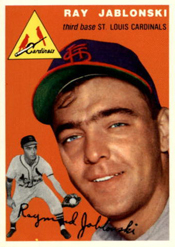
Ray Jablonski was an infielder who couldn’t field or throw well, but he excelled at stroking line drives for extra-base hits and generating large numbers of runs.

On Nov. 24, 1948, the Cardinals selected Jablonski from the Red Sox in the minor-league draft.

The minor move turned into a big deal for the Cardinals, who sought a right-handed batter with power to balance a lineup with left-handers Stan Musial and Enos Slaughter. Jablonski produced more than 100 RBI in each of his two seasons with St. Louis.

As a third baseman, though, Jablonski had the skills of a designated hitter. When prospect Ken Boyer proved ready to move from the minor leagues and play third base for the Cardinals, Jablonski became expendable.

Climbing the ladder

Ray Jablonski was born and raised in Chicago. As a youth, he was “an accomplished singer and piano player,” according to a biography by the Society for American Baseball Research.

A coach encouraged him to play high school baseball and he showed an ability to hit the ball hard and often. Jablonski enlisted in the Army in July 1945, spent most of his military service in France and was discharged in January 1947.

When he returned to Chicago, he attended a Red Sox tryout camp in Elgin, Ill., and was the only one of the 300 participants to get a contract offer, according to The Sporting News. The Red Sox assigned Jablonski to their Class D affiliate in Milford, Del., and he hit .326 in 1947 and .354 in 1948, primarily as a shortstop.

After the 1948 season, the Red Sox fired their farm director, former Cardinals shortstop Specs Toporcer, and in the reshuffling that followed the Red Sox left Jablonski exposed to the minor-league draft. He was selected by the Cardinals and assigned to their Class A Columbus (Ga.) club.

The leap from Class D Milford to Class A Columbus was a steep one and after Jablonski hit .275 for Columbus in 1949 he was sent down to Class B Lynchburg, Va., in 1950. Lynchburg was a turning point in Jablonski’s career because the manager there was Whitey Kurowski, the former third baseman who played in four World Series for the Cardinals. Kurowski put Jablonski at third base and mentored him.

After hitting .289 for Lynchburg, Jablonski played for Class B Winston-Salem in 1951 and led the Carolina League in batting at .363.

The Cardinals promoted Jablonski to Class AAA Rochester in 1952 and he played all four infield positions, committing 33 errors and batting .299 with 103 RBI.

Jablonski “has strong wrists and can get the bat through at the last split-second,” The Sporting News reported.

Competition at third

Billy Johnson was the incumbent at third base for the Cardinals. Johnson played in four World Series for the Yankees and was an American League all-star in 1947 before being traded to the Cardinals on May 14, 1951. A smooth fielder with a strong arm, Johnson gave the Cardinals “the best defensive play they’ve had at the hot corner in years,” according to writer Bob Broeg.

In 1952, Johnson hurt his elbow and the injury affected his throwing. Depriving Johnson “of his shotgun arm would be like taking a paint brush away from Rembrandt,” Broeg observed.

At spring training in 1953, the three contenders for the Cardinals’ third base job were Johnson, Jablonski, and Vern Benson, who’d spent parts of the 1951 and 1952 seasons with St. Louis.

Broeg concluded Jablonski’s “defensive play might be the drawback that could cost him the job.”

After observing Jablonski, former Cardinals infielder Frank “Creepy” Crespi said, “He’s got a lot to learn defensively and needs plenty of work, but he’s got a big thing in his favor and that’s willingness to listen and practice.”

In preseason exhibition games, Jablonski batted .302 with six home runs.

On April 14, when the Cardinals opened the 1953 regular season at Milwaukee in the Braves’ first game since relocating from Boston, Jablonski made his major-league debut as the starting third baseman.

He and two other newcomers to the starting lineup, first baseman Steve Bilko and center fielder Rip Repulski, became known as the Polish Falcons.

Jablonski finished his rookie season with 21 home runs and 112 RBI. He made 27 errors, the second-most among National League third basemen.

Too many errors

In 1954, Jablonski hit .296 with 104 RBI for the Cardinals and he was the starting third baseman for the National League all-star team, but his 34 errors were the most by any third baseman in the league.

Post-Dispatch sports editor J. Roy Stockton, citing Jablonski’s fielding problems, described him as “a defective player who broke the hearts of the pitchers.”

Cardinals pitcher Gerry Staley “was openly critical of the slow defensive reactions and uncertain throwing of Jablonski,” the Post-Dispatch reported.

In his two seasons with St. Louis, Jablonski had many of his best games against the Reds. He had five hits versus the Reds on July 8, 1953 (Boxscore), and he twice produced five RBI against them _ on May 28, 1953 (Boxscore) and on May 23, 1954 (Boxscore). Jablonski hit .315 with 20 RBI against the Reds in 1953 and .359 with 22 RBI versus them in 1954.

In December 1954, the Cardinals offered to trade Staley to the Reds for reliever Frank Smith. The Reds wanted second base prospect Don Blasingame as well but the Cardinals “flatly refused,” according to the Post-Dispatch.

The Cardinals, desperate to improve their relief pitching, countered by giving the Reds their choice of Jablonski or infielder Solly Hemus. On Dec. 8, 1954, the Cardinals dealt Jablonski and Staley to the Reds for Smith.

Cardinals general manager Dick Meyer admitted “we might have given too much,” but added, “We felt the need for relief pitching was that great.”

The Cardinals were influenced by the emergence of Boyer, a highly regarded prospect who was ready to take over at third base in 1955. Cardinals scout Joe Mathes predicted Boyer “could become the greatest third baseman in Cardinals history” and former Cardinals manager Eddie Dyer said Boyer “will hit the ball as far as any third baseman in the National League and he’ll outrun any third baseman I know of in the league.”

Boyer fulfilled those expectations and Jablonski, unable to overcome his fielding deficiencies, went on to have a journeyman career. After two seasons (1955-56) with the Reds and two seasons with the Giants (1957-58), Jablonski and Bill White were traded by San Francisco to the Cardinals on March 25, 1959, for pitchers Sam Jones and Don Choate.

Used in a reserve role, Jablonski hit .253 with the 1959 Cardinals and on Aug. 20 he was claimed on waivers by the Athletics. He ended his major-league career with the Athletics in 1960 and played another four years in the minors.

Jablonski was 58 when he died of kidney failure on Nov. 25, 1985.

Read Full Post »

(Updated Aug. 26, 2024)

Carl Hubbell and Mel Ott forever are linked as teammates, friends, road roommates, Hall of Famers and, tragically, by a bizarre twist of fate.

On Nov. 21, 1988, Hubbell, 85, died in a Scottsdale, Ariz., hospital from injuries suffered in a car accident two days earlier.
Hubbell’s death occurred 30 years to the day Ott died under eerily similar circumstances. On Nov. 21, 1958, Ott, 49, died in a New Orleans hospital from injuries suffered in a car accident.

Hubbell was the ace pitcher and Ott the home run slugger who spent their entire major-league playing careers with the Giants.

Ott, 17, debuted with the Giants in 1926 and Hubbell, 25, joined them in 1928. They roomed together on road trips from the time Hubbell arrived with the Giants until he pitched his last game in 1943, according to the Associated Press. Both men had low-key personalities and friendly demeanors and genuinely liked one another.

Hubbell was elected to the National Baseball Hall of Fame in 1947 and Ott was inducted four years later in 1951.

When Ott died, Hubbell told the New York Daily News, “I’m heartsick. Mel was one of my closest friends.”

Perfect pitch

Hubbell was born in Carthage, Mo., and grew up on a cotton and pecan farm near Meeker, Okla.

In 1924, when he turned 21, Hubbell signed with a minor-league club in Oklahoma and taught himself to throw a “reverse curve” or “fadeaway.”

When right-handers Christy Mathewson of the Giants and Grover Cleveland Alexander of the Cardinals threw the “reverse curve,” it broke in to right-handed batters and away from left-handed ones. In his memoir, “Baseball As I Have Known It,” journalist Fred Lieb wrote, “Sometimes when (Mathewson) threw it, it didn’t curve but suddenly plunged, as does a tennis ball rolled across and off a dining room table.” As a left-hander, Hubbell’s version broke in to left-handed batters and away from right-handed ones.

In 1925, when Hubbell was tossing the pitch in warmups, the catcher said, “That’s the screwiest thing I ever saw,” and the “reverse curve” became known as a screwball, according to The Sporting News.

Hubbell’s success with the pitch attracted the interest of major-league scouts and in August 1925 the Tigers acquired him from the Oklahoma City club in the Western League.

The Tigers invited Hubbell to spring training in 1926 and 1927 but returned him to the minor leagues both times. According to the Associated Press, a Tigers coach, believing Hubbell would hurt his arm throwing a screwball, told him, “Don’t fool with that. Forget it.”

“So I forget it,” said Hubbell, “and Detroit forgot me.”

The Tigers sold Hubbell’s contract to a minor-league club in Beaumont, Texas, in April 1928. Giants scout Dick Kinsella liked what he saw from Hubbell there and on July 12, 1928, the Giants purchased his contract. Two weeks later, Hubbell made his big-league debut.

Big winner

Hubbell’s most celebrated performance came in the 1934 All-Star Game when he struck out five future Hall of Famers, Babe Ruth, Lou Gehrig, Jimmie Foxx, Al Simmons and Joe Cronin, in succession. Boxscore

“My style of pitching was to make the other team hit the ball, but on the ground,” Hubbell told writer John P. Carmichael. “It was as big a surprise to me to strike out all those fellows as it probably was to them.”

The all-star feat got the glory, but in games that counted in the standings Hubbell’s most impressive outing occurred against the Cardinals.

On July 2, 1933, in the opener of a doubleheader at the Polo Grounds in New York, Hubbell pitched an 18-inning shutout in a 1-0 victory over the Cardinals.

Hubbell held the Cardinals to six hits, didn’t walk a batter and struck out 12. He retired 20 batters in a row from the seventh inning to the 13th and only one Cardinals runner reached third.

Cardinals starter Tex Carleton nearly matched Hubbell, pitching 16 scoreless innings before he was relieved by Jesse Haines. In the 18th, with Giants runners on first and third, two outs, Hughie Critz “shot a single past Haines’ left ear,” scoring Jo-Jo Moore, the St. Louis Star-Times reported. When Moore touched the plate, “a deafening roar went up and straw hats, torn programs and other debris rained upon the turf,” according to the New York Daily News. Boxscore

Hubbell pitched 16 seasons (1928-43) for the Giants and had a record of 253-154 with a 2.98 ERA. He twice won the National League Most Valuable Player Award (1933 and 1936), pitched in three World Series (1933, 1936 and 1937) and was a nine-time all-star.

Hubbell earned 21 wins or more in five consecutive seasons (1933-37) and in 1933 he led the league in wins (23), ERA (1.66), shutouts (10) and innings (308.2). He won 24 consecutive regular-season decisions over a two-year period (1936-37). Flagstaff Film clip of Hubbell vs. Cardinals on July 21, 1938.

Throwing the screwball eventually took a physical toll on him. When Hubbell’s left arm was at rest, his palm faced out instead of in. “I couldn’t get over Hubbell’s hand,” writer Roger Angell observed. “It was like meeting a gladiator who bore scars inflicted at the Colosseum.”

Eye for talent

Following his retirement as a player after the 1943 season, Hubbell became Giants farm director and rebuilt their sagging minor-league system. Among the prospects the Giants developed under Hubbell were Willie Mays, Orlando Cepeda, Willie McCovey, Juan Marichal and Gaylord Perry.

Hubbell made all decisions on which prospects the Giants would draft and which of the organization’s minor-league players got promotions, the San Francisco Examiner reported.

He was Giants farm director for 34 years until a stroke forced him to give up the job in 1977 at age 74. The stroke “left him unable to walk for a while and caused slurred speech,” according to the Arizona Republic. Hubbell had a second stroke in 1984, but continued to do scouting for the Giants in Arizona.

Hubbell lived in an apartment in Mesa, Ariz., not far from the Giants’ spring training base. “I get along all right,” Hubbell said to the New York Daily News in 1987. “When I can get to the car, I go to the post office, the bank, different places you have to go. There’s nothing wrong with the car. Only me.”

He ate breakfast at the counter of a Mesa restaurant every other morning and that’s where he was headed on Nov. 19, 1988, when he lost control of his car and hit a metal pole after suffering an apparent stroke, according to police reports.

Hubbell, who was alone in the car, was taken by helicopter to a hospital in Scottsdale, Ariz. He died of head and chest injuries two days later. He was survived by two sons and two grandchildren. His wife, Lucille, whom he married in 1930, died in 1967.

In citing his “consistency of excellence” as a pitcher, the New York Times noted, “Hubbell’s businesslike demeanor on and off the pitching mound contrasted with more colorful, eccentric pitchers of his era, like Lefty Gomez of the Yankees and Dizzy Dean of the Cardinals. Hubbell won respect and attention solely from on-field performances.”

Read Full Post »

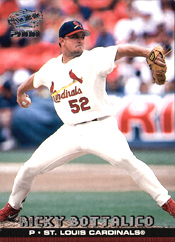
Ricky Bottalico was acquired by the Cardinals to be a setup reliever, became the closer instead and didn’t perform well enough to keep the job.

On Nov. 19, 1998, the Cardinals got Bottalico and pitcher Garrett Stephenson from the Phillies for outfielder Ron Gant and pitchers Jeff Brantley and Cliff Politte. The Cardinals also agreed to pay $6 million toward Gant’s salary over the next two years and Brantley’s salary in 1999.
With an 0-5 record, eight blown save chances and a 4.44 ERA, Brantley was a bust as Cardinals closer in 1998 and he relinquished the role to Juan Acevedo over the last two months of the season. Acevedo responded with 15 saves and the Cardinals were convinced he’d be their closer in 1999. “Our people have (Acevedo) ranked among the top five in the National League,” Cardinals general manager Walt Jocketty told the St. Louis Post-Dispatch.

What the Cardinals wanted were established setup relievers to protect leads before turning to Acevedo in the ninth. They thought they’d acquired an ideal tandem in Bottalico, a right-hander, and Scott Radinsky, a left-hander they signed as a free agent after he posted a 2.63 ERA and 13 saves for the 1998 Dodgers.

Quick study

Bottalico was a catcher in college at Florida Southern and Central Connecticut, but wasn’t selected in the major-league draft. The Phillies signed him as an amateur free agent in July 1991 and projected him to be a pitcher.

“I knew I threw the ball hard, but I really didn’t have even a windup at that point,” Bottalico said. “I was throwing more like a catcher, straight from the ear.”

Bottalico was sent to the low levels of the Phillies farm system and was used as a starter. “I learned more about pitching in the first week of minor-league baseball than in the whole rest of my life,” Bottalico said.

After making 11 starts in 1992, he was converted into a closer and began a quick ascension through the farm system. “The Phillies saw my intensity level,” Bottalico said. “Once they saw that, I was labeled for a closer’s role.”

Bottalico debuted in the big leagues with the Phillies in 1994 and he had 34 saves for them in each of two seasons, 1996 and 1997.

In April 1998, Bottalico had surgery to remove bone spurs in his right elbow. He sat out two months, returned in July and “struggled to regain his control and velocity,” the Philadelphia Inquirer reported.

Left-handed batters hit .375 against Bottalico in 1998. He had an 11.68 ERA in August and a 5.59 ERA in September.

Something is amiss

The Cardinals approached the Phillies in November 1998 and suggested trading Gant for Bottalico, Phillies manager Terry Francona said. “We were dying for a 30-homer guy like Gant,” said Phillies general manager Ed Wade.

To sweeten the deal, the Cardinals said they’d include Brantley and Politte and pay portions of the remainder of Gant’s and Brantley’s contracts, Francona said.

The Phillies included Stephenson in the package because he’d filed a grievance against them, claiming he was sent to the minors while injured, and “wore out his welcome here,” Wade said.

Though Bottalico was 1-5 with a 6.44 ERA for the 1998 Phillies, Jocketty called him “a guy we’ve liked for a long time” and said Cardinals doctors were convinced the pitcher’s arm was sound. “My arm hasn’t felt this good in years,” Bottalico said.

Early in the 1999 season, Bottalico pitched well for the Cardinals and Acevedo didn’t. Bottalico had a 1.46 ERA in 11 appearances in April. By mid-May, Acevedo had a 6.75 ERA, so the Cardinals made Bottalico the closer.

Though Bottalico had stretches of success, he faltered in the final two months of the season. His ERA in August was 9.72 and in September it was 7.84.

Meanwhile, Radinsky injured his elbow and didn’t pitch for the Cardinals in August and September.

The relievers who began the season as the Cardinals’ top three all produced poor results:

_ Acevedo, 4-5, 5.06 ERA, four saves as a reliever.

_ Bottalico, 3-7, 4.91 ERA, 20 saves and eight blown save chances.

_ Radinsky, 2-1, 4.88 ERA, three saves.

Bottalico had “too many walks, too many late-inning home runs, too little confidence” during the second half of the season, the Post-Dispatch surmised.

The pitcher who turned out to provide a boost was the throw-in from the Phillies deal. Stephenson, sent to the minors early in spring training, was called up to the Cardinals in June 1999 and won his first five decisions. He finished 6-3 with a 4.22 ERA. In 2000, he was a 16-game winner for the Cardinals.

One and done

The Cardinals were 75-86 in 1999 and they vowed to make moves to improve.

On Nov. 16, 1999, the Cardinals acquired reliever Dave Veres from the Rockies and projected him to be their closer in 2000.

Soon after, the Cardinals offered to deal Bottalico and outfielder Eric Davis to the Dodgers for starting pitcher Ismael Valdez and second baseman Eric Young, the Post-Dispatch reported. When the Dodgers balked at taking Davis, talks continued about a swap of Bottalico for Young.

On Dec. 12, 1999, the Dodgers got what they considered a better offer and dealt Valdez and Young to the Cubs for pitchers Terry Adams, Chad Ricketts and Brian Stephenson. A week later, the Cardinals got second baseman Fernando Vina for Acevedo, catcher Eliezer Alfonzo and pitcher Matt Parker.

Unable to trade Bottalico and unwilling to pay him the $2.2 million salary he got in 1999, the Cardinals decided they wouldn’t offer him a contract for 2000, making him a free agent. “I had a feeling this is what they might do,” Bottalico said.

In January 2000, Bottalico signed a one-year contract with the Royals, bringing his short, unfulfilling stint with the Cardinals to an official end.

Read Full Post »

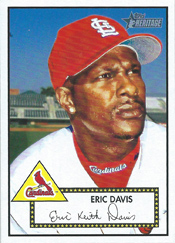
Eric Davis, who conquered cancer, convinced the Cardinals he could help them as an inspirational and productive player.

On Nov. 19, 1998, Davis, a free-agent outfielder, signed with St. Louis for two years at $8 million.

Davis, 36, was acquired to provide run production, defense and clubhouse leadership for an underachieving Cardinals club. Even with Mark McGwire clouting 70 home runs, the Cardinals finished 83-79, 19 wins fewer than the division champion Astros, in 1998.

In May 1997, Davis was diagnosed with colon cancer, had a portion of his colon removed and underwent months of chemotherapy. Remarkably, he returned to the Orioles in September 1997 and played well in the last weeks of the season. Then, in 1998, Davis performed like a player in his prime, producing a 30-game hitting streak and batting .327 with 28 home runs for the Orioles.

A star is born

Davis made his major-league debut with the Reds on May 19, 1984, against the Cardinals and soon displayed a special combination of power and speed. His first big-league hit was a triple off Dave LaPoint.

In 1986, Davis had 27 home runs and 80 stolen bases for the Reds. Over the next three seasons, 1987-89, Davis won three Gold Glove awards and excelled on offense, too. He produced 37 homers, 100 RBI and 50 steals in 1987, 26 homers, 93 RBI and 35 steals in 1988, and 34 homers, 101 RBI and 21 steals in 1989.

The Reds won the National League pennant in 1990 and advanced to the World Series against manager Tony La Russa’s American League champion Athletics. In Game 4, with the Reds on the verge of a sweep, Davis suffered a lacerated kidney when he dived for a drive by Willie McGee.

After that, Davis experienced a series of injuries and setbacks. The Reds traded him to the Dodgers after the 1991 season. Two years later, on July 24, 1993, Davis was with Vince Coleman when the former Cardinal tossed a powerful explosive device into a parking lot and injured three people. A month later, the Dodgers dealt Davis to the Tigers.

In 1994, Davis had surgery for a herniated disc in his neck and sat out the 1995 season. In 1996, he made a successful comeback with the Reds, hitting 26 home runs, and became a free agent after the season, signing with the Orioles.

Profile in courage

On June 13, 1997, Davis had surgery for colon cancer. He returned to the Orioles on Sept. 15, 1997, while still undergoing weekly chemotherapy and hit .310 in eight games that month, helping the club secure a berth in the postseason.

Davis’ courageous return in 1997 positioned him for more achievements in 1998. The 1998 Orioles were loaded with hitters such as Cal Ripken Jr., Roberto Alomar, Rafael Palmeiro and Harold Baines. Davis led the club in batting average (.327), on-base percentage (.388) and slugging percentage (.582).

Baltimore Sun columnist John Eisenberg called Davis “a positive and inspirational leader in a sour clubhouse.”

Davis expressed interest in staying with the Orioles, but wanted $8 million for two years. The Orioles offered him two years at $5.6 million, the Sun reported.

“They were either forcing me to leave, or to come in at a lower salary than I deserved,” Davis said. “I wasn’t looking forward to leaving Baltimore, but it became clear I wasn’t part of their thinking.”

Meet me in St. Louis

Davis told his agent the Cardinals were one of his top choices. The Cardinals, looking to restructure their outfield, gave Davis what he wanted.

The Cardinals “are getting one of baseball’s best guys,” declared the Sun.

Davis said he was glad he’d be playing for La Russa, who left the Athletics after the 1995 season to manage the Cardinals, and joining a lineup with players such as McGwire and Ray Lankford.

“Their interest is winning now,” Davis explained to the St. Louis Post-Dispatch. “I’m 36 years old. I can’t be part of rebuilding.”

On the day the Cardinals signed Davis, they also traded outfielder Ron Gant and pitchers Jeff Brantley and Cliff Politte to the Phillies for pitchers Ricky Bottalico and Garrett Stephenson. With Gant gone and outfielder Brian Jordan soon to depart as a free agent, the Cardinals projected a 1999 outfield of Davis in right, J.D. Drew in center and Lankford in left.

“Anybody that knows about hard work, dedication, sacrifice and adversity, who better than I?” Davis said. “I’ve proven my leadership qualities over the years.”

Finishing strong

On June 25, 1999, Davis made two diving catches to help Jose Jimenez preserve a no-hitter against the Diamondbacks, but damaged his left shoulder. Boxscore The injury caused Davis to sit out the last three months of the season and he underwent surgery to repair a torn left rotator cuff. In 58 games for the 1999 Cardinals, Davis hit .257 with 30 RBI and the club finished 75-86.

From the start, Davis’ second season with the Cardinals was more successful than the first. On April 3, 2000, in the Cardinals’ season opener against the Cubs at St. Louis, Davis hit a home run. Boxscore

A month later, on May 7, 2000, Davis hit a grand slam off Denny Neagle of the Reds at Cincinnati. Boxscore

As the designated hitter against the White Sox at Chicago, Davis produced the only five-hit game of his major-league career on July 15, 2000. Boxscore

With Lankford in left, Jim Edmonds in center and Davis platooning with Drew in right, the Cardinals finished 95-67 and won a division title. Davis hit .303 with 40 RBI in 92 games for the 2000 Cardinals. He batted .390 against left-handers and .321 with runners in scoring position.

After the Cardinals were eliminated in the National League Championship Series versus the Mets, Davis became a free agent, signed with the Giants and played his final season for them in 2001.

Read Full Post »

« Newer Posts - Older Posts »