Feeds:
Posts
Comments

Archive for the ‘Hitters’ Category

(Updated July 23, 2022)

Joe Medwick was a special hitter for the Cardinals. He also was expensive and high maintenance. When his popularity waned, the Cardinals decided the value Medwick could bring them in a trade was greater than what he could produce for them in the lineup.

joe_medwick3On June 12, 1940, the Cardinals traded Medwick and pitcher Curt Davis to the Dodgers for $125,000 and four undistinguished players, or, as one writer described them, “a few ham sandwiches.”

Cardinals owner Sam Breadon and his top baseball executive, Branch Rickey, got exactly what they wanted. With attendance sagging and the Cardinals out of contention, Breadon and Rickey were seeking cash.

Rickey had a personal incentive to trade players for cash because his contract called for him to get a percentage of the sale as remuneration in addition to his salary.

As The Sporting News noted, the Cardinals traded Medwick “while he had high market value.”

Medwick, a hitter of Hall of Fame skills, had sulked about being lifted in the late innings for a defensive replacement. When he fell into a hitting funk, Cardinals fans taunted him from the Sportsman’s Park bleachers. Witnessing this, Breadon realized there wouldn’t be a public relations backlash if he traded the club’s standout hitter, and instructed Rickey to pursue a deal.

Breadon told the St. Louis Star-Times, “Medwick was through with the Cardinals. The fans had sent me that message.”

“The tide had turned,” wrote columnist Dan Daniel. “The fans would not shout against the departure of (Medwick).”

Remarkable hitter

A right-handed batter who swung at pitches outside the strike zone with savage aggressiveness, Medwick debuted with the Cardinals in September 1932 and became their starting left fielder in 1933.

Among his many remarkable hitting feats with the Cardinals, Medwick:

_ Achieved the Triple Crown in 1937, leading the National League in batting average (.374), home runs (31) and RBI (154). Medwick is the last NL player to accomplish the feat.

_ Won the NL Most Valuable Player Award in 1937. He also led the NL that season in runs (111), hits (237), doubles (56), slugging percentage (.641) and total bases (406).

_ Led the NL in hits in 1936 (223).

_ Led the NL in doubles in 1936 (64) and 1938 (47).

_ Led the NL in RBI in 1936 (138) and 1938 (122).

_ Hit .379 (11-for-29) with five RBI in the 1934 World Series vs. the Tigers.

Medwick remains the Cardinals’ all-time single-season leader in doubles (64) and RBI (154).

Interest from Dodgers

Dodgers president Larry MacPhail offered the Cardinals $200,000 for Medwick in 1939, The Sporting News reported, but the Cardinals were in contention and rejected the offer.

In 1940, the Cardinals started poorly, losing 20 of their first 32 games. On June 3, Medwick was hitting .297 _ good for most but subpar for him.

“I believe Joe is slowing up and will not be the star he was,” Breadon said to the St. Louis Star-Times. “He also proved conclusively to me he did not care to hustle for the Cards this year.”

Medwick felt disrespected by Breadon and Rickey. After his Triple Crown and MVP season in 1937, the Cardinals rewarded Medwick with a salary of $20,000 in 1938. When he followed his .374 batting average of 1937 with a .322 mark in 1938, the Cardinals cut his pay to $18,000 in 1939. After hitting .332 in 1939, Medwick demanded a $20,000 salary in 1940, but the Cardinals gave him $18,000.

“They ruined my incentive,” Medwick told the Brooklyn Daily Eagle.

Recalling MacPhail’s interest in Medwick, Rickey contacted the Dodgers in June 1940. “Rickey telephoned and said that the Cardinals were in the mood to do some trading,” MacPhail told The Sporting News.

The ensuing conversation:

MacPhail: “Who will you trade?”

Rickey: “Anybody.”

MacPhail: “Does that go for Medwick, too?”

Rickey: “Yes.”

MacPhail took a flight to St. Louis and closed the deal.

Said MacPhail: “Frankly, the Medwick deal surprised me more than anyone else. If you’d have told me a week before that we’d come up with Medwick, I’d have said you were crazy. A month ago, I put out a feeler for him and was told there wasn’t a chance.”

Finances a factor

In exchange for Medwick and Davis (who had 22 wins for the 1939 Cardinals), the Dodgers sent the cash, plus pitchers Carl Doyle and Sam Nahem, outfielder Ernie Koy and third baseman Bert Haas. The Cardinals assigned Nahem and Haas to the minor leagues.

“St. Louis believes the passing of Medwick and the development of a better feeling on the club, minus Joe and his $18,000 salary, will lift the (Cardinals),” Daniel wrote.

Said Breadon: “The Cardinals were going no place with Medwick and Davis on the job _ and they certainly couldn’t be any worse without them.”

The reduction in salaries paired with the infusion of cash helped the Cardinals overcome a drop in attendance. After drawing 400,245 paid customers in 1939, the Cardinals had a total home attendance of 324,078 in 1940. According to columnist Dick Farrington, Breadon was facing “the specter of a financial loss on the season.”

Hit by pitch

In joining the Dodgers, Medwick was reunited with his pal, manager Leo Durocher. They had been Cardinals teammates from 1933-37, and played golf together in the off-season. Medwick called Durocher “the greatest guy in the world,” the New York Daily News reported.

A New Jersey native, Medwick said, “Ever since I was a kid, I wanted to play in Brooklyn.” Regarding hitting in Ebbets Field, Medwick told the Brooklyn Daily Eagle, “That right field wall is going to be duck soup for me.”

On the day of the trade, the Dodgers and Reds were tied atop the National League standings. “No ballplayer is sorry to join a first-place club,” Medwick said to the St. Louis Post-Dispatch.

On June 18, in his sixth game for the Dodgers, Medwick faced the Cardinals at Brooklyn. In the first inning, a fastball from Bob Bowman struck Medwick behind the left ear, knocking him unconscious. As Medwick was carried on a stretcher to the clubhouse, MacPhail “stormed over to the Cardinals dugout and challenged the players, individually and collectively,” The Sporting News reported.

All of the Cardinals stood but none made a move. “Take it easy,” Cardinals outfielder Pepper Martin said to MacPhail.

Medwick was taken to a hospital and diagnosed with a concussion.

Bowman said he didn’t intend to hit him. “Medwick was looking for a curveball, expecting the ball to break,” Bowman said.

According to author Robert Creamer, Dodgers coach Chuck Dressen was stealing signs and would whistle when he thought a curve was coming. Bowman said he and catcher Don Padgett decided to try to fool Medwick. When Padgett called for a curve, Dressen whistled but Bowman threw a high inside fastball. Leaning in for the curve, Medwick couldn’t get out of the way.

After the game, Bowman was being escorted from the ballpark by two detectives when MacPhail approached and “sent a wild swing at him,” according to The Sporting News.

The Cardinals visited Medwick in the hospital. Manager Billy Southworth, the only member of the contingent admitted to the room, expressed regret for the injury. Medwick absolved the Cardinals, calling the incident “just one of those things.” Boxscore

Medwick was released from the hospital on June 21. He hit .300 in 106 games for the 1940 Dodgers. In 1941, he helped them win the pennant, hitting .318 with 18 home runs and 88 RBI.

Medwick returned to the Cardinals in 1947 and finished his playing career with them in 1948. He was elected to the National Baseball Hall of Fame in 1968.


Read Full Post »

With one swing, Tim McCarver lifted the Cardinals to a victory and propelled Fred Gladding toward a long, productive coaching career.

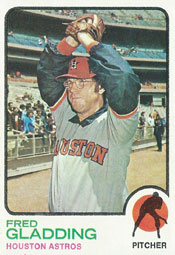
fred_gladdingOn June 2, 1973, at St. Louis, McCarver hit a pinch-hit grand slam against Gladding in the eighth inning for a 6-2 win over the Astros.

It would be the last major-league appearance for Gladding. He was sent to the minors soon after and served that summer as a player-coach at Class AAA Denver. That experience launched him the following season into a 22-year career as a coach in the Tigers, Astros and Indians organizations, including three seasons as Detroit’s pitching coach.

Fading veterans

In June 1973, McCarver, 31, and Gladding, 36, were relegated to support roles after ranking among the best at their positions. McCarver was the starting catcher on Cardinals clubs that won three National League pennants and two World Series championships in the 1960s. He twice was an all-star with St. Louis (1966-67).

After he was traded to the Phillies in October 1969, McCarver was reacquired by the Cardinals from the Expos in November 1972 and given roles as backup to Ted Simmons at catcher and Joe Torre at first base.

Gladding had been a stellar reliever. He was 6-4 with 12 saves and a 1.99 ERA in 42 games for the 1967 Tigers. In November 1967, the right-hander was dealt to the Astros, completing a trade for third baseman Eddie Mathews.

In 1969, Gladding had a NL-leading 29 saves for Houston. He followed that with 18 saves for the 1970 Astros.

McCarver magic

On June 2, 1973, a Saturday night in St. Louis, the Astros led, 2-1, when the Cardinals batted in the bottom of the eighth against reliever Jim York. With two outs, Simmons doubled, scoring Dwain Anderson from first, tying the score at 2-2.

The next batter, Jose Cruz, was walked intentionally, putting runners at first and second and setting up a potential forceout. Luis Melendez followed with an infield single, loading the bases.

With Ken Reitz due to bat next, Astros manager Leo Durocher lifted York and replaced him with Gladding. Cardinals manager Red Schoendienst countered by calling on McCarver to bat for Reitz.

Gladding had a 4.11 ERA. McCarver, a left-handed batter, had no home runs.

McCarver swung at the first pitch from Gladding and hit it over the right-field wall for his fifth grand slam of his career.

“I said when we got him back last winter we could use his bat _ and I meant it,” Schoendienst told the Associated Press. “Tim is a tough out. I don’t care who is pitching.”

Rick Wise, the Cardinals’ starter, retired the Astros in the ninth, securing the win. Boxscore

New chapter

Deemed ineffective, Gladding was sent to the minor leagues for the first time since 1964. He went 0-2 with a 4.74 ERA and one save in 20 appearances for the Astros’ Class AAA Denver farm team. The Astros released him in October 1973.

Then, his full-time coaching career began.

The Tigers named Gladding the pitching coach for their 1974 Evansville farm club. Among the pitchers Gladding worked with were future major-leaguers Vern Ruhle and Steve Grilli.

In 1975, Gladding was again at Evansville when he got the chance to mentor a phenom, Mark Fidrych.

Fidrych had started the 1975 season with Class A Lakeland and skyrocketed through the Tigers system, going to Class AA Montgomery and then Class AAA Evansville. With Gladding as his pitching coach, Fidrych, 20, was 4-1 with a 1.58 ERA in six starts for Evansville.

Back in the bigs

In 1976, Gladding returned to the major leagues as pitching coach for Tigers manager Ralph Houk. Fidrych earned a spot in the Tigers’ starting rotation. The combination produced sensational results.

Nicknamed “The Bird,” Fidrych was 19-9 for the 1976 Tigers. He led the American League in ERA (2.34) and complete games (24), started the All-Star Game and was named winner of the Rookie of the Year Award.

In the book “The Bird: The Life and Legacy of Mark Fidrych,” Gladding said of his star pupil, “He was very easy to coach. He would listen to you and do what you suggested.”

Gladding remained Tigers pitching coach in 1977 and 1978, mentoring, among others, Jack Morris, who developed into Detroit’s ace. After the 1978 season, Houk retired and his successor, Les Moss, replaced Gladding with former Cardinals pitcher Johnny Grodzicki.

Gladding spent the remainder of his coaching career in the minor-league systems of the Astros and Indians.

In an interview with MLB.com, Steve Kline, the former Cardinals reliever, cited Gladding as a positive influence while Kline was in the Indians organization.


Read Full Post »

(Updated June 12, 2024)

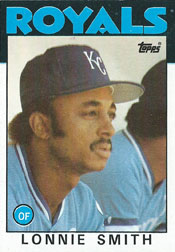
With Vince Coleman offering a younger, less expensive and more productive alternative as a left fielder, the Cardinals deemed Lonnie Smith expendable.

lonnie_smith5On May 17, 1985, the Cardinals dealt Smith to the Royals for John Morris, a minor-league outfielder.

Cardinals manager Whitey Herzog told a Kansas City reporter seeking a comment about the trade, “You’ve just won the damn pennant.”

Five months later, Smith played an integral role in the Royals defeating the Cardinals in seven games in the 1985 World Series.

St. Louis sparkplug

In four seasons with the Cardinals, Smith hit .292 with 173 steals and a .371 on-base percentage.

In 1982, his first season with the Cardinals, Smith ignited the offense, hitting .307, scoring 120 runs and stealing 68 bases. In the 1982 World Series, Smith hit .321 with six runs scored, helping the Cardinals beat the Brewers in seven games.

Smith underwent rehabilitation for drug abuse in 1983, missing about a month of the season, but hit .321 with 43 steals. In 1984, his batting average was .250.

Smith opened the 1985 season as the Cardinals’ left fielder, joining Willie McGee in center and Andy Van Slyke in right. When McGee was sidelined by an injury in April, the Cardinals promoted Coleman from Class AAA Louisville. The rookie speedster established himself as a force, hitting .300 with 12 steals in his first dozen games. When McGee returned to the lineup, Smith was odd man out.

“If the National League had a designated hitter, he would have died a Cardinal,” Herzog told the St. Louis Post-Dispatch.

Royals come calling

The Royals were among several clubs that expressed interest in Smith, Cardinals general manager Dal Maxvill said. According to the Post-Dispatch, Royals general manager John Schuerholz contacted Maxvill, who asked for Morris. “John Morris is the top prospect in their organization,” Maxvill said. “We’ve checked with tons of people to find out about the young man. All reports were excellent.”

Morris, 24, was the first-round choice of the Royals in the 1982 amateur draft. In 1983, he was named winner of the Southern League Most Valuable Player Award, hitting .288 with 23 home runs and 92 RBI for Jacksonville.

On May 13, 1985, four days before the trade was made, the New York Daily News reported a deal was in the works. Morris got a phone call from his mother, who informed him of the newspaper report. Stunned, Morris called Schuerholz and asked him about it.

According to Morris’ book “Bullet Bob Comes to Louisville,” Schuerholz told him, “The news about you being traded is strictly a rumor created by the St. Louis media. You have nothing to worry about. Everything will be fine.”

Hurt feelings

On the day of the trade, Morris was with the Omaha club in Buffalo when he got a call from Schuerholz. According to Morris’ book, the conversation went like this:

Schuerholz: “John, we just made a trade. You’ve been dealt to the St. Louis Cardinals for Lonnie Smith. I know we discussed this the other day, but at the time I couldn’t give you any information.”

Morris: “So, you knew all along that I was going to be traded. I think it’s unfortunate that I had to find out from my mom, who just happened to stumble upon it in the newspaper.”

Schuerholz: “You’re going to a first-class organization and we know you will do well with the Cardinals … Whitey Herzog is a great manager who thinks the world of you. He even told me that himself in spring training.”

Smith was upset about being traded and told the Post-Dispatch, “I had thought about quitting very seriously.”

Smith also said to Cardinals Magazine, “I didn’t want to leave St. Louis.”

Some Cardinals said they thought the club should have gotten more in return for Smith. Cardinals pitcher John Tudor said to the Post-Dispatch, “I think the deal stinks. I don’t think it helps the club … Lonnie always had a lot of spark, he was aggressive, he’d run into a wall for you if that was going to win you a game. I’m sorry to see him go.”

Said Van Slyke: “I wonder why we couldn’t get a pitcher in return?”

Maxvill told The Sporting News he expected to be criticized for trading Smith. “People are going to say that it’s a matter of economics, that the Cardinals don’t want to pay the salaries,” Maxvill said.

Coleman, 23, had a $60,000 salary. Smith, 29, was getting $850,000.

Cardinals management said playing time was a factor, too.

“We didn’t plan on Lonnie playing that much … I don’t think he would be satisfied as a utility player,” said Maxvill.

Herzog said, “I would venture to say there’s never been a better defensive outfield than Van Slyke, McGee and Vince.”

Royals benefit

The Cardinals assigned Morris to Class AAA Louisville. Smith became the Royals’ left fielder.

“Lonnie Smith adds the element of speed and run production to our lineup,” said Schuerholz. “When you start your lineup with Willie Wilson, Lonnie Smith and George Brett, it can be very exciting.”

Regarding Smith’s drug history, Royals manager Dick Howser told United Press International, “Our indications are _ and we’ve checked it out _ he’s very good. He’s done what he’s had to do. We feel comfortable with the fact he’s clean.”

Smith told the Post-Dispatch, “My doctor, my counselor and my wife know I’m clean … Knowing that I’m clean, I can deal with my problems a lot easier.”

(In his book “White Rat: A Life in Baseball,” Herzog said of Smith’s drug problem, “I admired him, and still do, for having the guts to ask for help.”)

Smith hit .257 with 40 steals for the 1985 Royals. In the World Series versus the Cardinals, he batted .333 with four runs scored, four RBI and two steals.

Morris played five seasons (1986-90) with the Cardinals, hitting .247.


Read Full Post »

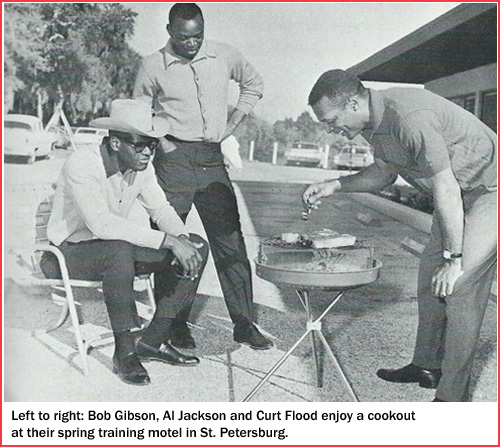
On the field, pitcher Bob Gibson and center fielder Curt Flood were all-star players who exceled for a Cardinals club that won two World Series titles and three National League pennants in the 1960s. Off the field, Gibson and Flood were road roommates and confidantes.

In his book “Stranger to the Game,” Gibson called Flood “my best friend in baseball.”

In 12 years (1958-69) with the Cardinals, Flood batted .293 (1,853 hits in 1,738 games) and three times led the NL in singles. He also won the Gold Glove Award seven times and was named an all-star three times.

“Curt Flood was more than my best friend on the ballclub,” Gibson said in his book. “To me, he personified what the Cardinals were all about. As a man and teammate, he was smart, funny, sensitive and, most of all, unique. As a ballplayer, he was resourceful, dedicated and very, very good.”

After being traded by the Cardinals to the Phillies in October 1969, Flood refused to report and challenged baseball’s reserve clause, opening the path to free agency for players.

“As Flood’s suit made the judicial circuit, Curt waited it out in Copenhagen, Denmark,” Gibson recalled. “I received long, philosophical letters from him every now and then. I missed him.

“At the ballpark, I missed Flood in center field, where his remarkable catches would often bring his cynical teammates to the top step of the dugout in applause. But I also missed his discussions about the latest works of (writer) James Baldwin and I missed his play on words. When, for instance, he took his place in the outfield between Stan Musial and Minnie Minoso, he referred to the alignment as Old Taylor and Ancient Age with a little Squirt for a chaser.

“I especially missed him as a roommate. By that time, Curt and I understood each other so well that we no longer had to talk to communicate.”

Regarding Flood’s self-sacrifice in challenging the reserve clause and, by so doing, shortening his playing career, Gibson said in his 1994 book, “The modern player has gotten fat from the efforts of Curt Flood and has returned him no gratitude or any other form of appreciation.

“I’ve often thought of what an appropriate and decent thing it would be if every player in the major leagues turned over 1 percent of his paycheck just one time to Curt Flood. They certainly owe him that much and more.”

gibson_jackson_flood


Previously: George Crowe was Cardinals mentor to Curt Flood

Read Full Post »

Starting with a walk to Yadier Molina and culminating with a home run by John Mabry, the Cardinals completed the biggest ninth-inning comeback in franchise history.

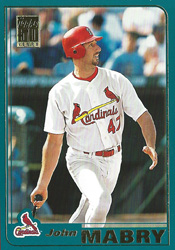
john_mabry2On May 2, 2005, the Cardinals overcame a six-run deficit by scoring seven runs in the ninth and defeating the Reds, 10-9, at Cincinnati.

The Cardinals sent 12 batters to the plate in that memorable inning and rallied against two relievers on a combination of four singles, two walks, two home runs and an error.

“I’ve never seen this happen,” Cardinals infielder Abraham Nunez told the St. Louis Post-Dispatch. “I hope I don’t see it happen again either.”

The Cardinals never had rallied from six runs behind in the ninth inning. The Reds hadn’t blown a six-run lead in the ninth since June 29, 1952, when an 8-2 advantage turned into a 9-8 loss to the Cubs at Cincinnati. Boxscore

“It’s not easy to give a big-league game away, but that’s what we did,” said Reds reliever Danny Graves after yielding the game-winning home run to Mabry. “It takes 27 outs, not 26 (to win).”

Walks will haunt

With the Reds ahead, 5-3, in the eighth, Graves began to throw in the bullpen in preparation for pitching the ninth. When the Reds scored four in the eighth, however, manager Dave Miley decided to save his closer and instead sent David Weathers to pitch the ninth, entrusting the 15-year big-league veteran with a 9-3 lead.

“The only way they could get back in the game is if we walked guys _ and I walked guys,” Weathers said to The Cincinnati Post.

Weathers walked the first two batters, Molina and Nunez. David Eckstein singled, loading the bases with none out.

“I was just all over the place,” Weathers said of his pitches.

Still, he almost escaped the jam unscathed.

Roger Cedeno struck out.

When Albert Pujols followed with a grounder to shortstop Rich Aurilia, it appeared the Reds might turn a game-ending double play.

Aurilia fielded the ball cleanly and tossed to D’Angelo Jimenez for the forceout of Eckstein at second base. Jimenez, however, couldn’t complete the turn and Pujols was safe at first. Molina scooted home from third on the play, making the score, 9-4.

The Cardinals remained alive, with Nunez on third, Pujols on first and two outs.

Reggie Sanders, the ex-Red, then singled, plating Nunez, moving Pujols to second and making the score 9-5.

Said Weathers: “It’s embarrassing … No excuses. That’s just bad pitching.”

Edmonds delivers

Miley lifted Weathers and replaced him with Graves, who had converted all eight of his save chances that season.

The first batter Graves faced was Jim Edmonds.

Hoping to catch the Reds by surprise, “I was thinking about bunting, honestly,” Edmonds told the Associated Press.

The slugger changed his mind, though, and decided to swing away.

Graves’ third pitch to Edmonds was a hanging breaking ball.

Edmonds belted it for a three-run home run, making the score 9-8.

Reds unravel

The Reds were reeling, but the Cardinals still trailed with the bases empty and two outs.

“Nobody wants to make that last out,” said Mabry. “That’s what it comes down to.”

Following Edmonds was Mark Grudzielanek. He smacked a grounder directly at Sean Casey. The ball ricocheted off the first baseman’s arm for a two-base error.

That brought up Mabry, who started the game at third base in place of Scott Rolen, who was nursing a back strain.

With the tying run at second, “I was just trying to drive the run home by staying inside the ball and driving it to the big part of the ballpark,” Mabry said.

Mabry did even better. He hit the first pitch over the center-field fence, a two-run homer, giving the Cardinals a 10-9 lead.

“That’s why baseball’s a beautiful game,” Mabry said.

A rattled Graves yielded singles to Molina and Nunez before retiring Eckstein on a fly out to right.

As Graves left the mound, the crowd, estimated at fewer than 10,000 in the ninth, was “booing at the top of their lungs,” The Post reported.

“To have that happen just makes us feel really small,” Graves said to Post columnist Lonnie Wheeler.

Finish the job

With closer Jason Isringhausen unavailable, Cardinals manager Tony La Russa chose Julian Tavarez to pitch the bottom of the ninth.

The first batter, Joe Randa, singled. Aurilia tried a sacrifice bunt, but Randa was forced out at second.

Tavarez then plunked Jason LaRue with a pitch, advancing Aurilia to second.

The drama finally ended when Austin Kearns grounded into a double play. Boxscore

“We have no baseball luck, I guess,” said Graves, “and in this game you do need a lot of luck along with skill.”

Three weeks later, Graves ran out of luck with the Reds. They released him.

Previously: How David Bell rang up a special Cardinals home run

Previously: Jim Edmonds was dandy for Cardinals in 2004 NLCS

Previously: Slugging, fielding give Jim Edmonds hope for Hall of Fame

Read Full Post »

(Updated Nov. 1, 2025)

Unwilling to bend on principle, Cardinals general manager Dal Maxvill reluctantly traded a slugger he wanted to keep. In a stroke of good fortune, he got in exchange a closer who would rank among the franchise’s all-time best.

On May 4, 1990, the Cardinals acquired Lee Smith from the Red Sox for outfielder Tom Brunansky.

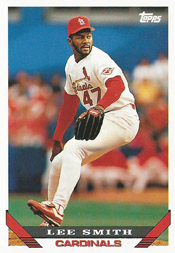
lee_smith3It was one of Maxvill’s best trades during his tenure (1985-94) as Cardinals general manager. On Dec. 9, 2018, Smith was elected to the National Baseball Hall of Fame.

The deal came about after Brunansky demanded a no-trade clause in exchange for waiving free agency and staying with St. Louis. “I haven’t been looking to trade him,” Maxvill told the St. Louis Post-Dispatch. “We wanted to keep Brunansky.”

Seeking security

The Cardinals had acquired Brunansky from the Twins for second baseman Tommy Herr on April 22, 1988, six months after Minnesota had prevailed in a seven-game World Series with St. Louis.

Early in the 1990 season, the Cardinals approached Brunansky about a three-year contract. Eligible to become a free agent after the 1990 season, Brunansky wanted a no-trade provision in any new contract. “We don’t have those in St. Louis,” Cardinals manager Whitey Herzog said.

Brunansky explained “my wife and I wanted to settle down and buy a house here,” but couldn’t commit to that without the no-trade clause, the Post-Dispatch reported. “For me to stay here, I would need some kind of security,” Brunansky said. “I wasn’t going to sign here for three years, buy a house and everything and keep hearing trade rumors … It was a big issue for me and, of course, it was a big issue for the ballclub.”

Motivated to act

The Red Sox were eager to deal because they needed a right fielder to replace Dwight Evans, who was restricted to designated hitter duties because of back problems. The Cardinals needed an established closer to replace Todd Worrell, who was recuperating from elbow surgery.

Herzog said to the Post-Dispatch, “We felt if we waited any longer, (Smith) wouldn’t be there.”

Smith became available when the Red Sox signed another closer, Jeff Reardon.

The Cardinals also had talked with the White Sox about closer Bobby Thigpen, according to the Post-Dispatch. The Red Sox, though, were motivated to act.

“They called us. It’s as simple as that,” Red Sox manager Joe Morgan said to the Worcester (Mass.) Telegram and Gazette. “Nobody would give us the kind of pitcher we wanted, so we went with the right-handed power.”

According to the Boston Globe, the Red Sox turned down a two-for-one swap with the Braves involving pitcher Tommy Greene and third baseman Jim Presley for Smith. “We offered them a heck of a deal.” Braves general manager Bobby Cox said to The Sporting News.

Reunited with Roarke

Brunansky hit 43 home runs in three years with the Cardinals, but only 11 at Busch Memorial Stadium in St. Louis. “He’ll hit homers in Fenway (Park),” said Red Sox catcher Tony Pena, a former Cardinal.

Smith posted a 2-1 record with four saves, a 1.88 ERA and 17 strikeouts in 14.1 innings for the 1990 Red Sox. In joining the Cardinals, he was reunited with coach Mike Roarke, who had been his coach as a rookie with the 1980 Cubs.

Smith welcomed the chance to be the Cardinals’ closer. With Reardon the primary closer in Boston, Smith said he “sort of felt like the odd man out” there.

“I’m going to get an opportunity to pitch in the situation that I’m used to,” Smith said to Boston reporters. “I’m really pleased.”

Smith earned his first save for the Cardinals on May 11, 1990, pitching a flawless ninth inning in relief of Bryn Smith in St. Louis’ 5-2 victory over the Braves. Boxscore Smith posted 27 saves and a 2.10 ERA for the 1990 Cardinals.

Brunansky played four years with the Red Sox and hit 56 home runs.

Smith played four years with the Cardinals and earned 160 saves. Only Jason Isringhausen (217) has more saves as a Cardinal.

Smith was the first Cardinal to record 40 saves in consecutive seasons. He twice had back-to-back 40-save seasons: 1991-1992 and 1992-1993. He had 47 saves in 1991, 43 in 1992 and 43 again in 1993.

In 1993, less than two hours before the Sept. 1 trade deadline, the Cardinals dealt Smith to the Yankees for pitcher Rich Batchelor, clearing the way to test Mike Perez as the closer the rest of the season. The trade “took me off the hook” from having to inform Smith he was being removed from the closer role, said Joe Torre, who’d replaced Herzog as Cardinals manager.

Read Full Post »

« Newer Posts - Older Posts »