Feeds:
Posts
Comments

Archive for the ‘Hitters’ Category

(Updated March 12, 2023)

The Cardinals acquired Jose Oquendo with the idea he would become the eventual replacement for Ozzie Smith at shortstop. Instead, Oquendo became their second baseman and paired with Smith to form a top keystone combination.
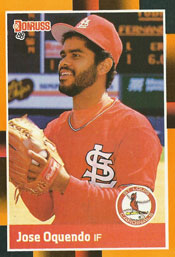
jose_oquendo5On April 2, 1985, the Cardinals got Oquendo from the Mets in the first trade engineered by general manager Dal Maxvill.

Maxvill knew what it took to play shortstop, having been the Cardinals’ starter at that position on pennant-winning clubs in 1967 and 1968. Like Maxvill, Smith was a Gold Glove Award winner. Like Maxvill in 1967, Smith helped the 1982 Cardinals to a pennant and World Series title.

The Cardinals wanted Smith to remain their shortstop, but he was eligible to become a free agent after the 1985 season. If Smith and the Cardinals were unable to negotiate a contract extension, Maxvill was prepared to trade him.

Shoring up shortstop

A headline in an April 1985 edition of The Sporting News declared, “Cardinals Admit Ozzie May Be Dealt.”

“If we can’t sign him, there’s got to be some thought about trading him,” said Fred Kuhlmann, Cardinals chief operating officer.

Said Smith: “A trade is a possibility.”

Also, Smith had a serious shoulder injury (a torn rotator cuff) in 1985. Smith wanted to let the injury heal naturally rather than undergo surgery, so the Cardinals were concerned whether he could make it through the season.

The Cardinals, though, had no suitable replacement for Smith.

That’s when Maxvill went to work.

The Cardinals dealt shortstop Angel Salazar, whom they had acquired from the Expos three months earlier, and minor-league pitcher John Young to the Mets for Oquendo and minor-league pitcher Mark Davis. Four days later, April 6, 1985, the Cardinals got veteran shortstop Ivan DeJesus and reliever Bill Campbell from the Phillies for reliever Dave Rucker.

Maxvill saw DeJesus, 32, as the stopgap and Oquendo, 21, as the long-term answer at shortstop if Smith was traded or couldn’t overcome the bum shoulder.

“You have to prepare yourself for any eventuality,” Maxvill said. “I looked in our system and there was nothing there at shortstop. You have to backstop yourself whether (Smith) is here or not.”

Mets prospect

Oquendo was 15 when he signed with the Mets as an amateur free agent in 1979 and made his professional debut that year with their Class A affiliate, the Grays Harbor Loggers of Aberdeen, Wash., in the Northwest League. He made 40 errors in 63 games at shortstop that season.

Four years later, Oquendo, 19, became the starting shortstop for the 1983 Mets under manager George Bamberger.

In 1984, the Mets were managed by Davey Johnson. He saw Rafael Santana, a former Cardinal, and Ron Gardenhire as shortstop options.

“Johnson felt Oquendo had to be a better hitter,” The Sporting News wrote. “He also was less enamored of Oquendo’s fielding than that of other shortstops in the organization.”

Smith stays

Maxvill was more impressed with Oquendo than Johnson was. (After the deal was made, Johnson learned Gardenhire had back problems. “If I had known about this,” said Johnson, “Jose Oquendo might still be here.”)

The Cardinals assigned Oquendo to Class AAA Louisville.

“You can look for the Wizard to pack his bags any day now,” Bill Conlin, a columnist for The Sporting News, wrote of Smith after the Cardinals got Oquendo and DeJesus.

Instead, on April 15, hours before the Cardinals played their 1985 home opener that night against the Expos, Smith agreed to a four-year contract extension to remain with St. Louis.

The deal was worth $8.7 million. Smith received a $700,000 signing bonus and salaries of $1.8 million a year in 1986 and 1987 and $2.2 million a year in 1988 and 1989, The Sporting News reported. Also, the Cardinals provided Smith a $500,000 loan at 10 percent interest and Anheuser-Busch promised him consideration for a wholesale beer distributorship.

Smith played the entire 1985 season despite the bad shoulder. He would play for the Cardinals through the 1996 season before retiring.

Shift to second

Oquendo spent the 1985 season with Louisville. His manager was Jim Fregosi, who had been an all-star shortstop with the Angels. Oquendo hit .211 in 133 games for Louisville and made 23 errors at shortstop.

In 1986, Oquendo stuck with the Cardinals as a backup to Smith at shortstop and to Tommy Herr at second base. He hit .297 in 76 games, establishing himself as a valuable utility player.

After Herr was traded to the Twins in 1988, Oquendo became the Cardinals’ starter in 1989. He led National League second basemen in fielding percentage in 1989 (.994) and 1990 (.996).

In 10 seasons with the Cardinals (1986-1995), Oquendo hit .264 with an on-base percentage of .359. In 1989, he was eighth in the NL in batting at .291.
Read Full Post »

Instead of working with established big-leaguers, Bob Gibson spent the spring training of 1995 teaching basic grips to pitchers who normally would have had no chance to be in a Cardinals camp.

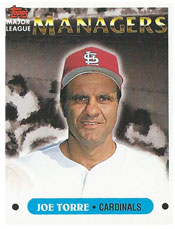
joe_torre6Spring training in 1995 was an odd, depressing experience for the Cardinals and other big-league teams because of the labor dispute between players and owners.

The players’ strike that began in August 1994 carried into spring training 1995. None of the players on the Cardinals’ big-league roster reported to camp at St. Petersburg, Fla. Instead, the Cardinals, like other clubs, brought in replacement players.

Hall of Fame helper

Manager Joe Torre and his staff were required to train the replacement players, with the intent of having them ready to open the regular season on April 3.

Gibson, the Hall of Fame pitcher who carried the Cardinals to two World Series championships, was hired by Torre to be a Cardinals coach.

Replacement player Paul Anderson, 26, a right-hander who was a combined 4-6 with a 6.65 ERA for two Cardinals farm clubs in 1994, asked Gibson for assistance in learning the proper grip to throw a slider.

“I was doing it wrong, so I did it the way he taught me,” Anderson told Rick Hummel of the St. Louis Post-Dispatch. “I like it a lot better. I’m learning from the best.”

Scribe and rejects

The 55-player Cardinals replacement team at training camp had no one who had appeared in a major-league game.

In the Cardinals’ exhibition opener against the Indians on March 4 at St. Petersburg, Mike Hinkle started and pitched three scoreless innings for St. Louis. Hinkle, 29, had last played professional baseball in Italy in 1993.

Outfielder Doug Radziewicz, 25, an aspiring journalist who was filing reports from camp for his hometown newspaper in Somerville, N.J., drove in the winning run with a pinch-hit single in the eighth, lifting the Cardinals to a 4-2 victory.

“You can’t judge baseball from one day, but it was well-played,” Torre said after the game. “The thing you’re concerned with is that playing for the first time they’re a little in awe.”

Walt Jocketty, hired in October 1994 to replace Dal Maxvill as general manager, was asked what it was like to watch replacement players instead of big-leaguers in his first Cardinals spring training game. “As long as I’ve got Joe (Torre) here, we can hold hands and go through this together,” Jocketty said.

Wrote Hummel: “There were no pickets, as the striking players earlier had advertised, which was good because the minor leaguers were nervous enough as it was. The clubhouse was very quiet before the game.”

Fans weren’t buying into replacement baseball. Hummel reported the Cardinals were averaging 1,470 tickets sold per exhibition game instead of the usual 5,000. In March, 54 percent of respondents to a Post-Dispatch poll said they probably or absolutely wouldn’t pay to see a game played by replacements.

Chasing a dream

The Cardinals broke camp with a roster of 32 replacement players, intending to open the season with them.

Anderson, Hinkle and Radziewicz were on the Opening Day roster. In a late move, the Cardinals also acquired Glenn Sutko, a catcher who had one hit in 10 at-bats for the 1991 Reds.

Among other replacement Cardinals on the Opening Day roster:

_ Ty Griffin, second baseman. A No. 1 pick of the Cubs in the 1988 amateur draft, Griffin also had played for the U.S. Olympic baseball team. He flopped in the Cubs system and spent the 1994 season with a pair of independent league teams.

_ Larry Shikles, starting pitcher. In eight seasons in the minor league systems of the Red Sox and Athletics, the right-hander compiled a 70-68 record.

_ Howard Prager, first baseman. He hit .239 for the Cardinals’ Class AAA Louisville club in 1994.

_ John “Skeets” Thomas, outfielder. He slugged 17 home runs for Louisville in 1994.

_ Tony Diggs, outfielder. A sixth-round draft choice of the Brewers in 1989, Diggs hit .215 for the Cardinals’ Class AA Arkansas team in 1994.

_ Anthony Lewis, outfielder. An eighth-round draft pick of the Cardinals in 1989, Lewis hit a combined .230 for two St. Louis farm clubs in 1994.

“We went with the players on the morning side of the mountain rather than the twilight side of the hill,” Torre said, explaining why the Cardinals (with the exception of Sutko) chose players without big-league experience.

On April 2, 1995, the day before the season was to open, the 234-day strike ended. The season opener was moved to April 26; spring training was re-opened for players on big-league rosters. The replacement players either were assigned to the minors or released.

Said Torre: “It feels weird starting all over again.”

Read Full Post »

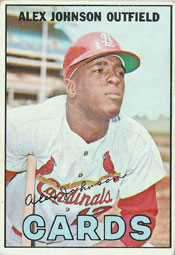
The Cardinals traded two all-star infielders, first baseman Bill White and shortstop Dick Groat, to acquire Alex Johnson and told Lou Brock to shift outfield positions to accommodate the heralded newcomer.

alex_johnsonJohnson never fulfilled his potential with St. Louis. Instead of joining Brock and Curt Flood as an outfield regular, Johnson got demoted to the minors in his first Cardinals season and backed up Roger Maris in his second and last year with St. Louis.

Phillies phenom

At 21, Johnson debuted in the big leagues with the 1964 Phillies. He hit .296 in two seasons with Philadelphia.

Cardinals general manager Bob Howsam envisioned Johnson as an ideal fit to join Brock and Flood in forming a fleet, productive St. Louis outfield.

On Oct. 27, 1965, the Cardinals dealt White, Groat and catcher Bob Uecker to the Phillies for Johnson, catcher Pat Corrales and pitcher Art Mahaffey.

White was a five-time all-star who hit .298 and won the Gold Glove Award six times. In three years with St. Louis, Groat was a two-time all-star who batted .289. Both were key contributors to the Cardinals’ World Series championship season in 1964.

Power potential

“We expect Johnson to hit the long ball for us,” Howsam told The Sporting News. “Playing everyday instead of just against left-handed pitchers, he may even surpass White in long-ball hitting over the full season.”

Said Cardinals vice president Stan Musial, who was consulted by Howsam before the deal was made: “Over the long haul is what we’re thinking about. We’re trying to analyze our team better and it’s a switch to the youth system.”

The Cardinals believed Johnson would hit for a higher average and had more speed than Mike Shannon, their right fielder in 1964 and 1965.

Johnson hit .307 against left-handed pitching for the 1965 Phillies. He also hit .424 in 11 games versus the Cardinals that season.

Move over, Lou

Johnson reported to the Cardinals’ Florida Instructional League camp at St. Petersburg and worked with manager Red Schoendienst and coach Dick Sisler. “He has a better arm than I thought he did,” Schoendienst said.

The Cardinals decided to shift Brock from left to right and start Johnson in left, with Flood in center. Shannon was relegated to a reserve role. “I know the Cardinals made a big deal to get Johnson, but all I want is a chance,” Shannon said. “… I think I can hit .300. I’m strong. I can run and I’ve got good power.”

Johnson hit .286 in spring training and opened the 1966 regular season as the left fielder. He started each of the Cardinals’ first 20 games and hit .195. The Cardinals’ record was 8-12 and Johnson received part of the blame. “It’s not the pitchers getting me out,” Johnson said. “I’ve been getting myself out. I’ve been going for the long taters.”

On May 8, 1966, the Cardinals played their final game at Busch Stadium, formerly Sportsman’s Park. Johnson had the last at-bat and hit into a game-ending double play. Boxscore

Four days later, the Cardinals played their first game at the new Busch Memorial Stadium. Johnson started in left field and was 1-for-4 with a run scored. Boxscore

On May 18, 1966, the Cardinals sent Johnson to Class AAA Tulsa and called up outfielder Bobby Tolan. Brock returned to left field and Shannon took over in right.

In 25 games with the Cardinals, Johnson batted .186 with two home runs.

“Johnson appeared overmatched in his first opportunity at a regular job.” The Sporting News declared. “He has plenty of raw talent and good speed. There is considerable hope for him, especially if he can develop the ability to learn from coaches both in the minors and in the majors. He has not adapted well to instruction and he has been easy to pitch to.”

At Tulsa, Johnson prospered under manager Charlie Metro, batting .355 with 104 hits in 80 games.

Carlton to Cubs?

After the 1966 season, Howsam agreed to a proposed deal to send Johnson, Tolan and pitchers Steve Carlton and Nelson Briles to the Cubs for outfielder Billy Williams, The Sporting News reported. The trade was vetoed by Cardinals “super brass,” who presumably included Musial. “We needed a lefthanded-hitting outfielder and we went after (Billy) Williams,” Musial confirmed.

After the proposed trade was nixed, Howsam dealt third baseman Charlie Smith to the Yankees for outfielder Roger Maris. Soon after, Howsam resigned to become general manager of the Reds and was replaced by Musial.

In spring training, the Cardinals assigned hitting instructor Joe Medwick to work with Johnson. “I told him, ‘The only guy who is keeping you down is yourself. You’ve got all the equipment,’ ” Medwick said. “Alex was pulling too many pitches.”

Some thought Johnson and Maris would platoon in right field for the 1967 Cardinals. Maris, though, won the job outright, with Shannon replacing Smith at third base and Johnson taking a reserve outfield role.

In May 1967, The Sporting News reported Johnson was “swinging at too many bad balls and fouling off too many good ones.” Musial “had tried hard to deal Johnson to an American League club, but there were no takers.”

Johnson hit .223 with one home run in 81 games for the 1967 Cardinals, who won the National League pennant. He didn’t appear in the World Series against the Red Sox.

After the Cardinals won the championship, Musial resigned in triumph and was replaced by Bing Devine, in his second stint as St. Louis general manager. Devine’s first trade was to send Johnson to the Reds for outfielder Dick Simpson on Jan.11, 1968.

In two seasons with the Cardinals, Johnson hit .211 in 106 games with three home runs and 18 RBI. “Alex just might put everything together one of these days and become quite a ballplayer,” Schoendienst said.

Red was right

Reunited with Howsam and Metro (who had become a Reds scout), Johnson hit .313 with 146 RBI in two seasons with Cincinnati.

Traded to the Angels, Johnson was the 1970 American League batting champion, hitting .329, but his career continued to be marred by controversy and accusations of an indifferent attitude.

Said Cardinals coach Dick Sisler: “The tag on Johnson is that he will not accept advice from a manager or a competent coach. He easily could have become a great Cardinal player, but he showed no interest.”

In 13 years with the Phillies, Cardinals, Reds, Angels, Indians, Rangers, Yankees and Tigers, Johnson batted .288 with 1,331 hits.

Previously: Here’s how Mike Shannon became a Cardinals catcher

Previously: Bill White: We thought Lou Brock deal was nuts

Previously: How Charlie Metro miffed Stan Musial

Read Full Post »

(Updated March 9, 2019)

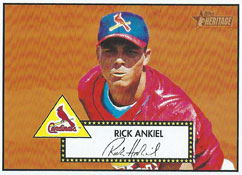
Disheartened by what he described as an erosion of his spirit and altering of his personality, Rick Ankiel changed the course of his baseball career.

rick_ankiel7On March 9, 2005, Ankiel announced he was transforming from a pitcher to an outfielder.

Ankiel, 25, entered 2005 spring training at Jupiter, Fla., as a strong candidate to earn a Cardinals Opening Day roster spot as a left-handed reliever.

After posting an 11-7 record with 194 strikeouts in 175 innings in 2000, Ankiel experienced a meltdown in the postseason against the Braves and Mets (nine wild pitches and 11 walks in four innings). He pitched briefly for the 2001 Cardinals and suffered a series of elbow injuries before returning to the big leagues with St. Louis as a reliever in September 2004.

Ankiel pitched in the Puerto Rico winter league after the 2004 Cardinals season, but cut short his stay there after experiencing a twinge in his left elbow. When he got to Cardinals camp in February 2005, his throwing sessions were erratic.

Change of plans

On March 8, 2005, the day before he was scheduled to make his spring training debut against the Marlins in a morning B squad game, Ankiel approached Cardinals manager Tony La Russa and informed him he was retiring as a player.

In his 2017 book “The Phenom,” Ankiel explained, “In my heart, I believed I could pitch in the big leagues. I’d earned it. It was just so hard. It was just so burdensome. It was time to stop, for those reasons. I was exhausted.”

Ankiel’s agent, Scott Boras, called Cardinals general manager Walt Jocketty and asked whether the club would be willing to let Ankiel go to the minor leagues, be an outfielder and get a chance to earn his way back to the majors. When Jocketty agreed, Boras called Ankiel, who was surprised by his agent’s actions, and convinced him to give the transformation a try.

The next day, Ankiel took indoor batting practice off pitches from Cardinals scout Jim Leyland. In a hastily called press conference, Ankiel announced his plans to switch positions and explained why he was giving up pitching.

“The frustration of not being effective, not being able to go out there and replicate my mechanics, and the way it affected me off the field, wasn’t worth it,” Ankiel said to the St. Louis Post-Dispatch. “The reward wasn’t there. I feel relieved now. It’s time to move on.

“This whole time, the frustration has built up. It seemed like it was eroding my spirit and affecting my personality off the field as well. It just became apparent it was time for me to move on and become an outfielder.”

According to the Post-Dispatch, Ankiel’s decision “stunned many within the Cardinals’ clubhouse.”

“Ongoing head case”

As a Cardinals pitcher, Ankiel hit .207 for his career with two home runs and nine RBI. He hadn’t played the outfield since his senior year at Port St. Lucie High School in Florida.

The reaction to his plan drew skepticism.

Bernie Miklasz, Post-Dispatch columnist: “The Cardinals wasted too much time, and emotion, in the lost cause that is Rick Ankiel. And now, as the organization recoils from Ankiel’s stunning surrender in his mission of regaining a foothold on the mound, the Cardinals are going to baby him one more time … It is time to stop treating Ankiel’s ongoing head case as if he’s a charity case … It’s time to let Ankiel move on with his life. The Cardinals did their part. Now they need to get out of the day care business.”

Rob Neyer, baseball analyst for ESPN.com: “He’s immensely talented, but almost certainly not talented enough to hit major-league pitching with any sort of consistency.”

Road to redemption

Ankiel began receiving instruction from coach Dave McKay on outfield play and from coach Hal McRae on hitting.

“I stood across from Dave McKay, an exceptional outfield coach, and put my feet where he told me to, and began to learn to become a big-league center fielder,” Ankiel said in his book. “I hit off a tee, and hit soft-toss, and hit batting practice fastballs, and faced real pitchers, and began to learn to be a big-league hitter.’

Out of options with the Cardinals, Ankiel could have been chosen on waivers by any of the other 29 big-league clubs before he was sent to the minors in the spring of 2005, but no one claimed him.

Ankiel spent 2005 in the minors, sat out 2006 because of a knee injury and hit 32 home runs in 102 games for Class AAA Memphis in 2007. On Aug. 9, 2007, he returned to the Cardinals as an outfielder and hit a home run against the Padres. Boxscore

Ankiel hit .285 with 11 home runs and 39 RBI in 47 games for the 2007 Cardinals. The next year, he slugged 25 home runs for St. Louis.

From 2007-2013, Ankiel was an outfielder for the Cardinals, Royals, Braves, Nationals, Astros and Mets.

In 2010, a decade after his wild streak against the Braves in the National League Division Series, he hit a home run for them in the NL Division Series against the Giants. Boxscore Ankiel and Babe Ruth are the only big-league players to both start a postseason game as a pitcher and hit a home run in the postseason as a position player.

Previously: How Rick Ankiel made happy return to St. Louis as pitcher

Previously: Rick Ankiel and his last hurrah as a pitcher

Previously: Pitching or hitting, Rick Ankiel was marvel and mystery

Read Full Post »

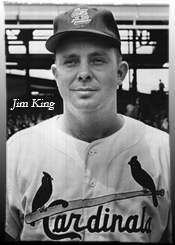
Jim King spent five years in the Cardinals organization, learning from the likes of George Kissell and Johnny Keane, but he twice departed and never got much of a chance to make an impact with St. Louis at the big-league level.

jim_kingKing, an outfielder who started in the first big-league game played in California, spent 11 seasons in the majors, primarily with the Senators.

After making his professional debut at 17 in 1950 with the independent Vernon Dusters of the Class D Longhorn League, King was signed by the Cardinals. He played in the St. Louis minor-league system from 1951-54, including two stints with Omaha clubs managed by Kissell, the franchise’s iconic instructor.

In 1954, King had his best season in the Cardinals organization, hitting .314 with 31 doubles and 25 home runs for Omaha. King, who had a strong arm, also contributed 19 outfield assists.

Courted by Cubs

King caught the attention of Wid Matthews, director of personnel for the Cubs, and on Nov. 22, 1954, the Cubs claimed King from the Cardinals in the minor-league draft.

King made his major-league debut with the Cubs in 1955 and played for them for two seasons.

In 1957, Cubs general manager John Holland was seeking to overhaul the roster. Cardinals general manager Frank Lane was seeking a left-handed pull hitter who could benefit from the Busch Stadium dimensions. The distance along the right field line from home plate to the outfield at the former Sportsman’s Park was an enticing 310 feet.

Holland made a special trip to Memphis to talk with Lane as the Cardinals headed north from spring training. Their talks continued in the Busch Stadium press box lounge when the Cubs and Cardinals played in St. Louis during the first week of the 1957 regular season, The Sporting News reported.

Second chance

On April 20, 1957, the Cardinals reacquired King from the Cubs for outfielder Bobby Del Greco and pitcher Ed Mayer.

“The deal for King was completed within 48 hours, culminating a lengthy series of conversations between Lane and Holland,” St. Louis writer Bob Broeg reported.

Broeg described King as “a pull hitter for whom the Busch Stadium dimensions are tailored” and declared the Cardinals were “stronger and deeper” with King on the roster.

Said Lane: “He’s got the knack of pulling, an asset especially with our short right field, and he won’t be handicapped in St. Louis by the wind blowing in as it does so often off the lake in Chicago, making hitting tough for left-handers.”

The Cardinals issued uniform No. 9 to King. It was the number worn by Cardinals standout Enos Slaughter before it was retired by the club.

King was used primarily as a pinch-hitter. On May 15, 1957, less than a month after he was acquired, the Cardinals sent King to Class AAA Omaha in order to get their roster to the mandated 25-player limit.

Wrote Broeg: “Entirely unexpected was the decision to send down King rather than Tom Alston, the good-field, no-hit first baseman … Although mum was the word around the club, it was apparent that owner Gussie Busch … had requested that Alston be given another chance or, at least, a longer look.”

At Omaha, King played for manager Johnny Keane (who, seven years later, would lead the Cardinals to a World Series title) and hit 20 home runs in 116 games before being called back to the Cardinals in September.

In 22 games overall for the 1957 Cardinals, King hit .314. All 11 of his hits were singles.

California connection

King appeared poised to earn a spot on the 1958 Cardinals. However, the Cardinals were seeking catching help and the Giants needed a lefthanded-hitting outfielder to replace Don Mueller. On April 2, 1958, the Cardinals traded King to the Giants for catcher Ray Katt.

When the Dodgers faced the Giants on April 15, 1958, at San Francisco’s Seals Stadium in the first regular-season major-league game played in California, King was in the starting lineup, playing left field and batting second, just ahead of Willie Mays. King was 2-for-3 with two walks, a run scored and a RBI-single off Don Drysdale. Boxscore

King had his best seasons with the 1963 Senators (24 home runs) and 1964 Senators (18 home runs). He broke Mickey Vernon’s Senators single-season record of 20 home runs by a left-handed batter. On June 8, 1964, King hit three solo home runs in a game at Washington against the Athletics. Boxscore

In a big-league career spanning 1955 to 1967 with the Cubs, Cardinals, Giants, Senators, White Sox and Indians, King hit .240 with 117 home runs.

Previously: How Cardinals nearly traded Bob Gibson to Senators

Read Full Post »

(Updated Dec. 14, 2015)

Imagine Pete Rose in a Cardinals lineup with Ted Simmons, Keith Hernandez, George Hendrick and Garry Templeton. The Cardinals tried to make it happen.

brock_roseThe catch: Rose likely would have been brought in to replace Lou Brock, relegating the popular Cardinals standout to a reserve role.

In November 1978, Rose left the Reds, his hometown team and the only one for whom he had played since entering the majors in 1963, and became a free agent. Five clubs _ Cardinals, Phillies, Braves, Pirates and Royals _ were finalists in bidding to sign him.

The Cardinals, determined to become contenders after finishing 24 games under .500 in 1978, wanted Rose, 37, to bring his hitting, hustle and hubris to St. Louis.

Rose chose the Phillies, even though the Cardinals and the others made more lucrative offers.

Sorely needed

Before the December 1978 baseball winter meetings began in Orlando, Rose met with Cardinals owner Gussie Busch, general manager John Claiborne and manager Ken Boyer in St. Louis “with the hope the Cardinals might be able to land a man who certainly would fit the type of offensive player so sorely needed by the Redbirds,” The Sporting News reported.

Rose, who started at third base for the 1978 Reds, likely would have played left field for the 1979 Cardinals, joining an outfield of Hendrick in right and Tony Scott in center. Simmons was the St. Louis catcher. The infield for the 1979 Cardinals was Hernandez at first, Ken Oberkfell at second, Templeton at shortstop and Ken Reitz at third.

Brock, the stolen base champion and future Hall of Famer who had sparked the Cardinals to three National League pennants and two World Series titles, had experienced a miserable 1978 season, batting .221 with no home runs and 12 RBI. He would turn 40 in 1979 and there were doubts whether he could be an effective everyday player.

In a 2014 interview with the Web site of Boston radio station WEEI, Rose recalled, “I went to St. Louis to talk with Gussie Busch, who offered me a Budweiser distributorship. I liked that, but he wanted me to replace Lou Brock and I didn’t want to get in that situation.”

(Brock remained the Cardinals’ regular left fielder in 1979 and rebounded strongly, hitting .304 in his final big-league season.)

In the book “The Lords of the Realm,” author John Helyar wrote that Busch talked with Rose about being a Budweiser spokesman and also discussed a distributorship. The meeting occurred at a St. Louis hospital, where Busch was preparing for hernia surgery.

“I probably would have had a hernia, too, if I had to carry all the money he was offering me,” Rose said.

In the Jan. 13, 1979, edition of The Sporting News, Claiborne denied Rose was offered a distributorship from Anheuser-Busch, though he confirmed the Cardinals “had made a very strong pitch for Rose.”

Treated like son

Indeed, Rose said the Phillies’ offer was lower than the bids of the Cardinals, Braves, Pirates and Royals.

“There were five bids and I took the lowest one,” Rose said. “Being conservative, I could have gotten at least another million and a half.

“I wish I could have played a year for each of the other four owners. They treated me like a son. But I had to analyze where I’d be the happiest. And the Phillies’ revised offer was enough that I didn’t have to worry about the money.”

The Phillies initially offered Rose a three-year, $2.1 million contract _ an average of $700,000 per year. When they sweetened the deal to $3.2 million for four years _ an average of $800,000 per year _ Rose accepted. He said his friendship with Phillies players Larry Bowa, Greg Luzinski and Mike Schmidt also persuaded him.

(The book “Pete Rose: A Biography” reports the breakdown of the Phillies deal as $905,000 the first year, $805,000 the second, $705,000 the third and $565,000 the fourth, with a $245,000 bonus if Rose played in 125 games.)

Chasing The Man

Royals owner Ewing Kauffman had made an aggressive bid, “but Rose has insisted all along he is a National Leaguer and what he lusts after most is Stan Musial’s record for hits in that league,” The Sporting News reported.

(Rose would surpass Musial’s NL record of 3,630 hits and then move ahead of Ty Cobb for the all-time mark. Cobb had 4,189 hits. Rose finished with 4,256.)

If Rose had selected the 1979 Royals, he would have played that season for manager Whitey Herzog.

The Braves thought Rose would pick them. Team owner Ted Turner offered Rose $1 million per year for “three years, four years, five years, whatever you want,” Sports Illustrated reported.

“A major network and a wire service columnist reported Rose was headed for the Braves,” wrote The Sporting News. “Team officials in Orlando for the winter meetings had Rose’s statistics printed upon the club’s letterhead and another member of the front office staff flew from Atlanta to Orlando with a Braves jersey and cap for Rose to wear at the signing.”

The contract Rose got from the Phillies made him baseball’s highest-paid player. “$3.2 million for a leadoff man, ye gods!” wrote Atlanta columnist Furman Bisher.

Phillies vs. Cardinals

Rose made his Phillies debut on Opening Day, April 6, 1979, against the Cardinals at St. Louis. Playing first base and batting leadoff a week before his 38th birthday, Rose was 1-for-3 with a walk against John Denny, who pitched a five-hitter in an 8-1 Cardinals triumph. Boxscore

The Cardinals would finish ahead of the Phillies in the NL East in 1979. The Cardinals were third at 86-76 and the Phillies were fourth at 84-78.

Rose had a spectacular 1979 season, collecting 208 hits and batting .331. He finished second to Hernandez (.344) for the NL batting title. Rose led the league in on-base percentage (.418), edging Hernandez (.417).

On Dec. 14, 2015, baseball commissioner Rob Manfred denied a request to reinstate Rose, who was banned from baseball in 1989 for misconduct related to gambling. In 2004, Rose admitted to betting on games during his tenure as Reds manager.


Read Full Post »

« Newer Posts - Older Posts »