Feeds:
Posts
Comments

Archive for the ‘Hitters’ Category

(Updated March 9, 2019)

Disheartened by what he described as an erosion of his spirit and altering of his personality, Rick Ankiel changed the course of his baseball career.

rick_ankiel7On March 9, 2005, Ankiel announced he was transforming from a pitcher to an outfielder.

Ankiel, 25, entered 2005 spring training at Jupiter, Fla., as a strong candidate to earn a Cardinals Opening Day roster spot as a left-handed reliever.

After posting an 11-7 record with 194 strikeouts in 175 innings in 2000, Ankiel experienced a meltdown in the postseason against the Braves and Mets (nine wild pitches and 11 walks in four innings). He pitched briefly for the 2001 Cardinals and suffered a series of elbow injuries before returning to the big leagues with St. Louis as a reliever in September 2004.

Ankiel pitched in the Puerto Rico winter league after the 2004 Cardinals season, but cut short his stay there after experiencing a twinge in his left elbow. When he got to Cardinals camp in February 2005, his throwing sessions were erratic.

Change of plans

On March 8, 2005, the day before he was scheduled to make his spring training debut against the Marlins in a morning B squad game, Ankiel approached Cardinals manager Tony La Russa and informed him he was retiring as a player.

In his 2017 book “The Phenom,” Ankiel explained, “In my heart, I believed I could pitch in the big leagues. I’d earned it. It was just so hard. It was just so burdensome. It was time to stop, for those reasons. I was exhausted.”

Ankiel’s agent, Scott Boras, called Cardinals general manager Walt Jocketty and asked whether the club would be willing to let Ankiel go to the minor leagues, be an outfielder and get a chance to earn his way back to the majors. When Jocketty agreed, Boras called Ankiel, who was surprised by his agent’s actions, and convinced him to give the transformation a try.

The next day, Ankiel took indoor batting practice off pitches from Cardinals scout Jim Leyland. In a hastily called press conference, Ankiel announced his plans to switch positions and explained why he was giving up pitching.

“The frustration of not being effective, not being able to go out there and replicate my mechanics, and the way it affected me off the field, wasn’t worth it,” Ankiel said to the St. Louis Post-Dispatch. “The reward wasn’t there. I feel relieved now. It’s time to move on.

“This whole time, the frustration has built up. It seemed like it was eroding my spirit and affecting my personality off the field as well. It just became apparent it was time for me to move on and become an outfielder.”

According to the Post-Dispatch, Ankiel’s decision “stunned many within the Cardinals’ clubhouse.”

“Ongoing head case”

As a Cardinals pitcher, Ankiel hit .207 for his career with two home runs and nine RBI. He hadn’t played the outfield since his senior year at Port St. Lucie High School in Florida.

The reaction to his plan drew skepticism.

Bernie Miklasz, Post-Dispatch columnist: “The Cardinals wasted too much time, and emotion, in the lost cause that is Rick Ankiel. And now, as the organization recoils from Ankiel’s stunning surrender in his mission of regaining a foothold on the mound, the Cardinals are going to baby him one more time … It is time to stop treating Ankiel’s ongoing head case as if he’s a charity case … It’s time to let Ankiel move on with his life. The Cardinals did their part. Now they need to get out of the day care business.”

Rob Neyer, baseball analyst for ESPN.com: “He’s immensely talented, but almost certainly not talented enough to hit major-league pitching with any sort of consistency.”

Road to redemption

Ankiel began receiving instruction from coach Dave McKay on outfield play and from coach Hal McRae on hitting.

“I stood across from Dave McKay, an exceptional outfield coach, and put my feet where he told me to, and began to learn to become a big-league center fielder,” Ankiel said in his book. “I hit off a tee, and hit soft-toss, and hit batting practice fastballs, and faced real pitchers, and began to learn to be a big-league hitter.’

Out of options with the Cardinals, Ankiel could have been chosen on waivers by any of the other 29 big-league clubs before he was sent to the minors in the spring of 2005, but no one claimed him.

Ankiel spent 2005 in the minors, sat out 2006 because of a knee injury and hit 32 home runs in 102 games for Class AAA Memphis in 2007. On Aug. 9, 2007, he returned to the Cardinals as an outfielder and hit a home run against the Padres. Boxscore

Ankiel hit .285 with 11 home runs and 39 RBI in 47 games for the 2007 Cardinals. The next year, he slugged 25 home runs for St. Louis.

From 2007-2013, Ankiel was an outfielder for the Cardinals, Royals, Braves, Nationals, Astros and Mets.

In 2010, a decade after his wild streak against the Braves in the National League Division Series, he hit a home run for them in the NL Division Series against the Giants. Boxscore Ankiel and Babe Ruth are the only big-league players to both start a postseason game as a pitcher and hit a home run in the postseason as a position player.

Previously: How Rick Ankiel made happy return to St. Louis as pitcher

Previously: Rick Ankiel and his last hurrah as a pitcher

Previously: Pitching or hitting, Rick Ankiel was marvel and mystery

Read Full Post »

Jim King spent five years in the Cardinals organization, learning from the likes of George Kissell and Johnny Keane, but he twice departed and never got much of a chance to make an impact with St. Louis at the big-league level.

jim_kingKing, an outfielder who started in the first big-league game played in California, spent 11 seasons in the majors, primarily with the Senators.

After making his professional debut at 17 in 1950 with the independent Vernon Dusters of the Class D Longhorn League, King was signed by the Cardinals. He played in the St. Louis minor-league system from 1951-54, including two stints with Omaha clubs managed by Kissell, the franchise’s iconic instructor.

In 1954, King had his best season in the Cardinals organization, hitting .314 with 31 doubles and 25 home runs for Omaha. King, who had a strong arm, also contributed 19 outfield assists.

Courted by Cubs

King caught the attention of Wid Matthews, director of personnel for the Cubs, and on Nov. 22, 1954, the Cubs claimed King from the Cardinals in the minor-league draft.

King made his major-league debut with the Cubs in 1955 and played for them for two seasons.

In 1957, Cubs general manager John Holland was seeking to overhaul the roster. Cardinals general manager Frank Lane was seeking a left-handed pull hitter who could benefit from the Busch Stadium dimensions. The distance along the right field line from home plate to the outfield at the former Sportsman’s Park was an enticing 310 feet.

Holland made a special trip to Memphis to talk with Lane as the Cardinals headed north from spring training. Their talks continued in the Busch Stadium press box lounge when the Cubs and Cardinals played in St. Louis during the first week of the 1957 regular season, The Sporting News reported.

Second chance

On April 20, 1957, the Cardinals reacquired King from the Cubs for outfielder Bobby Del Greco and pitcher Ed Mayer.

“The deal for King was completed within 48 hours, culminating a lengthy series of conversations between Lane and Holland,” St. Louis writer Bob Broeg reported.

Broeg described King as “a pull hitter for whom the Busch Stadium dimensions are tailored” and declared the Cardinals were “stronger and deeper” with King on the roster.

Said Lane: “He’s got the knack of pulling, an asset especially with our short right field, and he won’t be handicapped in St. Louis by the wind blowing in as it does so often off the lake in Chicago, making hitting tough for left-handers.”

The Cardinals issued uniform No. 9 to King. It was the number worn by Cardinals standout Enos Slaughter before it was retired by the club.

King was used primarily as a pinch-hitter. On May 15, 1957, less than a month after he was acquired, the Cardinals sent King to Class AAA Omaha in order to get their roster to the mandated 25-player limit.

Wrote Broeg: “Entirely unexpected was the decision to send down King rather than Tom Alston, the good-field, no-hit first baseman … Although mum was the word around the club, it was apparent that owner Gussie Busch … had requested that Alston be given another chance or, at least, a longer look.”

At Omaha, King played for manager Johnny Keane (who, seven years later, would lead the Cardinals to a World Series title) and hit 20 home runs in 116 games before being called back to the Cardinals in September.

In 22 games overall for the 1957 Cardinals, King hit .314. All 11 of his hits were singles.

California connection

King appeared poised to earn a spot on the 1958 Cardinals. However, the Cardinals were seeking catching help and the Giants needed a lefthanded-hitting outfielder to replace Don Mueller. On April 2, 1958, the Cardinals traded King to the Giants for catcher Ray Katt.

When the Dodgers faced the Giants on April 15, 1958, at San Francisco’s Seals Stadium in the first regular-season major-league game played in California, King was in the starting lineup, playing left field and batting second, just ahead of Willie Mays. King was 2-for-3 with two walks, a run scored and a RBI-single off Don Drysdale. Boxscore

King had his best seasons with the 1963 Senators (24 home runs) and 1964 Senators (18 home runs). He broke Mickey Vernon’s Senators single-season record of 20 home runs by a left-handed batter. On June 8, 1964, King hit three solo home runs in a game at Washington against the Athletics. Boxscore

In a big-league career spanning 1955 to 1967 with the Cubs, Cardinals, Giants, Senators, White Sox and Indians, King hit .240 with 117 home runs.

Previously: How Cardinals nearly traded Bob Gibson to Senators

Read Full Post »

(Updated Dec. 14, 2015)

Imagine Pete Rose in a Cardinals lineup with Ted Simmons, Keith Hernandez, George Hendrick and Garry Templeton. The Cardinals tried to make it happen.

brock_roseThe catch: Rose likely would have been brought in to replace Lou Brock, relegating the popular Cardinals standout to a reserve role.

In November 1978, Rose left the Reds, his hometown team and the only one for whom he had played since entering the majors in 1963, and became a free agent. Five clubs _ Cardinals, Phillies, Braves, Pirates and Royals _ were finalists in bidding to sign him.

The Cardinals, determined to become contenders after finishing 24 games under .500 in 1978, wanted Rose, 37, to bring his hitting, hustle and hubris to St. Louis.

Rose chose the Phillies, even though the Cardinals and the others made more lucrative offers.

Sorely needed

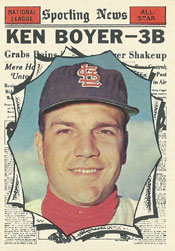
Before the December 1978 baseball winter meetings began in Orlando, Rose met with Cardinals owner Gussie Busch, general manager John Claiborne and manager Ken Boyer in St. Louis “with the hope the Cardinals might be able to land a man who certainly would fit the type of offensive player so sorely needed by the Redbirds,” The Sporting News reported.

Rose, who started at third base for the 1978 Reds, likely would have played left field for the 1979 Cardinals, joining an outfield of Hendrick in right and Tony Scott in center. Simmons was the St. Louis catcher. The infield for the 1979 Cardinals was Hernandez at first, Ken Oberkfell at second, Templeton at shortstop and Ken Reitz at third.

Brock, the stolen base champion and future Hall of Famer who had sparked the Cardinals to three National League pennants and two World Series titles, had experienced a miserable 1978 season, batting .221 with no home runs and 12 RBI. He would turn 40 in 1979 and there were doubts whether he could be an effective everyday player.

In a 2014 interview with the Web site of Boston radio station WEEI, Rose recalled, “I went to St. Louis to talk with Gussie Busch, who offered me a Budweiser distributorship. I liked that, but he wanted me to replace Lou Brock and I didn’t want to get in that situation.”

(Brock remained the Cardinals’ regular left fielder in 1979 and rebounded strongly, hitting .304 in his final big-league season.)

In the book “The Lords of the Realm,” author John Helyar wrote that Busch talked with Rose about being a Budweiser spokesman and also discussed a distributorship. The meeting occurred at a St. Louis hospital, where Busch was preparing for hernia surgery.

“I probably would have had a hernia, too, if I had to carry all the money he was offering me,” Rose said.

In the Jan. 13, 1979, edition of The Sporting News, Claiborne denied Rose was offered a distributorship from Anheuser-Busch, though he confirmed the Cardinals “had made a very strong pitch for Rose.”

Treated like son

Indeed, Rose said the Phillies’ offer was lower than the bids of the Cardinals, Braves, Pirates and Royals.

“There were five bids and I took the lowest one,” Rose said. “Being conservative, I could have gotten at least another million and a half.

“I wish I could have played a year for each of the other four owners. They treated me like a son. But I had to analyze where I’d be the happiest. And the Phillies’ revised offer was enough that I didn’t have to worry about the money.”

The Phillies initially offered Rose a three-year, $2.1 million contract _ an average of $700,000 per year. When they sweetened the deal to $3.2 million for four years _ an average of $800,000 per year _ Rose accepted. He said his friendship with Phillies players Larry Bowa, Greg Luzinski and Mike Schmidt also persuaded him.

(The book “Pete Rose: A Biography” reports the breakdown of the Phillies deal as $905,000 the first year, $805,000 the second, $705,000 the third and $565,000 the fourth, with a $245,000 bonus if Rose played in 125 games.)

Chasing The Man

Royals owner Ewing Kauffman had made an aggressive bid, “but Rose has insisted all along he is a National Leaguer and what he lusts after most is Stan Musial’s record for hits in that league,” The Sporting News reported.

(Rose would surpass Musial’s NL record of 3,630 hits and then move ahead of Ty Cobb for the all-time mark. Cobb had 4,189 hits. Rose finished with 4,256.)

If Rose had selected the 1979 Royals, he would have played that season for manager Whitey Herzog.

The Braves thought Rose would pick them. Team owner Ted Turner offered Rose $1 million per year for “three years, four years, five years, whatever you want,” Sports Illustrated reported.

“A major network and a wire service columnist reported Rose was headed for the Braves,” wrote The Sporting News. “Team officials in Orlando for the winter meetings had Rose’s statistics printed upon the club’s letterhead and another member of the front office staff flew from Atlanta to Orlando with a Braves jersey and cap for Rose to wear at the signing.”

The contract Rose got from the Phillies made him baseball’s highest-paid player. “$3.2 million for a leadoff man, ye gods!” wrote Atlanta columnist Furman Bisher.

Phillies vs. Cardinals

Rose made his Phillies debut on Opening Day, April 6, 1979, against the Cardinals at St. Louis. Playing first base and batting leadoff a week before his 38th birthday, Rose was 1-for-3 with a walk against John Denny, who pitched a five-hitter in an 8-1 Cardinals triumph. Boxscore

The Cardinals would finish ahead of the Phillies in the NL East in 1979. The Cardinals were third at 86-76 and the Phillies were fourth at 84-78.

Rose had a spectacular 1979 season, collecting 208 hits and batting .331. He finished second to Hernandez (.344) for the NL batting title. Rose led the league in on-base percentage (.418), edging Hernandez (.417).

On Dec. 14, 2015, baseball commissioner Rob Manfred denied a request to reinstate Rose, who was banned from baseball in 1989 for misconduct related to gambling. In 2004, Rose admitted to betting on games during his tenure as Reds manager.


Read Full Post »

(Updated June 12, 2024)

In a deal that triggered their transformation into champions, the 1985 Cardinals got a sleeping giant to wake up their offense.

jack_clark4On Feb. 1, 1985, the Cardinals acquired Jack Clark from the Giants for Dave LaPoint, David Green, Jose Uribe and Gary Rajsich.

Cardinals manager Whitey Herzog saw Clark as the answer for an offense that lacked consistent power. “I’m getting a sleeping giant who immediately fits right into our picture a lot better,” Herzog said to The Sporting News.

Clark, 29, was a proven run producer, but he missed three months of the 1984 season because of right knee surgery. He also developed a reputation as a malcontent.

Asked about his image, Clark told the St. Louis Post-Dispatch, “I give my best effort on and off the field. I don’t act crazy. I’m a real straight shooter. Some people like that and some people don’t.”

Green, 24, was a prized prospect, but personal problems led to him being admitted to a treatment center in 1984.

“You’re really gambling on his potential,” Herzog said. “Of all the players I’ve had the opportunity to manage, David Green has more ability than anyone as far as hitting, hitting with power, speed and throwing arm. (Garry) Templeton and George Brett are in that category, but Green has more power than either, he runs better than either and he throws better than George (Brett).”

Prime target

After the Cardinals traded their top run producer, George Hendrick, to the Pirates in a December 1984 deal that brought them pitcher John Tudor, Herzog sought a replacement for the heart of the batting order. Clark was a prime target.

“It all happened rather quickly,” Giants general manager Tom Haller said. “The Cardinals instigated talks about Clark and we threw some names at him.”

In his book “The White Rat: A Life in Baseball,” Herzog said, “I’d always wondered what it would be like to write his name down on my lineup card. We went after Jack Clark hammer and tong in the winter of 1984-85.

“With Hendrick gone, we stepped up the campaign for Clark, the same kind of hitter George had been, only better. We knew he was unhappy in San Francisco, playing in that disgraceful ballpark of theirs (Candlestick Park). The Giants were down on him because he was unhappy there.”

Let’s make a deal

The trade initially called for the Cardinals to receive Clark and minor-league pitcher Colin Ward. Talks hit a snag when it was discovered Clark had several financial incentives in his contract, including a clause stating Clark would be given a $250,000 payment if he joined another team in 1987.

When Giants owner Bob Lurie agreed to compensate the Cardinals with $125,000, Ward was dropped from the deal and the transaction was completed.

“I’ll be playing somewhere I can be more productive and it will be more fun coming to the park every day,” Clark said to columnist Stan Isle. “You don’t develop good work habits at Candlestick Park. You can’t always do what you want to do out there, like trying to hit Nolan Ryan with dust blowing in your eyes.”

Said Herzog to the Associated Press: “Jack Clark puts us in the situation of definite contenders again. Here’s a guy who can win a ballgame with one swing of the bat. He’s the only player in the league besides (Mike) Schmidt who could hit 20 homers a year playing in our park.”

Said Lurie to columnist Art Spander, “Nobody in the organization was anxious to trade Jack Clark … but we need players; we need starting pitchers. We’re supposed to be getting some top prospects.”

Upper hand

The deal was lopsided in favor of the Cardinals.

The Giants, who had finished in last place in the National League West at 66-96 in 1984, did even worse after the trade, finishing last again at 62-100 in 1985.

Green, primarily playing first base, hit .248 with 20 RBI in 106 games in 1985.

Uribe, who had played for the 1984 Cardinals under the name Jose Gonzalez, was the everyday shortstop for the 1985 Giants. He hit .237 and committed 26 errors.

Rajsich hit .165 as a utility player. LaPoint was 7-17 with a 3.57 ERA in 31 starts.

Clark connects

The Cardinals, who had finished in third place in the NL East at 84-78 in 1984, won the division title at 101-61 in 1985. Sparked by the additions of Clark and rookie left fielder Vince Coleman, the Cardinals, who scored 652 runs in 1984, scored a league-leading 747 runs in 1985.

Clark, primarily playing first base, had a .393 on-base percentage and .502 slugging percentage for the 1985 Cardinals. He had 26 doubles, 22 home runs, 83 walks and 87 RBI. Clark hit the game-winning home run that clinched the pennant for St. Louis in Game 6 of the NL Championship Series versus the Dodgers.

In the book “You’re Missin’ a Great Game,” Herzog said, “Jack Clark could pull a bullet … I could be blindfolded and tell when Jack was taking (batting practice). He was the only guy I had who didn’t sound like he was hitting underwater … The man’s power scared people, kept the defenses honest and kept our jackrabbits circling the bases.”

In three seasons with the Cardinals, Clark had a .413 on-base percentage and a .522 slugging percentage, powering St. Louis to two pennants.

Herzog “was the best manager I ever played for, and he was the best manager I ever played against,” Clark told Cardinals Magazine. “Whitey was the X factor that gave his team an opportunity, or the right matchup, and put his players in position to succeed.”

Read Full Post »

(Updated April 28, 2025)

Whether facing a journeyman such as Barney Schultz or future Hall of Famer Steve Carlton, Cubs icon Ernie Banks produced some of his best performances against Cardinals pitching.

ernie_banksBanks began his pro career with the Negro League Kansas City Monarchs, who signed him on the recommendation of St. Louis resident and former standout player Cool Papa Bell. The Cubs acquired Banks in September 1953.

In a 19-year playing career with the Cubs, Banks had 512 home runs, 1,636 RBI and 2,583 hits. Against the Cardinals, Banks totaled 326 hits in 324 games, including 64 home runs.

“One thing fans never really knew about Ernie is he talked all the time,” teammate George Altman said in his autobiography. “He talked to opposing hitters when they reached first base. He talked to our infielders. He talked to us on the bench.”

All of that talking became too much for Cardinals ace Bob Gibson.

“Ernie Banks was a good example of a guy whom I probably would have enjoyed quite a bit if he had been on my side _ I don’t doubt that he was as nice a guy as everybody said _ but as it was he talked too damn much,” Gibson said in his book “Stranger to the Game.”

“He was always jabbering at me a day or two before I pitched against the Cubs, trying to get me off my game. One day … he came by during batting practice and said, ‘Hoot, you pitching tomorrow? We’re going to beat you. We’re going to beat your ass tomorrow.’ I said, ‘Ernie, you’d better leave me alone.’ It wasn’t in his nature to do that, though, and the next day I answered him.”

Gibson drilled Banks in the ribs with a pitch. “He didn’t have much to say to me after that,” Gibson said.

That day, July 18, 1962, Gibson struck out Banks three times and held the Cubs to three hits in a 2-1 Cardinals victory. Boxscore

Banks had a career batting mark of .229 (24-for-105) against Gibson with three home runs and 13 RBI.

Some of Banks’ most memorable games versus the Cardinals:

Communication breakdown

Banks hit two home runs on April 16, 1955, but the Cardinals won, 12-11, in 14 innings at St. Louis.

In the second inning, Randy Jackson, Banks and Dee Fondy hit consecutive home runs off Tom Poholsky.

With the score at 9-9 in the 12th, Banks and Fondy connected for back-to-back homers off Schultz. The Cardinals tied the score in the bottom half of the inning on Wally Moon’s two-run homer with two outs off Bubba Church.

A misplay involving Banks ignited the winning rally in the 14th. Bill Sarni lifted a fly to short left. Banks, the shortstop, and left fielder Hank Sauer miscommunicated and the ball dropped in for a double. Moon followed with a single, scoring Sarni. Boxscore

Slugging shortstop

Three months later, on July 8, 1955, Banks again homered twice against the Cardinals, and the Cubs won, 6-4, in 11 innings.

Banks hit a solo home run off Floyd Wooldridge in the first. In the 11th, Banks broke a 4-4 tie with a two-run homer off Gordon Jones. Boxscore

The home runs gave Banks a season total of 23, most for a shortstop in one year since Glenn Wright slugged 22 for the 1930 Dodgers.

In a five-game stretch against St. Louis in July 1955, Banks hit .550 (10-for-18).

Perfect at plate

Banks produced five hits in a game for the only time in his major-league career on Sept. 29, 1957, against the Cardinals. He was 5-for-5 with a career-best three doubles and two singles in an 8-3 Cubs victory in the season finale. Boxscore

Lucky seven

Banks tied a career high with seven RBI against the Cardinals at St. Louis on May 1, 1963. Banks hit a pair of three-run home runs _ in the first inning off Ray Sadecki and in the seventh off Harry Fanok _ and added an RBI-single in the eighth. The Cubs won, 13-8. Boxscore

Fit to be tied

Ten years after his 12th-inning home run off Schultz, Banks hit another dramatic shot against the Cardinals knuckleball pitcher.

On April 12, 1965, in the season opener at Chicago, the Cardinals carried a 9-6 lead into the bottom of the ninth. With two outs and none on, Tracy Stallard walked Ron Santo and Altman followed with a single.

Red Schoendienst, in his debut as manager, replaced Stallard with Schultz. Banks powered a three-run homer “into the teeth of a 20 mph wind,” according to the Associated Press, tying the score at 9-9.

After each team scored in the 11th, the game was ended because of darkness and declared a tie, with all statistics counting. Boxscore

“Stallard pitched like a son of a gun,” said Schoendienst, “but when Altman got that good, solid hit I … decided to take him out. Why not? Schultz was warmed up and nobody has touched him for anything in the spring games.”

Last hurrah

At 39, Banks hit a pair of two-run home runs off Carlton _ the first giving the Cubs a 4-3 lead in the sixth and the second snapping a 4-4 tie in the eighth _ but the Cardinals rallied and won, 8-6, at St. Louis on June 29, 1970.

The home runs were the 506th and 507th of Banks’ career and were the last he would hit against Cardinals pitching. Boxscore

Composer Burt Bacharach, Banks’ self-described No. 1 fan, was in St. Louis for a concert and was greeted by Banks outside the clubhouse after the game.

“You were making beautiful music out there,” Bacharach said to Banks.

Banks played against the Cardinals for the final time on Sept. 10, 1971, when he grounded out as a pinch-hitter against Don Shaw at Wrigley Field. Boxscore


Read Full Post »

Joining the Navy helped Stan Musial boost his baseball career with the Cardinals.

On Jan. 22, 1945, seven months after passing his Navy physical, Musial, 24, was inducted and sent to the United States Naval Training Center at Bainbridge, Md.

stan_musial_navy“I was really relieved to go into service when my draft board finally called in January 1945,” Musial said in his book “Stan Musial: The Man’s Own Story.”

Musial had helped the Cardinals win three consecutive National League pennants and two World Series championships during the World War II years 1942 through 1944.

In a January 1945 edition, The Sporting News wrote of Musial, “The Cardinals consider themselves lucky that the young clouter was permitted to remain with the club through three war seasons. Sam Breadon (owner of the Cardinals) was reconciled to losing Musial last winter.”

While receiving his naval training at the Bainbridge facility near the banks of the Susquehanna River, Musial also played for its baseball team.

Though he was a two-time National League all-star, a NL batting champion (.357 in 1943) and a NL Most Valuable Player Award winner (1943), Musial learned two important baseball skills at Bainbridge.

Serious about first

Musial had played all three outfield positions for the Cardinals. At Bainbridge, the athletic officer, Lt. Jerry O’Brien, instructed Musial to play first base.

“I was amused,” said Musial. “O’Brien was not.”

Said O’Brien to Musial: “You’re terrible.”

Stung by the criticism, Musial worked on becoming an adept first baseman. The effort paid off for him and the Cardinals. Musial would play 1,016 games at first base for St. Louis, extending his career and helping the club.

Pull with power

The other skill Musial learned at Bainbridge was how to pull pitches with power.

“Service personnel wanted to see the home run,” said Musial. “So to pull more often, to hit the long ball, I altered my batting stance a bit. I moved up closer to the plate. This proved to be an important step in my evolution as a hitter.”

Before joining the Navy, Musial’s single-season high in home runs for the Cardinals was 13 in 1943. In 1948, he hit a career-high 39 home runs, starting a streak of slugging 20 or more for 10 consecutive seasons.

Popular with the other Navy recruits at Bainbridge, Musial “autographed the inside of the white sailor caps of many of his fellow boots, by insistent request,” The Sporting News reported.

No Musial, no title

Musial was one of three regulars from the 1944 World Series championship team who went into military service in 1945. Musial and outfielder Danny Litwhiler missed the entire 1945 season. Catcher Walker Cooper missed all but four games.

Johnny Hopp, the Cardinals’ center fielder in 1944, moved to right field to replace Musial in 1945. The Cardinals reacquired Buster Adams from the Phillies to take over for Hopp in center. Rookie Red Schoendienst, a natural infielder, replaced Litwhiler as left fielder. Backup Ken O’Dea took over the catching for Cooper.

“I still think the Cards have enough pitching to finish first,” Musial said in April 1945. “That’s the big thing that will win it, the pitching _ and that great boy (Marty) Marion at short.”

Pie Traynor, a Pittsburgh radio commentator after a Hall of Fame playing career for the Pirates, predicted the 1945 Cardinals wouldn’t overcome the loss of Musial. “Few realize the real greatness of Stan,” Traynor said. “He is a natural hustler, he is on the bases continually and he is one of the best base runners in the game.”

The 1945 Cardinals earned 95 wins, but finished in second place, three games behind the Cubs, who won eight of their last 10.

Repair work

Musial completed his training at Bainbridge on April 9, 1945, and was assigned to the ship repair unit at Pearl Harbor in Hawaii.

“I never did learn how to repair ships,” Musial said.

In the fall of 1945, Musial requested a leave to visit his ailing father in Pennsylvania. The request eventually was granted and he got there after Christmas. At the end of his leave, in January 1946, Musial was assigned to the Philadelphia Navy Yard.

“I was listed among ship repairmen assigned to dismantle a British destroyer,” Musial said. “The day before I was scheduled to work, I walked over to watch men already at work, wearing goggles and heavy gloves and carrying blow torches. I realized a green pea like me could wind up maiming himself or someone else.”

Musial asked an officer, “Sir, I’m a ship repairman who never has repaired a ship. For my sake and the Navy’s, can’t you please have my orders changed?”

The officer agreed. Two months later, in March 1946, Musial was discharged at Bainbridge. After taking a train to Philadelphia, Musial and two colleagues hitchhiked together to their homes in Pennsylvania. After a week at home in Donora, Musial reported to Cardinals spring training camp and played the entire 1946 season, helping them to their third World Series crown in five years.

Previously: How a B-17 nearly clipped Cardinals in World Series

Read Full Post »

« Newer Posts - Older Posts »