Feeds:
Posts
Comments

Archive for the ‘Hitters’ Category

Before he played a game for the Cardinals, Ken Boyer was hyped as their best third baseman all-time. In his debut, he heightened expectations, hitting a home run against a Cardinals nemesis.

ken_boyer9On April 12, 1955, Boyer appeared in his first game in the majors, playing third and batting sixth in the Cardinals’ season opener against the Cubs at Chicago’s Wrigley Field.

In the eighth inning, with two outs, Red Schoendienst on first and the Cubs ahead, 14-2, Boyer slugged a home run off starter Paul Minner. The longball ignited a productive rookie season and a standout Cardinals career.

The Natural

After hitting .319 with 42 doubles, 21 home runs, 116 RBI and 29 stolen bases for the Cardinals’ minor-league Houston affiliate in 1954, Boyer was assured a spot with the 1955 Cardinals. In December 1954, the Cardinals traded their starting third baseman, Ray Jablonski, to the Reds, making Boyer the heir apparent at that position entering spring training.

In an interview with The Sporting News, Art Routzong, Houston’s general manager, said of Boyer, “He is the best prospect I’ve seen in 17 years in baseball.”

In a preview to spring training, St. Louis writer Bob Broeg opined, “If looks didn’t deceive, the Cardinals would have their greatest third baseman ever in Kenton Lloyd Boyer. It does seem possible _ it would be daring to say ‘probable’ _ that the rookie will become the Redbirds’ best at their most vexing position.”

Broeg’s colleague, J. Roy Stockton, added that Boyer “would be the Cardinals’ first complete infielder since Red Schoendienst.”

Solid spring

In spring training, Boyer played well at both third base and shortstop. In a poll of baseball correspondents for The Sporting News, Boyer and Indians pitcher Herb Score were selected the best rookies entering the 1955 season.

Scout Tony Kaufmann compared Boyer with a Hall of Famer, saying the rookie could become “another Pie Traynor.”

“He’s deadly efficient and with no apparent weakness,” Cardinals manager Eddie Stanky said of Boyer.

Wrote Broeg: “He can run fast, throw hard, field well and hit with power.”

Quick adjustment

Boyer’s performance in his debut game affirmed his skills and his ability to adapt.

Minner, a left-hander, often baffled the Cardinals. In a 10-year career with the Dodgers and Cubs, Minner was 21-8 versus St. Louis. He was 48-76 against the rest of the National League. In 1955, when he finished 9-9, Minner was 5-0 against the Cardinals.

In his first big-league at-bat in the season opener, Boyer flied out to right. In his next two at-bats, Boyer struck out against Minner, both times with a pair of runners on base.

In the eighth, Schoendienst singled with two outs. Boyer followed with his home run. Boxscore

(A month later, May 30, 1955, Boyer hit two home runs in a game against Minner, including a two-run, two-out shot in the bottom of the ninth that tied the score.)

Strong season

Boyer had a successful rookie year. He hit .264 with 27 doubles, 18 home runs and 22 stolen bases. Boyer was one of four National League players to achieve double figures in home runs and steals in 1955. The others: Willie Mays of the Giants (51 homers, 24 steals), Sandy Amoros of the Dodgers (10 homers, 10 steals) and Boyer’s teammate, Wally Moon (19 homers, 11 steals).

Among NL third basemen in 1955, Boyer ranked second in double plays turned (24), third in assists (253) and third in fielding percentage (.952).

Yet, Boyer’s teammate, outfielder Bill Virdon, won the 1955 NL Rookie of the Year Award. Virdon hit .281 with 18 doubles and 17 home runs.

As predicted, Boyer developed into the all-time best Cardinals third baseman. In 11 years with St. Louis, he hit .293 with 255 home runs and 1,001 RBI. Boyer also won five Gold Glove awards and the 1964 NL Most Valuable Player Award with the Cardinals.

Previously: 1964 effort supports Ken Boyer Hall of Fame case

Previously: With Ron Santo in Hall, Ken Boyer should be there, too

Previously: Ken Boyer converted from infield to center

Read Full Post »

On a gray, chilly Tuesday afternoon at Chicago’s Wrigley Field, the Cardinals opened their 1991 season with a textbook example of how playing fundamental baseball _ the George Kissell way _ can bring a positive result.

bryn_smithRelying on effective pitching, good base running, plate discipline and timely contact, the Cardinals beat the Cubs, 4-1, on April 9, 1991. Cardinals manager Joe Torre sent the game ball and lineup card to Kissell, the club’s long-time instructor. “Kissell gets this for teaching the Cardinals organization how to play baseball,” Torre told the St. Louis Post-Dispatch.

Smith vs. Jackson

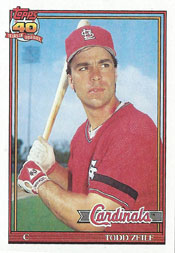
Bryn Smith, 35, a nine-game winner for the 1990 Cardinals, was the starting pitcher for St. Louis in the 1991 opener. Torre selected a batting order of center fielder Rex Hudler, shortstop Ozzie Smith, left fielder Bernard Gilkey, first baseman Pedro Guerrero, right fielder Felix Jose, third baseman Todd Zeile, catcher Tom Pagnozzi, second baseman Jose Oquendo and Bryn Smith.

Cubs manager Don Zimmer chose Danny Jackson as his starting pitcher. Chicago’s lineup featured a pair of future Hall of Famers, second baseman Ryne Sandberg and right fielder Andre Dawson, and standouts such as first baseman Mark Grace, shortstop Shawon Dunston and left fielder George Bell.

Game time temperature was 42 degrees. Rick Hummel of the Post-Dispatch described it as a “numbing, cold, drizzling day.” His colleague, Dan O’Neill, wrote, “The grass was green, but soaking wet and bent by a wintry breeze.”

The Cardinals scored first in the fifth. With the bases loaded and two outs, Gilkey fell behind in the count 0-and-2 before drawing a walk, scoring Pagnozzi from third. The full-count pitch from Jackson to Gilkey “missed inside by a few inches,” according to the Chicago Sun-Times.

Dunston led off the bottom half of the inning with a home run, tying the score at 1-1.

Small ball

In the eighth, the Cardinals struck for three runs, using a walk and three ground balls that never left the infield as their weapons.

Here’s how it happened:

With the bases loaded and one out, Paul Assenmacher relieved Jackson. Oquendo hit a dribbler toward the left side of the infield. “I broke my bat in three pieces,” Oquendo said.

The ball eluded Assenmacher. Dunston raced in from his shortstop position, grabbed the ball and flipped it to second. Pagnozzi beat the toss. Jose streaked home from third on the fielder’s choice play, putting the Cardinals ahead, 2-1, and the bases remained loaded.

“I was panicking,” the slow-footed Pagnozzi said of his sprint from first to second. “I didn’t think I was going to get there.”

Said Oquendo: “He surprised me.”

Bunch of runts

Torre sent Craig Wilson to hit for Bryn Smith. Wilson slapped a grounder toward the mound. Assenmacher reached for it and the ball deflected off his glove toward Dunston, who had no play. Zeile scored from third, putting the Cardinals ahead, 3-1. Wilson was credited with a RBI-single. The bases still were loaded.

“We’ve got the guy (Zeile) at home if I don’t touch it, but the reflex is to go for it,” Assenmacher said.

Said Wilson: “I think he thought it was hit harder than it was.”

Zimmer yanked Assenmacher and replaced him with Les Lancaster. Hudler grounded to Dunston, whose spikes “stuck in the moist dirt,” the Sun-Times reported.

Instead of an inning-ending double play, Dunston settled for a force of Wilson at second, with Pagnozzi scoring from third.

The Cardinals’ bullpen protected the 4-1 lead. Mike Perez pitched a scoreless eighth and Lee Smith earned the save with a scoreless ninth. “I’m glad I’m playing with this bunch of runts,” Lee Smith said of the Cardinals.

Said Bryn Smith: “This was our type of baseball. We’re a patient club and we have to play our game … We feel if we play our caliber of ball you’re going to have to beat us because we won’t beat ourselves.” Boxscore

Previously: Ernie Banks and his greatest hits against Cardinals

Previously: Bob Gibson vs. Billy Williams: a classic duel

Previously: Reds-Cardinals: Easter night to remember

Read Full Post »

In theory, the trade for Scott Cooper appeared to be ideal for the Cardinals. Cooper was a St. Louis native, a Cardinals fan and a two-time all-star third baseman who looked to be entering his prime. In reality, the deal was a bust.

scott_cooper2On April 8, 1995, the Cardinals acquired Cooper and reliever Cory Bailey from the Red Sox for outfielder Mark Whiten and pitcher Rheal Cormier.

Cooper, 27, was thrilled to join his hometown team and the Cardinals were thrilled to get a player with a reputation for producing steady hitting and solid defense.

After a fairy tale debut _ he hit a two-run single in the bottom of the ninth to lift the Cardinals to a 7-6 victory over the Phillies in the season opener at St. Louis _ Cooper failed to meet expectations. He hit .230 with three home runs for the 1995 Cardinals and made 18 errors.

When the season ended, he became a free agent and went to Japan.

Replacing a legend

Cooper was 15 when the Cardinals won the 1982 World Series title. The exhilarating experience of seeing his favorite team become big-league champions “left a dent in my soul,” he told the Associated Press.

A standout player at Pattonville High School in the St. Louis suburb of Maryland Heights, Mo., Cooper was chosen by the Red Sox in the third round of the 1986 amateur draft. He signed with them and made his big-league debut with Boston in 1990.

When free-agent Wade Boggs left the Red Sox for the Yankees after the 1992 season, Cooper replaced the five-time American League batting champion as Boston’s third baseman.

Cooper responded splendidly to the challenge. He was named an AL all-star in 1993 and 1994. His batting average in five years with Boston was .284.

Cardinals calling

In April 1995, general managers Walt Jocketty of the Cardinals and Dan Duquette of the Red Sox discussed a deal. The Red Sox wanted Whiten and Cormier. Jocketty wanted Cooper.

Jocketty agreed to trade Whiten but offered pitcher Tom Urbani instead of Cormier.

“We needed Cormier in the deal to make it go,” Duquette said.

Talks stalled. Jocketty gave the Red Sox a deadline of April 8.

When it became clear the Red Sox wouldn’t make the deal without Cormier being included _ “They were pretty adamant about it,” Cardinals manager Joe Torre told the St. Louis Post-Dispatch _ Jocketty relented.

No joke

On the afternoon of April 8, Cooper and teammates Roger Clemens and Eric Wedge were golfing in Fort Myers, Fla. “I was getting ready to hit this ball and this guy in a cart comes barreling around the corner,” Cooper said.

“Are you Scott Cooper?” asked the man in the cart. “Mr. Dan Duquette wants you to call him immediately.”

Said Cooper: “My heart sank. I looked at Clem and said, ‘Are you messing with me?’ … Roger looked at me and he was real serious. He said, ‘I would never play that kind of trick on you.’ ”

Duquette told Cooper of the trade to the Cardinals.

Contacted soon after by Rick Hummel of the Post-Dispatch, Cooper said, “I can’t begin to describe the emotion I’m feeling right now. I’m numb all over. The Red Sox let me fulfill my dream. They gave me the opportunity to be a major leaguer. But my lifetime dream as a kid was to play for the St. Louis Cardinals.”

Asked about the pressure of playing at home, Cooper told The Sporting News, “If I can come in and take the place of Wade Boggs and play in front of that crowd in Boston and make two all-star teams, I can play in my hometown in front of my family and friends.”

Lineup shifts

The Cardinals moved Todd Zeile, a converted catcher, from third base to first base, replacing Gregg Jefferies, who had become a free agent and signed with the Phillies. Brian Jordan, a highly-regarded prospect, replaced Whiten in right field. Urbani took over for Cormier in the starting rotation.

“Cooper is known for his defense and that was one of the major reasons we wanted to get him,” Jocketty said. “Plus, he’s a good left-handed bat.

“We feel Zeile will be a better first baseman than Jefferies was and we feel Cooper will make us better defensively at third. He has good hands, a good arm. He’s a real third baseman.”

(Bailey, the other player acquired from Boston by the Cardinals, became a productive reliever. He spent most of the 1995 season as the closer at Class AAA Louisville, earning 25 saves, and was 5-2 with a 3.00 ERA in 51 games for the 1996 Cardinals.)

Plans unravel

By mid June, the 1995 Cardinals were scuffling. Torre got fired. Zeile was traded to the Cubs.

Cooper, hitting .310 as late as May 20, had a miserable summer. He batted .164 in July and .183 in August.

For the season, Cooper hit .210 (21-for-100) with runners in scoring position. He had almost as many strikeouts (85) as hits (86).

After spending the 1996 season in Japan (where he hit .243 in 81 games), Cooper returned to the big leagues with the 1997 Royals and batted .201.

That would be his final major-league season. At age 30, three years after being named an all-star, his big-league playing career was finished.

Previously: How Scott Cooper made memorable Cardinals debut

Previously: How a tragic accident brought Mark Whiten to Cardinals

Read Full Post »

(Updated March 12, 2023)

The Cardinals acquired Jose Oquendo with the idea he would become the eventual replacement for Ozzie Smith at shortstop. Instead, Oquendo became their second baseman and paired with Smith to form a top keystone combination.

jose_oquendo5On April 2, 1985, the Cardinals got Oquendo from the Mets in the first trade engineered by general manager Dal Maxvill.

Maxvill knew what it took to play shortstop, having been the Cardinals’ starter at that position on pennant-winning clubs in 1967 and 1968. Like Maxvill, Smith was a Gold Glove Award winner. Like Maxvill in 1967, Smith helped the 1982 Cardinals to a pennant and World Series title.

The Cardinals wanted Smith to remain their shortstop, but he was eligible to become a free agent after the 1985 season. If Smith and the Cardinals were unable to negotiate a contract extension, Maxvill was prepared to trade him.

Shoring up shortstop

A headline in an April 1985 edition of The Sporting News declared, “Cardinals Admit Ozzie May Be Dealt.”

“If we can’t sign him, there’s got to be some thought about trading him,” said Fred Kuhlmann, Cardinals chief operating officer.

Said Smith: “A trade is a possibility.”

Also, Smith had a serious shoulder injury (a torn rotator cuff) in 1985. Smith wanted to let the injury heal naturally rather than undergo surgery, so the Cardinals were concerned whether he could make it through the season.

The Cardinals, though, had no suitable replacement for Smith.

That’s when Maxvill went to work.

The Cardinals dealt shortstop Angel Salazar, whom they had acquired from the Expos three months earlier, and minor-league pitcher John Young to the Mets for Oquendo and minor-league pitcher Mark Davis. Four days later, April 6, 1985, the Cardinals got veteran shortstop Ivan DeJesus and reliever Bill Campbell from the Phillies for reliever Dave Rucker.

Maxvill saw DeJesus, 32, as the stopgap and Oquendo, 21, as the long-term answer at shortstop if Smith was traded or couldn’t overcome the bum shoulder.

“You have to prepare yourself for any eventuality,” Maxvill said. “I looked in our system and there was nothing there at shortstop. You have to backstop yourself whether (Smith) is here or not.”

Mets prospect

Oquendo was 15 when he signed with the Mets as an amateur free agent in 1979 and made his professional debut that year with their Class A affiliate, the Grays Harbor Loggers of Aberdeen, Wash., in the Northwest League. He made 40 errors in 63 games at shortstop that season.

Four years later, Oquendo, 19, became the starting shortstop for the 1983 Mets under manager George Bamberger.

In 1984, the Mets were managed by Davey Johnson. He saw Rafael Santana, a former Cardinal, and Ron Gardenhire as shortstop options.

“Johnson felt Oquendo had to be a better hitter,” The Sporting News wrote. “He also was less enamored of Oquendo’s fielding than that of other shortstops in the organization.”

Smith stays

Maxvill was more impressed with Oquendo than Johnson was. (After the deal was made, Johnson learned Gardenhire had back problems. “If I had known about this,” said Johnson, “Jose Oquendo might still be here.”)

The Cardinals assigned Oquendo to Class AAA Louisville.

“You can look for the Wizard to pack his bags any day now,” Bill Conlin, a columnist for The Sporting News, wrote of Smith after the Cardinals got Oquendo and DeJesus.

Instead, on April 15, hours before the Cardinals played their 1985 home opener that night against the Expos, Smith agreed to a four-year contract extension to remain with St. Louis.

The deal was worth $8.7 million. Smith received a $700,000 signing bonus and salaries of $1.8 million a year in 1986 and 1987 and $2.2 million a year in 1988 and 1989, The Sporting News reported. Also, the Cardinals provided Smith a $500,000 loan at 10 percent interest and Anheuser-Busch promised him consideration for a wholesale beer distributorship.

Smith played the entire 1985 season despite the bad shoulder. He would play for the Cardinals through the 1996 season before retiring.

Shift to second

Oquendo spent the 1985 season with Louisville. His manager was Jim Fregosi, who had been an all-star shortstop with the Angels. Oquendo hit .211 in 133 games for Louisville and made 23 errors at shortstop.

In 1986, Oquendo stuck with the Cardinals as a backup to Smith at shortstop and to Tommy Herr at second base. He hit .297 in 76 games, establishing himself as a valuable utility player.

After Herr was traded to the Twins in 1988, Oquendo became the Cardinals’ starter in 1989. He led National League second basemen in fielding percentage in 1989 (.994) and 1990 (.996).

In 10 seasons with the Cardinals (1986-1995), Oquendo hit .264 with an on-base percentage of .359. In 1989, he was eighth in the NL in batting at .291.

Read Full Post »

Instead of working with established big-leaguers, Bob Gibson spent the spring training of 1995 teaching basic grips to pitchers who normally would have had no chance to be in a Cardinals camp.

joe_torre6Spring training in 1995 was an odd, depressing experience for the Cardinals and other big-league teams because of the labor dispute between players and owners.

The players’ strike that began in August 1994 carried into spring training 1995. None of the players on the Cardinals’ big-league roster reported to camp at St. Petersburg, Fla. Instead, the Cardinals, like other clubs, brought in replacement players.

Hall of Fame helper

Manager Joe Torre and his staff were required to train the replacement players, with the intent of having them ready to open the regular season on April 3.

Gibson, the Hall of Fame pitcher who carried the Cardinals to two World Series championships, was hired by Torre to be a Cardinals coach.

Replacement player Paul Anderson, 26, a right-hander who was a combined 4-6 with a 6.65 ERA for two Cardinals farm clubs in 1994, asked Gibson for assistance in learning the proper grip to throw a slider.

“I was doing it wrong, so I did it the way he taught me,” Anderson told Rick Hummel of the St. Louis Post-Dispatch. “I like it a lot better. I’m learning from the best.”

Scribe and rejects

The 55-player Cardinals replacement team at training camp had no one who had appeared in a major-league game.

In the Cardinals’ exhibition opener against the Indians on March 4 at St. Petersburg, Mike Hinkle started and pitched three scoreless innings for St. Louis. Hinkle, 29, had last played professional baseball in Italy in 1993.

Outfielder Doug Radziewicz, 25, an aspiring journalist who was filing reports from camp for his hometown newspaper in Somerville, N.J., drove in the winning run with a pinch-hit single in the eighth, lifting the Cardinals to a 4-2 victory.

“You can’t judge baseball from one day, but it was well-played,” Torre said after the game. “The thing you’re concerned with is that playing for the first time they’re a little in awe.”

Walt Jocketty, hired in October 1994 to replace Dal Maxvill as general manager, was asked what it was like to watch replacement players instead of big-leaguers in his first Cardinals spring training game. “As long as I’ve got Joe (Torre) here, we can hold hands and go through this together,” Jocketty said.

Wrote Hummel: “There were no pickets, as the striking players earlier had advertised, which was good because the minor leaguers were nervous enough as it was. The clubhouse was very quiet before the game.”

Fans weren’t buying into replacement baseball. Hummel reported the Cardinals were averaging 1,470 tickets sold per exhibition game instead of the usual 5,000. In March, 54 percent of respondents to a Post-Dispatch poll said they probably or absolutely wouldn’t pay to see a game played by replacements.

Chasing a dream

The Cardinals broke camp with a roster of 32 replacement players, intending to open the season with them.

Anderson, Hinkle and Radziewicz were on the Opening Day roster. In a late move, the Cardinals also acquired Glenn Sutko, a catcher who had one hit in 10 at-bats for the 1991 Reds.

Among other replacement Cardinals on the Opening Day roster:

_ Ty Griffin, second baseman. A No. 1 pick of the Cubs in the 1988 amateur draft, Griffin also had played for the U.S. Olympic baseball team. He flopped in the Cubs system and spent the 1994 season with a pair of independent league teams.

_ Larry Shikles, starting pitcher. In eight seasons in the minor league systems of the Red Sox and Athletics, the right-hander compiled a 70-68 record.

_ Howard Prager, first baseman. He hit .239 for the Cardinals’ Class AAA Louisville club in 1994.

_ John “Skeets” Thomas, outfielder. He slugged 17 home runs for Louisville in 1994.

_ Tony Diggs, outfielder. A sixth-round draft choice of the Brewers in 1989, Diggs hit .215 for the Cardinals’ Class AA Arkansas team in 1994.

_ Anthony Lewis, outfielder. An eighth-round draft pick of the Cardinals in 1989, Lewis hit a combined .230 for two St. Louis farm clubs in 1994.

“We went with the players on the morning side of the mountain rather than the twilight side of the hill,” Torre said, explaining why the Cardinals (with the exception of Sutko) chose players without big-league experience.

On April 2, 1995, the day before the season was to open, the 234-day strike ended. The season opener was moved to April 26; spring training was re-opened for players on big-league rosters. The replacement players either were assigned to the minors or released.

Said Torre: “It feels weird starting all over again.”

Read Full Post »

The Cardinals traded two all-star infielders, first baseman Bill White and shortstop Dick Groat, to acquire Alex Johnson and told Lou Brock to shift outfield positions to accommodate the heralded newcomer.

alex_johnsonJohnson never fulfilled his potential with St. Louis. Instead of joining Brock and Curt Flood as an outfield regular, Johnson got demoted to the minors in his first Cardinals season and backed up Roger Maris in his second and last year with St. Louis.

Phillies phenom

At 21, Johnson debuted in the big leagues with the 1964 Phillies. He hit .296 in two seasons with Philadelphia.

Cardinals general manager Bob Howsam envisioned Johnson as an ideal fit to join Brock and Flood in forming a fleet, productive St. Louis outfield.

On Oct. 27, 1965, the Cardinals dealt White, Groat and catcher Bob Uecker to the Phillies for Johnson, catcher Pat Corrales and pitcher Art Mahaffey.

White was a five-time all-star who hit .298 and won the Gold Glove Award six times. In three years with St. Louis, Groat was a two-time all-star who batted .289. Both were key contributors to the Cardinals’ World Series championship season in 1964.

Power potential

“We expect Johnson to hit the long ball for us,” Howsam told The Sporting News. “Playing everyday instead of just against left-handed pitchers, he may even surpass White in long-ball hitting over the full season.”

Said Cardinals vice president Stan Musial, who was consulted by Howsam before the deal was made: “Over the long haul is what we’re thinking about. We’re trying to analyze our team better and it’s a switch to the youth system.”

The Cardinals believed Johnson would hit for a higher average and had more speed than Mike Shannon, their right fielder in 1964 and 1965.

Johnson hit .307 against left-handed pitching for the 1965 Phillies. He also hit .424 in 11 games versus the Cardinals that season.

Move over, Lou

Johnson reported to the Cardinals’ Florida Instructional League camp at St. Petersburg and worked with manager Red Schoendienst and coach Dick Sisler. “He has a better arm than I thought he did,” Schoendienst said.

The Cardinals decided to shift Brock from left to right and start Johnson in left, with Flood in center. Shannon was relegated to a reserve role. “I know the Cardinals made a big deal to get Johnson, but all I want is a chance,” Shannon said. “… I think I can hit .300. I’m strong. I can run and I’ve got good power.”

Johnson hit .286 in spring training and opened the 1966 regular season as the left fielder. He started each of the Cardinals’ first 20 games and hit .195. The Cardinals’ record was 8-12 and Johnson received part of the blame. “It’s not the pitchers getting me out,” Johnson said. “I’ve been getting myself out. I’ve been going for the long taters.”

On May 8, 1966, the Cardinals played their final game at Busch Stadium, formerly Sportsman’s Park. Johnson had the last at-bat and hit into a game-ending double play. Boxscore

Four days later, the Cardinals played their first game at the new Busch Memorial Stadium. Johnson started in left field and was 1-for-4 with a run scored. Boxscore

On May 18, 1966, the Cardinals sent Johnson to Class AAA Tulsa and called up outfielder Bobby Tolan. Brock returned to left field and Shannon took over in right.

In 25 games with the Cardinals, Johnson batted .186 with two home runs.

“Johnson appeared overmatched in his first opportunity at a regular job.” The Sporting News declared. “He has plenty of raw talent and good speed. There is considerable hope for him, especially if he can develop the ability to learn from coaches both in the minors and in the majors. He has not adapted well to instruction and he has been easy to pitch to.”

At Tulsa, Johnson prospered under manager Charlie Metro, batting .355 with 104 hits in 80 games.

Carlton to Cubs?

After the 1966 season, Howsam agreed to a proposed deal to send Johnson, Tolan and pitchers Steve Carlton and Nelson Briles to the Cubs for outfielder Billy Williams, The Sporting News reported. The trade was vetoed by Cardinals “super brass,” who presumably included Musial. “We needed a lefthanded-hitting outfielder and we went after (Billy) Williams,” Musial confirmed.

After the proposed trade was nixed, Howsam dealt third baseman Charlie Smith to the Yankees for outfielder Roger Maris. Soon after, Howsam resigned to become general manager of the Reds and was replaced by Musial.

In spring training, the Cardinals assigned hitting instructor Joe Medwick to work with Johnson. “I told him, ‘The only guy who is keeping you down is yourself. You’ve got all the equipment,’ ” Medwick said. “Alex was pulling too many pitches.”

Some thought Johnson and Maris would platoon in right field for the 1967 Cardinals. Maris, though, won the job outright, with Shannon replacing Smith at third base and Johnson taking a reserve outfield role.

In May 1967, The Sporting News reported Johnson was “swinging at too many bad balls and fouling off too many good ones.” Musial “had tried hard to deal Johnson to an American League club, but there were no takers.”

Johnson hit .223 with one home run in 81 games for the 1967 Cardinals, who won the National League pennant. He didn’t appear in the World Series against the Red Sox.

After the Cardinals won the championship, Musial resigned in triumph and was replaced by Bing Devine, in his second stint as St. Louis general manager. Devine’s first trade was to send Johnson to the Reds for outfielder Dick Simpson on Jan.11, 1968.

In two seasons with the Cardinals, Johnson hit .211 in 106 games with three home runs and 18 RBI. “Alex just might put everything together one of these days and become quite a ballplayer,” Schoendienst said.

Red was right

Reunited with Howsam and Metro (who had become a Reds scout), Johnson hit .313 with 146 RBI in two seasons with Cincinnati.

Traded to the Angels, Johnson was the 1970 American League batting champion, hitting .329, but his career continued to be marred by controversy and accusations of an indifferent attitude.

Said Cardinals coach Dick Sisler: “The tag on Johnson is that he will not accept advice from a manager or a competent coach. He easily could have become a great Cardinal player, but he showed no interest.”

In 13 years with the Phillies, Cardinals, Reds, Angels, Indians, Rangers, Yankees and Tigers, Johnson batted .288 with 1,331 hits.

Previously: Here’s how Mike Shannon became a Cardinals catcher

Previously: Bill White: We thought Lou Brock deal was nuts

Previously: How Charlie Metro miffed Stan Musial

Read Full Post »

« Newer Posts - Older Posts »